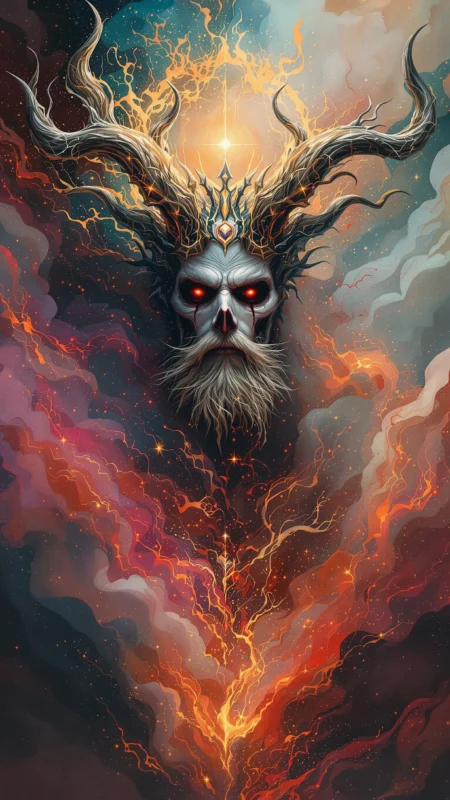


Hades

Archetype Meaning & Symbolism

Sovereign, introverted, wealthy, unseen, deep, final, misunderstood, steward, firm, psychological

  • The sun shows you the world, but the darkness shows you yourself. Do not mistake visibility for value.

If Hades is part of your personal mythology, you may...

Believe

  • The most valuable things in life are invisible.

    True sovereignty is mastery over one's inner world, not the outer one.

    Endings are not failures; they are sacred and necessary transitions.

Fear

  • Superficiality and forced pleasantries.

    Having your privacy violated or your inner world exposed against your will.

    Losing control and being 'abducted' by the chaos of the outer world or overwhelming emotions.

Strength

  • A profound capacity for deep insight and understanding of complex psychological patterns.

    Unshakeable personal boundaries and a powerful sense of self-possession.

    Comfort with grief, loss, endings, and the so-called 'darker' aspects of life.

Weakness

  • A tendency toward social isolation and emotional unavailability.

    Rigidity and an unwillingness to adapt or compromise with the 'upper world'.

    A potential for brooding, pessimism, or getting stuck in the past.

The Symbolism & Meaning of Hades

In personal mythology, Hades represents the sovereign ruler of the inner world. This is the part of you that is utterly unimpressed by external accolades, social status, or the dazzling performance of ego. Its currency is authenticity, its territory is the vast landscape of your subconscious, and its wealth is the wisdom gleaned from shadow and silence. To have a strong Hades element in your mythos is to possess a quiet, unshakeable sense of self that is rooted in the unseen. You may not be the life of the party, but you are the silent, steady chamber in which the soul's deepest truths are stored and protected.

This archetype also governs the principle of necessary endings. In a culture that fears finality, Hades offers the perspective that death, in all its forms, is not a failure but a transition that creates space for renewal. He is the quiet force that draws the curtain, the silent ferryman who helps you cross from one state of being to another. He is present in the end of a relationship, the shedding of an old identity, the quiet acceptance of loss. His presence in your personal story could suggest a life path that involves helping others navigate these thresholds, or one that requires you to become profoundly comfortable with your own cycles of psychic death and rebirth.

Finally, Hades symbolizes the immense value of what is hidden. He is the keeper of gems formed under pressure in darkness, the guardian of potent seeds that lie dormant through winter. This could mean your greatest talents are not for public display, or that your most profound healing happens in solitude. It suggests a life where the real work happens below the surface, in the slow, patient cultivation of inner riches. Your story may not be one of linear ascent into the light, but a cyclical descent into darkness to retrieve treasures that the sunlit world cannot even conceive of.


Hades Relationships With Other Archetypes

The Persephone Archetype:

The relationship with Persephone is the axis of the Hades mythos. Persephone represents the part of the psyche that must be initiated into the darkness to become whole. For Hades, she is the bridge, the one being who connects his silent, subterranean kingdom with the vibrant, sunlit world. In a personal myth, this dynamic could represent the tension and ultimate integration between your inner, private self and your outer, social self. It may point to a pivotal relationship or experience that forced you to confront your own depths, ultimately leading to a more mature and integrated personality, one who can navigate both the board room and the dreamscape with equal authority.

The Zeus Archetype:

Zeus, ruling the skies with thunderbolts and public proclamations, is Hades's polar opposite. Where Zeus represents expansive, visible, and often dramatic power in the external world, Hades represents intensive, invisible, and silent power in the internal world. In your own story, this could symbolize a conflict between a societal pressure to achieve and be seen (Zeus) and a deep, personal need for privacy and internal reflection (Hades). Your life may be a negotiation between these two forces: how much to expand into the world versus how much to consolidate and deepen your own soul. One is not better than the other; they are two halves of a complete cosmology.

The Hermes Archetype:

Hermes, the messenger and psychopomp, is the only other god who moves freely between worlds, and thus is a crucial ally to Hades. He represents the faculty that allows for communication between the conscious and unconscious minds: therapy, dream analysis, artistic expression, sudden insight. For the Hades-influenced individual who can risk becoming isolated in their own depths, Hermes is the vital connection to the outside world and to other parts of the self. He is the therapist who guides you through a dark memory, the dream symbol that delivers a crucial message, the creative spark that allows you to articulate a profound, ineffable feeling.

Using Hades in Every Day Life

Navigating Endings:

When a significant chapter of life closes—a career, a relationship, a long-held identity—the Hades archetype may offer a framework not of grieving what is lost in the light, but of appreciating the richness of what now exists only in memory and psychic space. It is a way to become a benevolent ruler of your own past, visiting it for its wisdom without being trapped by its ghosts. You could consciously create a ritual to honor the ending, treating it as a treasure to be placed in the vault of your inner world, rather than a failure to be banished.

Establishing Psychic Boundaries:

In a world demanding constant connection and transparency, embodying Hades could be a practice in radical privacy. This might manifest as turning down social invitations without guilt, curating your digital presence to reflect only a sliver of your reality, or simply refusing to explain your inner state to those who have not earned that intimacy. It is about building an invisible fence around your psyche, understanding that your deepest thoughts and feelings are precious minerals that do not belong to the commons.

Integrating the Shadow Self:

The Hades archetype provides a map for the descent into one's own underworld, the subconscious. When confronted with undesirable traits—envy, bitterness, profound sadness—the work is not to banish them but to meet them with sovereign curiosity. You might engage in journaling, therapy, or deep meditation as a journey to meet these hidden aspects of yourself, learning their stories and needs. This transforms them from terrifying monsters in the dark to integrated, understood parts of a complex and whole self.

Hades is Known For

Ruler of the Underworld

Hades governs the realm of the unseen: the subconscious, the collective unconscious, the souls of the departed, and all that is hidden beneath the surface of conscious awareness. This rulership is not malevolent but custodial, a stewardship of the deep cycles of existence.

God of Wealth:

His domain includes all the mineral and hidden wealth of the earth—gems, precious metals, fertile soil. This symbolizes the profound psychological and spiritual riches that are found not in the sunlit world of achievement but through introspection, deep work, and confronting what has been buried.

The Abduction of Persephone:

This central myth is less a simple kidnapping and more a profound allegory for the necessary, often forceful, drawing of the conscious self (Persephone) into the depths of the unconscious (the Underworld) to gain wisdom, maturity, and a holistic view of life and death.

How Hades Might Affect Your Personal Mythology

How Hades Might Affect Your Mythos

When Hades is a prominent feature of your personal mythology, your life story may not follow a traditional heroic arc. The defining quests are not outward adventures to slay dragons, but inward descents to confront personal demons, retrieve lost soul-parts, and map the labyrinthine corridors of your own psyche. The climax of your story might be a moment of silent, internal realization rather than a public victory. Your narrative might be defined by periods of withdrawal and quietude, which an outside observer could mistake for stagnation, but which you understand as crucial periods of gestation, where the seeds of your next chapter are gathering strength in the dark.

Your personal myth could also be one of a steward or a gatekeeper. You may find yourself as the keeper of family secrets, the silent holder of a friend's grief, or the one who honors the unacknowledged histories of a place or a community. Your purpose isn't to fix or to change, but to hold and to witness. Your legend is not written in headlines but in the psychic integrity you maintain, in the boundaries you uphold, and in the quiet, profound safety you create for the parts of life that society prefers to keep in the shadows.

How Hades Might Affect Your Sense of Self

Your sense of self may be unusually deep and self-contained. You might not require external validation to feel worthy, deriving your esteem from a private, internal wellspring of self-knowledge. This could lead to a profound sense of sovereignty: the feeling that your inner kingdom is yours alone to rule, and its gates do not open for just anyone. You may see your introversion not as a social failing but as a necessary condition for cultivating your inner riches. The identity is not built on what is done, but on what is known in the quietest chambers of the heart.

However, this can also lead to a feeling of being fundamentally different or misunderstood. You might feel like you are speaking a different language than those who live entirely in the “upper world” of social interaction and material achievement. This could foster a sense of loneliness or an alienation from the mainstream, a feeling that your true self is invisible to others. The challenge is to find value in this invisibility, to see it as a source of power and mystique rather than a deficit.

How Hades Might Affect Your Beliefs About The World

You may view the world with a kind of psychological x-ray vision, instinctively looking beneath the surface of people, events, and systems to understand the hidden structures and unseen motivations at play. You could have a natural skepticism for surface appearances and a deep appreciation for complexity and nuance. This perspective might see society not just as a collection of visible achievements, but as a vast psychic iceberg, with most of its reality submerged in the collective unconscious—in shared fears, forgotten histories, and unspoken desires.

This worldview often includes a profound acceptance of life's cycles, including its endings. You might not share the common cultural terror of death, aging, or loss, seeing them instead as integral, meaningful parts of a larger pattern. Your philosophy could be one that honors decay as much as growth, silence as much as sound, and winter as much as spring. The world, for you, is not a problem to be solved, but a great mystery to be witnessed, especially in its darker, more hidden corners.

How Hades Might Affect Your Relationships

In relationships, you likely crave depth and authenticity above all else. Superficial connections may feel draining or utterly pointless. You are not one for small talk; you want to know another's soul, their shadows, their hidden treasures. This means you may have very few relationships, but the ones you do have are likely to be intensely loyal, profound, and transformative. You offer a rare kind of presence: the ability to sit with someone in their darkness without needing to fix it or turn on a light.

The challenge in this relational style is a potential for possessiveness or isolation. Because your connections are so deep, you might struggle with letting go. The boundary of your inner kingdom can also become a wall, making it difficult for others to get in or for you to venture out. A partner may sometimes feel shut out from your vast inner world, which you guard so fiercely. The work is to learn where the gate is, and for whom you are willing to open it.

How Hades Might Affect Your Role in Life

You may feel that your role in the world is not to be on the stage, but to be the silent, foundational structure that makes the play possible. You could be the strategist behind the scenes, the researcher in the archives, the therapist holding space for another's transformation, or the artist who channels the subconscious. Your contribution may often be invisible or uncredited, yet it is essential. Your sense of purpose could be tied to protecting what is precious and hidden, whether that is a delicate ecosystem, a forgotten tradition, or the sanctity of an individual's inner life.

This can lead to a feeling of being a perpetual outsider, observing the world from a reserved distance. You might see yourself as the ferryman on the edge of the river, the guardian at the gate, or the hermit in the cave. This role, while potentially lonely, carries a unique authority. You are not swayed by popular opinion or fleeting trends. Your power comes from your connection to the deep, unchanging currents of life, and your purpose is to remain true to that depth, regardless of the demands of the sunlit world.

Dream Interpretation of Hades

In a positive context, dreaming of Hades or his realm—a cave, a vast underground chamber, a quiet river in the dark—may signal a readiness to engage with your own subconscious. It could be an invitation from your psyche to begin a period of deep introspection, to reclaim a lost part of yourself, or to find the hidden treasure in a difficult situation. Meeting a figure who feels like Hades could represent an encounter with a powerful, sovereign part of yourself that has been waiting for your attention. Such a dream often leaves you with a feeling of awe and quiet significance, suggesting you are on the brink of a profound personal discovery.

In a negative context, a dream of the underworld might reflect feelings of being trapped, isolated, or overwhelmed by depression. You might find yourself lost in endless, dark tunnels, unable to escape, or bound in a place of stagnant silence. A threatening or tyrannical Hades figure could symbolize a rigid, controlling aspect of your own psyche that is cutting you off from life, joy, and connection. This kind of dream is a potent warning, urging you to seek a 'Hermes' figure—a guide, a therapist, a new perspective—to help you find your way back to the surface before you become a permanent prisoner of your own shadows.

How Hades Archetype Might Affect Your Needs

How Hades Might Affect Your Physiological Needs

The Hades archetype may influence your basic physiological needs by prioritizing stillness and quietude. Your body might genuinely require more silence and less stimulation than others to feel regulated. The constant noise and frantic pace of the modern world could feel like a physical assault, leading you to create a home environment that is a sanctuary of calm: dim lighting, quiet spaces, and minimal clutter. Your physical well-being might be deeply entwined with your ability to withdraw and recharge your energy in solitude, as if your very cells require a period of darkness to function correctly.

This could also manifest in a relationship with food and substance that is private and controlled. You may not enjoy communal, boisterous meals, preferring to eat alone or with one trusted companion. There could be a tendency towards either asceticism or secret indulgence, as the body's needs are managed within the private sphere of your kingdom. The key is maintaining a healthy stewardship over your physical self, ensuring your retreat from the world nourishes your body rather than depletes it through neglect or secret excess.

How Hades Might Affect Your Ideas of Belonging

Belonging is not found in the crowd. For the Hades archetype, love and connection are rare, precious gems mined from the deepest shafts of relationship. You may feel a sense of belonging with only a handful of souls in your entire lifetime, people with whom you can share the silent language of the underworld. The bond is not based on shared interests or social convenience, but on a shared recognition of the soul's depths. It is an intense, fiercely loyal, and often private form of love.

This can make finding a sense of community challenging. You may feel like an outsider in most groups, unable to engage in the surface-level camaraderie that seems to bind others together. The feeling of belonging might come not from people, but from a connection to deep time, to geology, to ancestors, or to the unseen world. The risk is a profound loneliness, a sense that no one can truly visit your kingdom. The reward is that when connection is finally made, it is absolute, unshakable, and eternal.

How Hades Might Affect Your Feelings of Safety

For one with Hades in their mythos, safety is synonymous with privacy and control over one's own domain. A sense of security doesn't come from a large community or visible signs of protection, but from the strength of one's psychic and physical boundaries. You might feel safest when you are unseen, unobserved, and undisturbed. This could mean living in a secluded place, having unlisted numbers, or simply maintaining a powerful reserve that discourages intrusion. The ultimate safe space is your own mind, a well-guarded fortress of solitude.

The threat to safety, therefore, is exposure. You may feel a primal sense of danger when your privacy is violated, when you are forced into the spotlight, or when others demand to know your inner workings. This can make you highly resistant to surveillance, gossip, and institutions that require radical transparency. Your work is to distinguish between healthy boundaries that create safety and rigid walls that create a prison, ensuring your need for security doesn't completely sever your connection to the world of light and life.

How Hades Might Affect Your Views of Esteem

Esteem is not sought; it is owned. Your sense of self-worth is likely derived from internal sources that are invisible to the outside world: your integrity, your self-knowledge, your ability to withstand psychological pressure, your loyalty to your own soul. You are the sole arbiter of your own value. This creates a powerful immunity to both criticism and praise, as you are the rich king of a realm no one else can see. You know the value of the gems in your vault, and it doesn't matter if no one else ever does.

The potential pitfall is that this internally-generated esteem can become divorced from reality, tipping into arrogance or a defensive superiority complex. You might devalue the achievements and values of the 'upper world' as inherently superficial, cutting yourself off from the joy and connection available there. True esteem involves not only valuing your own depths but also recognizing the worth of the sunlit realms, even if you don't choose to live there permanently.

Shadow of Hades

The shadow of Hades emerges when the sovereign of the inner realm becomes its prisoner. This is the archetype curdled into profound depression, a state of being where the gates to the upper world are sealed shut and all light is extinguished. Here, the rich silence becomes a tormenting void, and the inner treasures feel like nothing more than a hoard of regrets and sorrows. The shadow Hades is emotionally frigid, cutting off all avenues of connection and warmth, convinced of the utter meaninglessness of the sunlit world and its trivial pursuits. He is the bitter recluse who pulls others down into his misery, the emotional black hole from which no light can escape.

Another manifestation of the shadow is a tyrannical control and possessiveness. This is the Hades who doesn't just invite Persephone to his realm but truly imprisons her, refusing to acknowledge her need for light and life. In a person, this can look like extreme jealousy, emotional manipulation, and a refusal to let people or situations go. It is the hoarding of power, of secrets, of wealth, driven by a deep fear of loss. The steward of endings becomes one who morbidly clings to what is already gone, turning the underworld from a place of transition into a stagnant museum of the dead.

Pros & Cons of Hades in Your Mythology

Pros

  • You possess a rare depth of character and are capable of profound wisdom.

    You are a loyal and steadfast presence for those you allow into your inner circle.

    You have a strong, resilient core and are not easily swayed by external pressures or opinions.

Cons

  • You may struggle with loneliness and forming new social connections.

    You can be perceived by others as cold, aloof, or morbid.

    There is a risk of getting stuck in depressive states or becoming overly rigid and isolated.