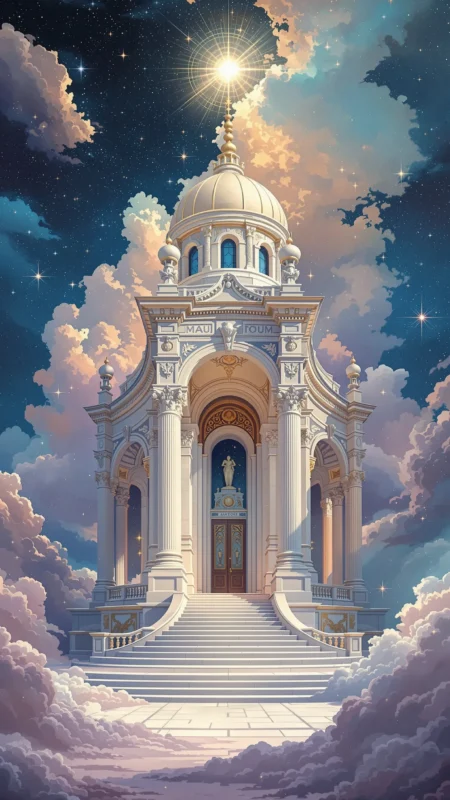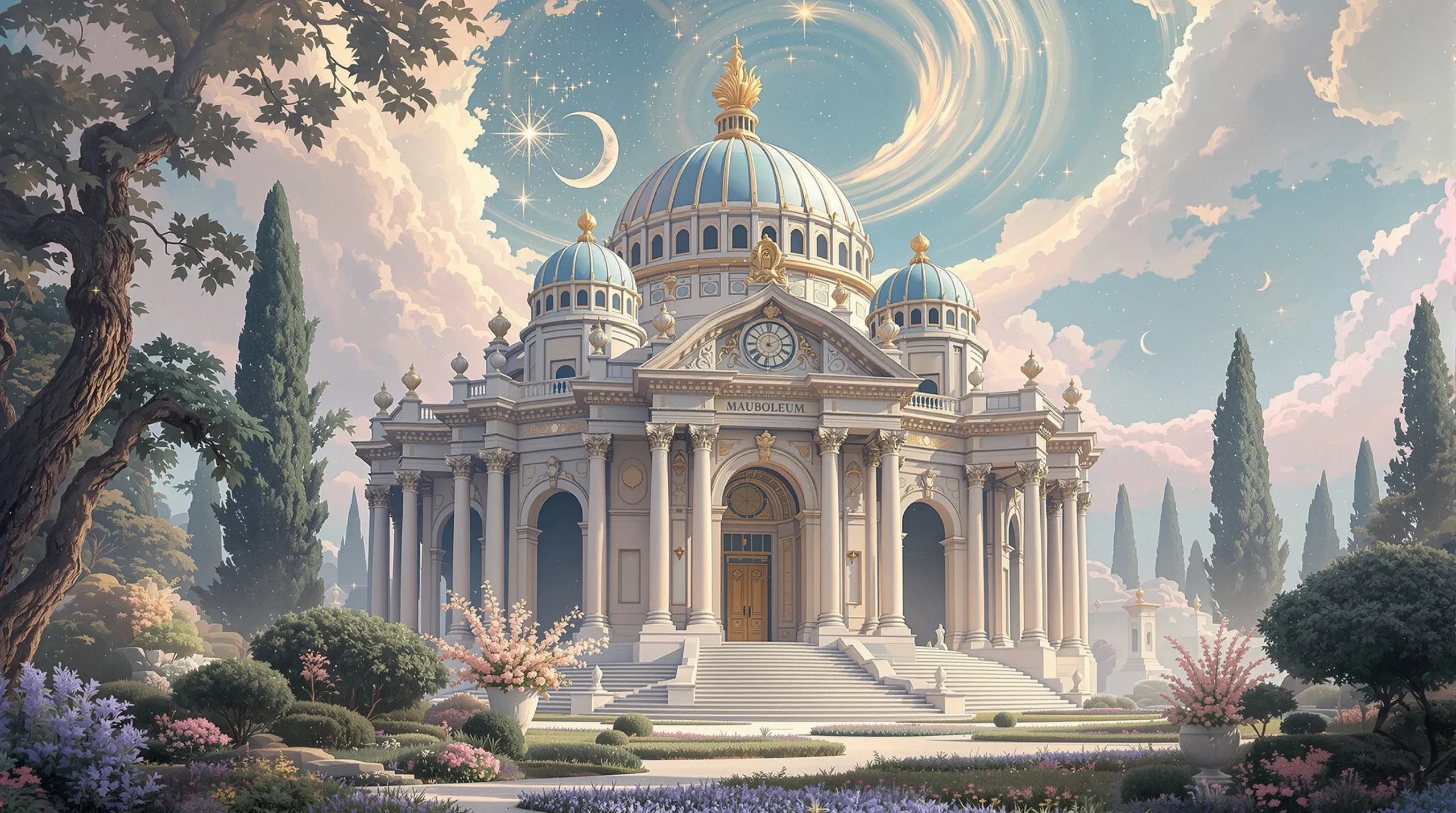


Mausoleum

Archetype Meaning & Symbolism

Somber, commemorative, permanent, still, silent, monumental, ancestral, reverent, private, enduring

  • Memory is not a ghost, but the foundation stone upon which new life is built.

If Mausoleum is part of your personal mythology, you may...

Believe

  • The past is not dead; it is the foundation upon which the present is built, and its echoes shape every room we inhabit.
  • A life's ultimate meaning is measured not by its fleeting joys, but by the integrity and beauty of the legacy it leaves behind.
  • True silence is not an absence of sound, but a profound presence of memory, a space where the most important truths can be heard.

Fear

  • Being forgotten, that your life and the lives of your loved ones will leave no trace, as if they had never been.
  • The desecration of what is sacred: the breaking of a solemn promise, the loss of family history, or the cheapening of a profound experience.
  • Discovering that the foundations upon which your life is built—a core belief, a family story, a guiding principle—are unstable or false.

Strength

  • A profound and grounding sense of perspective, allowing you to see personal and global crises as part of a much larger, more comprehensible timeline.
  • An immense capacity for loyalty and steadfastness. Your commitments, once made, are as solid as stone, making you an incredibly reliable presence in the lives of others.
  • The ability to create and hold sacred space, both internally and for others, offering a sanctuary of quiet contemplation and honor in a chaotic world.

Weakness

  • A deep-seated resistance to change, which can lead to clinging to traditions or relationships long after they have ceased to be life-giving.
  • A tendency towards solemnity and melancholy, finding it difficult to engage with the lighter, more spontaneous, and playful aspects of existence.
  • An inclination to judge the world and others based on their perceived lack of depth or reverence, which can lead to isolation and a sense of superiority.

The Symbolism & Meaning of Mausoleum

The Mausoleum in personal mythology is rarely about death itself: it is about the architecture of memory. It represents the parts of your story that you have chosen to make permanent, the experiences so formative they are carved in stone. This is the inner sanctum where you house your most defining loves, losses, and transformations. To have the Mausoleum as part of your mythos suggests you understand that a life is built: it requires foundations, honored materials, and a quiet place to reflect on the blueprints of the past. It is the belief that a self is not just a transient being but an edifice, a structure that contains all of its previous incarnations within its walls.

Furthermore, this archetype speaks to the transfer of energy from the personal to the ancestral. The Mausoleum is where individual grief graduates into collective legacy. It’s the understanding that your personal story is a single, ornate sarcophagus within a much larger family vault. The concerns of the day-to-day may fade, but the inscriptions of deep love, profound sacrifice, and hard-won wisdom are meant to be read by future generations. It is a commitment to living a life worthy of inscription, to creating a narrative that provides shelter and meaning for those who will walk the halls after you.

In a modern context, where culture often prizes the ephemeral and the new, the Mausoleum archetype is a radical act of preservation. It is the quiet insistence that some things should not be swiped away. It could manifest as a dedication to a craft, the careful curation of a family history, or the building of a business on principles of longevity over profit. It is a psychic space of stillness in a world of noise, reminding you that your identity is not defined by the fleeting trends of the moment but by the enduring truths you have chosen to honor and protect.


Mausoleum Relationships With Other Archetypes

The Garden

The Mausoleum and the Garden are locked in a necessary, poignant embrace. The Garden represents the vibrant, messy, cyclical nature of life: growth, decay, and rebirth. The Mausoleum stands beside it, a testament to permanence and stillness. In one's personal mythos, this relationship suggests that new life, creativity, and flourishing (The Garden) may draw their deepest nourishment from the soil enriched by what has been laid to rest and honored (The Mausoleum). One cannot exist meaningfully without the other: a garden without memory is shallow, and a mausoleum without life around it is just a monument to sterile endings.

The River

The River is the archetype of constant flow, change, and the irreversible passage of time. The Mausoleum is the stone edifice on its bank, a fixed point of reference. It does not try to stop the river, but its presence changes how the river is perceived. For someone with the Mausoleum archetype, their life (The River) may be seen in relation to the permanent structures of belief, family, and legacy they have built. They might find stability not by resisting change, but by ensuring they have an anchor of purpose, a place of honor to return to, as the currents of life carry them forward.

The Librarian

The Librarian curates and organizes knowledge; the Mausoleum consecrates it. The Librarian's domain is the story, the text, the cataloged fact. The Mausoleum’s domain is the inscription, the epitaph, the embodied truth. They are partners in preservation. The Librarian may tend to the vast archives of one's personal history, but it is within the Mausoleum that the most essential, soul-defining narratives are etched into the walls for eternity. The Librarian provides the details; the Mausoleum provides the monumental silence that gives those details their weight.

Using Mausoleum in Every Day Life

Honoring Past Selves

To navigate personal transformation, one might consciously build an internal Mausoleum for a former self: the person you were in a past relationship, a previous career, or before a major life change. This is not about burying them, but about creating a sacred space to visit, to honor the lessons learned and the life lived, allowing you to move forward without disowning the chapters that brought you here. It is the practice of acknowledging that endings are not erasures.

Establishing Family Rituals

In family life, the Mausoleum archetype could inspire the creation of intentional, lasting rituals that honor lineage. This might be more than a photo album: it could be a yearly storytelling night dedicated to a specific ancestor, the careful preservation and use of an heirloom, or the creation of a 'family testament' that records values and hopes for future generations. It transforms family history from a collection of facts into a living, sacred text.

Processing Collective Grief

When facing a communal loss—the end of an era at a workplace, the changing of a neighborhood, or a societal tragedy—the Mausoleum archetype offers a framework for containment. One could create a symbolic monument, a digital archive, or a community art project that serves as a focal point for shared remembrance. This act of creating a container for grief allows a community to honor what was lost together, preventing the sorrow from becoming a diffuse and isolating fog.

Mausoleum is Known For

Preservation of Memory

It is known as a structure built not for the living, but for what the living refuse to forget. It serves as a physical anchor for memory, legacy, and lineage.

Architectural Permanence

Unlike a simple grave, a Mausoleum is a monumental statement against impermanence. Its stone and marble are chosen to defy time, to declare that what is housed within has a weight that outlasts a single lifespan.

A Space of Reverence

It is a place of profound quiet. A space where the external world fades and one is invited into a state of contemplation, not necessarily of sadness, but of deep respect for the continuity of life and death.

How Mausoleum Might Affect Your Personal Mythology

How Mausoleum Might Affect Your Mythos

When the Mausoleum is a key location in your personal mythos, your life story may be perceived not as a linear adventure but as the construction of a lasting edifice. Each major event, each significant relationship, is another block of marble, another carved inscription. Your narrative is less about the journey and more about what is being built along the way. The central quest may not be for treasure or for glory, but for a sense of permanence, for the creation of a legacy that will provide shelter and meaning for others. You are the architect of your own memorial, living your life in such a way that its story will be worth preserving.

The conflicts in this mythos are often about desecration versus preservation. Villains are not dragons to be slain, but forces of forgetfulness, cynicism, or chaos that threaten to erode the foundations you have so carefully laid. Your greatest trials might involve protecting a family tradition, defending an honored principle, or finding a way to sanctify a painful loss rather than letting it be erased by time. Your personal myth is one of quiet dignity, immense weight, and the profound responsibility of being a keeper of what is sacred.

How Mausoleum Might Affect Your Sense of Self

Your sense of self may be deeply historical, layered like geological strata. You perceive your current identity not as a spontaneous creation, but as the uppermost floor of a structure built by your past selves, your ancestors, and your defining experiences. This can lead to a powerful sense of self-possession and inner stillness. You are not easily swayed by fleeting opinions or trends because you understand yourself to be a thing of substance, a place of permanence. You may feel a quiet confidence that comes from knowing the foundations upon which you stand.

This can also mean you carry the weight of your own history quite heavily. The halls of your inner Mausoleum may be places you retreat to, but they can also be places where you get lost. You might have a tendency towards introspection that can sometimes border on melancholy, a solemnity that can be mistaken for sadness. The self is not a light, adaptable thing, but a monumental structure that requires careful maintenance and, at times, can feel more like a beautiful prison than a home.

How Mausoleum Might Affect Your Beliefs About The World

The world, through the lens of the Mausoleum archetype, may appear as a vast museum of actions and consequences. You might see history not as a dry subject but as a living presence that shapes every aspect of the present. Institutions, traditions, and cultural norms are seen as large, elaborate mausoleums built to house the beliefs of past generations. This perspective can foster a deep sense of respect for tradition and a skepticism towards radical change for its own sake. You may believe that true progress involves building upon the old foundations, not demolishing them.

This worldview can also engender a certain fatalism or sobriety. You may be acutely aware of the endings of things, seeing the lifecycle of civilizations, movements, and even ideas. You might perceive the frantic energy of modern life as a denial of this truth, a desperate attempt to outrun the inevitable stillness. Your focus is on the long-term, the enduring, the things that will still matter in a hundred years. This can make you a wise counselor but may also distance you from the simple, fleeting joys of the present moment.

How Mausoleum Might Affect Your Relationships

In relationships, you may seek a sense of permanence and sacred commitment. A partnership is not a temporary arrangement; it is the joining of two legacies, the construction of a shared vault where memories and dreams are kept safe. You may demonstrate love through acts of devotion, loyalty, and the creation of shared traditions. You are the one who remembers the anniversaries, who tells the stories of how you met, who honors the past of your partner as carefully as you honor your own. Intimacy, for you, could be the quiet act of sharing the most private chambers of your inner Mausoleum with another.

However, this can create challenges. You may have difficulty with relationships that are, by their nature, temporary or casual. The end of a friendship or a romance can feel like the crumbling of a monument, a desecration rather than a natural conclusion. There might be a tendency to hold on too long, to treat a relationship like a memorial to what it once was, rather than allowing it to end. You may need to learn that some beautiful things are not meant to be etched in stone, but to be written in water.

How Mausoleum Might Affect Your Role in Life

Your perceived role in your family, community, or workplace might be that of the Guardian of Legacy. You are the anchor, the historian, the one who reminds everyone of the founding principles when they are in danger of being forgotten. You might not be the charismatic leader who inspires action, but the quiet counselor who provides perspective. You feel a profound responsibility to uphold promises, to honor commitments, and to ensure that the sacrifices of the past were not in vain. This role is one of immense stability and integrity.

This sense of duty could also feel like a heavy burden. You may feel that the weight of the past rests solely on your shoulders, making it difficult to innovate or deviate from the established path. There is a risk of becoming rigid, of seeing your role as a protector of ashes rather than a tender of a living flame. The challenge is to embody the stability of the Mausoleum while allowing for the necessary renovations that allow the structure to remain relevant and alive for new generations.

Dream Interpretation of Mausoleum

In a positive context, dreaming of a Mausoleum may symbolize a healthy and integrated relationship with your past. If the Mausoleum in your dream is well-lit, clean, and feels peaceful, it could suggest that you have successfully processed old griefs and honored your personal history without being trapped by it. Walking through its silent halls might represent a moment of deep introspection where you are accessing ancestral wisdom or the lessons from your own past selves. It can be a sign of finding a solid foundation within yourself, a deep sense of inner peace and permanence.

A negative dream featuring a Mausoleum—one that is crumbling, dark, filled with cobwebs, or that evokes a sense of dread—could point to an unhealthy attachment to the past. You may be haunted by unresolved grief, trapped in patterns of behavior inherited from your family, or burdened by a legacy you do not wish to carry. Being locked inside a Mausoleum in a dream is a powerful symbol of feeling emotionally entombed, unable to move forward into the future because the weight of what has been is too heavy.

How Mausoleum Archetype Might Affect Your Needs

How Mausoleum Might Affect Your Physiological Needs

From a mythological perspective, the Mausoleum archetype reframes basic physiological needs as acts of reverence for the vessel of life. The need for shelter is not just for a roof over one's head, but for a home with history, a place that feels like a repository of memory and safety. You may feel a deep, almost instinctual pull towards places with 'good bones,' structures that feel solid and permanent. A flimsy, temporary dwelling could feel profoundly unsettling, as if your very foundation is insecure.

Sustenance, too, might be imbued with meaning. Food may be seen as a connection to heritage, with family recipes serving as sacred texts passed down through generations. The act of eating is not just fueling the body but honoring the long line of ancestors who were sustained by the same earth. There may be a need for rhythm and ritual in daily life: a consistent time for sleep, for meals, for waking. This creates a predictable structure, a daily architecture that makes the body itself feel like a well-tended, sacred space.

How Mausoleum Might Affect Your Ideas of Belonging

The need for belongingness is fulfilled not through social popularity, but through a profound sense of lineage. You may feel you belong more to your ancestors than to your contemporary peers. Love and friendship are not about casual connection, but about finding those few souls who understand the sanctity of commitment and shared history. A romantic partner may be sought who can be a co-builder of your shared legacy, someone with whom you can create a private world with its own traditions and sacred memories.

This can make finding a sense of belonging difficult in a transient world. You may feel like an outsider in groups that prize novelty and spontaneity. Your circle of trusted friends may be small, but the bonds are forged in loyalty and shared values that feel as solid as granite. The greatest feeling of love and connection might come from a quiet moment of understanding with a loved one, a silent acknowledgment that you are both part of something much larger and more enduring than yourselves.

How Mausoleum Might Affect Your Feelings of Safety

Safety, for one with the Mausoleum in their mythos, is synonymous with permanence. It is not found in alarm systems or emergency funds, though those may be present, but in deep roots and unshakable foundations. Financial security is sought not for lavish spending, but for the creation of generational stability—an endowment that will support the family legacy long after you are gone. Career safety is found in building a reputation of utter reliability and timeless skill, rather than chasing volatile trends.

Emotional safety is perhaps the most critical: it is the quiet confidence that comes from knowing who you are and where you come from. It is the feeling of being part of an unbroken chain, a lineage that has weathered countless storms and endured. This can make you resilient in the face of personal crises, as you see your own struggles against a vast historical backdrop. The threat to safety is not physical harm, but the erosion of identity, the loss of memory, the desecration of what you hold sacred.

How Mausoleum Might Affect Your Views of Esteem

Esteem is not derived from external praise or fleeting achievements, but from the quiet dignity of your role as a keeper of what matters. Self-respect comes from upholding your principles, from honoring your word, and from the knowledge that you are building something of lasting value. The respect of others is earned through your steadfastness, your integrity, and your role as a source of stability. You may not seek the spotlight, but you command a quiet authority that comes from your deep connection to purpose.

Your self-worth is intrinsically linked to the permanence of your creations: your family, your life's work, the principles you embody. A failure can feel catastrophic, not just as a personal setback, but as a crack in the foundation of the edifice you are building. The highest form of esteem is the belief that you have lived a life worthy of remembrance, that you have been a faithful custodian of the legacy entrusted to you and have added a beautiful, enduring stone to its structure.

Shadow of Mausoleum

When the Mausoleum archetype falls into shadow, it becomes a cold, airless crypt. The guardian of legacy becomes a ghoul, jealously hoarding the past and refusing to allow new life to enter. Life becomes a static monument to what was, rather than a living continuation. This shadow manifests as a crippling fear of change, a rigid adherence to tradition that suffocates the young, and an inability to forgive or move on from past hurts. The home, once a sanctuary of memory, becomes a museum of sorrow where dust settles on everything and no windows are ever opened to the fresh air of the present.

Conversely, the shadow can appear as a violent rejection of its core tenets. This is the Mausoleum desecrated. It is the person who pathologically fears commitment, who erases their own past, who actively dismantles traditions and mocks sentimentality. This is not healthy adaptation but a frantic, fearful flight from the weight of history and the responsibility of legacy. In this state, the individual becomes rootless, foundationless, and ultimately insubstantial, building a life out of disposable materials on ground that constantly shifts, mistaking this chaotic instability for freedom.

Pros & Cons of Mausoleum in Your Mythology

Pros

  • You possess a deep and grounding connection to your roots, providing a powerful sense of identity and stability.
  • You build things to last, whether they are relationships, careers, or creative works, contributing something of enduring value to the world.
  • You serve as an anchor for your family and community, a keeper of stories and a source of quiet wisdom that others rely on in times of turmoil.

Cons

  • You can be perceived as overly serious, somber, or resistant to new ideas, which may create distance between you and more spontaneous people.
  • You may struggle to adapt to sudden, unexpected change, viewing it as a threat to the stability you work so hard to maintain.
  • There is a significant risk of becoming emotionally entombed by past griefs, failures, or nostalgia, finding it difficult to live fully in the present.