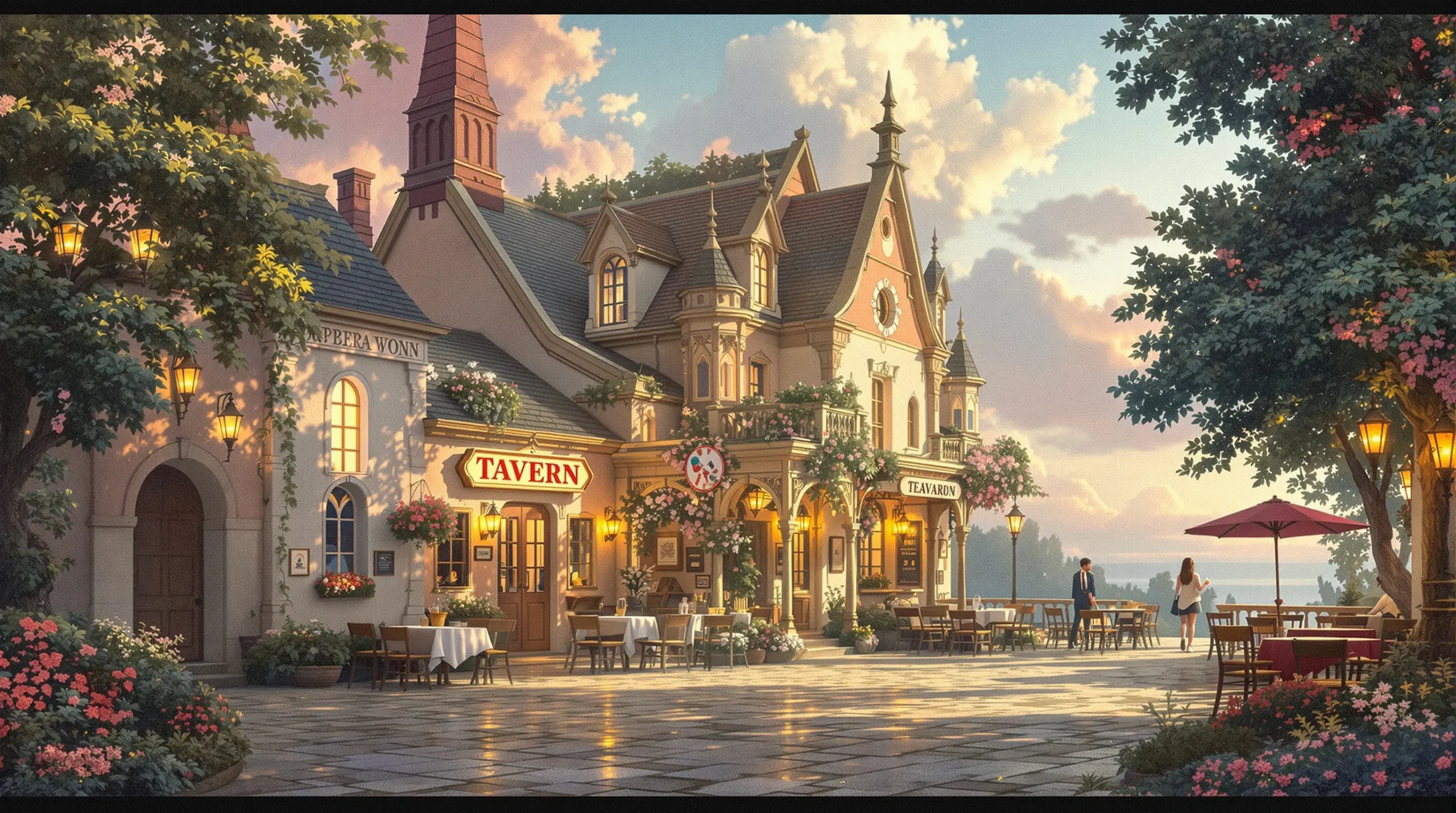


Tavern

Archetype Meaning & Symbolism

Communal, transitional, clandestine, celebratory, chaotic, sheltering, narrative, boisterous, grounding, risky

  • Come, leave your road dust at the door. Your story is the price of admission, and your silence is the most interesting tale of all.

If Tavern is part of your personal mythology, you may...

Believe

  • Every person, no matter how outwardly plain, contains a story worth hearing.

  • True community can be found in the most temporary of settings, a momentary bulwark against the vast wilderness.

  • Rest is not idleness; it is a sacred act of gathering strength and story before the next stage of the journey.

Fear

  • Being cast out into the cold, alone, with no door willing to open to you.

  • That all the stories, laughter, and connections are merely superficial distractions from a fundamental, unbreachable loneliness.

  • Losing your own, unique voice in the overwhelming noise of the crowd, your personal narrative dissolving into gossip and cliché.

Strength

  • The ability to find common ground and build rapport with almost anyone, regardless of their background.

  • A natural talent for listening, for drawing out the stories of others and making them feel seen and heard.

  • A profound social adaptability, a chameleon-like capacity to feel at home in a wide variety of social ecosystems.

Weakness

  • A tendency towards escapism, preferring the warm, hazy camaraderie of the tavern to the sharp, often solitary demands of reality.

  • A reluctance to form deep, lasting attachments, finding more comfort in the revolving door of transient connections than in the challenging work of building a permanent home.

  • A potential to lose your own narrative in the act of collecting the stories of others, becoming a vessel for gossip rather than a creator of your own tale.

The Symbolism & Meaning of Tavern

The Tavern may symbolize the vital pause in the human narrative, the necessary interlude between action and consequence. It is a space of becoming, not of being. Here, you are not defined by your destination or your origin, but by the story you choose to tell tonight. It represents a microcosm of the world at large: a messy, vibrant, and often contradictory collection of souls seeking warmth, connection, or simple oblivion. In your personal mythos, the Tavern is perhaps the theater where your various inner selves can convene, argue, and find a fleeting, fragile consensus under the low-hanging rafters of your consciousness.

It could also be the symbol of transition itself. The Tavern is neither the perilous Road nor the safe Hearth; it exists in the space between. It is the port for the sailor, the station for the train traveler, the lobby for the patient. To have the Tavern in your mythos is to understand that much of life is lived in these waiting rooms, and that these transitional zones are not empty time but charged spaces where destinies can pivot on a chance encounter or a whispered secret. It suggests that growth happens not just in striving and arriving, but in the moments one is forced to simply sit and wait.

Furthermore, the Tavern archetype may speak to a primal need for a 'third place', a location that is neither home nor work, where community can flourish without the obligations of family or the pressures of profession. It champions the power of loose connections, the temporary tribe formed by circumstance. It is a testament to the idea that belonging doesn't always require deep roots, but can sometimes be found in the shared warmth of a hearth with strangers, a fleeting but essential reminder that you are part of a larger, wandering human caravan.


Tavern Relationships With Other Archetypes

The Road:

The Tavern has an antithetical and symbiotic relationship with The Road. The Road is linear, a promise of progress, a vector pointing toward a future. The Tavern is cyclical, a space of rest, a circle of firelight that holds the present moment. One cannot exist meaningfully without the other. The Road gives the Tavern its customers and its stories of elsewhere, while the Tavern gives travelers the strength and supplies to face The Road again. In a personal mythos, this pairing could represent the dynamic tension between ambition and contentment, between the drive to move forward and the wisdom of knowing when to stop.

The Wanderer:

For The Wanderer, the Tavern is a recurring miracle, a familiar sanctuary in a world of constant change. The Wanderer brings the outside world in, carrying the dust of distant lands and the scent of foreign news, and in exchange, the Tavern offers a temporary anchor. Their relationship is one of mutual necessity. The Tavern would be a silent, hollow place without the Wanderer's endless thirst for a drink and an audience. This dynamic might symbolize one's own relationship with new experiences: the part of you that seeks them and the part that needs to process them in a familiar, reflective space.

The Hearth:

The Hearth is the private, sanctified heart of the home, its warmth reserved for kin. The Tavern is the public heart of a community, its warmth available for a price. While the Hearth represents belonging through blood and deep history, the Tavern represents belonging through shared circumstance and immediate presence. They are two different kinds of fire. One's mythos may feature a lifelong negotiation between these two poles: the pull of the intimate, familial space versus the lure of the chaotic, public forum where one can be temporarily anonymous and free.

Using Tavern in Every Day Life

Navigating a Career Crossroads:

When you stand between the job you are leaving and the one you have yet to find, you could frame this liminal space as a stay at the Tavern. It is not a void but a place of gathering: you collect stories (informational interviews), sample new brews (explore different industries), and listen to the rumors from other travelers (market trends). This reframes a period of uncertainty as one of rich, albeit temporary, community and intelligence-gathering before you set back out on the road.

Healing a Rift in a Friendship:

To mend a fractured relationship, you might mentally invite the person to meet you in the Tavern archetype. This is a neutral ground, a place outside the history of your own private territories. Here, the rules are different: you are two travelers sharing a table, not two combatants on a familiar battlefield. The goal is not to win the argument but to share your respective stories of the journey, to understand the map that led each of you to this point of conflict.

Overcoming Creative Stagnation:

When inspiration runs dry, you may visit the Tavern within your own mind. It is a space to sit quietly in a corner and simply overhear the chatter of your own disparate parts: the inner critic grumbling at the bar, the inner child playing a game by the fire, the weary adventurer nursing a drink. By not forcing a narrative but simply listening to the ambient noise, you could find that new stories, characters, and ideas begin to emerge from the din, offering themselves up for the taking.

Tavern is Known For

A Haven for Storytellers

It is known as the crucible of narrative, a place where personal histories are hammered into legend and whispers of the future are traded like currency. The Tavern is where the raw material of experience is spun into the gold of a shared tale.

The Neutral Ground

Within its walls, a temporary truce may hold sway. It could be a sanctuary where enemies can speak without drawing blades, where social strata dissolve into the simple roles of drinker and listener, and where the only allegiance that matters is to the moment itself.

A Crossroads of Destinies

More quests have begun in a tavern than have ended in a castle. It is the archetypal starting point, the space where a random assortment of individuals might discover a shared purpose, where a mysterious stranger offers a map, and where the call to adventure is finally heard over the noise of ordinary life.

How Tavern Might Affect Your Personal Mythology

How Tavern Might Affect Your Mythos

When the Tavern is a cornerstone of your personal mythos, your life story may be less of a singular, heroic epic and more of a collection of intertwined tales, like a Canterbury Tales of the self. Pivotal moments may not be grand battles or solitary epiphanies, but rather quiet conversations in crowded rooms, revelations that arrive in the shared laughter between strangers, or life-altering decisions made over a shared meal. Your narrative arc might not be a straight line but a series of stops, starts, and long layovers, with each 'tavern' on your journey representing a distinct chapter, complete with its own unique cast of characters and its own specific lesson.

You might perceive your own history as a story told and retold, its meaning shifting with each new audience and each new telling. The 'truth' of your past is not a fixed monument but a living tale, shaped by the atmosphere of the room and the faces of those listening. Your mythos could be rich with supporting characters, people who entered for a single chapter and departed, yet left an indelible mark. It suggests a belief that one's story is not forged in isolation, but is a collaborative project, co-authored by every person with whom you have ever shared a table.

How Tavern Might Affect Your Sense of Self

Your sense of self may be uniquely fluid, a composite identity assembled from the countless roles you play in different social settings. You might see yourself not as a single, consistent protagonist, but as an adaptable actor, capable of being the sage, the fool, the silent observer, or the boisterous life of the party, depending on the tavern of the moment. This doesn't necessarily imply inauthenticity, but rather a profound understanding that the self is relational, called into being by the presence and expectations of others.

This archetype could also foster a deep sense of inner community. Your mind may not feel like a kingdom with a single ruler, but a bustling inn populated by your various fears, ambitions, memories, and desires. You might be adept at facilitating their internal conversations, giving each a voice at the table. This could lead to a complex self-awareness, an ability to hold contradictory feelings and ideas in a dynamic, noisy, but ultimately functional, balance. Self-knowledge comes not from solitary meditation, but from listening to the din within.

How Tavern Might Affect Your Beliefs About The World

The world, seen through the lens of the Tavern, may appear not as a vast, impersonal wilderness, but as a sprawling network of interconnected watering holes and waystations. You might believe that civilization is built not on laws and institutions, but on the informal contracts of community, on the simple rituals of sharing food, drink, and story. It is a worldview that finds meaning in the mundane and sacredness in the communal. You may see society as a great, noisy, and sometimes dangerous tavern, and your role is to find a good table and listen.

This perspective could also lead to a deep-seated belief in the provisional nature of things. Alliances, enmities, fortunes, and beliefs are all temporary, subject to change with the next traveler who walks through the door. This fosters a certain kind of pragmatic, grounded hope: even in the darkest of times, the tavern door might open and a new story, a new possibility, could walk in. It is a worldview that is skeptical of grand, permanent solutions and trusts instead in the small, transient, human-scale moments of connection.

How Tavern Might Affect Your Relationships

Your relationships may be characterized by an open-door policy. You might excel at creating spaces where people feel welcome to be themselves, to share their troubles without fear of lasting entanglement. You could be the friend everyone feels they can talk to, the keeper of countless secrets, because you understand the sanctity of the tavern's confidential space. You might place a high value on camaraderie and easy companionship, sometimes even more than on the demanding intimacies of deeply romantic or familial bonds.

You could, perhaps, struggle with permanence. The very nature of the Tavern is transient; people come and people go. This might lead to a pattern of intense but short-lived friendships or a reluctance to fully commit, always half-expecting your companions to pay their tab and head back out onto the road. You may see love not as building a home together, but as finding a fellow traveler who is, for a while, heading in the same direction and is willing to share a fire with you against the night.

How Tavern Might Affect Your Role in Life

You may perceive your role in life as that of the Innkeeper: the facilitator, the host, the neutral party who holds the space for others to live out their own dramas. You might not seek the spotlight but find satisfaction in creating the conditions for connection and community to thrive. Your purpose could be to provide warmth, sustenance, and a safe harbor for the weary, to be the calm center of a swirling storm of other people's lives. You are the one who keeps the fire lit and the drinks pouring, the quiet custodian of a public trust.

Alternatively, your role could be that of the Bard or the Story-gatherer. You are not the keeper of the space, but its primary beneficiary. Your purpose is to move through these communal spaces, to listen to the whispers and the boasts, the tragedies and the comedies, and to weave them into a larger tapestry of meaning. Your role is not to provide comfort, but to witness, to remember, and to retell. You are the living library of the Tavern, the memory of all the souls who have passed through its doors.

Dream Interpretation of Tavern

To dream of a warm, bustling, and friendly Tavern may suggest a deep-seated need for community and social nourishment. It could be a sign from your subconscious that you are feeling isolated and yearn for the easy camaraderie and shared stories that such a place represents. The dream might be encouraging you to seek out new social connections or to reconnect with an existing community. It can be an affirmation that you are in a good place socially, feeling supported, heard, and part of a vibrant human tapestry. The specific conversations or characters you encounter could offer clues about the types of wisdom or connection you are currently seeking.

A dream featuring a dark, empty, hostile, or dilapidated Tavern often speaks to feelings of social alienation, rejection, or danger in your communal life. It could symbolize a friendship group that has turned toxic, a feeling of being an outsider, or the fear that your social support systems are crumbling. An empty tavern might represent loneliness and a lack of connection, while a brawl or threatening figures could indicate a perceived threat within your social circle or a fear of vulnerability in public spaces. This dream may be a warning to examine your relationships and the 'places' where you seek emotional shelter.

How Tavern Archetype Might Affect Your Needs

How Tavern Might Affect Your Physiological Needs

The Tavern archetype may ground your understanding of physiological needs in a communal context. The act of eating and drinking is rarely just about sustenance; it is a ritual of connection, a reason to gather. You might find that a meal eaten alone, no matter how nutritious, feels less satisfying than simple bread and cheese shared with good company. Your mythos could suggest that the body is best nourished when the spirit is also being fed by fellowship, and that thirst can be a metaphor for a deeper longing for shared experience.

Rest, in this framework, is also a public and necessary act. It is not the hidden, private rest of the bedroom, but the visible, earned rest of the traveler who has come in from the cold. You may believe that true recuperation involves not just ceasing labor, but doing so in a place of safety and warmth, surrounded by the low hum of other lives. This perspective sanctifies the pause, viewing downtime not as a failing or a luxury, but as an essential, life-giving rhythm in the dance of striving and achieving.

How Tavern Might Affect Your Ideas of Belonging

Belonging, through the lens of the Tavern, may be a fluid and situational state rather than a permanent destination. You might feel you belong in many places, but only for a little while. Your sense of connection is forged in the moment, over a shared experience or a common complaint, and does not require a shared history or a promised future. This archetype allows for a form of 'serial belonging', an ability to quickly integrate into new groups and find your place, even if you know you will be moving on tomorrow.

This can create a profound sense of being part of a universal human family of wayfarers. Your tribe is not defined by geography or lineage, but by the shared condition of being on a journey. You may find kinship with anyone who has ever felt lost, or weary, or in need of a warm fire. Love and connection are not about possession or permanence, but about the grace of offering and accepting hospitality, of sharing a brief moment of warmth before stepping back out into the individual cold.

How Tavern Might Affect Your Feelings of Safety

If the Tavern is central to your mythos, safety may be perceived not as a fortress wall or a locked door, but as a social contract. It is the unspoken agreement in a crowded room that allows for vulnerability. Safety is the light from the windows spilling onto a dark road, a promise of shelter, however temporary. You might feel most secure when you are not alone, but surrounded by the unpredictable energy of others, believing that there is a strange kind of protection in the multitude, a safety in the sheer number of witnesses.

However, this also means that safety is inherently fragile. The peace of the tavern can be shattered by a single angry drunk, a drawn blade, or a careless word. You may carry a keen awareness that security is contingent on the goodwill of others and the adherence to unwritten rules of conduct. This could lead to a highly developed social intuition, a constant scanning of the 'room' to assess threats and alliances, understanding that the difference between a safe haven and a dangerous trap is often just a shift in the collective mood.

How Tavern Might Affect Your Views of Esteem

Your self-esteem could be deeply tied to your social utility and your narrative currency. You may feel worthy when your stories are listened to, when your advice is sought, or when your presence contributes to the good cheer of the room. Esteem is not something you possess in isolation; it is something that is granted and reflected back to you by the community you are in. Your value might be measured by your ability to be a good tavern-fellow: a great storyteller, a rapt listener, a generous companion, a keeper of secrets.

Conversely, your self-worth might plummet in moments of social rejection or invisibility. To be ignored in the tavern, to have your story fall on deaf ears, or to be cast out from the circle of firelight could feel like a fundamental negation of your being. This makes your esteem vulnerable to the shifting dynamics of the group. You may constantly work to maintain your place at the table, understanding that in the social ecosystem of the tavern, your standing is only as solid as your last good tale.

Shadow of Tavern

The shadow of the Tavern manifests as a place of grim stagnation and decay. It is the dive bar at the end of the world, where stories are not shared but endlessly and bitterly repeated, circling the drain of past glories and ancient grievances. Here, community sours into clique, welcome becomes suspicion, and the warmth of the fire is replaced by the fever of addiction. This shadow Tavern promises sanctuary but functions as a prison, trapping its patrons in a cycle of escapism and shared despair. It is a place where destinies come not to begin, but to die.

When you fall into this shadow, your role as Innkeeper may become that of a Warden, enabling the weaknesses of others to keep them dependent and trapped. Your open door becomes a Venus flytrap. As the Story-gatherer, you might become a malevolent gossip, a purveyor of secrets that ruin lives, using narrative as a weapon rather than a balm. The shadow Tavern archetype convinces you that this dimly lit world of stale beer and broken dreams is the only reality, and the bright, cold road outside is not a path to adventure, but a terrifying void to be avoided at all costs.

Pros & Cons of Tavern in Your Mythology

Pros

  • Fosters a deep appreciation for community, story, and the shared human experience.

  • Provides a powerful mental model for navigating social situations and finding connection in transitional life phases.

  • Encourages adaptability, good listening skills, and the ability to see value in a wide diversity of people.

Cons

  • Can romanticize escapism, substance use, and the avoidance of personal responsibility.

  • May lead to a fear of solitude or an inability to cultivate a strong, independent sense of self outside of a group context.

  • Risks promoting a pattern of superficial relationships over the courage and effort required for deep, lasting intimacy.