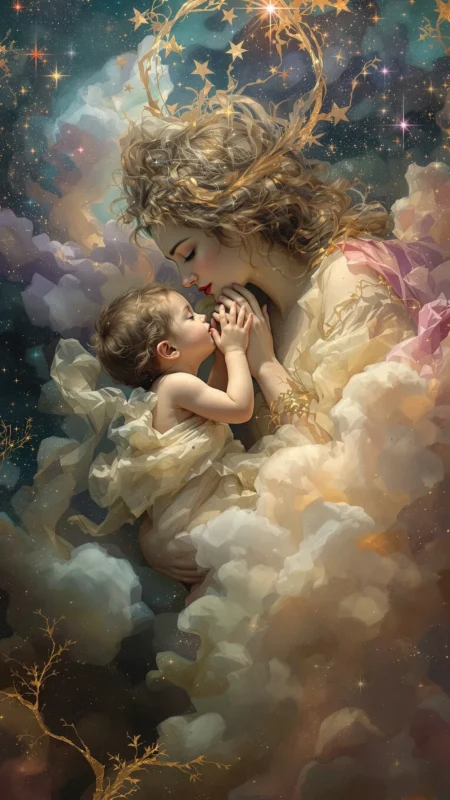


Adoption

Archetype Meaning & Symbolism

searching, bifurcated, adaptive, chosen, resilient, questioning, grafted, longing, grateful, complex

  • My roots are not found in soil, but in the stories I choose to grow.

If Adoption is part of your personal mythology, you may...

Believe

  • You may believe that family is a verb, an act of creation and daily recommitment, not a noun defined by blood.

  • You may believe that your life's true story began not on the day you were born, but on the day you were found.

  • You may believe that love has the alchemical power to transform strangers into kin and a house into a sacred home.

Fear

  • You may fear that your place in your family and in the world is conditional, and that if you make a mistake, you could be 'sent back.'

  • You may fear the existence of a hidden truth about your origins that, if revealed, would shatter your sense of self.

  • You may fear that you don't truly belong anywhere, that you are a permanent visitor in the lives of others.

Strength

  • You may possess a radical adaptability, an almost chameleon-like ability to find your footing and connect with others in any new environment.

  • You may have a profound and deeply ingrained empathy for anyone who feels like an outsider, a misfit, or a stray.

  • You may have the extraordinary ability to build family wherever you go, weaving networks of deep, chosen kinship with fierce loyalty and intention.

Weakness

  • You may struggle with a persistent sense of groundlessness, as if you are missing a fundamental anchor to a place or a people.

  • You may have a deep-seated tendency toward people-pleasing, an impulse to be 'good' and 'easy' to ensure your place is secure.

  • You may find endings of any kind particularly devastating, as they can unconsciously reactivate the primal wound of abandonment and separation.

The Symbolism & Meaning of Adoption

In the personal mythos, Adoption symbolizes the profound truth that identity can be both given and made. It is the story of the grafted branch, the one that learns to draw sap from a new tree, forever bearing the memory of its original rootstock while producing fruit in a garden that chose it. This archetype introduces a fundamental duality: a simultaneous experience of profound loss and extraordinary gain. It suggests that a life can be broken open and remade, not just once, but continuously. The narrative is not one of seamless inheritance but of curated belonging. One's sense of self may become a mosaic, pieced together from fragments of a known past, whispers of an unknown one, and the vibrant tiles of present reality. This is the mythology of the soul who understands that we are all, in some way, foundlings, searching for a place to be truly seen.

Furthermore, the archetype challenges our most basic assumptions about what makes a family and what constitutes a home. It posits that the strongest bonds are not necessarily those of blood, but those of story, of shared vulnerability, and of deliberate, persistent love. The personal mythology of one informed by Adoption might be a testament to human resilience and the creative power of care. It is a narrative that champions the idea that we can be planted in one place and bloom in another, that our beginnings do not have to be our destiny. This mythos often involves a lifelong dialogue between nature and nurture, fate and free will, asking whether we are defined more by the people we came from or the people who came for us.

This archetype also carries the subtle weight of the unanswered question. It is a story with a ghost in the machine: the specter of the other life, the other family, the other self that might have been. This haunting may not be a source of sorrow but a wellspring of empathy, curiosity, and a unique form of wisdom. It could foster a deep understanding of alternate realities and the thin veil between what is and what could be. For the individual, this might translate into a life rich with nuance, comfortable with ambiguity, and acutely aware that every story, including their own, is a tapestry of visible and invisible threads.


Adoption Relationships With Other Archetypes

The Orphan

The Adoption archetype often begins where The Orphan’s journey reaches a critical juncture. The Orphan embodies the initial state of loss, solitude, and the raw wound of being without origin or anchor. Adoption is the transformative event that offers a response to The Orphan’s plight. However, the connection is not a simple cure. The Orphan archetype may remain as a shadow self or an inner child within the Adoption narrative, a quiet voice that remembers the cold and questions the warmth. Their relationship is a dance between the memory of lack and the reality of provision, a constant negotiation between the fear of being alone and the comfort of being held.

The Seeker

Adoption is intrinsically fused with The Seeker. The central mystery of one’s origins, the “ghost limb” of a biological family, often ignites a lifelong quest. This is not merely a search for people, but a search for self: for mirror images, for genetic explanations, for the missing paragraphs of one’s own first chapter. The Seeker’s energy fuels the narrative, pushing the individual to journey into archives, across continents, or deep into their own psyche. The Adoption archetype provides the Seeker with its most personal and potent Grail: the story of its own beginning.

The Gardener

The relationship with The Gardener archetype is one of profound synergy, representing the 'nurture' side of the eternal debate. The adoptive parent, or the chosen family, embodies The Gardener who lovingly tends to a sapling they did not sow. They create the environment, provide the nourishment, and protect the growing thing from the elements. For the person living the Adoption mythos, The Gardener symbolizes the power of intentional care to shape a life. This relationship underscores the belief that a beautiful life can be cultivated in any soil, so long as it is tended with patience, commitment, and unconditional love. It is a testament to the idea that belonging can be grown.

Using Adoption in Every Day Life

Navigating Questions of Identity

When grappling with who you are, the Adoption archetype offers a framework of identity as a collage, not a monolith. You might learn to see your biological history and your lived experience not as competing truths, but as two distinct threads woven into a unique tapestry. This perspective allows one to hold the unknown with curiosity rather than anxiety, treating the gaps in the story as spaces for self-creation rather than voids of loss.

Building a 'Chosen Family'

In moments of loneliness or when traditional family structures feel inadequate, this archetype provides the blueprint for chosen family. It suggests that the most profound bonds are forged in the fires of mutual recognition and deliberate commitment, not just in the happenstance of birth. One may actively cultivate a network of friends, mentors, and partners who constitute a deeply felt, intentional home, proving that kinship is an action, a daily choosing.

Integrating a Divided Past

For anyone feeling split between two worlds: a past and a present, one culture and another, a former self and a new one, the archetype is a guide for integration. It models the process of holding duality. One could practice acknowledging the grief of what was lost or never known, while simultaneously celebrating the beauty of what was found and created. It is the art of living in the “and,” embracing the complexity of a story that begins more than once.

Adoption is Known For

The Genesis Mystery

At its core, this archetype is known for the fundamental question of origins. It introduces a blank page or a redacted chapter right at the beginning of the personal mythos, creating a narrative propelled by a search for answers, for reflections, for the missing pieces of a puzzle that is the self.

The Act of Choosing

It is defined by the profound act of being chosen and, in turn, choosing. This shifts the foundation of family from biological inevitability to intentional love. This dynamic may become a central theme, highlighting a life built on conscious commitment and the powerful affirmation of being wanted.

The Bifurcated Timeline

The archetype is recognized by its story structure

a life split into a 'before' and an 'after.' This creates a unique relationship with time and memory, where the narrative doesn't flow from a single source but is instead a confluence of two distinct rivers, each with its own current, history, and ghosts.

How Adoption Might Affect Your Personal Mythology

How Adoption Might Affect Your Mythos

When Adoption is a cornerstone of your personal mythos, your life story may not be a linear progression but a novel with a hidden prologue. The narrative begins not with birth, but with a moment of transference, a grafting of one story onto another. This creates a central mystery, a generative void from which much of the plot emerges. Your mythos may be that of the Changeling, the one who lives between two worlds, or The Bridge, the one who unites disparate lineages. The inciting incident of your life is not your arrival on earth, but your arrival into a specific story, making themes of fate, choice, and belonging the primary engines of your journey.

This narrative structure might also imbue your mythos with a profound sense of a 'second chance' or a 'fated rescue.' You may see your life as a heroic tale, not of your own making initially, but one you were called into. Key plot points may revolve around moments of proving worthiness, of searching for clues to your own backstory, and of ultimately defining your identity on your own terms. Your life story becomes a testament to the idea that the most important chapters are not the ones that are given to you, but the ones you choose to write.

How Adoption Might Affect Your Sense of Self

Your sense of self may be a composite creation, a carefully curated identity assembled from the known and the imagined. There might be a feeling of being a unique composition, a blend of natures and nurtures that defies easy categorization. This could lead to a highly adaptable and resilient self, capable of navigating different social and cultural contexts with ease. You may see yourself as a self-made person in the truest sense, not economically, but existentially. The core of your being is not something you inherited, but something you, in collaboration with those who chose you, have built.

Conversely, the self could feel perpetually provisional, as if your place in the world is conditional. A part of your identity might seem to be held in escrow, pending the discovery of more information. This can manifest as a persistent, low-level identity-anxiety or a feeling of being an imposter in your own life. The question 'Who am I?' may carry a different weight, being less a philosophical inquiry and more a practical, haunting puzzle. The self is not a solid island but perhaps an archipelago, a series of connected landmasses with water flowing in between.

How Adoption Might Affect Your Beliefs About The World

Your worldview could be profoundly shaped by the primacy of choice over circumstance. You might see the world not as a deterministic place governed by bloodlines and inherited traits, but as a space of radical possibility, where connections are forged by intent and commitment. This perspective may foster a deep and abiding empathy for all outsiders, for anyone who exists on the margins. You may inherently understand that belonging is a construct, and therefore you may view social structures, traditions, and definitions of family with a critical and flexible eye.

This archetype might also instill a view of the world as fundamentally mysterious and incomplete. You may be comfortable with ambiguity and unanswered questions, knowing from experience that not every story has a clear beginning or a neat resolution. This can lead to a worldview that is less dogmatic and more open to the complexities of human experience. You may believe that hidden truths and unseen connections govern much of life, and that what is visible on the surface is rarely the whole story.

How Adoption Might Affect Your Relationships

In relationships, you may operate from a place of conscious choice, valuing deliberate commitment above all else. Friendships and romantic partnerships could be seen as families you are actively building. Because your foundational experience of family was an intentional act, you may expect and offer a high degree of explicit reassurance and verbal affirmation of love and belonging. You might be fiercely loyal to those you let into your inner circle, having chosen them with great care. The bonds you form are not taken for granted; they are sacred pacts.

However, the primal wound of separation could cast a long shadow, creating a deep-seated fear of abandonment. You may unconsciously test the loyalty of partners and friends, seeking proof that they will not leave. There might be a tendency to merge too quickly or to hold back completely, oscillating between a desperate need for intimacy and a fear of its potential loss. Endings of any kind may be particularly painful, as they can trigger the original narrative of being 'given away,' making goodbyes feel like a catastrophic failure rather than a natural part of life.

How Adoption Might Affect Your Role in Life

Your perceived role in the world might be that of The Bridge-Builder. Having lived a life that spans at least two families, two histories, you may feel called to connect disparate people, ideas, or communities. You have a unique ability to see things from multiple perspectives and to hold space for conflicting truths. Your purpose, as you see it, might be to demonstrate that love can transcend biology and that unity can be created from fragmentation. You may be the diplomat in your social circle, the one who translates between different points of view.

Alternatively, you may feel your role is that of The Perpetual Outsider. This is not always a negative position; it can grant you the keen observational powers of one who is never fully immersed, never entirely taking the rules of the group for granted. From this vantage point, you might become an artist, a critic, a social commentator, or a reformer. Your life's work may be to question assumptions, challenge conventions, and speak for those who, like you once did, stand on the threshold, looking in.

Dream Interpretation of Adoption

In a positive context, dreaming of the Adoption archetype might manifest as discovering a hidden room in your house, one that is beautifully furnished and feels instantly like your own. This could symbolize the integration of a lost part of yourself and the profound joy of finding a place where you truly belong. Another dream might involve being given a key to an unknown door or being welcomed warmly into a home of strangers who treat you like family. These dreams may suggest a growing acceptance of your whole story, a feeling of being 'chosen' by the universe, and a sense of peace with your origins, known or unknown.

In a more challenging light, a dream influenced by this archetype could involve looking into a mirror and seeing a stranger's face staring back, symbolizing a fractured or uncertain sense of identity. You might dream of having two shadows, or of packing a suitcase for a journey with no destination, reflecting a feeling of groundlessness or of being caught between two worlds. A recurring nightmare could be standing on a shore as a ship sails away, or searching for a house you can't remember the address of, potent symbols of the primal wound of separation and the persistent fear of abandonment.

How Adoption Archetype Might Affect Your Needs

How Adoption Might Affect Your Physiological Needs

The foundational physiological needs of food, water, and shelter may be deeply encoded with symbolic meaning. The provision of these basics by an adoptive family is not a given but the central act of the story itself: the rescue, the embrace. This could create a deep appreciation for simple comforts and a sense of security tied to a full pantry or a warm bed. These are not just needs being met; they are a constant, tangible reaffirmation of the choice that was made, a physical manifestation of being wanted and cared for. A meal is never just a meal; it is a sacrament of belonging.

Conversely, there may be a lingering, subconscious anxiety around these fundamental needs. An echo of a time, real or imagined, when provision was not guaranteed could manifest as a scarcity mindset. This might not be rational, but archetypal: a fear that the resources, and the love they represent, could be withdrawn. This could lead to behaviors like hoarding, anxiety about finances, or a deep-seated unease when routines around meals or home life are disrupted, as these routines are the bedrock of the safety narrative.

How Adoption Might Affect Your Ideas of Belonging

The need for belongingness and love is the central axis around which the entire Adoption mythos revolves. This archetype may create an individual with a super-power for creating intimacy and connection, as they have been a student of belonging their entire life. They may not take love for granted, seeing it as a miraculous and intentional force. The capacity to love and be loved might feel like the ultimate achievement, the triumphant resolution of their personal story. They may pour enormous energy into nurturing their relationships and creating a powerful sense of 'us' with their chosen people.

The shadow side of this intense need is a profound sensitivity to any hint of rejection. A casual oversight from a friend or a moment of conflict with a partner might be interpreted through the lens of the core wound, feeling like a threat to one's very place in the world. This can lead to people-pleasing behaviors, an inability to set boundaries for fear of upsetting others, or a pattern of preemptive withdrawal to avoid the pain of being left. The quest for belonging can be so powerful that it sometimes eclipses the need for an authentic self, creating a tension between fitting in and being true.

How Adoption Might Affect Your Feelings of Safety

The archetype presents a paradox regarding safety. On one hand, the adoption is the ultimate act of ensuring safety, a literal and metaphorical journey from a precarious situation to a secure one. This may instill a powerful belief in the existence of benevolent forces, of rescue, and of the possibility of finding sanctuary in the world. Safety may be equated with the structure and predictability of the adoptive family, and one might actively seek to create highly stable and secure environments in their own life as a result.

On the other hand, the narrative begins with a profound breach of safety: the separation from the biological mother. This initial event can leave a permanent imprint, a kind of existential vulnerability. There might be a persistent feeling that safety is conditional and can be revoked without warning. This could manifest as hyper-vigilance, difficulty with trust, or a need to control one's environment. The world might feel like a place where one's footing is never entirely secure, as the foundation was proven, at the very beginning, to be movable.

How Adoption Might Affect Your Views of Esteem

Esteem may be deeply intertwined with the concept of being 'chosen.' This can be a powerful source of self-worth: 'I was wanted. I was selected. I am special.' This narrative can fuel a sense of purpose and a belief in one's own inherent value, providing a strong defense against feelings of inadequacy. The act of being brought into a family can be internalized as proof that one is worthy of love, effort, and commitment, forming a solid bedrock for confidence and self-respect.

However, the same story can be read another way, creating a fragile esteem built on a precarious foundation. The flip side of being chosen is the fact of being given up. This can plant a seed of doubt, a question that whispers: 'Was there something wrong with me?' Esteem might then become a performance, a constant effort to prove one's worthiness of being 'kept.' Achievements may not be for personal satisfaction but to validate the choice that was made, and any failure could feel catastrophic, as if it confirms the original, unstated fear of being inherently flawed.

Shadow of Adoption

The shadow of Adoption can manifest as the 'gratefulness trap.' This is a psychological state where the individual feels so indebted to their adoptive family that they suppress any negative feelings, legitimate grievances, or personal desires that might seem ungrateful. They may feel they have no right to be angry, sad, or to even explore their origins, for fear of hurting the people who 'saved' them. This forced gratitude can suffocate the authentic self, creating a pleasant facade that conceals a reservoir of unspoken resentment and a fractured identity.

Another shadow aspect is the Perpetual Search, where the quest for origins becomes an obsession that devalues and negates the present reality. The individual may idealize their unknown biological family, creating a fantasy that no real person could live up to. In this state, the current life feels provisional, a waiting room for the 'real' life that will begin once the mystery is solved. This prevents true integration and presence, turning the past not into a source of information, but into a mirage that forever recedes, ensuring the Seeker never finds a place to rest and simply be.

Pros & Cons of Adoption in Your Mythology

Pros

  • A unique dual perspective that allows you to see and understand the world through multiple lenses, fostering immense empathy and wisdom about human connection.

  • A heightened capacity for intentional relationships, leading to profoundly deep and loyal bonds with a chosen family of friends and partners.

  • A powerful resilience forged from navigating a complex origin story, granting you the strength to adapt and thrive in the face of life's uncertainties.

Cons

  • A lifelong internal dialogue with questions of identity, belonging, and the 'what ifs' of a life not lived.

  • A deep and sensitive wound around abandonment and rejection that can be easily triggered in relationships, requiring constant self-awareness and healing.

  • The emotional labor of carrying and often having to explain a story that is more complex than the societal default, which can be isolating and exhausting.