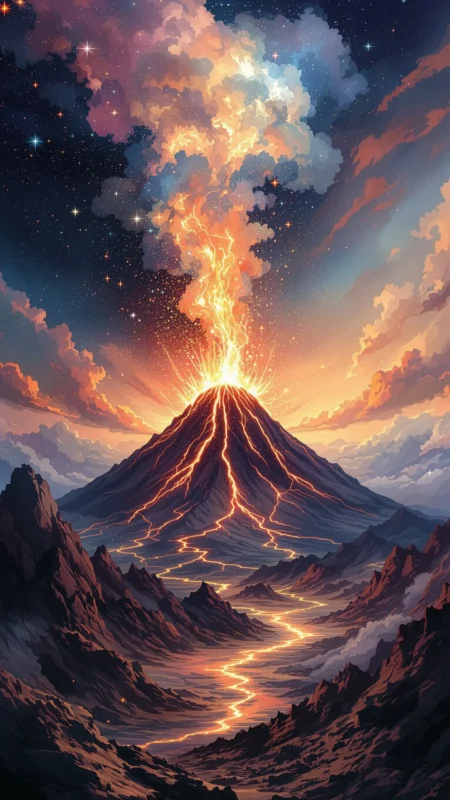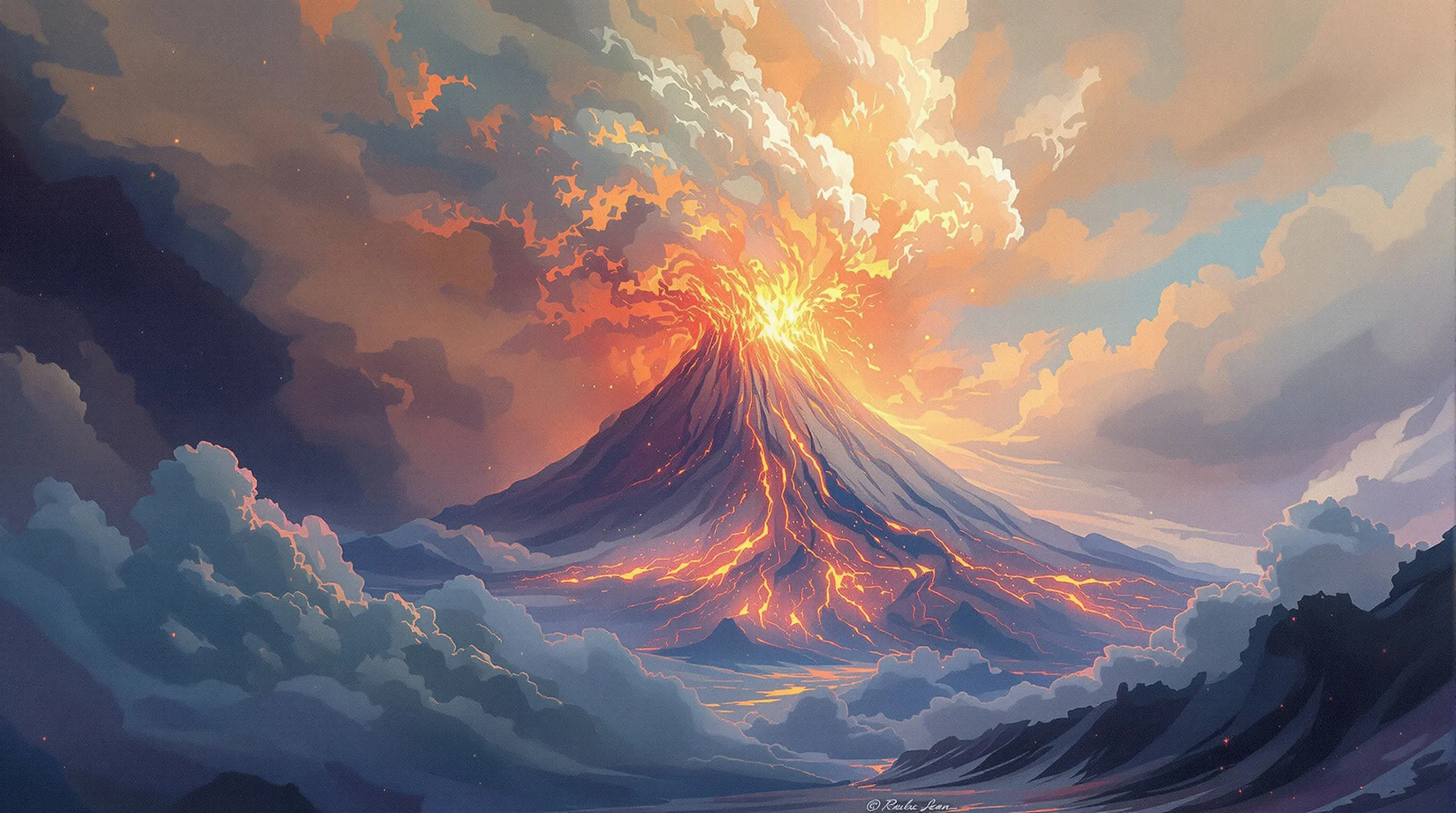


Volcanic Eruption

Archetype Meaning & Symbolism

Cathartic, explosive, transformative, primal, destructive, creative, sudden, repressed, foundational, fertile

  • Do not mistake my silence for dormancy: the greatest pressure builds in the quietest depths.

If Volcanic Eruption is part of your personal mythology, you may...

Believe

  • That truth, no matter how destructive in the short term, is ultimately a creative and life-giving force.

  • That repression, of emotions, creativity, or identity, is the most dangerous and unstable state of being.

  • That the most fertile ground for new growth is always created by the hottest fire of transformation.

Fear

  • That your inner power, once fully unleashed, will indiscriminately destroy everything and everyone you love.

  • That you will erupt at the wrong time or in the wrong context, causing irreparable harm and branding you as a monster.

  • That you are fundamentally unstable and incapable of the kind of sustained, gentle peace that seems to come easily to others.

Strength

  • A profound capacity for radical honesty and deep, systemic transformation, both for yourself and for the groups you are a part of.

  • An immense well of creative and passionate energy that, when channeled, can produce works of incredible power and originality.

  • The courage to clear away old, stagnant, and decaying structures in your life and relationships to make way for new, more vibrant growth.

Weakness

  • A tendency toward sudden, damaging outbursts that can alienate allies and burn bridges that might have been better left standing.

  • A difficulty with patience, moderation, and the slow, incremental work required for long-term stability and growth.

  • The potential to mistake any intense emotion for a profound truth, leading you to create unnecessary drama and chaos where none is required.

The Symbolism & Meaning of Volcanic Eruption

In the personal mythos, the Volcanic Eruption may symbolize the psyche's ultimate rejection of containment. It is the great, roaring 'no' to repression, to the gradual accumulation of unspoken truths, unexpressed emotions, and stifled creative impulses. It represents a force within that will, eventually, demand expression, regardless of the consequences. To carry this archetype is to understand that peace bought at the price of authenticity is a fragile crust over a molten core. The eruption is a catastrophic, yet necessary, act of truth-telling, a moment when the inner reality reshapes the outer landscape, burning away facades to reveal the foundational self.

The symbolism is not merely in the explosion, but in the aftermath. The lava flow that cools into new land signifies the creation of a new reality, a new foundation for life built from the very substance that was once hidden and dangerous. The ash that chokes the sky ultimately settles to become uniquely fertile soil. This speaks to a profound belief in the generative power of crisis. A volcanic event in one's life story—a dramatic breakup, a career collapse, a spiritual crisis—is not just an ending. It is the messy, chaotic, and terrifying process of creating new ground upon which to build, a landscape transformed by fire and pressure into something more capable of sustaining new growth.

Furthermore, this archetype could embody the moment of unbearable pressure that precedes a breakthrough. It is the dark night of the soul rendered in geological terms. The rumbling ground, the venting steam, the swelling cone: these are the anxieties, the flashes of insight, the growing sense of unease that signal an imminent transformation. To live with this archetype is to learn to read these signs not with fear, but with a kind of reverent anticipation. It suggests that the most profound changes in life do not come from gentle nudges but from deep, seismic shifts that irrevocably alter our understanding of ourselves and our place in the world.


Volcanic Eruption Relationships With Other Archetypes

The Ocean:

The relationship between the Volcanic Eruption and the Ocean is one of primal spectacle and generative violence. When molten lava, the volcano's very essence, meets the cool, deep expanse of the ocean, the result is steam, chaos, and the creation of new land. In a personal mythos, this could represent the collision of raw, fiery passion with the vast, formless depths of the unconscious or collective emotion. It is a relationship that is never calm. It is the explosive interaction between a sudden, undeniable truth and a deep, abiding feeling, a process that can feel tumultuous and painful but ultimately expands the shoreline of the self, creating more solid ground where once there was only water.

The Seed:

The Volcanic Eruption is the violent benefactor of the Seed archetype. On its own, the seed contains immense potential, but it requires the right conditions to germinate. The volcano provides these conditions in the most dramatic fashion possible. Its destructive eruption creates a blanket of ash that, once weathered, becomes incredibly fertile soil. This relationship suggests that our greatest potential (The Seed) may sometimes lie dormant, waiting for a cataclysmic event (The Volcanic Eruption) to clear the overgrowth of our old lives and provide the strange, nutrient-rich ground necessary for our true purpose to finally take root and flourish against all odds.

The Architect:

The Architect and the Volcanic Eruption exist in a state of profound tension. The Architect seeks to create order, to build lasting structures based on careful plans and predictable materials. The Volcano represents the unpredictable, foundational power that can obliterate those structures in an instant. This is not a relationship of malice, but of scale. The volcano reminds the architect that all human endeavors, all carefully constructed identities and belief systems, are built on a thin crust of stability over a dynamic, powerful, and ultimately uncontrollable reality. In a personal narrative, this tension could play out as a conflict between the desire for a controlled, planned life and the periodic, irresistible urge to demolish it all in the name of a deeper, more authentic truth.

Using Volcanic Eruption in Every Day Life

Navigating Creative Stagnation:

When faced with a creative block, you might perceive it not as an absence of ideas, but as a magma chamber of them, sealed by the hardened rock of perfectionism. The Volcanic Eruption archetype encourages a deliberate, controlled detonation: a timed freewriting session, a canvas attacked with chaotic color, a musical improvisation that permits dissonance. The goal is not a finished piece, but the catharsis of release, breaking the surface to see what flows out, trusting that fertile new ground for ideas will form in the aftermath.

Addressing Emotional Repression:

In relationships or professional settings where emotions are routinely swallowed, this archetype serves as a vital internal gauge. You may learn to recognize the subtle tremors that precede a major outburst: irritability, muscle tension, intrusive thoughts. Instead of waiting for the inevitable explosion of rage or tears, you could create small, controlled vents. This might be a brutally honest journal entry, a difficult conversation initiated with care, or a cathartic physical activity, releasing the pressure incrementally before it builds to a point of relational devastation.

Reframing a Life Transition:

A sudden career change, the end of a long-term relationship, or a move to a new country can feel like a purely destructive event. By viewing it through the lens of a volcanic eruption, the narrative shifts from one of loss to one of forceful creation. The old life is the landscape that has been wiped clean, not out of malice, but by a foundational force. The ensuing confusion and emptiness is not a void, but a cooling flow of lava and a settling of nutrient-rich ash. It is the primordial moment before new life, unique and unprecedented, begins to take root in the transformed soil of your existence.

Volcanic Eruption is Known For

Sudden Release

A defining characteristic is the catastrophic conversion of immense, subterranean pressure into a sudden, overwhelming expression. This is not a gradual process but a singular moment of rupture where all that has been contained is violently externalized.

Destruction and Creation

The archetype is known for its dualistic nature. It obliterates the existing ecosystem with pyroclastic flows and lava, a seeming apocalypse. Yet, from this sterile-looking canvas of ash and rock, it creates the most fertile soil, giving rise to new, often more vibrant, life.

Primal Power

It represents an untamable, foundational force that operates on a geological timescale, indifferent to human plans or desires. This power is not evil or good; it simply is. It is the raw energy of creation and destruction that underlies the seemingly stable surface of the world and the psyche.

How Volcanic Eruption Might Affect Your Personal Mythology

How Volcanic Eruption Might Affect Your Mythos

If the Volcanic Eruption is a core component of your personal mythos, your life story is likely not a linear progression but a series of dramatic landscapes separated by cataclysmic events. Your narrative is marked by a distinct 'before' and 'after' a specific eruption: before the career was incinerated, after the truth was told, before the relationship ended in a fiery spectacle. These are not mere turning points; they are geological epochs in your personal history. You might frame your own growth in terms of destruction and rebirth, seeing your past selves as ancient cities buried under the ash of who you have become, preserved and yet utterly inaccessible.

The mythos itself might center on a theme of hidden power. Your story could be one of a person who appears calm, even dormant, on the surface, while immense forces gather within. The dramatic tension in your narrative comes from the question of when, not if, the eruption will occur. You may see yourself as a vessel for a power greater than your conscious self, a force that uses you to enact necessary, albeit painful, change in the world around you. Your personal legend is not one of gentle influence, but of sudden, irreversible transformation, leaving a new and fertile landscape in your wake.

How Volcanic Eruption Might Affect Your Sense of Self

Your perception of self may be one of inherent duality: a placid, controlled exterior concealing a molten, pressurized core. You might not trust your own stillness, always sensing the low-frequency rumble of what lies beneath. This can lead to a feeling of being a stranger to yourself, as if your conscious personality is merely the thin crust of a mountain, while your true identity is the powerful, unpredictable magma chamber deep below. Self-knowledge, for you, may not arrive through quiet contemplation but in explosive flashes of insight, in moments where the pressure becomes too great and a raw, unvarnished truth about yourself breaks through the surface.

This could also manifest as a deep-seated respect for your own anger, passion, and creative urges, viewing them not as negative emotions to be managed, but as vital signs of the life force building within you. You may grant yourself permission for periodic emotional releases, understanding them as necessary venting to prevent a catastrophic explosion. Your sense of self-worth might be tied not to your consistency, but to your authenticity, valuing the courage it takes to let the truth erupt over the comfort of maintaining a stable, but false, facade.

How Volcanic Eruption Might Affect Your Beliefs About The World

Your worldview could be predicated on the belief that stability is a beautiful, but temporary, illusion. You may look at established institutions, societal norms, and even scientific certainties and see not permanence, but a thin crust over deep, tectonic forces of change. You are perhaps less surprised than others by sudden market crashes, political upheavals, or cultural shifts, seeing them as inevitable eruptions of long-suppressed energies. You might believe that history does not flow like a river but moves in seismic jolts, with long periods of dormancy followed by brief, violent periods of revolutionary change that redefine the landscape for generations.

This perspective may instill a certain detachment from worldly ambitions that rely on permanence. Why build a career meant to last for forty years when you know the entire industry could be rendered obsolete by a single disruptive innovation? This is not necessarily cynicism, but a geological realism applied to human affairs. Your focus might instead be on adaptability, resilience, and the ability to find opportunity in the fertile soil of chaos. You may see crisis not as something to be avoided at all costs, but as the primary engine of progress and creation, a necessary fire to clear the way for what's next.

How Volcanic Eruption Might Affect Your Relationships

In relationships, you may experience a pattern of placid intimacy punctuated by moments of intense, ground-clearing honesty. You might find small talk and the glossing over of minor issues to be unbearable, as you feel it is merely adding to the subterranean pressure. This can lead to confrontations that seem to come out of nowhere to your partner, but for you, they are the culmination of a long, silent build-up. The health of a relationship, in your view, might be measured by its ability to withstand these eruptions and to grow something new and stronger in the aftermath.

You might attract partners who are either 'volcanologists,' fascinated by your depth and intensity, or who are 'settlers,' desperately trying to build a peaceful village on your slopes, hoping for the best. This can create a dynamic of immense passion or immense conflict. True intimacy for you may be found not in uninterrupted harmony, but in the shared trust that allows for total, even destructive, honesty. You form the strongest bonds with those who are not afraid of the fire, who are willing to stand with you as the old ground burns away, trusting that the love between you is the new life that will grow back.

How Volcanic Eruption Might Affect Your Role in Life

You may feel that your role in any group, organization, or family is that of the catalyst or the truth-teller. You are the one who senses the pressure building, who sees the cracks in the facade, and who feels an almost geological compulsion to release the tension. This often means you are the one to say the unsayable, to point out the elephant in the room, to initiate the breakup or quit the job that everyone knows is necessary but is too afraid to precipitate. You might be perceived as disruptive, reckless, or even cruel, when in your own mythos, you are simply acting as an agent of a necessary, inevitable force.

Consequently, you may find yourself cast in the role of the revolutionary, the artist, or the shaman: figures who dismantle old realities to make way for new ones. You might be uncomfortable in roles that require you to maintain the status quo. Your purpose, as you see it, is not to tend the garden but to be the fire that clears the field so a new garden can be planted. This can be a lonely role, as it often involves a temporary destruction of the very systems and relationships that provide comfort and security. Your sense of fulfillment comes from witnessing the new life that eventually grows in the fertile ground of the change you initiated.

Dream Interpretation of Volcanic Eruption

In a positive context, dreaming of a volcanic eruption may symbolize an impending and deeply necessary breakthrough. It can represent the release of a massive amount of pent-up creative energy, repressed emotions, or a transformative spiritual insight that you have held below the level of consciousness. The dream is an affirmation from your psyche that this release, while it may appear chaotic and overwhelming, is fundamentally a creative and cleansing act. To watch the eruption from a safe distance in a dream could suggest you are ready to witness and integrate this powerful change in your life, trusting that it will clear the way for a more authentic and fertile existence.

In a negative context, a dream of being caught in or consumed by a volcanic eruption might signal a profound fear of your own power and anger. It could indicate a feeling that you are losing control, that the pressures of your life have built to an unmanageable point, and the imminent explosion will be purely destructive, harming yourself and those you care about. This dream may serve as a warning from your unconscious that your current methods of repression are failing. It is a desperate plea to find safer, more conscious ways to vent the pressure before it erupts indiscriminately, burying your life's landscape in sterile, un-reclaimable ash.

How Volcanic Eruption Archetype Might Affect Your Needs

How Volcanic Eruption Might Affect Your Physiological Needs

Your body's basic needs may be interpreted through a narrative of pressure and release. The need for sustenance isn't just about calories; it's about stoking the inner fire. You might favor spicy, intense foods or, conversely, cooling foods that soothe the internal heat. There may be a deep, instinctual understanding that the body stores tension, not just in the muscles, but in a deeper, more energetic way. This tension, if not addressed, is the physiological equivalent of building magma pressure. Therefore, physiological well-being is not just about maintenance but about active, regular catharsis.

This need for release can manifest as a craving for intense physical exertion: sprinting, heavy lifting, or any activity that brings the body to a point of explosive effort and subsequent exhaustion. It's not just exercise; it's a ritual of venting steam. Similarly, the need for rest isn't a gentle recharging but a period of profound dormancy, a deep quiet necessary to gather strength after a significant expenditure of energy. The health of your physical self is directly linked to how well you manage these cycles of pressure build-up and release.

How Volcanic Eruption Might Affect Your Ideas of Belonging

Your need for belongingness and love can be complicated by the nature of your energy. In groups or relationships that prize harmony, politeness, and the avoidance of conflict, you may feel like a geological anomaly, fundamentally out of place. The pressure to conform, to remain dormant, can be immense, leading to a profound sense of alienation. You might feel that to be loved, you must conceal the most powerful and authentic part of yourself, leading to relationships that feel safe but are ultimately unsatisfying and brittle.

True belonging is found not in placid acceptance but in fiery, authentic connection. You may form incredibly strong, resilient bonds with a select few who are not afraid of your intensity. These are the people who can withstand the heat of your honesty and who see your eruptions not as personal attacks but as expressions of a powerful life force. Love, in this mythos, is forged in the crucible of truth. It is the partner who stays not despite the eruptions, but because of them, recognizing that the same fire that can destroy also creates the most fertile ground for a deep, authentic, and ever-evolving connection.

How Volcanic Eruption Might Affect Your Feelings of Safety

The concept of safety may be paradoxical for you. On one hand, you might crave stability and control, meticulously building a life that feels solid and secure, like a village on the slopes of the mountain. This involves creating predictable routines, financial buffers, and emotional walls. However, on a deeper level, you may know that this stability is an illusion. The very structures you build to feel safe can begin to feel like a cap on the volcano, increasing the internal pressure and making the eventual eruption all the more devastating.

True safety, within this archetypal framework, is not found in static fortifications but in dynamic readiness. It is the wisdom of the volcanologist who does not try to stop the eruption but learns to read the signs and know when to evacuate. For you, this translates into developing emotional intelligence, self-awareness, and constructive outlets for your intensity. Safety is the confidence that you can channel the flow when the eruption comes, directing your power consciously rather than letting it explode indiscriminately. It is the security of knowing your own nature, not the false security of a life designed to deny it.

How Volcanic Eruption Might Affect Your Views of Esteem

Your self-esteem could be as volatile as the archetype itself. During the long, quiet periods of pressure-building, you may be plagued by self-doubt, frustration, and a sense of being stuck or inauthentic. You might see your inability to 'just be happy' or conform as a personal failing, leading to low self-worth. Your esteem in these phases is buried deep beneath a crust of self-criticism and societal expectation.

However, in the wake of an 'eruption'—a moment where you speak a profound truth, complete a massive creative project, or make a courageous life change—your esteem may surge to great heights. You feel aligned with your core power, authentic, and alive. Self-worth, therefore, is not a steady state but is derived from the act of authentic expression. Your challenge is to cultivate a more stable sense of esteem that honors both the dormant phases and the explosive ones, recognizing that the quiet pressure-building is just as essential to your nature as the spectacular release.

Shadow of Volcanic Eruption

The shadow of the Volcanic Eruption manifests when the release is no longer a necessary catharsis but becomes a perverse end in itself. This is the individual who is addicted to drama, who manufactures crises to feel the rush of the explosion. They may use rage as a tool of intimidation and control, engineering emotional eruptions to manipulate others, burning down relationships not to create fertile ground, but for the sheer spectacle of the fire. Their identity becomes so enmeshed with being 'the explosive one' that they seek out situations that will allow them to perform this role, unable to tolerate the quiet, 'boring' periods of dormancy and growth. The creative aspect is lost, leaving only a scorched-earth policy toward intimacy and connection.

Conversely, the shadow can appear as its opposite: a total, terrified suppression of the volcanic nature. This is a person who dedicates their entire life to capping the volcano, pouring concrete over every fissure, denying every tremor. The immense energy of the archetype, when turned inward, becomes a destructive, implosive force. It may manifest as chronic depression, autoimmune disorders, or a life of quiet desperation where all passion and vitality have been extinguished. This is the Pompeii of the soul, a city frozen in ash not by a fiery explosion, but by the slow, suffocating weight of a lifetime of self-denial.

Pros & Cons of Volcanic Eruption in Your Mythology

Pros

  • You are a powerful catalyst for necessary change, rarely allowing yourself or those around you to remain stuck in stagnant or inauthentic situations for long.

  • Your connection to a deep well of primal energy means that your creative, emotional, and spiritual expressions can have an immense, landscape-altering impact.

  • You tend to live a life of high authenticity, as you find it constitutionally difficult to repress your core truths for the sake of superficial peace or social acceptance.

Cons

  • Your intensity can be exhausting and overwhelming for yourself and others, making the creation and maintenance of stable, peaceful relationships a significant challenge.

  • You may inadvertently cause significant collateral damage to careers, friendships, and opportunities during your periodic eruptions, burning bridges you later regret.

  • A reliance on cathartic release can prevent the development of other valuable skills: patience, diplomacy, compromise, and the ability to enact gentle, incremental change.