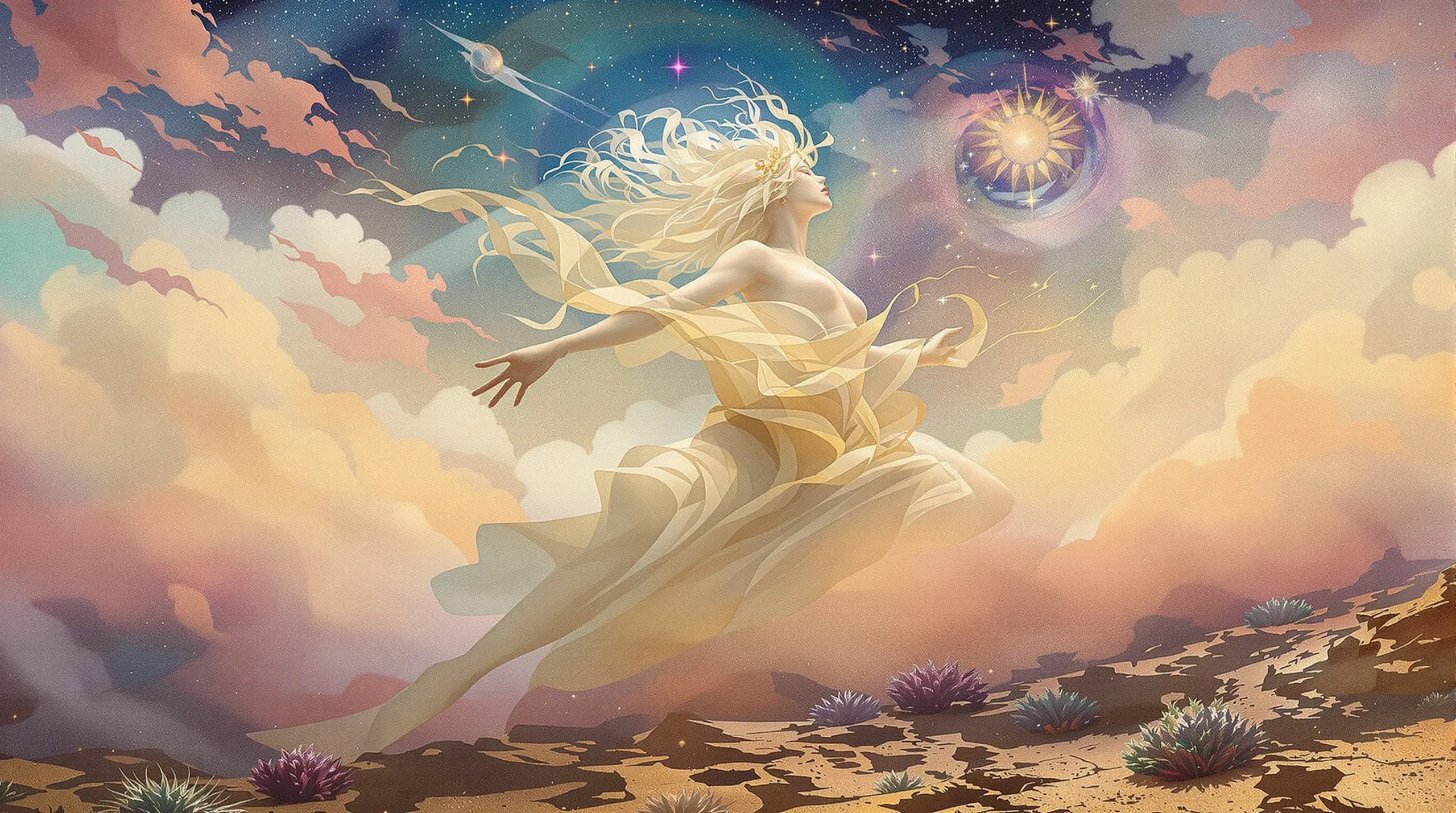


Drought

Archetype Meaning & Symbolism

Barren, austere, patient, enduring, stark, clarifying, minimalist, conserving, vast, thirsty

  • What is essential is not what you gather, but what you can live without. In the long quiet, you will finally hear what truly calls for water.

If Drought is part of your personal mythology, you may...

Believe

  • You may believe that true character is revealed not in victory, but in how one endures a long and lonely wait.

    You may believe that less is not just more, but that less is purer, more honest, and more beautiful.

    You may believe that the most precious things in life are those that can survive when everything else has been stripped away.

Fear

  • You may fear that the well of your creativity, love, or energy will finally run dry, and this time, there will be no rain.

    You may fear abundance itself, seeing it as a corrupting influence, a flood that will drown your hard-won clarity and self-reliance.

    You may fear that you have been in the desert so long that you would no longer know how to live in a green and gentle land.

Strength

  • You possess an almost unbreakable resilience, an ability to persist and find a way forward under the most challenging conditions.

    You have a profound capacity for focus, able to distinguish the essential from the trivial with piercing clarity.

    You cultivate a deep appreciation for small miracles and find immense beauty in simplicity, a gift lost on those who live in constant plenty.

Weakness

  • You may have a tendency toward emotional austerity, finding it difficult to express or receive affection freely, which can lead to isolation.

    A deep-seated scarcity mindset can prevent you from taking healthy risks or enjoying periods of prosperity, as you are always bracing for the next famine.

    You might project your inner barrenness onto the world, becoming cynical or critical of the joy and vibrancy of others.

The Symbolism & Meaning of Drought

In the personal mythology, Drought is the great clarifier. It is the long, sun-bleached season of the soul when external nourishment—praise, abundance, constant connection, easy success—recedes, leaving you alone with the stark landscape of your own character. This period, while challenging, is not merely about lack. It is perhaps a sacred fallowness, a time when the soil of the self is allowed to rest, to bake, to purify. The things that cannot withstand the heat, the superficial attachments and fair-weather beliefs, turn to dust and blow away. What remains is elemental, resilient, and true. To have Drought in your mythos is to understand that growth is not always green and lush; sometimes, it is the slow, almost imperceptible deepening of roots searching for a hidden aquifer.

Drought also symbolizes a profound state of waiting and endurance. It is the archetype of the long game, of faith in a cycle that extends beyond immediate gratification. It teaches a quiet, steady patience that is not passive, but deeply observant. You may learn the language of subtle signs: a change in the wind, the behavior of deep-rooted plants, the feeling of moisture in the distant air. This archetype could suggest a part of your story is about conserving energy for a critical moment, for the coming of a rain that you must believe in without any visible evidence. It is the spiritual discipline of existing in the liminal space between what was and what will be, trusting that the emptiness is a necessary part of the story.

Furthermore, Drought may represent a spiritual or creative thirst, a deep yearning for meaning, connection, or inspiration that feels tantalizingly out of reach. It is the experience of the dark night of the soul, the artist's block, the existential crisis. Yet, within this aridity lies a strange kind of freedom. When the landscape is stripped bare, you can see the bones of the world, the fundamental structures of your life, without the distraction of foliage. It could be in this starkness that you finally ask the most vital questions, unburdened by the noise of plenty. The answer you seek is not in a sudden flood, but perhaps in a single drop of dew on a spider's web at dawn: a small, precious, and miraculous sign of life persisting against all odds.


Drought Relationships With Other Archetypes

The Flood:

The Flood is Drought's chaotic, overwhelming sibling and its polar opposite. Where Drought strips away, Flood inundates. Where Drought demands conservation, Flood erases boundaries and washes everything away. For a person whose mythos is shaped by Drought, The Flood archetype may represent a terrifying loss of control, an excess of emotion or stimulus that threatens to drown their carefully managed inner world. Yet, it is also the Flood that ends the Drought, bringing life-giving, if destructive, change. Their relationship is the primal cycle of extremes: the parched earth that cracks and prays for rain, only to be potentially shattered by the very deluge it summoned.

The Oasis:

The Oasis is Drought’s most potent symbol of hope and salvation. It is not the opposite of the desert, but a miracle born within it. In a personal narrative, The Oasis archetype represents the sources of unexpected grace, the relationships, places, or moments of inspiration that provide just enough nourishment to continue the journey. For the Drought-influenced individual, The Oasis is not a permanent home but a sacred space of respite. They may fear becoming too dependent on it, knowing the vast, dry lands that surround it. This relationship teaches that sustenance is often found in concentrated, precious forms, and that the memory of the desert makes the taste of water all the more sacred.

The Seed:

The Seed and Drought share a relationship of profound, paradoxical intimacy. The Seed is the archetype of dormant potential, of life in waiting. Drought is the condition that enforces this waiting. For a seed to germinate, it needs water, but many desert seeds also need the intense, dry heat of a drought to crack their tough outer shells. In a personal mythos, this suggests that periods of spiritual or creative barrenness might be the very thing needed to break open one's own hardened defenses, preparing the soul for a future growth that would otherwise be impossible. The Drought does not kill the seed; it perhaps collaborates with it, testing its resilience and making it ready for the eventual, inevitable rain.

Using Drought in Every Day Life

Navigating Creative Stagnation:

When inspiration feels like a dry riverbed, the Drought archetype offers a strategy not of forcing the water, but of studying the cracks in the earth. It encourages a period of fallowness, a deliberate turning away from the demand for output. You may find that by ceasing to dig desperately for a new idea, you instead discover the seeds that lie dormant, waiting for a different kind of nourishment: time, silence, and the patient acceptance of emptiness as a precursor to creativity.

Managing Emotional Overwhelm:

In a life saturated with constant input and emotional deluge, embodying Drought can be a conscious act of creating internal space. It is the practice of intentional simplification: curating your social feeds, declining invitations that drain your reserves, and allowing for moments of profound silence. This isn't about isolation, but about conserving your precious emotional water, ensuring what you have goes to the relationships and endeavors that truly sustain your core being.

Embracing Financial Austerity:

When faced with financial limitation, whether chosen or imposed, the Drought archetype provides a mythic framework for minimalism and resourcefulness. It transforms a narrative of lack into a story of resilience. You may learn to see the elegance in conservation, to mend rather than replace, to find richness in experiences over possessions. This period could become a defining chapter in your mythos about discovering that your worth is not tied to what you have, but to how resourcefully you live with what is available.

Drought is Known For

Famine

A profound and prolonged lack of sustenance. It is the ultimate test of survival, forcing a confrontation with what is absolutely necessary for life and stripping away everything else.

Migration

The necessary journey in search of water and life. Drought often catalyzes epic movements, narratives of exodus where survival depends on leaving the familiar behind in a desperate, hopeful search for a promised, fertile land.

Mirages

The deceptive promise of relief that shimmers on the horizon. A powerful symbol for false hopes, illusions, and the tricks the mind can play when it is desperate for something that is not there.

How Drought Might Affect Your Personal Mythology

How Drought Might Affect Your Mythos

When Drought is a central feature of your personal mythos, your life story is often framed as a narrative of endurance. The defining chapters are not tales of conquest or discovery, but of survival through long periods of scarcity: a scarcity of love, of opportunity, of inspiration, of resources. Your myth might be that of the lone traveler crossing a vast desert, where the climax is not reaching a city of gold, but finding a hidden well. You may see your past not as a series of events, but as a series of ever-receding horizons, each one crossed with quiet fortitude. This can create a powerful, if somber, identity as a survivor, one who knows how to make much from little and who carries the wisdom of the long, hard journey.

This archetype could also cast your personal mythos as a quest for what is essential. The story is a process of shedding: letting go of superfluous relationships, ambitions, and possessions that cannot survive the harsh light of your inner landscape. You may have a foundational myth, an 'origin story' of a time when everything was stripped away, and in that barrenness, you discovered your true, unshakeable core. Subsequent events in your life are then interpreted through this lens: is this nourishing? Is this essential? Can it survive the heat? Your life's purpose, in this telling, may not be to accumulate, but to distill your existence down to its most potent and authentic form.

How Drought Might Affect Your Sense of Self

A self-concept shaped by the Drought archetype may be one of profound self-reliance. You might see yourself as a closed system, a cactus that stores its own water and protects it with spines. This fosters a deep sense of inner strength and resilience; you trust your ability to get through hardship because you have learned not to depend on external conditions for your survival. There could be a quiet pride in your minimalism, in your ability to thrive where others would wither. You may perceive yourself as someone who is not easily swayed by popular opinion or fleeting trends, anchored by a stern, unadorned authenticity.

Conversely, this self-view can also be one of chronic lack. You may feel perpetually 'less than': less vibrant, less connected, less fortunate than others who seem to live in lush, well-watered worlds. This could manifest as a sense of emotional dehydration, a feeling that you don't have enough love, energy, or creativity to give freely. You might see a hard, brittle shell around your own heart, a necessary defense that has also become a prison, preventing the waters of intimacy and joy from seeping in. The self is perceived as a parched landscape, and you may forget that even deserts have their own unique and stunning seasons of bloom.

How Drought Might Affect Your Beliefs About The World

Your view of the world may be filtered through a lens of scarcity. You could operate from the fundamental assumption that resources—time, energy, love, money—are finite and must be meticulously conserved. This can lead to a worldview that is pragmatic, realistic, and skeptical of grand promises or easy abundance. You might see the cycles of boom and bust in society not as aberrations, but as the natural order of things, the inevitable rhythm of rain and drought. This perspective values sustainability, long-term planning, and a deep respect for the fragility of any system, whether ecological or economic.

Alternatively, a Drought-informed worldview can be one of incredible clarity and appreciation. When you do not expect abundance, every small blessing becomes a miracle. A kind word is a spring in the rock, a moment of connection is a shady palm tree, a stroke of good fortune is a sudden, drenching rain. This perspective finds profound beauty in starkness and simplicity. You may see the world not as a place of lack, but as a place that reveals its secrets to those who are patient and observant enough to look past the obvious. It is a worldview that finds meaning in the bones of a thing, not in its fleshy exterior.

How Drought Might Affect Your Relationships

In relationships, the Drought archetype may manifest as a cautious and conservative emotional economy. You might be slow to open up, hesitant to invest your precious 'water' in others until you are certain they are not a mirage. This can make you seem aloof or detached, but it comes from a place of deep self-preservation. The relationships you do form, however, are likely to be incredibly resilient and deeply valued, like a deep-rooted desert plant that has found a reliable source of groundwater. You may not offer effusive, showy displays of affection, but you provide a steady, enduring presence that can withstand the harshest conditions.

This archetype could also create a dynamic where you feel unable to receive nourishment from others. Even when someone offers love, support, or generosity, you may be unable to absorb it, like hard-baked earth that causes the water to run off. There might be a deep-seated belief that you must be entirely self-sufficient, and accepting help feels like a weakness or a debt. This can create a lonely existence, even when surrounded by people who care. You may inadvertently create a drought around you, finding it difficult to sustain relationships because you are unable to participate in the free-flowing give-and-take that nurtures them.

How Drought Might Affect Your Role in Life

Your perceived role in your family, community, or workplace might be that of The Conserver. You are the one who is pragmatic, who cautions against wastefulness, who reminds everyone of the need to save for a dry season. You might be the keeper of resources, the planner, the one who ensures the survival of the group through foresight and discipline. This is a vital role, providing stability and grounding to those who might be more prone to extravagance. You are the anchor, the one who knows how to read the sky and prepare for what's to come, ensuring the well never runs completely dry.

Alternatively, you may feel your role is simply to endure. You might see yourself as the one who must bear the hardship, who must go without so that others may have more. This can be a noble, self-sacrificing role, but it can also lead to a quiet martyrdom. You may believe your purpose is to absorb the lack, to be the stoic, uncomplaining rock while others flourish. This can lead to resentment or a complete depletion of your own inner resources, as you facilitate the growth of others' gardens while your own land turns to dust.

Dream Interpretation of Drought

In a positive context, dreaming of a drought or a vast, empty desert could symbolize a necessary and cleansing period of simplification in your waking life. Your subconscious may be indicating a need to strip away distractions, responsibilities, and emotional clutter to focus on what is truly essential. Such a dream could be an invitation to a spiritual quest or a period of introspection. Seeing a single, healthy plant, a hidden well, or a clear starry sky in the desert dream would be powerful omens of hope, resilience, and the discovery of hidden resources within this stark, quiet phase of your life.

In a negative context, a dream of drought can be a potent symbol of emotional, creative, or spiritual barrenness. It may reflect feelings of isolation, loneliness, and a lack of nourishment in your relationships or work. A dream where you are dying of thirst could be a direct cry from your psyche for connection and meaning. If the dream landscape is not just dry but also dead, with cracked earth and animal skeletons, it might signify a deep-seated fear that a part of you is withering away from neglect, or that a vital source of your inner sustenance has been exhausted entirely.

How Drought Archetype Might Affect Your Needs

How Drought Might Affect Your Physiological Needs

At the level of basic physiological needs, the Drought archetype can instill a deep-seated impulse for conservation. You may be someone who is naturally frugal with food, water, and energy, not out of want but out of an ingrained principle of sustainability. Your body's rhythms might attune to a minimalist philosophy: you eat what is necessary, you rest to conserve strength, you are hyper-aware of your own physical resources. This isn't about deprivation, but about efficiency. You may feel a quiet satisfaction in knowing you can subsist on less, that your body is a well-managed ecosystem prepared for lean times.

This can also manifest as a chronic disregard for your own physiological signals. You might be so accustomed to 'running on empty' that you ignore signs of thirst, hunger, or fatigue. The story you tell yourself is that you can push through, that needing less is a virtue. This can lead to burnout, adrenal fatigue, or a general state of physical depletion. Your myth of the stoic survivor may come at the cost of your actual well-being, as you treat your own body like a barren landscape from which you must constantly extract resources without providing replenishment.

How Drought Might Affect Your Ideas of Belonging

The need for love and belonging, when influenced by the Drought archetype, is often expressed with a quiet, discerning intensity. You may not seek a large social circle, but rather a few, deep connections that can withstand the test of time and hardship. For you, belonging is not about being in the crowd; it's about finding the other person who knows the value of a single cup of water shared in the desert. You give your loyalty and love carefully, but once given, it is steadfast and enduring. You find your tribe among other survivors, other minimalists, other souls who understand the beauty of a spare landscape.

However, this archetype can also create significant barriers to intimacy. You might believe that you do not have enough emotional 'water' to offer another person, or you may fear that others will drain your precious, limited resources. This can lead to a self-imposed isolation, a belief that it is safer to be alone than to risk the vulnerability of connection. You may hold others at a distance, mistaking your self-sufficiency for true belonging, and in doing so, create the very emotional desert you fear. The yearning for love remains, a persistent thirst in a land you've forbidden to be watered.

How Drought Might Affect Your Feelings of Safety

Safety, through the lens of Drought, is defined by resource security. Your sense of safety may be directly tied to the state of your bank account, your pantry, or your reserves of emotional energy. You might find comfort in spreadsheets, budgets, and meticulous planning, as these are the tools you use to manage your oasis and prepare for potential hardship. Safety is not found in a fortress or a weapon, but in a well-stocked cellar and a diversified set of skills. The greatest threat is not an invader, but an unexpected expense, a sudden loss of income, a leak in the water tank.

This constant focus on scarcity can also create a pervasive sense of insecurity, even in times of abundance. You may never feel truly safe, because your worldview dictates that the drought is always just over the horizon. You might hoard resources—money, possessions, even affection—out of a deep-seated fear that it will all disappear. This can prevent you from taking calculated risks, from investing in things that could lead to growth, or from enjoying the present moment. Your search for safety becomes a prison of anxiety, a self-imposed state of lack where you are perpetually bracing for a disaster that may never come.

How Drought Might Affect Your Views of Esteem

Esteem, for one with Drought in their mythos, is often built on a foundation of fortitude. Your self-worth is derived from your resilience, your independence, and your ability to endure what others cannot. You feel pride not in what you have accomplished in terms of external accolades, but in what you have survived. You respect the person you see in the mirror because you know they have walked through fire and not been consumed, have crossed deserts and not given up. This creates a solid, internal locus of esteem that is not easily shaken by the opinions of others.

The shadow side of this is an esteem that is conditional upon hardship. You may only feel good about yourself when you are struggling, and feel a sense of guilt, emptiness, or unworthiness during times of ease and abundance. You might not know who you are without the struggle. This can lead to self-sabotage, an unconscious creation of 'droughts' in your life to feel the familiar and validating comfort of stoic survival. You may find it difficult to accept compliments or celebrate success, as these experiences do not fit into your narrative of a life defined by honorable endurance.

Shadow of Drought

The shadow of the Drought archetype emerges when conservation curdles into a voluntary desolation. It is the individual who, out of pride or fear, refuses all forms of nourishment. They become the desert that desiccates everything around them, sucking the life and joy out of relationships, projects, and communities with their relentless pessimism and scarcity mindset. This shadow aspect isn't just enduring a drought; it is actively creating one. They may take a perverse pride in their suffering, scorning those who seek comfort or abundance and transforming the virtue of resilience into a rigid, life-denying martyrdom.

In its other shadow form, Drought manifests as a ravenous and desperate thirst that can never be quenched. This individual feels so profoundly empty that they become a black hole of need. They may drain the resources of everyone around them, their emotional hunger a constant, exhausting demand. They chase mirages of fulfillment—in addictions, in fleeting relationships, in material possessions—but the feeling of inner barrenness persists. The deep well of self-sufficiency is forgotten, replaced by a panicked and bottomless need that drives away the very rain it so desperately craves.

Pros & Cons of Drought in Your Mythology

Pros

  • You develop an unshakeable core of self-reliance and inner strength, knowing you can depend on yourself through any hardship.

    Your life is stripped of non-essentials, granting you a powerful clarity of purpose and a focus on what truly matters.

    You learn to cultivate a deep and profound appreciation for the smallest blessings: a kind word, a moment of beauty, a simple pleasure.

Cons

  • You may live in a state of chronic emotional or spiritual dehydration, cut off from the nourishing flow of intimacy and joy.

    A persistent scarcity mindset can make it difficult to enjoy periods of abundance, trapping you in a cycle of anxiety and fear of future loss.

    Your stoicism can be mistaken for coldness, potentially straining relationships with those who wish to offer support and connection.