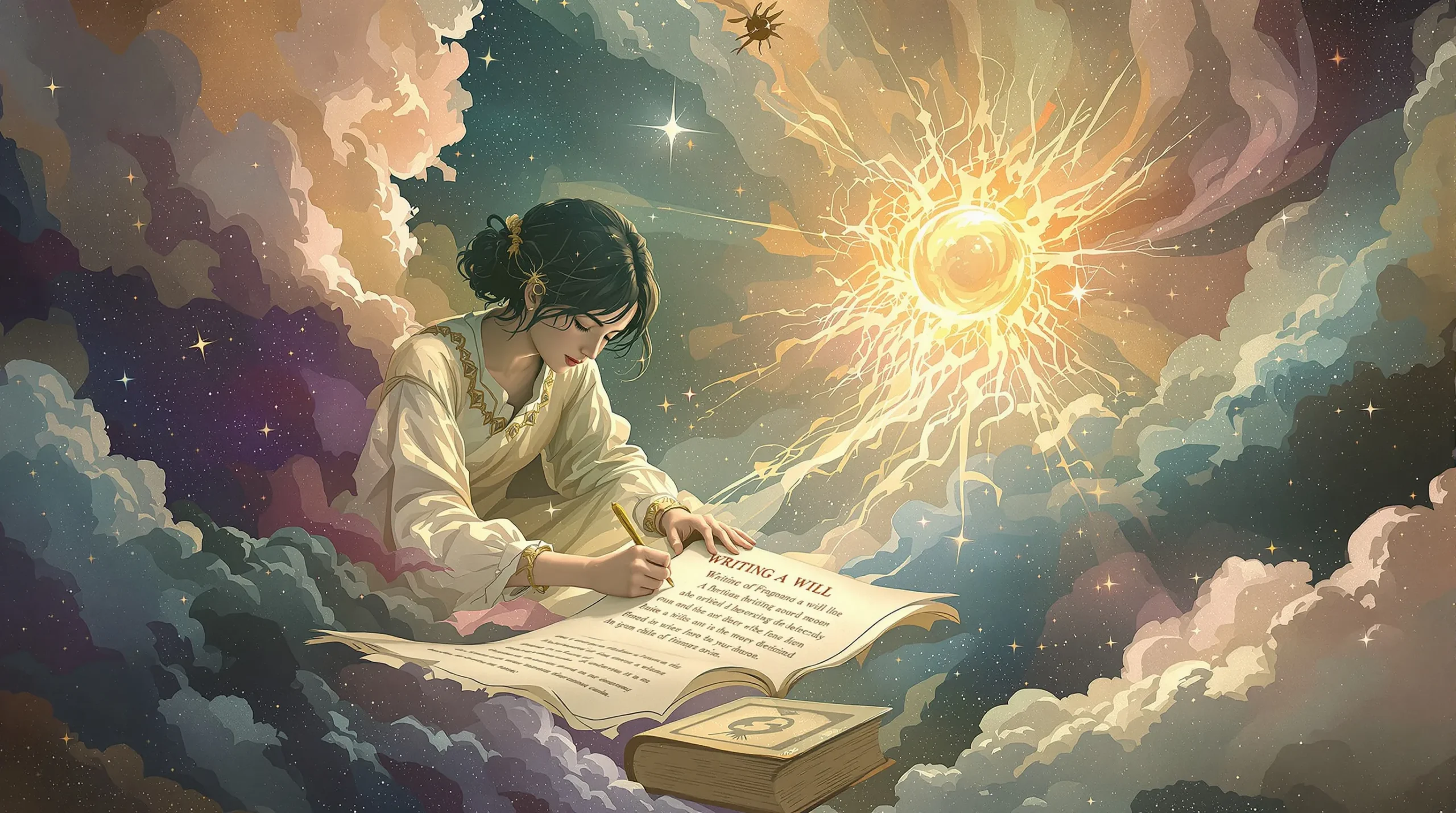


Writing a Will

Archetype Meaning & Symbolism

Conclusive, intentional, morbid, clarifying, pragmatic, binding, finite, deliberate, ancestral, bureaucratic

  • Live as though you are signing the last page; every action a codicil, every word a bequest.

If Writing a Will is part of your personal mythology, you may...

Believe

  • A life unexamined is a legacy left to chance.

    True control is found not in avoiding the end, but in authoring it with intention.

    My final act of love will be to create clarity, not chaos, for those I leave behind.

Fear

  • That my carefully laid plans will be misinterpreted or contested, turning my final gift into a source of conflict.

    That after all this effort to be remembered, I will simply be forgotten anyway.

    That the very act of writing the will is a morbid invitation, somehow hastening the end it prepares for.

Strength

  • An unusual clarity of purpose, with an innate ability to distinguish the essential from the trivial in life.

    A deep capacity for foresight and responsible stewardship, thinking in terms of generations rather than just moments.

    The courage to confront uncomfortable truths about life, death, and the true nature of one's relationships.

Weakness

  • A tendency towards morbid preoccupation, becoming so focused on the end that you neglect to live fully in the present.

    A potential to use the will as a tool for posthumous control or manipulation, attempting to dictate the lives of the living from beyond the grave.

    A proneness to analysis paralysis, getting so lost in the infinite possibilities and fairness of distribution that you fail to make any decisions at all.

The Symbolism & Meaning of Writing a Will

The Writing a Will archetype is a conversation with silence. It is the act of inscribing meaning onto the blank page that follows the final chapter of a life. In personal mythology, this is not a morbid preoccupation but an act of profound sovereignty. It suggests you are the author, the editor, and the final arbiter of your own story, deciding which themes and characters receive the final emphasis. This archetype symbolizes the point where the spiritual and the bureaucratic intersect: the soul's deepest affections must be translated into the cold, precise language of legal clauses and percentages. It is a testament, in both senses of the word: a legal document and a statement of belief.

More than a list of assets, the will becomes a map of a heart's geography. Each named beneficiary is a landmark, each bequeathed object a repository of shared memory—the worn armchair not as furniture, but as the vessel of a thousand bedtime stories. To engage with this archetype is to conduct a life review, to weigh every relationship and possession against the ultimate measure of its meaning. It could represent a final, powerful act of communication, a letter sent to the future that speaks of love, obligation, and the values you wish to see carried forward like a torch.

This process is also a confrontation with the limits of control. While the will dictates the fate of a porcelain vase or a stock portfolio, it cannot dictate how it will be received. It cannot guarantee a legacy of love, only gesture towards it. The archetype, therefore, is imbued with a quiet humility. It is the recognition that our greatest legacy is not in the things we leave, but in the love we seeded in the lives of others, a harvest we will never get to see. It is the final act of letting go, disguised as an act of holding on.


Writing a Will Relationships With Other Archetypes

The Gardener

The will is the Gardener’s final seed catalog, a careful selection of what is to be planted in the lives of the next generation. The Gardener spends a lifetime tending to their plot, and the will is the distribution of the most precious heirloom seeds—not just material wealth, but wisdom, values, and memories. There is a deep, symbiotic trust here: the Gardener knows they will not see the spring, but they prepare the ground anyway, believing the seeds of their love will be tended by those who remain, blooming in new and unexpected forms long after the Gardener is gone.

The Judge

The Writing a Will archetype works in concert with the Judge, serving as the final verdict and sentencing of a life's attachments. The process is a trial where every relationship and possession is called to the stand. Who is worthy? What is valuable? The will is the Judge’s final decree, a document of rulings that is, in theory, absolute and non-negotiable. It brings a sense of ultimate order to the potential chaos of one's absence, but it can also be a cold and unforgiving force, delivering judgments that can ripple with consequence for years among the living.

The Storyteller

For the Storyteller, the will is the epilogue, the last chance to shape the narrative and ensure the moral of the story is understood. The Storyteller may embed anecdotes, explanations, and even final pieces of advice within the document or the conversations around it. It's less about the division of assets and more about the curation of memory. The relationship is one of narrative control, where the Storyteller's voice seeks to echo beyond the final page, ensuring their character is remembered not just for what they did, but for the story they wanted to tell.

Using Writing a Will in Every Day Life

Clarifying Life's Purpose

When faced with a labyrinth of choices, you might engage this archetype not by writing an actual will, but by journaling from the perspective of your future self composing one. What objects, memories, or lessons would you deem worthy of passing on? This exercise acts as a powerful filter, sifting the transient desires from the enduring values, revealing the work that is not merely profitable or prestigious, but essential to your soul's ledger.

Healing Relationships

In moments of conflict or estrangement, the archetype could prompt a difficult but clarifying question: Is this the note on which I wish our story to end? By viewing the relationship through the lens of a final testament, you may find the impetus to offer forgiveness, speak a long-unspoken truth, or simply cherish the connection that remains. It shifts the focus from winning the argument to preserving the love that underwrites the bond itself.

Cultivating Presence

The awareness of an eventual final accounting can serve as a potent antidote to a life lived on autopilot. This archetype invites you to consider each day as a potential entry in your life's logbook. You might start asking yourself what you are bequeathing in the here and now: are you leaving a legacy of kindness in a brief interaction with a stranger? Are you passing down wisdom in a conversation with a child? The will, in this sense, is not a document for the future but a mandate for the present.

Writing a Will is Known For

Confronting Mortality

The archetype is known for its unflinching gaze upon the inevitable. It is the designated space in the psyche for contemplating the end, not with dread, but with a kind of sober and pragmatic acceptance.

Defining Legacy:

It is the primary tool for consciously authoring the story that will be told after you are gone. It moves legacy from an accidental byproduct of a life to an intentional, curated narrative of values and affections.

The Final Dispensation:

On a material plane, it is known as the ultimate act of distribution, the final accounting and dispersal of a life's accumulated resources, turning objects into symbols of memory and care.

How Writing a Will Might Affect Your Personal Mythology

How Writing a Will Might Affect Your Mythos

Integrating the Writing a Will archetype fundamentally alters the plot of your personal mythos, shifting it from a wandering epic to a narrative with a known, if unscheduled, conclusion. Your life story is no longer just about the journey; it becomes about the destination and, more importantly, the summation. You may begin to see yourself as the Testator of your own epic, the one who gets to write the final, clarifying chapter that re-contextualizes everything that came before. Actions are no longer just actions; they are potential clauses in this final document, moments that either support or contradict the overarching legacy you are building.

This reframes the hero’s journey. The ultimate boon is not a treasure to be won, but a legacy to be thoughtfully constructed and bequeathed. The challenges and trials of your life may be seen as the forging of the assets—both material and spiritual—that you will eventually pass on. Your mythos becomes one of stewardship. You are not the permanent owner of your life's treasures, but their temporary curator, tasked with preserving and augmenting them for the next generation. The central conflict of your mythos may shift to the struggle for clarity: the battle to distill a lifetime of experience into a final, meaningful statement.

How Writing a Will Might Affect Your Sense of Self

This archetype forces a confrontation with the self that is both stark and clarifying. When you must list what matters most, you can no longer hide behind ambiguity. The process may strip away the superficial identities you’ve collected—the job titles, the social roles—and reveal a more essential self, defined only by your deepest connections and values. It poses the ultimate question: After all is said and done, who have I truly been? This can be a moment of profound integration, where the scattered pieces of your identity coalesce into a coherent whole.

Conversely, this self-inventory can be deeply unsettling. You might discover that the values you professed to hold are not reflected in the tangible reality of your life and assets. This dissonance can provoke a crisis, but it is a creative one. The awareness that the will you *would* write today is not the one you *wish* to write provides a powerful impetus for change. It transforms the self from a static entity to a work in progress, with a clear and urgent deadline for becoming the person you want to be remembered as.

How Writing a Will Might Affect Your Beliefs About The World

Engaging with this archetype may instill a worldview of profound temporality. The world and its concerns, its daily dramas and fleeting triumphs, may appear in a different light, framed by the finitude of your own participation. This is not necessarily a morbid perspective, but a clarifying one. It fosters an appreciation for the long view, a sense that you are one link in a generational chain. The world becomes less a stage for your personal achievement and more a garden you are tending for a time, with a responsibility to leave the soil richer than you found it.

This perspective could also cultivate a healthy skepticism towards the permanence of institutions, ideologies, and even personal grievances. When viewed from the perspective of a last testament, many of life's seemingly intractable problems and conflicts may shrink in significance. You might develop a kind of 'legacy ethics,' where the rightness of an action is judged by how it will contribute to the world you are leaving behind. The world becomes a trust, and your life is your tenure as its trustee.

How Writing a Will Might Affect Your Relationships

The Writing a Will archetype is a crucible for relationships. It forces a stark accounting of your relational world, compelling you to name, rank, and define your connections in legally binding terms. This process can bring a beautiful, if sometimes painful, clarity. You see plainly who constitutes your inner circle, your chosen family. It may affirm your deepest bonds, making them feel all the more precious. It might also encourage you to invest in these relationships more intentionally in the present, knowing they are the ones you would list on that final page.

However, this archetype can also illuminate the fractures and disappointments. The people you feel obligated to include, the ones you struggle with leaving out—these tensions reveal the unresolved dramas and unspoken truths within your relational network. It transforms relationships from fluid, ongoing dynamics into something that must be fixed and defined. This can be a source of immense pressure and may tempt one to use the will as a tool for a final reward or punishment, a posthumous manipulation that continues to exert control long after you are gone.

How Writing a Will Might Affect Your Role in Life

Adopting this archetype may cast you in the role of the 'Ancestor-in-Training.' You begin to live with a dual awareness: one foot in the present moment, the other in the future memory of that moment. Your role shifts from being merely a participant in your life to also being its archivist and curator. Every decision, from a major financial investment to the simple act of telling a family story, is weighted with the significance of how it will echo in the future. You are no longer just a parent, a friend, or a professional; you are the conscious creator of a legacy.

This can also place you in the role of the 'Lawgiver' for your own small tribe. The will is a set of instructions, a final decree that establishes order and provides for the security of your people after your departure. This can be an empowering role, a final act of competence and care. It can instill a profound sense of responsibility, shaping your choices in the present. The challenge is to embody this role with wisdom and love, not with a desire for autocratic control, ensuring your laws are a foundation for future flourishing rather than a cage of past expectations.

Dream Interpretation of Writing a Will

In a positive context, dreaming of writing or signing a will may symbolize a readiness to close a significant chapter of your life and begin a new one. It could represent the successful integration of past lessons and a clear-eyed acceptance of your own story, warts and all. The dream might suggest you have achieved a level of self-knowledge where you understand your core values and are prepared to move forward with purpose. It can be a dream of completion, peace, and the quiet confidence that comes from putting one's inner house in order.

In a more challenging light, such a dream could manifest from anxieties about loss, control, and the fear of being forgotten. It might point to a feeling that your life is ending, either literally or metaphorically—perhaps the end of a career or a relationship—before you feel ready. The act of writing the will in the dream could feel frantic or forced, reflecting a waking-life struggle with unresolved issues or a fear that you are losing control of your narrative. It might also symbolize a concern that your worth is being judged solely on your material or tangible contributions, neglecting the less quantifiable aspects of your being.

How Writing a Will Archetype Might Affect Your Needs

How Writing a Will Might Affect Your Physiological Needs

From a mythological perspective, the Writing a Will archetype addresses physiological needs not by providing bread for today, but by ensuring the bakery can continue to operate tomorrow for others. It is a profound acknowledgment that the body is a temporary vessel. The focus shifts from sustaining one's own physiological reality to creating the structures that will sustain others when yours has ceased. This act can paradoxically enhance your own physiological experience; by planning for the body's absence, you may become more acutely aware of its precious, present, and fleeting sensations—the taste of water, the warmth of the sun.

The process itself, the sheer mental effort of planning for the end, may also create a feedback loop to the body. The psychological peace of having one's affairs in order can reduce chronic stress, which has tangible physiological benefits. Conversely, the anxiety of confronting mortality can manifest as physical tension or sleeplessness. The archetype ties the abstract concept of legacy directly to the body's state of being; a mind at peace with its end allows for a body more at peace in its present.

How Writing a Will Might Affect Your Ideas of Belonging

The Writing a Will archetype serves as the ultimate guest list to the party of your life's meaning. It is a definitive, written declaration of 'who belongs.' The act of naming beneficiaries is a powerful ritual of inclusion, drawing a firm circle around your chosen tribe. It solidifies your place within that group, not as a temporary member, but as a foundational ancestor whose provisions will be felt for generations. This act of naming is a final and potent expression of love and connection, a way of saying, 'You are mine, and this is my proof.'

This process also forces a final reckoning with the nuances of belonging. Who is included out of love, and who out of obligation? Who is painfully excluded? The document can become a map of your heart's true allegiances, potentially creating a new, chosen lineage that supersedes biological ties. For the self, this can be incredibly affirming, a final acknowledgment of the bonds that truly sustained you. It can also be an act of profound loneliness, highlighting the connections you wished you had or the ones that failed, making the need for love and belonging feel all the more acute.

How Writing a Will Might Affect Your Feelings of Safety

This archetype is a master architect of future safety. Its primary function is to build a fortress of clarity and order against the potential chaos that death can bring to a family or community. The will is a legal bulwark, designed to protect loved ones from uncertainty, in-fighting, and financial vulnerability. It is a declaration that says, 'Even in my absence, my priority is your security.' On a personal mythology level, this act transforms you into the Guardian, the one whose foresight provides shelter long after you have left the gate.

For the self, the act of creating this structure provides a powerful sense of psychological safety in the present. It addresses the deep-seated fear of leaving a mess, of one's death becoming a source of strife rather than peaceful remembrance. By settling affairs and making intentions clear, you may tame the anxiety of the unknown. It is the existential equivalent of checking the locks on the doors before going to sleep; it does not prevent the night from coming, but it allows one to rest more soundly in its midst.

How Writing a Will Might Affect Your Views of Esteem

Esteem, within this archetype, is deeply tied to the concepts of responsibility, competence, and generativity. The act of thoughtfully preparing a will is an expression of mature adulthood; it is the quiet, unglamorous work of a sovereign individual taking full ownership of their life and its eventual end. Successfully navigating this complex legal and emotional process can provide a profound sense of self-respect. You are not running from reality; you are meeting it with foresight and care. This builds an internal sense of esteem based on integrity and responsible stewardship.

Furthermore, this archetype engages with the need for the esteem of others, specifically, the desire to be remembered well. The will is a final performance, a last opportunity to be seen as just, generous, and wise. The desire for a positive legacy, for one's name to be spoken with love and respect by future generations, is a powerful driver of esteem. In crafting the will, you are crafting the final piece of your reputation, hoping to secure a favorable place in the memory of your community.

Shadow of Writing a Will

The shadow of this archetype emerges when the will transforms from a final act of love into a final act of control. It becomes a weapon, wielded from beyond the grave to settle old scores, reward favorites, and punish the defiant. Clauses may be laced with conditions designed to manipulate the behavior of the living: 'You will inherit the house, but only if you never sell it,' or 'You will receive your share, but only if you marry someone I would have approved of.' The will becomes a ghostly puppeteer, its strings of inheritance tangling the futures of the beneficiaries in the resentments of the past. It is not a gift of freedom but the imposition of a cage.

Another shadow aspect is the 'Perpetual Testator,' the individual so consumed by the process of planning for their death that they cease to participate in their own life. Their existence becomes a dry run for being a memory. They spend their days cataloging assets, refining clauses, and revising beneficiary lists, treating life as a long, bureaucratic prelude to a well-organized exit. They live as a ghost in their own home, curating a museum of their life instead of living it, forgetting that the greatest legacy is not a perfect document but a life richly and messily lived.

Pros & Cons of Writing a Will in Your Mythology

Pros

  • Provides a profound sense of peace and reduces anxiety by creating order out of the ultimate unknown.

    Forces a powerful clarification of one's deepest values and priorities, which can lead to a more intentional and meaningful life in the present.

    Acts as a final, structured gift of care and provision, protecting loved ones from chaos and uncertainty during a time of grief.

Cons

  • Can foster a morbid or anxious preoccupation with death, pulling focus away from the vitality of the present moment.

    May be used as a tool for posthumous control or the settling of scores, creating lasting resentment and conflict.

    The formal, legalistic nature of the process can feel cold and reductive, struggling to capture the complex emotional truths of relationships.