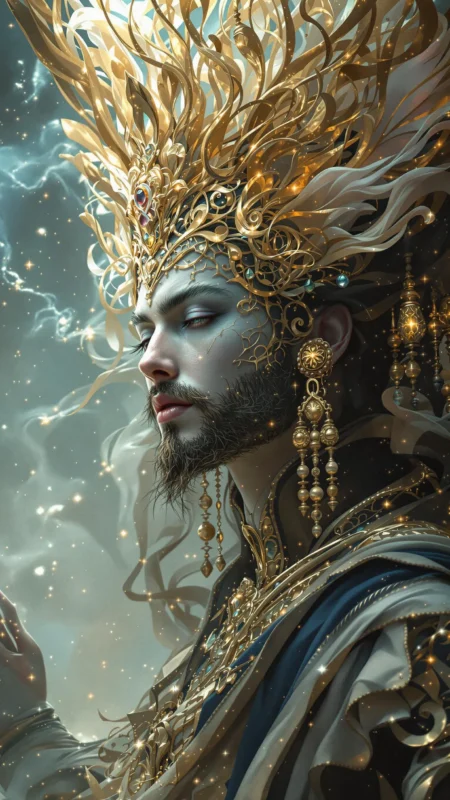
Creator

Archetype Meaning & Symbolism

Imaginative, obsessive, visionary, restless, generative, meticulous, chaotic, resourceful, isolated, inspired

  • The void is not an absence to be feared, but a silence waiting for a voice.

If Creator is part of your personal mythology, you may...

Believe

  • You may believe that the purpose of life is not to find meaning, but to make it.
  • You may believe that beauty is not a luxury, but a fundamental human need, as essential as bread.
  • You may believe that the universe is not a finished masterpiece, but an interactive work in progress, and it is inviting you to contribute a verse.

Fear

  • You may fear the quiet horror of mediocrity: creating something that is technically proficient but completely devoid of soul.
  • You may fear the moment when the well runs dry, the terror of waking up one day to find the muse has departed without leaving a forwarding address.
  • You may fear being a Cassandra of creation, seeing a vision so clearly that you cannot make anyone else see, hear, or feel it.

Strength

  • You may possess an extraordinary resilience, viewing every failure not as a final judgment but as a necessary draft on the path to a better version.
  • You may have the ability to perceive profound connections and hidden patterns, to find the signal in the noise where others only experience chaos.
  • You may be fueled by a deep, intrinsic sense of purpose that can act as a powerful engine through periods of doubt, hardship, and isolation.

Weakness

  • You may be plagued by a paralyzing perfectionism, an inability to let a creation go, forever tinkering with it in pursuit of an impossible ideal.
  • You may develop a form of creative narcissism, becoming so absorbed in your own vision that you neglect the needs of your relationships and the practicalities of daily life.
  • You may have a 'glass jaw' for criticism, where any negative feedback on your work feels like a devastating indictment of your core self.

The Symbolism & Meaning of Creator

In a personal mythology, the Creator archetype casts the individual as the primary architect of their own reality. It suggests that the world one inhabits is not a given set of circumstances but a reflection, however distorted, of an inner blueprint. The core drive is to make the external world match the internal vision. This could be as literal as an artist painting a canvas or as abstract as an entrepreneur building a company culture. Every choice, every project, every relationship becomes an act of world-building, an attempt to impose a personal, meaningful order onto the inherent chaos of existence. Your life is not just a journey; it could be a construction site, and you are the one holding the plans, even if you are drawing them as you go.

The act of creation is also an act of continuous self-definition. Each piece of work, whether a garden, a story, or a relationship, may serve as a mirror. It is a fragment of the soul made external, a tangible piece of evidence that says, 'I am here, and this is what is inside me.' This carries an immense risk, for to show your creation is to show your self, naked and vulnerable. The reception of the work can feel like a judgment on one’s very essence. Therefore, the Creator’s mythos is often a story of courage: the courage to externalize the internal, to face both the void of the blank page and the gaze of the audience.

This archetype also embraces a cycle of creation and destruction. To build something new, something old must often be cleared away. This can be terrifying. It might mean dismantling a comfortable but unfulfilling career, deconstructing a long-held belief system, or ending a relationship that no longer allows for growth. The Creator in a personal mythos may be a perpetual 'renovator' of the self and its circumstances. They are unafraid to tear things down to the studs, trusting in their ability to build something more authentic, more resonant, and more beautiful in its place. This is not destruction for its own sake, but a necessary, often painful, tilling of the soil for a future harvest.


Creator Relationships With Other Archetypes

The Trickster

The Creator's relationship with the Trickster is one of generative friction. The Creator seeks order, vision, and perfection. The Trickster, in contrast, introduces chaos, randomness, and inconvenient truths. When the Creator is building a meticulous sandcastle, the Trickster is the unexpected wave that washes it away. Yet, in the ruins, the Creator might find a new, more resilient design. The Trickster is the glitch in the software that reveals a deeper vulnerability, the heckler whose interjection accidentally unlocks a new perspective. This archetype keeps the Creator humble and adaptive, preventing vision from hardening into dogma.

The Ruler

The Creator and the Ruler often exist in a state of symbiotic tension. The Creator generates the ideas, the art, the innovations, and the cultural narratives. The Ruler then organizes, institutionalizes, and scales these creations to build and maintain a kingdom, whether that kingdom is a nation, a corporation, or a family. The Ruler provides the Creator with resources and a platform, but may also demand that creativity serves a specific, pragmatic agenda. The Creator, in turn, may resent the Ruler's constraints but secretly relies on their structure to give their work lasting impact. It's the volatile marriage of vision and power.

The Innocent

The Creator might feel a complex mix of guardianship and frustration toward the Innocent. The Innocent’s pure, unfiltered wonder at the world can be a profound source of inspiration, a reminder of the 'why' behind the work. They see the magic in the creation without dissecting its technique. However, the Innocent's naivety can also be grating. They may not comprehend the sweat, sacrifice, and doubt—the 'agony' part of the ecstasy—that creation demands. The Creator may yearn for the Innocent's simple joy while simultaneously feeling utterly alone in the complex, often dark, workshop of their own mind.

Using Creator in Every Day Life

Navigating Career Stagnation

When a career path feels like a dead end, the Creator archetype may suggest reframing the situation. A job is perhaps not a fixed role but a medium. One might begin to innovate within the confines of their position, introducing new systems, starting a skunkworks project, or finding ways to inject artistry into mundane tasks. The goal shifts from climbing a ladder to sculpting the rungs themselves, transforming a static position into a living project.

Healing from Profound Loss

In the face of grief, which can feel like a hollowing out of the self, the Creator does not simply endure the emptiness. It might compel a person to metabolize the pain into form. This could manifest as writing poetry that gives shape to sorrow, cultivating a memorial garden that brings life from barren ground, or establishing a new family ritual that honors what was lost. The act of making becomes a way to build a bridge across the abyss of absence.

Overcoming Creative Blocks

When inspiration vanishes and the proverbial page is blank, invoking the Creator archetype could mean embracing the void rather than fighting it. It suggests that a block is not a lack of ideas, but perhaps a fear of imperfection. The Creator’s wisdom is to allow for the messy, chaotic, and seemingly pointless first stage: the bad draft, the atonal melody, the incoherent sketch. It is in this primordial soup of failure that the new form finds its unexpected genesis.

Creator is Known For

Bringing Form from the Void

The fundamental act of manifestation

turning a thought into a thing, a feeling into a song, chaos into a system. This is the Creator’s primary miracle, the translation of the unseen inner world into the tangible, shared reality.

The Agony and the Ecstasy

The Creator is known for the profound dualism of the creative process. This is the cycle of frustrating, painstaking work, the dark nights of the soul filled with self-doubt, followed by sublime, ecstatic moments of breakthrough when the vision finally clicks into place.

Unconventional Vision

A capacity to perceive potential where others see nothing. The Creator might look at a scrapyard and see a sculpture, hear a city's ambient noise and find a symphony, or recognize a revolutionary business model in a mundane complaint. It is the ability to see the ghost of what could be.

How Creator Might Affect Your Personal Mythology

How Creator Might Affect Your Mythos

When the Creator is a dominant force in a personal mythos, the life story itself may be framed as a deliberate act of authorship. Life is not a series of events that happen to you, but rather raw material to be shaped into a narrative. Failures are not dead ends; they are plot twists. Traumas are not just wounds; they are the crucible in which the protagonist is forged. Your personal history becomes a living document, subject to constant revision and reinterpretation. You are not just the main character; you are the writer, and you hold the pen. This perspective grants an enormous sense of agency, the feeling that you can, at any moment, start a new chapter.

Consequently, the mythos of a Creator is often punctuated by distinct 'eras' defined by major projects. One's life might be measured not in linear years, but in the things brought into being: 'the years I spent writing that novel,' 'the era of building the business from scratch,' 'the season of raising the children and crafting a family culture.' The self is the ultimate magnum opus, a work-in-progress. The central conflict in this life story is often the battle against entropy, mediocrity, and the blank page, a heroic struggle to leave a mark, to make something that speaks, to prove that you were here.

How Creator Might Affect Your Sense of Self

A sense of self, for one in whom the Creator archetype is strong, may become perilously intertwined with creative output. The phrase 'I think, therefore I am' might be revised to 'I make, therefore I am.' Self-worth is not an inherent quality but something that is built, piece by piece, with every finished project. This can be a source of immense purpose and pride, a bulwark against meaninglessness. The act of making is proof of existence and vitality. However, this also means that periods of creative inactivity or failure can feel like a frightening erasure of the self, an existential void.

There may also be a curious detachment from the self, a feeling of being merely a conduit for a force greater than oneself. Inspiration can feel less like a product of one's own intellect and more like a mysterious dictation from an unknown source. This can foster humility, but also a profound loneliness. The individual may feel like a vessel, a tool in the hands of the muse, and this experience of being 'used' by creativity can be difficult to share or explain, isolating them even from those they love. The self is both a godlike author and a humble servant.

How Creator Might Affect Your Beliefs About The World

To view the world through the Creator's eyes is to see it as a vast, perpetually unfinished project. Everything, from a social injustice to a poorly designed teapot, may present itself as a design problem awaiting a solution. The world is not a static reality to be passively accepted, but a malleable medium brimming with potential. This perspective fosters a fundamental optimism: a belief that things can be improved, reimagined, and remade. Stagnation is the only true sin. This worldview is active, not passive; it constantly asks 'what if?' and 'why not?'.

This same lens, however, can breed a chronic dissatisfaction with reality. The gap between the messy, imperfect world that *is* and the elegant, idealized world that *could be* is a source of constant, low-grade agitation. A beautiful landscape isn't just a landscape; it's a potential painting whose composition could be improved. A political system isn't just a system; it's a flawed design that needs a complete overhaul. This inability to simply let things *be* can be exhausting, preventing a quiet enjoyment of the present moment and fostering a restless, critical spirit.

How Creator Might Affect Your Relationships

In the realm of relationships, the Creator archetype may lead one to view connections as co-creative acts. A friendship is not something one 'has,' but something one 'builds' together, brick by brick, with shared stories, inside jokes, and acts of mutual support. A romantic partnership can be seen as the ultimate collaborative project: the creation of a shared life, a unique culture for two. Intimacy is found in the process of making something together, whether it is a meal, a conversation, a garden, or a family.

This creative lens can also introduce significant challenges. There might be an impatience with relationships that feel static or passive. A person driven by the Creator archetype could have a tendency to want to 'fix' or 'improve' their partners, seeing them as unfinished projects rather than sovereign beings. They may feel stifled in relationships that lack a sense of forward momentum or a shared creative goal. If a partner is not a willing co-creator, the Creator may feel profoundly lonely and misunderstood, as if they are building a cathedral by themselves.

How Creator Might Affect Your Role in Life

The Creator archetype profoundly shapes one's perceived role in the world, shifting it from a pre-assigned part to a self-sculpted identity. There may be a deep resistance to being defined by conventional labels like 'manager,' 'teacher,' or 'parent.' Instead, these roles are seen as mere containers or platforms for the real work of creation. A manager becomes an architect of team culture. A teacher is not just imparting information but designing experiences that ignite curiosity. A parent is not merely a caregiver but the co-creator of new human beings and the culture they will inhabit.

This bestows a tremendous sense of agency, but also the heavy burden of total responsibility. If you are the one designing your role, then its failures are yours alone. There is no script to follow and no one else to blame. This can lead to a constant, restless reinvention of one's professional and personal roles, a refusal to settle into any comfortable definition. The role is not a destination but a perpetual process of becoming, a constant negotiation between one's inner vision and the world's external demands.

Dream Interpretation of Creator

In a positive context, to dream of the Creator archetype—perhaps you are an artist effortlessly filling a canvas, a composer hearing a finished symphony in your head, or a deity shaping a world from clay—could signal a profound alignment between your conscious goals and subconscious energies. It may suggest that a period of blockage is over and you are ready to bring a long-held vision into reality. The dream acts as a blessing from your own depths, an affirmation that you have the skill, the resources, and the inspiration needed for your next great work. It is a green light for manifestation.

In a negative context, a dream of a frustrated Creator can be deeply unsettling. You might dream that your tools are broken or missing, your materials are rotten or inert, or that your creation has become monstrous and turned against you. This could reflect a powerful creative block, a fear that your skills are inadequate, or a project that has spiraled out of your control. It may also symbolize a fear of the consequences of your creations, a shadow aspect where what you are making in your life—be it a business, a relationship, or an artwork—is having a destructive impact that your conscious mind refuses to acknowledge.

How Creator Archetype Might Affect Your Needs

How Creator Might Affect Your Physiological Needs

For the individual driven by the Creator, the body's physiological needs—for sleep, food, and rest—may be regarded as inconvenient overhead. In the fever pitch of a project, these needs are often ignored. The body becomes a simple vehicle for the mind's ambitions, fueled by caffeine and sheer willpower until it forces a collapse. This perspective treats the body as separate from the creative self, an annoyance to be managed rather than an integral part of the process. Sustenance is merely a logistical problem to be solved in the service of the work.

Alternatively, the physiological realm can become another canvas for creation. Cooking ceases to be a chore and becomes a culinary art form. Exercise is not for health but for the deliberate sculpting of the body. Rest and sleep are not passive states but strategic acts of incubation, allowing the subconscious to work on a problem. In this view, the body is not an obstacle but the very first material one has to work with. Honoring its needs becomes part of the creative practice itself, a way of keeping the instrument finely tuned.

How Creator Might Affect Your Ideas of Belonging

Belongingness, for the Creator, is rarely found through conformity. Instead, it is sought in a communion of shared vision. The deep human need for connection is met by finding a 'tribe' of fellow makers, artists, or innovators. This is the fabled 'scenius'—a collective genius of a scene where ideas are currency and constructive critique is a love language. In personal relationships, love and friendship may be predicated on a mutual respect for each other's inner worlds and creative passions. True intimacy is feeling that someone else understands not just you, but the thing you are trying to bring into being.

This same drive, however, can foster a profound and persistent loneliness. The singularity of one's vision can feel like a glass wall, separating the Creator from those who cannot see what they see. Explaining the internal world of a project can feel impossible, leading to a sense of being fundamentally misunderstood. While they may crave community, the Creator often does their most important work in solitude. They may feel most at home in the quiet, isolated workshop of their own mind, a kingdom with a population of one.

How Creator Might Affect Your Feelings of Safety

Safety needs, through the lens of the Creator archetype, are often re-prioritized. The primary source of security is not a stable job or a large bank account, but the continued ability to create. The greatest fear is not physical danger but the terror of stagnation, the loss of inspiration, or having one's life's work destroyed or rendered irrelevant. Financial security might be pursued not for its own sake, but as a means to an end: to buy the time, freedom, and resources to create without compromise. The ultimate safe harbor is a well-equipped studio or a mind brimming with ideas.

The act of creating itself can be a powerful strategy for building a sense of safety in a chaotic world. By imposing order onto a canvas, a page, or a business plan, the Creator builds a small pocket of manageable reality. A meticulously organized workshop, a perfected body of work, a thriving enterprise—these are psychological fortresses against the randomness of fate. The structures built in one's work become the true shelter in which the spirit resides, a bulwark against existential dread.

How Creator Might Affect Your Views of Esteem

The Creator's esteem needs are almost entirely fulfilled by the act of creation and its reception. Self-respect is built through the discipline of the craft, the daily struggle to improve and refine one's skills. The respect of others is earned not by personality or status, but by the quality of the finished work. Acknowledgment from peers who understand the difficulty of the process is often valued far more than praise from the uninformed masses. Esteem is the quiet satisfaction of looking at a finished piece and knowing, 'I made this, and it is good.'

This makes self-esteem a fragile and volatile construct. It can soar to ecstatic heights on the back of a successful project or a glowing review, only to plummet into despair with a critical failure or a period of unproductivity. An attack on the work is felt as a deeply personal attack on the self. A core challenge for the Creator is to cultivate an unconditional self-worth that is independent of their creative output, to learn that their value as a human being is not contingent on their last success or their next big idea.

Shadow of Creator

The shadow of the Creator can emerge as a tyrant of perfectionism. This is the dark side of vision, where high standards curdle into impossible demands placed upon the self and others. It is the artist who destroys their work in a fit of rage, the entrepreneur who burns out their team in pursuit of a flawless product, the parent who crushes their child's spirit with relentless creative expectations. Here, the joy of making is replaced by a gnawing anxiety. Creation is no longer a life-affirming act but a desperate, joyless attempt to control a chaotic world, a tool to bully reality into submission.

Another facet of the shadow is the obsessive, amoral maker, the 'mad scientist' so consumed by the act of creation that all ethical considerations are discarded. This is the writer who shamelessly exploits the traumas of loved ones for material, the innovator who unleashes a harmful technology without regard for its consequences, the individual who constantly 'reinvents' themselves by adopting new personalities, leaving a wake of confused and betrayed people. In this shadow form, the creative urge becomes a monstrous, runaway engine, disconnected from humanity, compassion, and responsibility. It creates, but it also destroys.

Pros & Cons of Creator in Your Mythology

Pros

  • You may experience life with a profound sense of agency, armed with the belief that you are the primary author of your own story.
  • You have access to the sublime, the potential to experience moments of pure 'flow' where you feel connected to something larger than yourself, a channel for inspiration.
  • You have the capacity to leave a tangible legacy, to create works that might outlive you, continuing to move, inspire, or serve others long after you are gone.

Cons

  • Your sense of self-worth can become dangerously dependent on your productivity and the external validation of your work.
  • You may experience a deep, abiding loneliness, feeling isolated by the unique nature of your vision and the solitary demands of your craft.
  • The relentless inner drive to create can lead to chronic burnout, obsession, and the neglect of your physical health and personal relationships.