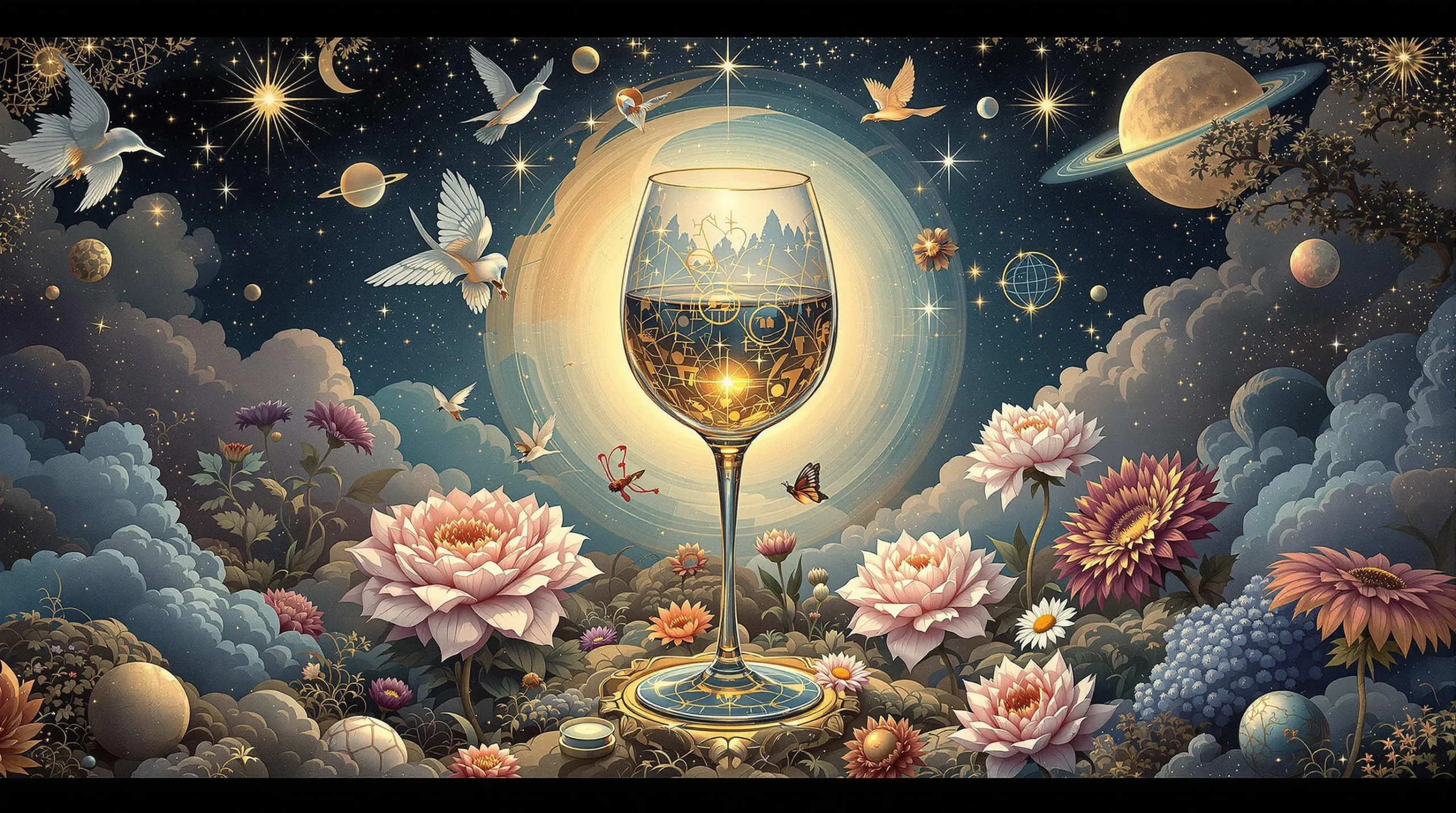


Wine Glass

Archetype Meaning & Symbolism

Receptive, fragile, celebratory, transparent, elegant, vulnerable, refined, ritualistic, resonant, delicate

  • Hold the moment, not to possess it, but to let its color and aroma fill you. Know that to be empty is to be ready, and to be full is a fleeting, beautiful state.

If Wine Glass is part of your personal mythology, you may...

Believe

  • The container is as important as the contents; how something is held determines its meaning.

    Life is meant to be savored, not just consumed, and the space between sips is as important as the sips themselves.

    True strength lies not in being unbreakable, but in the grace of knowing your own fragility.

Fear

  • Being shattered by a sudden shock or a moment of carelessness from which there is no recovery.

    Being filled with something cheap, poisonous, or unworthy, thereby tainting your own form.

    Being left empty on a shelf, forgotten, overlooked, and gathering dust while life’s celebrations happen elsewhere.

Strength

  • An innate ability to elevate any experience, transforming the mundane into the sacred through ritual and focused attention.

    A profound capacity for holding space for others, receiving their stories and emotions with a rare and calming clarity.

    A heightened sensitivity to beauty, nuance, and subtlety that allows you to perceive and appreciate the delicate grace notes of the world.

Weakness

  • A tendency toward brittleness, finding it difficult to function or adapt in chaotic, unpredictable, or unrefined environments.

    A potential for aloofness or snobbery, judging people and experiences that do not meet your aesthetic or intellectual standards.

    An over-reliance on external sources to provide a sense of purpose; a feeling of being hollow or useless unless you are being 'filled' by others.

The Symbolism & Meaning of Wine Glass

In personal mythology, the Wine Glass archetype speaks to the exquisite tension between form and essence. You may be one who understands that the container shapes the experience: that a conversation held over a delicate stemware feels different from one shouted across a crowded room. Your life story could be a testament to the power of ritual, the belief that how we do something is as significant as what we do. You are the vessel, and your personal mythos may revolve around what you choose to be filled with, be it knowledge, love, or spirit. The glass does not judge its contents, it merely holds and reveals them, suggesting a capacity for non-judgmental presence and profound receptivity.

This archetype also places vulnerability at the center of the narrative. To be a Wine Glass is to live with the constant, quiet awareness of your own breaking points. Your mythos may not be about building impenetrable walls, but about cultivating the grace to exist without them. This could manifest as a life of curated risks and carefully chosen intimacies. The beauty of the Wine Glass is not in its indestructibility, but in its resonant clarity, a clarity that is only possible because its walls are so thin. It symbolizes that a life lived with sensitivity, though fragile, may be the one that resonates most truly.

Furthermore, the Wine Glass is a symbol of communion and celebration. It is rarely used in solitude. Its presence suggests a gathering, a toast, a shared moment lifted out of the ordinary. In your personal mythos, you might be the catalyst for connection, the one who brings people together and provides the structure for shared joy or solemn remembrance. Your story is perhaps not about grand, solitary quests, but about the creation of countless, sacred moments where souls can meet over a shared substance, with you as the elegant, essential conduit.


Wine Glass Relationships With Other Archetypes

The Table

The Wine Glass finds its grounding and context upon The Table. The Table represents community, stability, a shared surface for sustenance and discourse. Without The Table, the Glass is unmoored, at risk of being tipped or left on an unstable surface. In one’s mythos, The Table may symbolize the family, the community, or the tradition that provides the essential foundation for the Glass’s delicate existence. The relationship is symbiotic: the Glass brings elegance and ritual to The Table, while The Table provides the secure stage upon which the Glass can fulfill its purpose.

The Hand

The Hand is the archetype of agency, action, and intention. It is The Hand that lifts the Wine Glass, fills it, brings it to the lips, or, through carelessness, sends it shattering to the floor. For the Wine Glass, The Hand represents both its greatest ally and its greatest threat. This relationship explores the theme of trust and control. One with the Wine Glass archetype in their mythos may feel that their well-being is often in the hands of others, or they may grapple with their own agency, learning how to handle their own fragility with a firm but gentle grip.

The Wine

The Wine is pure essence, spirit, the intoxicating lifeblood of experience itself. The Wine Glass is the form that gives this essence shape and allows it to be savored. This is the archetypal dance of content and container, spirit and structure. A Wine Glass without Wine is an object of unfulfilled potential, beautiful but empty. The Wine without a glass is a shapeless, un-servable mess. In a personal narrative, this speaks to the need for both profound experiences (The Wine) and the personal structure, discipline, and self-awareness (The Glass) required to hold them without spilling or shattering.

Using Wine Glass in Every Day Life

Navigating a Difficult Conversation

In a tense discussion, one might embody the Wine Glass not by speaking, but by receiving. You become a clear vessel for the other person’s words, their emotions, their truth, allowing them to fill the space you hold. Your purpose is not to argue or opine, but to contain the moment with clarity, allowing its complexities to be seen without distortion. This act of receptive silence can transform a confrontation into a communion, demonstrating that strength can be found in stillness and transparency.

Marking a Personal Milestone

When a small, private victory occurs, the temptation is to let it pass unacknowledged. The Wine Glass archetype insists on ritual. You might not uncork a vintage bottle, but you could pour sparkling water into your finest glass, hold it to the light, and make a silent toast to yourself. This elevates the moment from a simple fact to a sacred memory. It is the act of deliberately framing an experience, of giving it form and ceremony, that imbues it with mythological weight.

Overcoming a Creative Impasse

Faced with a blank page or an empty canvas, one could feel a crushing pressure to produce. The Wine Glass offers a different perspective: your role is not to create the wine, but to be the worthy vessel for it. The task shifts from frantic generation to patient preparation. You might focus on making yourself ready, on refining your own form, on becoming so clear and well-shaped that inspiration, when it arrives, will be honored. The impasse is no longer a failure but a necessary state of emptiness, a quiet readiness for what is to come.

Wine Glass is Known For

Holding Potential

It is defined by its ability to contain something other than itself. It is a vessel for libations, emotions, or ideas, presenting them for contemplation and transforming them through its very form. Its purpose is realized only when it is filled.

Amplifying Nuance

The specific shape of its bowl is not arbitrary; it is designed to concentrate aromas and enhance the character of its contents. Metaphorically, this speaks to an ability to magnify the subtle details of an experience, to notice and appreciate the overlooked grace notes of life.

Elegant Fragility

Its inherent breakability is central to its identity. This vulnerability demands careful handling and serves as a constant reminder of its preciousness. To interact with a Wine Glass is to accept a pact of gentleness and acknowledge that the most beautiful things are often the most easily broken.

How Wine Glass Might Affect Your Personal Mythology

How Wine Glass Might Affect Your Mythos

When the Wine Glass informs your personal mythos, your life story may not be a rugged epic but a curated gallery of moments. The narrative arc is less about mountains conquered and more about celebrations orchestrated, conversations held, and sorrows contained. Key plot points are perhaps the toasts: the marking of births, the sealing of partnerships, the honoring of endings. Your legend is written in the quality of your attention and the grace with which you handle the precious, fragile substance of your life and the lives of others.

The central dramatic tension in this mythos is the ever-present possibility of shattering. Betrayals are not just wounds; they are cracks that threaten the integrity of the entire vessel. Failure might feel like a cataclysmic break. Consequently, the heroic journey is one of resilience through finesse, not force. It is the story of learning to withstand the vibrations of the world without breaking, of being emptied and refilled, and of understanding that even a repaired crack can become a part of your unique history, a line that tells a story of survival.

How Wine Glass Might Affect Your Sense of Self

Your view of self may be one of a delicate and specialized instrument. You might perceive yourself as designed for a specific purpose: to hold, to clarify, to beautify. This can lead to a sense of profound purpose when you are in the right environment, feeling filled with meaning and connection. There may be a deep identification with transparency; you might pride yourself on your honesty and the clarity with which you present yourself to the world, believing that what you see is what you get.

Conversely, this self-perception could lead to a constant, low-grade anxiety about your own fragility. You may be acutely aware of your own boundaries and breaking points, leading to a cautious, sometimes distant, way of being. Self-worth might become perilously tied to what you contain. An empty period of life might not feel like a restful pause but like a hollow failure. The challenge is to find inherent value in the vessel itself, empty or full, pristine or marked by the stories of its use.

How Wine Glass Might Affect Your Beliefs About The World

The world, seen through the lens of a Wine Glass, is a place of potential ceremony and potential catastrophe. You may be attuned to the subtle shifts in atmosphere, the unspoken rules of engagement, and the aesthetic harmony or discord of a space. The world is not a battlefield to be conquered but a banquet to be appreciated, and you are always looking for the right occasion to raise a glass. This perspective fosters a deep appreciation for culture, art, tradition, and the unwritten social contracts that allow for graceful interaction.

This worldview also implies a certain allergy to crudeness, chaos, and carelessness. The world can seem like a terribly clumsy place, full of blunt objects and sudden, jarring movements. You may feel a persistent need for order, beauty, and quiet. There might be a pessimistic streak, a sense that beauty is fleeting and disaster is always one careless elbow away. This can lead to a retreat into controlled environments, a preference for the curated over the wild, and a deep-seated belief that civilization is a fragile, precious construct.

How Wine Glass Might Affect Your Relationships

In relationships, you may function as a facilitator of intimacy. You create the conditions for meaningful exchange. Friends and lovers might find that with you, conversations go deeper, celebrations feel more significant, and moments of silence are comfortable rather than awkward. You are the one who suggests the toast, who holds their stories with care, and who reflects their own emotions back to them with startling clarity. You seek a resonance in your connections, a harmonic hum between yourself and another.

The challenge in this relational style is your inherent need for careful handling. You may be easily 'chipped' by a thoughtless comment or 'cracked' by a broken promise. Partners and friends might feel they have to be perpetually cautious around you, which can stifle spontaneity. You may have little tolerance for 'messy' emotional displays, preferring feelings to be decanted and served elegantly. True intimacy requires accepting that others can be clumsy, and that love can sometimes be a bit of a spill.

How Wine Glass Might Affect Your Role in Life

Your perceived role in life, in your community, or in your family might be that of the Curator or the Celebrant. You are the one who preserves and presents what is most valuable, be it a memory, a tradition, or a delicate feeling. You may not be the 'leader' in a traditional sense, but the 'host' who sets the stage, ensuring that everything is in its right place so that something beautiful can unfold. Your contribution is often atmospheric, creating the container in which community and connection can flourish.

This role can feel both essential and secondary. While others provide the 'wine'—the dramatic stories, the bold actions, the raw content—your purpose is to provide the elegant context. There can be a frustration in this, a feeling of being merely a vessel for others' experiences. The deeper understanding of this role involves recognizing that without the proper vessel, the wine is lost. Your role is to make experience meaningful through the application of form, ritual, and transparent presence.

Dream Interpretation of Wine Glass

To dream of a Wine Glass in a positive context often speaks of readiness and fulfillment. An empty, gleaming glass might appear as a symbol of your readiness to receive a new experience, a new relationship, or a new spiritual insight. It signals a state of clean-slate potential. To dream of a full glass, particularly one being raised in a toast, can signify communion, celebration, success, and the joyful fulfillment of your emotional or social needs. It's an affirmation of connection and of being filled with something good.

In a negative context, the Wine Glass becomes a potent symbol of anxiety and loss. A dream of a chipped or cracked glass may point to a past trauma or a current wound that compromises your sense of self and makes you feel vulnerable. To dream of a glass shattering is a classic and powerful image of sudden devastation: the end of a relationship, a catastrophic failure, a broken heart, or the complete loss of your composure. Spilling wine from a glass might represent wasted opportunity, emotional carelessness, or a fear of being unable to contain your own feelings.

How Wine Glass Archetype Might Affect Your Needs

How Wine Glass Might Affect Your Physiological Needs

For the one embodying the Wine Glass, physiological needs transcend mere sustenance. It is not just about what is consumed, but how. The quality of food, the aesthetics of its presentation, the very atmosphere in which a meal is taken become paramount. You may find that a crude or rushed meal leaves you feeling not just unsatisfied but somehow violated. Your body’s well-being might seem directly linked to aesthetic harmony and refinement; you require a diet of beauty as much as a diet of nutrients.

This translates to a need for environments that are calibrated to a fine tolerance. You might be sensitive to noise, to harsh lighting, to clutter. Your physical energy is sustained not just by sleep and food, but by order and elegance. The physiological need is for a setting that doesn’t cause a constant, low-level vibration of stress. You are nourished by quiet rooms, clean lines, and the silent hum of a space where everything is in its proper place.

How Wine Glass Might Affect Your Ideas of Belonging

A sense of belonging, for the Wine Glass, is found in being part of a matched set. It is the feeling of being on the right shelf, with other glasses of a similar pattern and purpose. You find your place not in a raucous crowd, but in a curated gathering. Love and belonging are experienced through shared ritual: the clinking of glasses in a toast, the quiet intimacy of a shared bottle, the silent understanding across a dinner table.

To feel loved is to feel chosen and handled with care. It is to be lifted from the shelf for the special occasion, to be filled with something wonderful, to be appreciated for your specific form. Rejection or exclusion can feel like being deemed a cheap tumbler, relegated to the back of the cupboard, or worse, left out entirely. You seek connections that honor your nature, where your receptivity and clarity are seen not as passivity but as a gift that facilitates true communion.

How Wine Glass Might Affect Your Feelings of Safety

Safety is not merely the absence of physical threat; it is the absence of shock. The Wine Glass archetype requires a world of predictable, gentle movements. Safety is a stable table on a level floor. Sudden changes, loud arguments, and emotional volatility can feel like direct threats to your integrity, as if a careless gesture could shatter you at any moment. You may seek security by creating highly controlled personal environments and routines.

Emotional safety is paramount. You need to know that your vulnerabilities will be handled with care, that your transparency will not be exploited. A safe relationship is one where you feel you can be 'held' without fear of being dropped. This can lead to a highly discerning choice of friends and partners, as you are subconsciously vetting them for their degree of gracefulness versus clumsiness. The greatest sense of security comes from being with those who understand the unspoken rules of handling something precious.

How Wine Glass Might Affect Your Views of Esteem

Esteem is deeply connected to being worthy of holding something of value. Self-worth for the Wine Glass archetype is not about being strong or powerful, but about being elegant, refined, and fit for a high purpose. You may feel your best when you are facilitating a beautiful moment, holding a profound idea, or containing the precious confidence of a friend. Esteem is the feeling of being clear, resonant, and perfectly formed for the task.

Low esteem, therefore, can manifest as a feeling of being empty, dusty, or flawed. A chip in your rim becomes a catastrophic personality defect. You might feel useless if you are not being 'used' for a noble purpose, leading to a dependency on external validation to feel good about yourself. The journey toward robust self-esteem involves appreciating the beauty and worth of the glass itself, even when it sits empty on the shelf, simply for its own clear, elegant being.

Shadow of Wine Glass

The shadow of the Wine Glass emerges when its defining traits are twisted by fear or excess. The appreciation for refinement can curdle into an immobilizing perfectionism. This is the individual who cannot enjoy a meal because the silverware is wrong, who cannot connect with a person because their manner is not sufficiently polished. Fragility becomes a weapon, a form of passive control where everyone must walk on eggshells, their spontaneity held hostage by the Glass’s neurotic fear of being disturbed. Life becomes a sterile museum exhibit rather than a living banquet.

The other shadow appears when the Glass is filled with a poisoned substance: escapism. The desire for a transcendent experience devolves into a desperate flight from reality. Here, the Glass becomes a symbol of addiction, whether to substances, drama, or romantic illusion. It constantly seeks to be filled to avoid the terror of its own emptiness. When this shadow shatters, it does not do so cleanly. It becomes a collection of bitter, sharp edges, a cynical vessel that resents its past contents and cuts anyone who dares to try and touch it.

Pros & Cons of Wine Glass in Your Mythology

Pros

  • You bring a sense of occasion and sacredness to daily life, reminding others of the importance of celebration and ritual.

    Your presence can create an atmosphere of refined intimacy and connection, allowing for deeper, more meaningful interactions.

    Your sensitivity allows you to perceive and appreciate layers of beauty and meaning that others might miss entirely.

Cons

  • You can be perceived as high-maintenance, unapproachable, or overly fragile, causing others to keep a cautious distance.

    You may struggle to feel comfortable or effective in environments that are inherently chaotic, loud, or lacking in aesthetic refinement.

    Your profound fear of being 'shattered' can lead to risk-aversion, causing you to miss out on rich, spontaneous, and beautifully messy life experiences.