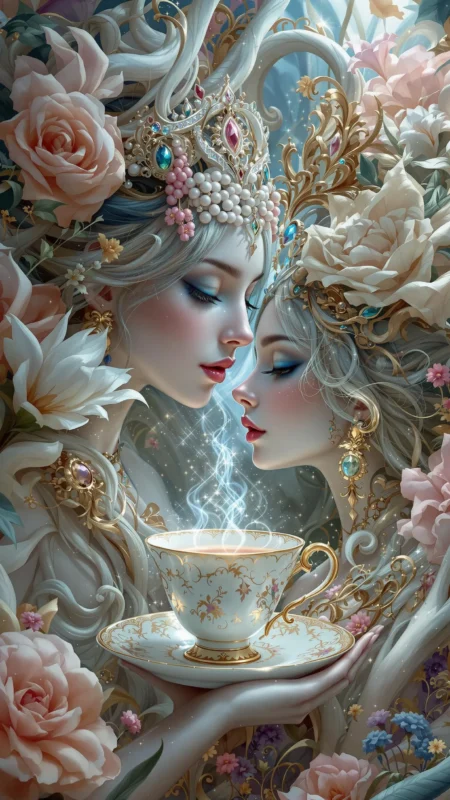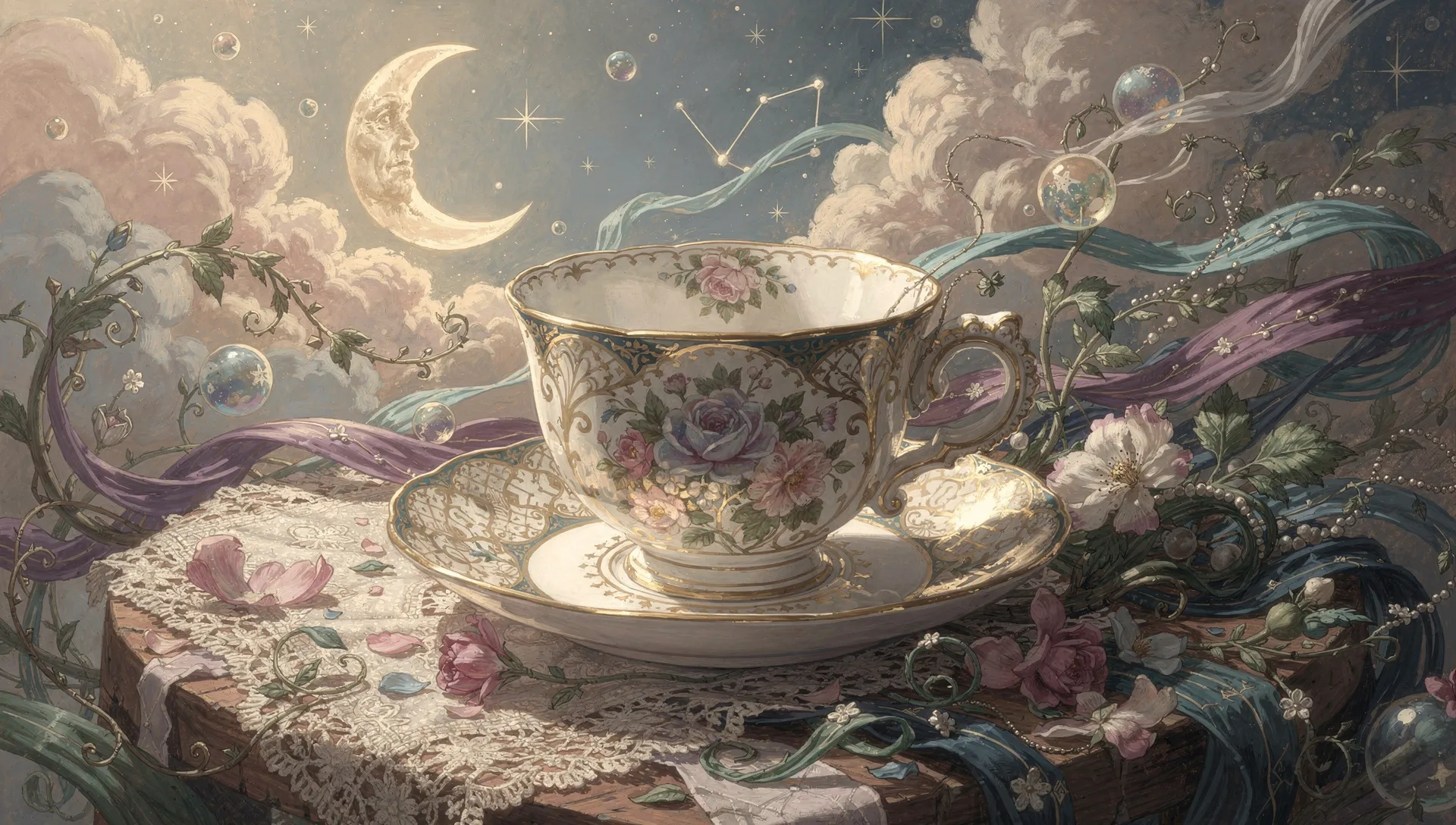


Teacup

Archetype Meaning & Symbolism

Receptive, Ritualistic, Delicate, Contained, Civilized, Poised, Fragile, Intimate, Refined, Composed

  • Hold me gently, but do not fear the heat I contain. My purpose is not to be empty, but to be filled with that which warms you.

If Teacup is part of your personal mythology, you may...

Believe

  • You may believe that the quality of a life is measured in its quiet moments, not its loud achievements.
  • You may believe that true strength is shown not through force, but through the ability to hold steady and contain chaos with grace.
  • You may believe that civility is not a trivial matter of manners, but a sacred practice that holds society together.

Fear

  • You may fear sudden shocks: unexpected news, emotional outbursts, or betrayals that threaten to shatter your carefully constructed peace.
  • You may fear carelessness, both in yourself and others, seeing it as a destructive force that breaks beautiful things and precious connections.
  • You may fear being empty and alone, a forgotten vessel on a shelf with no one to share a moment of warmth with.

Strength

  • Your strength lies in your ability to create calm in the midst of chaos, offering a space of quiet refuge for yourself and others.
  • Your strength is your capacity for deep, focused intimacy and your talent for fostering genuine connection through the art of listening.
  • Your strength is your resilience, the quiet fortitude that allows you to hold intense emotional heat without immediately breaking.

Weakness

  • Your weakness may be an over-sensitivity to perceived slights and a tendency to retreat when faced with necessary, but uncomfortable, conflict.
  • Your weakness could be a slide into rigidity or brittleness, where your need for order makes you unable to adapt to life's inherent messiness.
  • Your weakness might be a tendency toward passive-aggression, holding resentments like bitter, cold tea rather than addressing issues directly.

The Symbolism & Meaning of Teacup

In personal mythology, the Teacup is first and foremost a symbol of receptivity. It is an empty vessel by design, its value realized only when it is filled. To have the Teacup in your mythos suggests a capacity for deep listening, for holding space for others' stories, emotions, and warmth. It is the quiet power of being present. Your narrative may be less about active conquest and more about the profound strength required to receive the world without being overwhelmed. The Teacup proposes that true influence may lie not in projection, but in the gentle, magnetic pull of a calm and open vessel, inviting others to pour out what they hold inside.

The Teacup is also an emblem of civility and the sacred pause. It represents the deliberate creation of a moment of grace amidst the chaos of life. The act of using a teacup is inherently mindful: it demands a gentle hand, a steady posture, a focus on the small details of warmth and aroma. If this archetype resonates, your life story might be punctuated by these quiet rituals. You may find meaning in the carefully constructed boundaries between the wildness of the world and the curated peace of your inner life. This isn't an escape, but a conscious act of centering, a belief that civilization itself is built upon such small, repeated gestures of poise and consideration.

Finally, the Teacup’s very fragility is central to its meaning. It is often made of porcelain, a material that speaks of refinement but also of the ever-present possibility of being broken. This could symbolize a deep awareness of your own vulnerability, and perhaps the vulnerability of your most cherished relationships and beliefs. Living with the Teacup archetype is not about avoiding breakage, but about understanding its inevitability. It is the recognition that a life lived fully will leave its marks: the hairline crack from a heated conversation, the chip from a careless moment. These imperfections do not necessarily diminish the cup's worth; they may become part of its story, a testament to the heat it has held and the life it has served.


Teacup Relationships With Other Archetypes

The Hearth

The Hearth is a natural counterpart to the Teacup. Where the Hearth is the immovable, communal center of warmth and nourishment for the entire home, the Teacup is its mobile, personal extension. It takes the fire’s essence and makes it intimate. A person with both archetypes in their mythos could be someone who not only creates a welcoming space for all (The Hearth) but is also skilled in fostering deep, one-on-one connections within that space (The Teacup). The Teacup needs the Hearth's fire to be filled, symbolizing a reliance on a greater source of energy or community to fuel its individual rituals.

The Spoon

The relationship with the Spoon archetype is one of gentle agitation and transformation. The Teacup offers stillness and containment; the Spoon introduces motion, mixing, and change. The Spoon might represent a new idea, a challenging question, or an external influence that stirs the contents of your quiet world. For a Teacup person, this can feel disruptive, even threatening to the carefully maintained calm. Yet, it is the Spoon that dissolves the sugar, that blends the milk, that creates a new flavor. This dynamic suggests that growth requires an element of disturbance, and that one’s inner world, however poised, must occasionally be stirred to prevent stagnation.

The Storm

The Teacup exists in direct opposition to The Storm. It is the very image of indoor peace against outdoor chaos. To hold a teacup is an act of defiance against the gale. In a personal mythos, The Storm could represent overwhelming external pressures, internal emotional turmoil, or societal upheaval. The Teacup archetype provides the ritual and the space to weather it. It does not fight The Storm directly; rather, it creates a pocket of profound quietude where one can gather strength. The danger, of course, is that a strong enough tremor from The Storm can shatter the Teacup, symbolizing the limits of composure when faced with overwhelming force.

Using Teacup in Every Day Life

Navigating Conflict:

When faced with a heated argument, you may draw upon the Teacup not to retreat, but to create a container for the intense emotions. Instead of matching the fire, you could introduce a ritual pause: suggesting a literal cup of tea, or simply shifting the tone to one of quiet, deliberate listening. You become the vessel that cools the scalding liquid of anger into something that can be safely processed, turning a potential shattering into a moment of shared vulnerability.

Cultivating Solitude:

In a life that feels loud and demanding, the Teacup archetype can help sanctify solitude. You may intentionally create small, daily ceremonies for yourself. This isn't about grand self-care gestures, but the simple, mindful act of preparing and drinking a cup of tea alone. This ritual creates a boundary, a quiet space where the world is held at bay by the circle of the cup's rim, allowing for reflection and a gentle return to your own center.

Fostering Intimacy:

To deepen a connection with another, you might invoke the Teacup's capacity for focused intimacy. This is about creating a shared space, a metaphorical table for two, where conversation is held with the same care one holds a delicate piece of porcelain. It means putting away distractions, offering your full, receptive attention, and allowing the warmth of the exchange to be the central focus, fostering a bond that is both refined and deeply felt.

Teacup is Known For

Holding Warmth

It is known for its ability to contain and offer warmth, be it the literal heat of a beverage or the metaphorical warmth of comfort, conversation, and companionship.

Fragility:

The Teacup is defined by its delicate nature. Its potential to chip or shatter serves as a constant reminder of the vulnerability inherent in beauty, ritual, and relationship.

Ritual:

It is a central object in ceremonies of civility and connection, from the formal tea ceremony to the simple, daily act of pausing for a cup, transforming a mundane moment into a mindful practice.

How Teacup Might Affect Your Personal Mythology

How Teacup Might Affect Your Mythos

When the Teacup becomes a central object in your personal mythos, your life story may shift from a grand, linear epic to a collection of resonant moments. The defining chapters of your tale might not be battles won or mountains climbed, but the quiet conversations that changed everything, the solitary dawns spent in reflection, the precise moments a fragile peace was either preserved or shattered. Your narrative values depth over distance, intimacy over impact. The quest is internal: to maintain composure and grace in a world that threatens to spill or break you. Your sacred artifacts are not swords, but saucers; your holy grails are not goblets of eternal life, an but ordinary cup that allows you to savor the present.

The conflicts in your story may be subtle, internal dramas. The primary antagonist could be carelessness: your own or that of others. It could be the pervasive cultural rush that denigrates slowness and ritual. Your heroic arc might involve learning how to hold more without cracking, how to mend your own chips, or how to accept the beauty of a vessel marked by a life of use. Your mythos becomes a testament to the idea that a person's strength is not measured by the force they project, but by the delicate, difficult, and deliberate art of holding still.

How Teacup Might Affect Your Sense of Self

Your sense of self, if informed by the Teacup, may be built around the concept of being a container. You might see your identity not as a fixed, solid thing, but as a vessel whose purpose is to hold experiences, emotions, and connections. This can lead to a fluid and receptive self-concept, one that is less about assertion and more about absorption and reflection. You may value your own capacity for empathy and calm, seeing your ability to provide a space of quiet comfort for others as a core part of who you are. The self is not the liquid inside, but the beautiful, structured thing that gives it shape.

This perspective could also mean you are acutely aware of your own boundaries, symbolized by the cup’s rim. You may feel a strong need to define where you end and others begin, lest their contents overwhelm and spill you. Your self-esteem might be tied to your integrity as a vessel: your ability to remain uncracked under pressure, to hold difficult emotions without breaking, to maintain your poise. There is a quiet pride in this, a sense of self rooted in grace and resilience. You are not loud, but you are present, and your shape is your own.

How Teacup Might Affect Your Beliefs About The World

A worldview shaped by the Teacup archetype may be one that finds profound meaning in the small and the specific. You might look at the world and see not a chaotic mess, but a series of potential rituals and moments of connection waiting to be created. You could believe that the grand problems of society and the soul are best addressed not through sweeping gestures, but through small, deliberate acts of civility, attention, and care, repeated daily. It is a philosophy of the microcosm: if one can perfect the ritual of a single cup of tea, one can bring a measure of order and beauty to the universe.

This perspective may also lead to a certain aesthetic appreciation for the world. You might be drawn to elegance, craftsmanship, and the beauty of well-made things, seeing them as physical manifestations of care and intention. Conversely, you may be deeply unsettled by crudeness, haste, and disrespect, seeing them as cracks in the fabric of a civilized world. Your view of progress might be less about technological advancement and more about the cultivation of quiet wisdom and the preservation of spaces for genuine human connection.

How Teacup Might Affect Your Relationships

In relationships, the Teacup archetype suggests you may function as a confidant, a keeper of secrets and stories. People may be drawn to you because you offer a safe and contained space for them to be vulnerable. You likely excel in one-on-one interactions, where the shared intimacy of conversation can be savored. You may believe that the foundation of any strong bond is built on these shared rituals of attention, these moments where two people simply sit with each other, holding the warmth of their connection between them. You create the conditions for closeness to brew.

However, this relational style carries the risk of fragility. You may be easily hurt by careless words or actions, perceiving them as cracks in the vessel of the relationship. Your need for civility and gentle handling could sometimes be interpreted as being overly sensitive or demanding. There is also the potential to become a passive receptacle, endlessly holding the emotional baggage of others without having your own needs met. The challenge for the Teacup in relationships is to be both a receptive vessel and to signal when you yourself are full or in need of warming.

How Teacup Might Affect Your Role in Life

Your perceived role in a group, family, or society might be that of the quiet stabilizer, the diplomat, the host. You may not see yourself as the leader who charges ahead, but as the one who creates the conditions for productive and humane interaction. Your role is to bring a sense of order, calm, and ritual to proceedings. In a chaotic business meeting, you might be the one to suggest a pause. In a fractured family gathering, you could be the one who quietly facilitates gentle conversation, steering it away from treacherous topics. You are the keeper of the social graces, not out of superficiality, but from a deep belief that these forms and rituals are essential for holding a group together.

This can also mean you may feel most comfortable in a supportive, rather than a starring, role. The teacup serves the tea; it is not the tea itself. You might find purpose and fulfillment in facilitating the brilliance of others, in creating the perfect environment for ideas and relationships to flourish. Your contribution is subtle but essential. Without the container you provide, everything would be spilled and wasted. Your power is structural, your presence a quiet necessity, ensuring that the warmth of the collective is not lost.

Dream Interpretation of Teacup

To dream of a teacup in a positive context, such as being offered a warm cup by a loved one or finding a beautiful, intact cup in an unexpected place, often points to moments of solace, intimacy, and receptivity. It may suggest that you are entering a period of quiet reflection or that you are ready to receive comfort, wisdom, or a new, gentle connection. The dream could be affirming your need for a pause, for a sacred moment just for yourself. A dream of a perfectly full, steaming teacup might symbolize a sense of fulfillment and inner warmth; you are holding something precious and nourishing within yourself.

Conversely, dreaming of a teacup in a negative light can be unsettling. A cracked or chipped teacup might symbolize a wound to your sense of self, a broken trust, or a feeling of being damaged yet still functional. A shattered teacup could represent a devastating emotional blow, the complete breakdown of a relationship, or the shattering of a carefully constructed peace. To dream of an empty teacup when you are thirsty may indicate a feeling of emotional or spiritual emptiness, a longing for connection that is not being met. Spilling a teacup could reflect a fear of emotional incontinence, of being unable to contain your feelings, or a recent social misstep that has caused you anxiety.

How Teacup Archetype Might Affect Your Needs

How Teacup Might Affect Your Physiological Needs

From a mythological perspective, the Teacup archetype connects directly to the body's need for regulation and homeostasis. The ritual of a warm drink is a primal act of self-soothing, a way to regulate internal temperature and calm the nervous system. If the Teacup is part of your mythos, you may be particularly sensitive to your body's need for these moments of quiet regulation. You might find that small, consistent rituals, like a morning cup of tea, are non-negotiable for your physical well-being, helping you to manage the physiological impacts of stress. Your body craves the pause as much as the warmth.

This archetype could also manifest as a heightened awareness of what you take into your body. The teacup is a vessel, and you may see your body in a similar light. This could lead to a mindful approach to food and drink, not necessarily for health fads, but from a place of respect for the vessel. You understand that what you consume becomes part of you, and you choose things that offer warmth, nourishment, and comfort, rather than agitation and discord. Your physiological needs are met through deliberate, gentle, and ritualistic acts of care.

How Teacup Might Affect Your Ideas of Belonging

For someone with the Teacup archetype, belonging is found in small, intimate circles. You do not need to be part of a vast crowd to feel connected; in fact, large, anonymous groups may feel alienating. True belonging is found in the quiet communion of a shared conversation, in the unspoken understanding between two or three friends. It is the feeling of being a cherished part of a matched set. You seek relationships where you can be both the vessel and the one who is filled, where the exchange of warmth and care is mutual and ritualized.

You may actively foster belonging by being a consummate host, not of large parties, but of intimate gatherings. Your gift is creating the atmosphere where people feel safe enough to be themselves, to put down their armor. However, this need for refined connection can also lead to loneliness if such companionship is scarce. You may feel like a single, solitary cup waiting for a saucer or a companion, feeling out of place in a world that seems to value loud, disposable connections over quiet, lasting ones.

How Teacup Might Affect Your Feelings of Safety

Your need for safety, as viewed through the Teacup lens, may be less about physical fortification and more about emotional and psychological containment. Safety is a space free from jarring emotional noises, from carelessness, from relational aggression. It is a predictable, orderly environment where you do not have to be on guard against being emotionally bruised or shattered. You might create safety by curating your home as a sanctuary, a place where the rules of gentle conduct apply and the chaos of the outside world is muted. Financial and physical security are important primarily because they build the walls of this sanctuary.

The fragility of the Teacup also informs your sense of danger. The greatest threat is not a frontal assault, but a sudden shock, a betrayal of trust, or an act of profound disrespect. These are the things that can 'shatter' your sense of security. Consequently, you may be highly skilled at risk assessment in relationships, sensing early on who is a 'bull in a china shop' and who understands the necessity of a gentle hand. Your safety lies in discernment, in choosing who is allowed into your inner circle and permitted to handle your vulnerable self.

How Teacup Might Affect Your Views of Esteem

Esteem, for the Teacup individual, is likely derived from grace, poise, and emotional integrity. You may feel a deep sense of self-worth when you successfully navigate a difficult social situation with diplomacy and calm, or when you provide comfort to someone in distress without losing your own center. Your esteem is not built on external accolades, but on the internal satisfaction of being a reliable, well-crafted vessel. It is the pride of being beautifully made, of having integrity in your form and function. You feel good about yourself when you are a source of warmth and civility in the world.

Conversely, your self-esteem can be deeply wounded by moments of emotional clumsiness or outburst. Losing your composure might feel like a profound personal failure, a crack in your very being. You may be your own harshest critic, replaying social interactions where you felt you were not graceful enough. The challenge to your esteem is to learn that a chip or a hairline crack does not mean you are ruined. True self-worth comes from accepting your own history and the marks it has left, understanding that a well-used cup is often more valuable than one that has never left the shelf.

Shadow of Teacup

The shadow of the Teacup emerges when its positive qualities curdle into their extremes. The desire for civility and calm can become a rigid demand for superficial pleasantries, a brittle perfectionism that cannot tolerate any form of dissent or emotional messiness. In this state, the Teacup person may police the emotions of others, shushing any expression that is too loud, too raw, too inconvenient. The home is no longer a sanctuary but a museum, where relationships are artifacts to be kept pristine and untouched. The Teacup becomes a container for poison rather than medicine: holding onto unspoken resentments, serving passive aggression with a smile, and valuing the appearance of peace over the reality of authentic connection. It is the tyranny of 'nice'.

Another shadow aspect arises from its fragility. An over-identification with the Teacup can lead to a state of perpetual victimhood, a belief that one is too delicate for this world. This can manifest as an inability to take responsibility, blaming others for every chip and crack in one's own composure. It fosters a learned helplessness, where the individual refuses to develop the resilience needed to handle life's inevitable bumps. The teacup, in its shadow form, does not just hold warmth; it demands to be handled with an impossible degree of care, becoming a fragile tyrant around which everyone else must tiptoe, lest they be blamed for the shattering.

Pros & Cons of Teacup in Your Mythology

Pros

  • You excel at creating pockets of peace and sanity, making you a comforting and grounding presence for others.
  • You cultivate deep, meaningful relationships based on mutual respect, focused attention, and shared intimacy.
  • You appreciate the beauty in small, everyday rituals, allowing you to live a life rich with meaning and mindful moments.

Cons

  • You may be perceived as overly sensitive or fragile, avoiding necessary confrontations and struggling with robust, chaotic environments.
  • Your need for order and quiet can sometimes isolate you from the messy, unpredictable, but often vibrant, parts of life and relationships.
  • You risk becoming a passive receptacle for others' emotional needs, neglecting to advocate for your own or to express your own less 'civilized' feelings.