 Believe
 Fear
Fear Strength
 Weakness
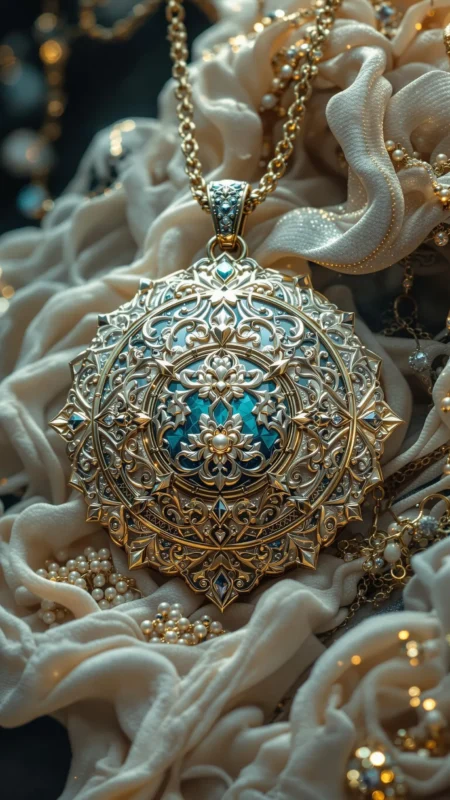
The Silver Locket in one's personal mythology speaks to the power of the specific, the singular, the secret. It proposes that identity is not a grand, sprawling narrative but perhaps a single, potent memory or love, held in a protected, cherished space. The exterior, cool and polished, is the persona presented to the world, smooth and socially legible. The clasp is the boundary between the public self and the private truth. The true self, the locket suggests, is what is held inside: the miniature portrait of a cherished face, a lock of a child's hair, the dust of a sacred place. This inner totem may be the source of one's greatest strength and resilience, a private anchor in a turbulent world.
Furthermore, the locket archetype explores the nature of time and memory. It is not a library or an archive; it cannot hold everything. Its smallness forces a deliberate curation. One must choose what to carry forward. This act of choosing is a profound myth-making activity. It separates the essential from the extraneous, the gold from the dross. The story you tell yourself about yourself may be defined not by the sum of your experiences, but by the one or two you have deemed worthy of placing in the locket. The metal itself, silver, is associated with the moon, with intuition, and with reflection, suggesting that the contents are not static but are perceived through the shifting light of inner wisdom.
This archetype also contains a quiet melancholy, a recognition of what is lost or absent. The locket holds a representation of something, not the thing itself. The photograph is not the person; the memory is not the event. It is a symbol of how we carry our ghosts and our pasts. It may represent a devotion to something that no longer exists in the physical world, making the wearer a keeper of a sacred absence. In this, the Silver Locket is an emblem of faithful love, of poignant nostalgia, and of the human need to make the intangible tangible, to give memory a home and a physical weight against the heart.