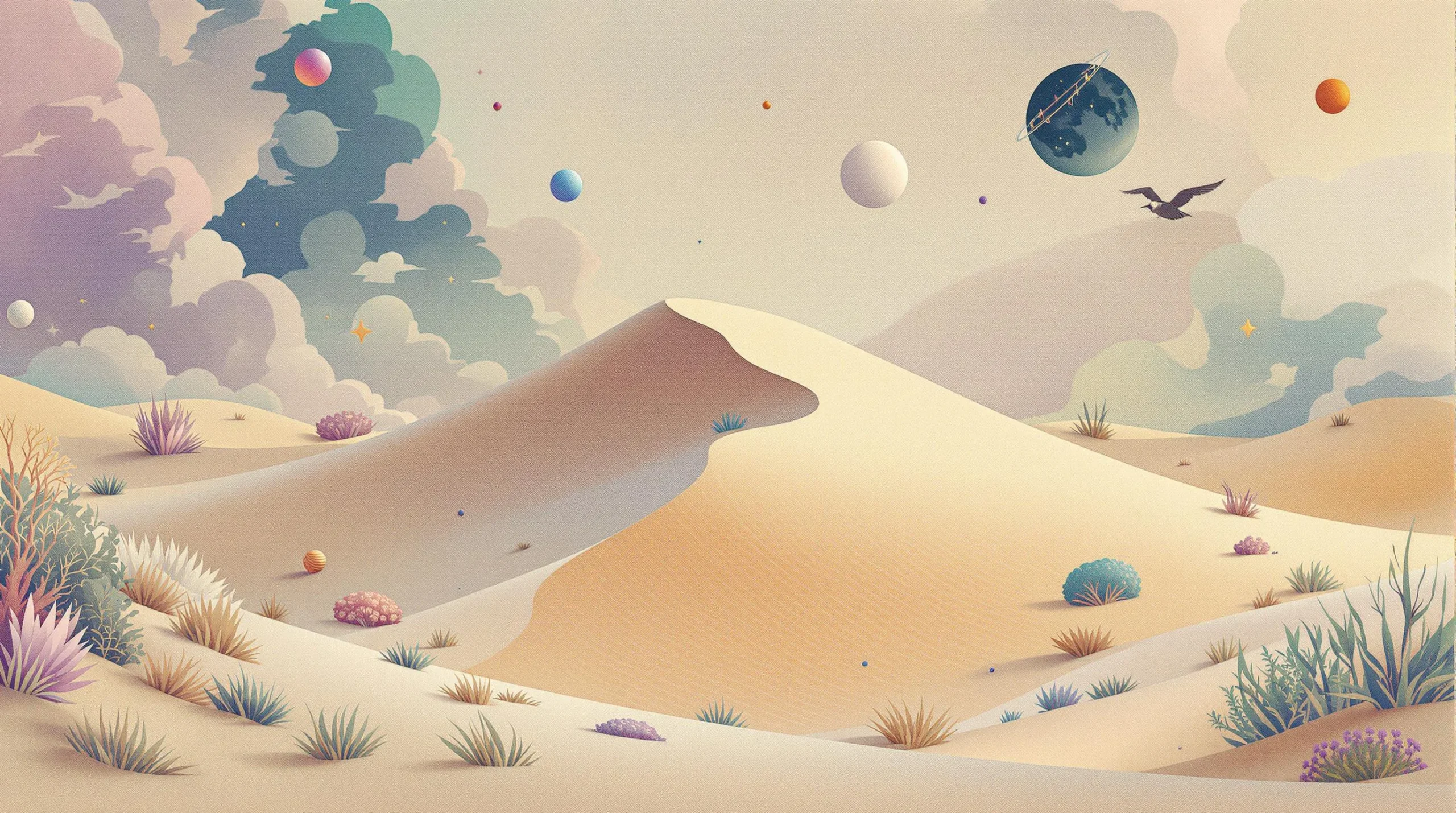


Sand Dune

Archetype Meaning & Symbolism

Shifting, vast, patient, resilient, sculpted, layered, isolating, graceful, formidable, absorbent, ancient, temporary

  • Do not seek my foundation in stone, for it is not there. My stability is a conversation with the wind, a form held in a constant state of release.

If Sand Dune is part of your personal mythology, you may...

Believe

  • Change is not an event to be endured, but the very medium in which life is expressed. To be alive is to be in flux.

    True strength is found not in resistance but in yielding. The most powerful force is the one that adapts.

    Within things that appear simple, barren, or empty, there is often a hidden, complex, and vital world.

Fear

  • Stagnation. The ultimate terror is not being blown apart by the wind, but becoming petrified, turning into solid, immoveable sandstone, unable to change ever again.

    That the winds of change will become so relentless that you are scattered completely, losing all coherence and form, becoming just dust in the air.

    Inscrutability. A deep fear that no one will ever have the patience or desire to look past your simple surface to see the intricate universe you hold within.

Strength

  • Profound resilience. You can absorb almost any shock or change, reforming yourself with a grace that others find astonishing.

    Geologic patience. You have an innate ability to wait, to trust in slow processes, and to see the long view when others are lost in the urgency of the moment.

    Adaptability. You are a master of context, able to shift your form, your approach, and your perspective to fit the needs of any new environment or situation.

Weakness

  • Passivity. Your tendency to yield and adapt can sometimes bleed into a lack of agency, where you allow external forces to dictate your path entirely.

    Emotional elusiveness. People may find it difficult to connect with you on a deep level, as your emotional state can seem as shifting and hard to grasp as a dune's surface.

    Lack of boundaries. In your willingness to absorb and accommodate, you may struggle to say 'no,' allowing others to erode your landscape or deplete your hidden resources.

The Symbolism & Meaning of Sand Dune

In the personal mythos, the Sand Dune archetype represents the beauty of yielding, the power of soft forms, and the profound truth of impermanence. To have the Dune as a guide is to understand that identity is not a fixed monument but a shifting landscape, sculpted by the invisible forces of experience, time, and relationship. It symbolizes a form of resilience that isn't about rigid resistance but about fluid adaptation. The Dune does not break in the wind; it converses with it, allowing itself to be dismantled and reformed into something new, yet fundamentally the same. It is a testament to the idea that one can endure immense pressure and constant change not by hardening, but by remaining granular, individual particles moving in concert.

Furthermore, the Dune speaks to the nature of time and memory. Each grain of sand could be seen as a moment, an experience, a word spoken. The whole is a vast repository of the past, yet its surface is always the present, perpetually new. This archetype may suggest a life where the past is not a burden to be dragged along, but the very substance from which the present self is shaped. There is a deep patience here, a trust in geologic timeframes rather than human ones. It whispers that true form is not about a final destination but the elegance of the journey itself, the endless dance of accumulation and erosion.

The symbolism of the Sand Dune also touches upon illusion and reality. From a distance, it appears solid, monolithic, a smooth and simple hill. Up close, its immense complexity is revealed: a universe of individual grains, each with its own history. This may mirror a personality that appears simple or placid on the surface but contains a rich, intricate inner world. The Dune is the keeper of hidden things, whether it's a literal oasis of water in the desert or a metaphorical wellspring of creativity and wisdom concealed beneath a quiet exterior. It is the paradox of being both empty and full, simple and complex, still and ever-moving.


Sand Dune Relationships With Other Archetypes

The Wind:

The relationship between the Sand Dune and The Wind is one of creator and created, dancer and dance. The Wind is the restless, invisible force of change, the divine sculptor, the whisper of inspiration or the howl of chaos. The Dune does not exist without it. For a person, this relationship may represent their dynamic with external forces: society's pressures, fate, or the flow of time. They are not a victim of The Wind, but its partner. Their life's shape, their very identity, is the result of this constant, intimate interaction, a testament to what is made when one yields to a power greater than oneself.

The Wanderer:

To The Wanderer, the Sand Dune is both obstacle and destination, a landscape of profound trial and potential revelation. The Dune is the terrain the Wanderer must cross to test their endurance and resolve. It represents a journey into the self, a landscape stripped of distractions where one confronts the vastness of their own inner world. The Dune offers no clear path, forcing The Wanderer to navigate by intuition, by the sun and stars. In turn, the Wanderer’s footprints are the most fleeting of marks on the Dune’s surface, a reminder that while the journey is transformative for the individual, the landscape endures, ready for the next soul seeking its wisdom.

The Oasis:

The Oasis is the secret heart of the Sand Dune, its hidden promise. It is the archetype of life, replenishment, and hope found in the most unlikely of places. The relationship is one of protection and revelation. The vast, arid slopes of the Dune protect the fragile life of the Oasis from the harshness of the outer world. For someone with the Dune archetype, the Oasis may represent their own core of vitality, their secret wellspring of creativity, love, or spirituality. It is a part of themselves they do not show to everyone, a precious resource guarded by their shifting, placid exterior, revealed only to those who have journeyed far enough to find it.

Using Sand Dune in Every Day Life

Navigating Career Transitions:

When faced with a sudden layoff or a necessary pivot in professional life, the Sand Dune archetype offers a map for reformation. Instead of resisting the force that has dismantled a previous structure, you might allow the 'winds of change' to reshape your skills and experiences into a new form. This is not about passive acceptance, but about active yielding, understanding that the individual grains of your knowledge can be rearranged to create a new, perhaps more graceful and strategic, professional landscape.

Processing Grief:

Grief can feel like a harsh, scouring wind that threatens to erase the self. The Sand Dune teaches that one can be altered by this force without being destroyed. It suggests that grief doesn't need to be a static monument of pain, but can be a process of reshaping. Each memory, each pang of loss, is a grain of sand. The archetype encourages allowing these grains to settle into new patterns, creating a landscape of memory that is soft, contoured by love and loss, rather than a jagged cliff of sorrow.

Cultivating Patience:

In a world demanding immediate results, the Sand Dune is a totem of geologic patience. To embody this archetype is to trust in slow, incremental processes. When working on a long-term project or personal growth, you may draw on the Dune's nature. You understand that the grandest forms are not built in a day, but through the persistent, almost invisible, accumulation and sculpting of tiny efforts over vast stretches of time. It is a quiet rebellion against the tyranny of the urgent.

Sand Dune is Known For

Constant Transformation

A Sand Dune is never the same from one moment to the next. It is a living sculpture, endlessly reshaped by the wind, embodying the principle of impermanence. Its form is a temporary agreement between gravity and air.

Hidden Life

Beneath a seemingly barren and inhospitable surface, dunes can shelter surprising ecosystems. They may hide oases, protect unique flora, and provide a habitat for creatures adapted to its extremes. This points to the hidden potential and resources within what appears to be simple or desolate.

Singing Sands

Under specific conditions, the movement of sand down a dune's face can create a deep, resonant sound, a phenomenon known as aeolian sound. This gives the Dune a voice, a mysterious and haunting song that suggests a hidden, vibrational life within the inert.

How Sand Dune Might Affect Your Personal Mythology

How Sand Dune Might Affect Your Mythos

When the Sand Dune shapes a personal mythos, the life story ceases to be a linear progression towards a single climax and becomes a narrative of landscapes. Your mythos is not about conquering the mountain or reaching the city of gold; it is about the profound beauty of your own changing topography. Key life events are not milestones on a road but winds that have sculpted you. A period of loss may be remembered as the ‘Great Erosion,’ which revealed a new, more graceful contour. A sudden success might be the ‘Singing Slope,’ a time when everything resonated in harmony. Your story is geologic, not dramatic.

The central theme of such a mythos could be 'finding permanence in the impermanent.' The protagonist, you, learns that stability is not a static state to be achieved but a dynamic equilibrium to be maintained. Your heroic journey might be an internal one: the quest to stop resisting change and instead learn to dance with it. The ultimate treasure is not an object but a state of being, the ability to hold your form lightly, to be both vast and humble, and to understand that your identity is a conversation between the countless grains of your past and the ever-present wind of the now.

How Sand Dune Might Affect Your Sense of Self

Your view of self may be one of immense complexity housed within a simple form. You may not see yourself as a single, coherent entity but as a collective, a vast congress of experiences, thoughts, and memories—each a grain of sand. This perspective could foster a deep sense of self-acceptance, as no single grain is judged, only the overall shape it contributes to. You might perceive your own personality as fluid, adaptable, and resilient, capable of absorbing impacts and reforming without shattering. There is a humility in this self-concept, an understanding that your form is largely a response to external forces you do not control.

This can also lead to a feeling of being an observer of your own life, watching the 'self' as a landscape being shaped. You might feel a certain detachment from ego, seeing it as just one of many shifting dunes in the desert of consciousness. This perspective could grant you a profound sense of peace, a release from the anxiety of maintaining a fixed, perfect identity. You are a process, not a product. Your worth is not in any one shape you hold, but in your timeless capacity to be reshaped, to endure, and to catch the light in ever-new ways.

How Sand Dune Might Affect Your Beliefs About The World

A worldview informed by the Sand Dune archetype is one that holds impermanence as a sacred principle. You may see civilizations, ideologies, and even personal identities as dunes in a vast desert, magnificent for a time but destined to shift. This does not lead to nihilism, but to a deeper appreciation for the beauty of the temporary. You find meaning not in things that last forever, but in the elegant, fleeting patterns created by the flow of energy through matter. This is a perspective that privileges the poetic over the dogmatic, the pattern over the specific part.

You might look at conflict, social change, or economic upheaval with a kind of geologic patience. You understand that these are winds shaping the collective landscape. This could foster a calm, non-reactive disposition, as you see the long-term patterns rather than getting lost in the immediate chaos of the sandstorm. The world is not a problem to be solved but a dynamic system to be observed and appreciated. There is a deep, quiet wisdom in this, a trust that even from apparent chaos, new and beautiful forms will emerge.

How Sand Dune Might Affect Your Relationships

In relationships, you may embody a kind of adaptable presence. You might have a high capacity to accommodate the moods and changes of a partner, shifting your own form to create a space of comfort and acceptance. You do not demand rigidity or fixed promises, understanding that people, like dunes, are always in a state of becoming. This can make you a deeply comforting and non-judgmental partner, a soft place to land. You absorb frustrations and offer a quiet, stable presence that is, paradoxically, always in motion.

However, this same quality could make you seem remote or difficult to truly know. A partner may feel that they can never find a solid footing, that your emotional landscape is always shifting under their feet. Your love may feel vast and encompassing, but also impersonal, like the desert itself. You might struggle to offer the sharp, defined edges of commitment or confrontation that relationships sometimes require. Intimacy, for you, might be less about two solid things meeting and more about two landscapes bleeding into one another, a process that can feel both beautifully deep and unnervingly boundless.

How Sand Dune Might Affect Your Role in Life

Your perceived role in a family, community, or workplace may be that of the silent, shaping presence. You might not be the outspoken leader or the active rebel, but the one whose quiet endurance and adaptability subtly influence the entire environment. Like a dune that changes the flow of wind around it, your presence can alter the dynamics of a group without overt action. You may take on the role of the absorber, soaking up tensions and creating a calmer atmosphere. You provide a backdrop against which others can define themselves.

This can also mean you assume a role of quiet strength and resilience, the one who is counted on to weather any storm. People may not notice your contribution until a crisis hits, at which point your ability to bend without breaking becomes invaluable. You might be the keeper of institutional memory (the lower layers of sand) while simultaneously being open to new ways of being (the shifting surface). Your role is not defined by a title but by a function: you are the landscape that allows things to happen, the patient ground of being for the collective.

Dream Interpretation of Sand Dune

In a positive context, to dream of a Sand Dune is often to connect with themes of peace, time, and limitless potential. Seeing a vast, sun-drenched dune, its ripples perfect and golden, may symbolize an acceptance of your life's path and a sense of harmony with the forces of change. You may be finding stability in flexibility. Walking effortlessly upon a dune could suggest you are navigating a period of uncertainty with grace and intuition. Discovering an oasis within the dunes in a dream is a powerful symbol of finding hidden resources, love, or spiritual nourishment within yourself, often in a part of your life you previously considered barren.

Conversely, a dream of Sand Dunes can evoke feelings of being lost, overwhelmed, or unstable. To be caught in a sandstorm, unable to see, suggests you feel powerless and lost in the face of chaotic events in your life, your sense of direction completely obscured. Being buried by sand, or sinking into it, can be a terrifying symbol of feeling your identity being erased, or being suffocated by overwhelming responsibilities or the slow, creeping pressure of a hopeless situation. A dream of an endless, featureless sea of dunes might reflect a sense of profound isolation, hopelessness, or the fear that your life lacks meaning and direction.

How Sand Dune Archetype Might Affect Your Needs

How Sand Dune Might Affect Your Physiological Needs

From the perspective of your personal mythos, your basic physiological needs are viewed through a lens of conservation and unexpected abundance. The Sand Dune archetype might instill a deep, almost instinctual understanding of energy management. You may be naturally inclined to conserve your physical and emotional resources, knowing that harsh conditions could arise at any moment. You might not be a person of excess, preferring simplicity and finding sustenance in what others overlook. There's a trust that you can survive on very little, that you have reserves you can call upon.

At the same time, the Dune's secret, the Oasis, suggests a profound belief in hidden wells of vitality. You may have a paradoxical relationship with sustenance: on the one hand, you are frugal and prepared for scarcity; on the other, you hold a deep faith that just when things seem most barren, a source of life-giving water, energy, or nourishment will be revealed. Your physical well-being might be tied to this rhythm of conservation and discovery, a cycle of enduring arid stretches with the quiet confidence of an oasis waiting within.

How Sand Dune Might Affect Your Ideas of Belonging

The need for love and belonging may be experienced as a complex duality of isolation and oneness. As a vast landscape, the Sand Dune is often solitary, and you may carry a profound sense of being alone in your specific form. You might feel that few people understand the intricate, shifting patterns of your inner world, leading to a feeling of gentle, non-tragic isolation. You are a world unto yourself, and you may be comfortable with that solitude, finding companionship in the vastness.

Yet, the Dune is also a collective of countless individual grains, a part of a single, interconnected desert. This may translate to a sense of belonging to something much larger than a single relationship or social group: humanity, nature, the cosmos. Love may be experienced not as a bond between two separate entities, but as a merging of landscapes, a space where another is welcome to leave their footprints, to shelter from the wind, or to simply be. Belonging is less about fitting in and more about being a part of the whole, recognizing your substance in the substance of others.

How Sand Dune Might Affect Your Feelings of Safety

Safety, for you, is not found in fortification but in formlessness. The Sand Dune teaches that rigidity is fragility; that which cannot bend will break. Therefore, you may feel most secure when you are untethered, mobile, and adaptable. A fixed address, a rigid job description, or an unchanging routine might feel more like a prison than a safe harbor. Your sense of security comes from the inner knowledge that you can reform after any impact. You can be scattered by a gale-force wind and still, grain by grain, reassemble yourself.

This can make your approach to safety seem counterintuitive to others. You might actively dismantle structures in your life that have become too rigid, sensing that their inflexibility makes them vulnerable. Danger is not the storm, but the attempt to build a stone wall against it. Your safety lies in your very granularity, your ability to let threats pass through you, altering your shape but leaving your essence untouched. It is the security of water, or wind, or sand: the safety of that which cannot be permanently held or broken.

How Sand Dune Might Affect Your Views of Esteem

Esteem is not derived from specific achievements or external validation, but from the quiet dignity of endurance and the aesthetic beauty of your own form. Your self-worth might be tied to your resilience, your ability to have weathered the storms of your life and to have been shaped by them into something unique and graceful. You may take pride in your own complexity, in the layers of self that have been deposited over time, even if those layers are invisible to most. It is the esteem of the survivor, the patient observer, the quiet landscape.

Your confidence might be subtle, a deep, unshakable belief in your ability to adapt. You don't need to be the strongest or the loudest, because you have the strength of sand: yielding, persistent, and ultimately, unconquerable. Esteem may also come from the role you play for others—as a place of peace, a calming presence, a beautiful and simple form that brings a sense of wonder. Your worth is self-evident in your being, not in your doing. You are a testament to the fact that something can be soft and still be powerful.

Shadow of Sand Dune

The shadow of the Sand Dune emerges when its essential balance is lost. In one manifestation, the shadow is utter passivity, a complete abdication of form. Here, the person becomes a mere pile of disconnected grains, having no coherence or will. They are blown about by every whim, every opinion, every fleeting trend, possessing no internal stability. Their adaptability sours into a lack of identity, their patience into apathy. They are a landscape without features, so completely yielded to the wind that they cease to be a dune at all, offering no shelter, no beauty, no form to the world, just a gritty and irritating instability.

Conversely, the shadow can manifest as its opposite: petrification. Fearing the endless change, the Dune hoards its form, resisting the wind. This is the dune that, through pressure and fear, begins to turn to stone. It becomes rigid, brittle, and stagnant. Its adaptability vanishes, replaced by a stubborn and fragile permanence. This shadow self refuses to grow, to change, to accept new experiences. It creates a harsh, barren landscape where nothing new can take root, and its surface, once soft, becomes a hard crust. It loses its grace and becomes a monument to its own fear of dissolution, ultimately just as lifeless as the dune scattered to the four winds.

Pros & Cons of Sand Dune in Your Mythology

Pros

  • You possess a calm and graceful resilience that allows you to navigate life's inevitable changes with minimal distress.

    Your inherent patience gives you a unique perspective, allowing you to succeed where haste would lead to failure.

    You can be a profoundly soothing and accepting presence for others, offering a 'soft place to land' in a hard world.

Cons

  • Your adaptability can be misread as a lack of conviction, passion, or a stable core.

    You may struggle to form relationships with those who require clear, solid emotional boundaries and verbal affirmation.

    In your tendency to yield, you risk being shaped by toxic or negative forces as readily as positive ones.