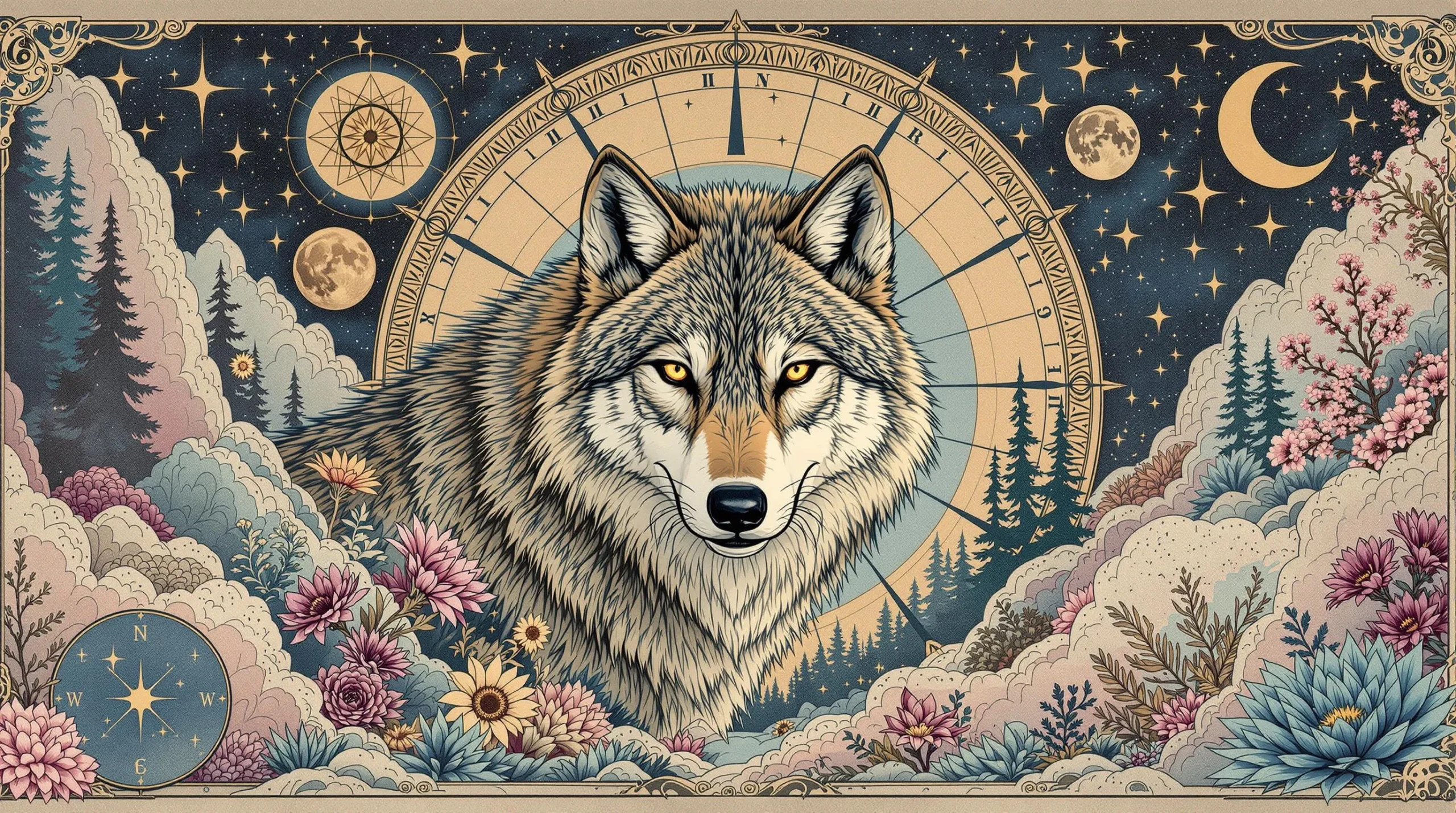


Wolf Track

Archetype Meaning & Symbolism

Directional, evidential, fleeting, purposeful, wild, instinctual, ancient, subtle, weathered, guiding

  • Do not ask where the path ends. Ask instead: does this next step feel like home?

If Wolf Track is part of your personal mythology, you may...

Believe

  • You may believe that the journey is the only real destination, and that every single step is a sacred arrival.

  • You may believe that your intuition is a more reliable compass than logic, tradition, or the opinions of others.

  • You may believe that the past is not a weight to be carried, but a trail to be read for patterns and wisdom.

Fear

  • You may fear losing the trail, which manifests as a terrifying dread of aimlessness or a loss of purpose.

  • You may fear that the path you follow so faithfully leads nowhere, or ends abruptly at an impassable chasm.

  • You may fear having your path, and thus your life's story, misunderstood, ignored, or erased by time or the actions of others.

Strength

  • You likely possess a profound ability to navigate ambiguity, trusting the process even when the way is unclear.

  • You may have a deep well of self-reliance and an unwavering confidence in your own instincts and internal guidance.

  • You may have the gift of seeing the hidden narrative and direction in complex situations, for yourself and for others.

Weakness

  • You may have a deep-seated reluctance to commit or settle, feeling the constant pull of the path ahead.

  • You may find it difficult to justify your decisions to others, as they are based on intuitive feelings that defy easy explanation.

  • You may have a tendency toward solitude or isolation, feeling that your unique path must ultimately be walked alone.

The Symbolism & Meaning of Wolf Track

In one’s personal mythology, the Wolf Track may symbolize the authority of instinct over intellect. It is not a map, meticulously drawn and sanctioned by committee. It is an impression left by a body in motion, a direct consequence of a creature following its own innate guidance system. To have this as a personal symbol is to trust the part of the self that navigates by scent and shadow, the part that knows the way without needing to see the destination. It suggests a life path that is not engineered but discovered, one footprint at a time, each step a conversation between the inner wilderness and the outer world.

The track is perhaps the ultimate liminal object, a paradox of presence and absence. It is the shape of something that is no longer there. This speaks to a deep understanding of legacy and memory. The mythos of the Wolf Track is not about building monuments but about leaving a meaningful trail. It posits that our lives are measured by the impressions we leave on others and on the world, faint prints that prove we walked with purpose. It is an archetype of subtlety, suggesting that true impact is often quiet, a trace that tells a story long after we have passed.

Furthermore, a track is defined as much by the ground as by the foot that makes it. A print in snow is different from one in mud or dust. This symbolizes an intimate, responsive relationship with circumstance. The person who identifies with the Wolf Track may not fight their environment but uses it. They understand that the nature of their journey—its ease, its difficulty, its clarity—is a dance between their own purpose (the wolf) and the conditions of their life (the ground). They do not curse the mud for obscuring the path; they learn to read the story it tells.


Wolf Track Relationships With Other Archetypes

The Moon

The Wolf Track holds a silent, collaborative relationship with The Moon. The track itself is a passive impression, but it is often the cool, revealing light of The Moon that makes it visible on a dark path. In a personal mythos, The Moon may represent the cycles of intuition, the ebb and flow of inner knowing. The Wolf Track, then, is the tangible proof of that intuition made manifest. One cannot follow the track without the light; one's intuitive light is useless without a path to illuminate. They are partners in the navigation of the soul's wilderness, one revealing the way that the other has already instinctually laid down.

The Forest

The Forest is the context, the beautiful and terrifying complexity in which the Wolf Track finds its meaning. The Forest archetype represents the world, with all its secrets, dangers, and overwhelming possibilities. It is chaos and life intertwined. The Wolf Track is the singular, personal thread of meaning pulled through that chaos. It is the assertion that even within the most tangled and immense systems, a personal path exists. The Forest is the question; the Wolf Track is the quiet, moving answer.

The Hunter

The relationship with The Hunter is one of tension, pursuit, and profound intimacy. The Hunter follows the track, seeking to understand, capture, or merge with the wildness it represents. In a personal narrative, The Hunter may be the conscious, analytical mind, while the wolf that made the track is the untamable, instinctual self. The track is the bridge between them. It is the evidence the conscious mind has of its own hidden depths. This relationship embodies the lifelong quest of the ego to track and integrate the wisdom of the wild soul without destroying it in the process.

Using Wolf Track in Every Day Life

Navigating a Career Change

When faced with professional crossroads, the Wolf Track archetype encourages a focus not on the five-year plan but on the next indicated step. It is the practice of listening for the pull towards a certain project, a conversation, a skill. It is trusting that a series of authentic, instinctual steps will create a career path more true than any meticulously plotted map, revealing a vocation not by force of will but by following the scent of what feels alive.

Healing from the Past

To understand personal history through this lens is to see it not as a chaotic series of events, but as a trail left behind. One can look back at the tracks of past decisions and relationships, not with judgment, but with the eye of a tracker. Where was I moving quickly? Where did I double back? Recognizing these patterns illuminates the underlying instincts and wounds that have guided you, allowing for conscious change in the path forward.

Making a Difficult Decision

When logic offers a dozen viable but uninspiring options, the Wolf Track calls for a different kind of clarity. It is the art of standing still until one direction feels resonant. The decision is not a calculation but an impression. You choose the path that, for a reason you may not be able to articulate, feels like it is yours to walk. This archetype is the courage to make a single, decisive print in the mud of ambiguity.

Wolf Track is Known For

Indication of Presence

A Wolf Track is foremost the ghost of a presence, undeniable proof that a wild, living thing passed this way. It transforms an empty space into a scene of a recent story, its primary power being the conversion of absence into evidence.

Direction of Travel

The track is an arrow of intent, pointing forward into the unknown or backward into memory. It is a vector of purpose, a natural compass embedded in the earth, offering a clear, albeit temporary, line of travel through a complex world.

Revelation of Intent

The character of the track reveals the state of the wolf. The depth, the gait, the splay of the toes can signal a leisurely walk, a stalk, or a panicked flight. The track, therefore, tells not just *where*, but *how* and *why*, offering a nuanced reading of the journey's hidden emotional context.

How Wolf Track Might Affect Your Personal Mythology

How Wolf Track Might Affect Your Mythos

When the Wolf Track becomes a central feature of a personal mythos, the life story ceases to be a novel with a clear beginning, middle, and end. Instead, it becomes an epic of passage, a narrative written in footprints. The meaning of the story is not found in the eventual arrival at a destination, which may remain forever mysterious, but in the quality and character of the trail itself. The personal mythos is one of discovery rather than creation, where the self is revealed through the act of journeying. The central conflict is often internal: the struggle to trust the path when it leads into darkness, and the challenge of keeping faith in the next step when the trail ahead is invisible.

This archetype shapes the mythos into one of a Path-finder or a Soul-Tracker. The protagonist's primary skill is not strength or charm, but perception and attunement. The great victories are not battles won, but moments of profound clarity when the correct path is suddenly sensed. The tragedies are not failures, but instances of losing the trail, of becoming lost in the meaningless wilderness. The entire life story is framed as a sacred hunt, not for an external prize, but for the next true impression of the self upon the world.

How Wolf Track Might Affect Your Sense of Self

An individual informed by the Wolf Track may come to view the self not as a fixed entity but as a vector. Identity is not a noun but a verb. Who you are is defined by where you are going. This perspective fosters a dynamic and fluid sense of self, less concerned with static labels and more with the direction of personal evolution. Self-awareness becomes the practice of looking down at one's own feet, metaphorically, to see which way they are pointing. This can be liberating, freeing one from the pressure to have it all figured out, and replacing that pressure with a simple, potent focus on the integrity of the next step.

This can also cultivate a profound and quiet self-reliance. Worth is not measured by external validation or the achievement of goals, but by the ability to navigate life by an internal compass. There may be a deep trust in what the body and intuition communicate, a belief that the self's deepest wisdom speaks in urges, pulls, and a felt sense of rightness. Esteem is rooted in the courage to follow this subtle guidance, even when it defies logic or convention. The proof of a life well-lived is the coherent trail left in one's wake, a testament to an authentic journey.

How Wolf Track Might Affect Your Beliefs About The World

The world, through the lens of the Wolf Track, may appear less like a society of human constructs and more like a vast, living wilderness teeming with signs. Reality becomes a text to be read, not just a stage on which to act. Every event, every coincidence, every pattern is a potential track, a clue to the underlying movement of things. This worldview fosters a heightened state of awareness, a kind of modern animism where everything is imbued with potential meaning and direction. One does not simply exist in the world; one navigates it, constantly interpreting the trail.

This perspective could lead to a deep faith in the coherence of the universe, but not a sentimental or simple one. It is not the belief that everything happens for a reason that can be easily understood, but that everything is part of a larger, mysterious pattern of movement. Synchronicity is not a magical anomaly but the normal mode of communication for a living cosmos. The universe does not speak in dictates from on high, but in whispers, in impressions left on the soft earth of the present moment, waiting for a skilled tracker to notice.

How Wolf Track Might Affect Your Relationships

In relationships, the Wolf Track archetype may shift the focus from possession to passage. A partner is not an object to be had, but a fellow traveler on a path that, for a time, runs parallel to one's own. The crucial question of compatibility becomes less about shared interests and more about a shared direction of growth. Love may be the profound recognition and honoring of another's true path, and the deepest intimacy might be the quiet act of walking together in silence, trusting the same invisible compass.

This worldview can also instill a powerful respect for the autonomy of others. It acknowledges that every person is on their own unique trail, and that some parts of that trail must be walked alone. This can lead to relationships with less codependency and a greater capacity for letting go. You cannot force another to change their direction any more than you can command a river. You can only read the tracks they are leaving, understand the journey they are on, and decide if your path, for now, aligns with theirs.

How Wolf Track Might Affect Your Role in Life

One's role in a family, community, or organization might be perceived as that of the scout or pioneer. This is not necessarily the leader who gives commands from the rear, but the one who goes ahead, quietly finding the way. Their value is not in managing others, but in their attunement to the path forward. They are the ones who sense a shift in the market, an unspoken tension in the family, or a new cultural current before others do. Their contribution is not a system or a structure, but a direction, a trail that others might choose to follow.

Alternatively, the role could be that of the quiet observer who understands the group's true dynamics by reading the 'tracks' everyone leaves. They see the hidden paths of influence, the subtle trails of resentment, the converging tracks of alliance. They may not speak often, but when they do, it is with a profound understanding of where the group has been and where it is unconsciously heading. Their role is to provide clarity not through force, but through insightful interpretation of the evidence left by everyone's passage.

Dream Interpretation of Wolf Track

In a positive context, to dream of a clear, single wolf track pressed into the earth is a powerful omen of affirmation. It is a message from the deepest parts of the psyche that your current path, however confusing or difficult it may seem to the conscious mind, is the correct one. It is the nod of approval from your own inner wolf. The dream may bring a feeling of profound peace and rightness, a quiet confidence to continue forward. If you are following a series of tracks, it suggests that you are successfully integrating your instinctual wisdom into your life's journey.

In a negative context, a dream of wolf tracks could be unsettling. To see tracks that are jumbled, chaotic, or that circle back upon themselves may symbolize a state of profound inner conflict, confusion, or aimlessness. It suggests your instincts are at war with each other or that you are trapped in a repetitive, unproductive pattern. Finding that the tracks suddenly vanish could indicate a terrifying loss of purpose or a fear that your path leads to nothing. A track filled with blood or dark water might point to a journey that is causing you deep emotional or spiritual harm.

How Wolf Track Archetype Might Affect Your Needs

How Wolf Track Might Affect Your Physiological Needs

From a mythological perspective, the Wolf Track reframes physiological needs as the very medium of the journey. Food, water, shelter, and rest are not mere maintenance requirements; they are the earth, snow, and mud upon which the print of life can be made. To neglect the body is to provide poor ground for the soul's passage, resulting in a faint, unclear trail. Honoring these foundational needs becomes a sacred act: it is the preparation of the canvas for the next step of the personal myth.

This may foster an instinctual and intuitive relationship with one's own body. Rather than adhering to rigid external diets or exercise regimens, one might learn to 'read the tracks' of the body's own wisdom. Health is achieved by listening to the body’s subtle signals for rest, movement, or specific nutrients. The body is not a machine to be optimized but a wild and intelligent creature whose needs must be tracked and respected. Its aches, cravings, and energy levels are all tracks pointing toward or away from a state of balance.

How Wolf Track Might Affect Your Ideas of Belonging

The need for belongingness is channeled into a search for one's pack, but the pack is defined by movement and direction, not by static identity. Belonging is discovered when one finds other tracks running parallel to one's own. It is the search for fellow travelers who are guided by a similar wild instinct, who are heading toward the same mysterious horizon. Love and friendship are the joyful recognition of another's true path and the quiet agreement to walk together for a time, sharing the journey's burdens and wonders.

However, this archetype can also carry a profound potential for loneliness. The path of pure instinct may be a singular one, and there may be long stretches of the journey with no other tracks in sight. The deep need for connection becomes a hunt for resonance, and its absence can feel like being the last wolf in an empty world. This fosters a bittersweet appreciation for connection when it is found, and a stoic acceptance of solitude when it is not. Belonging is not a right, but a discovery to be cherished.

How Wolf Track Might Affect Your Feelings of Safety

Safety, within the Wolf Track mythos, is not found in the construction of fortresses but in the cultivation of awareness. True security lies not in avoiding the wilderness of life, but in developing the skill to navigate it. It is the safety of competence. A person embodying this archetype feels secure when they trust their ability to read the signs of the environment, to sense danger before it arrives, and to find the trail that leads through rather than away from challenge. Security is a state of perpetual, calm attunement.

This translates to financial and emotional security as well. The primary source of stability is a clear, internal sense of direction. The deepest anxiety is not poverty or abandonment, but aimlessness. There is a core belief that as long as one is on an authentic path, the resources needed for the next step will appear. Safety is the confidence that even if stripped of all external resources, one would still possess the inner compass to find a new trail and begin again.

How Wolf Track Might Affect Your Views of Esteem

Esteem, for one who walks the Wolf Track path, is generated internally. It comes from the integrity and authenticity of the trail being laid down. Self-respect is the quiet, unshakable knowledge that each step, each choice, was made in alignment with one's deepest instinctual truth. The measure of one's worth is not found in accolades, titles, or wealth, but in the coherence of the trail left behind. It is a private esteem, the satisfaction of a master tracker proud of their work, whether anyone else sees it or not.

The need for esteem from others is fulfilled not through applause, but through recognition. It is the deep satisfaction of having another person see your path, understand its challenges, and respect the courage it took to walk it. It is the admiration of a fellow traveler who can appreciate the skill in your tracks. This person does not need to be liked by everyone, but they have a deep need to be seen for what they truly are: a being of purpose, direction, and quiet integrity.

Shadow of Wolf Track

The shadow of the Wolf Track emerges when the journey becomes a compulsion. The path is no longer a source of meaning but a relentless treadmill. The individual is driven by a hungry ghost, always pursuing the next step, the next sign, incapable of rest or presence. Life becomes a joyless, forward-leaning rush, and the beauty of the surrounding landscape is ignored in the obsessive focus on the trail. This can lead to a hollowed-out existence, alienation from loved ones who cannot keep up, and the tragic irony of leaving a long trail that signifies a life that was never truly lived.

A darker shadow manifests when the tracker turns their skills outward with judgment. Possessing a clear sense of their own path, they may view all other ways of life as inferior. They become a tracker of faults, using their perception to pinpoint where others have strayed, meandered, or failed. They judge the crooked trail of the recovering addict or the circular path of the indecisive artist from the vantage point of their own seemingly straight line. This turns the gift of navigation into a tool of arrogance, isolating them in a fortress of self-righteousness, forever tracking the flaws of others while losing the scent of their own humanity.

Pros & Cons of Wolf Track in Your Mythology

Pros

  • You possess a powerful and reliable inner compass that provides clarity and guidance in even the most confusing of life's circumstances.

  • You live a life that feels rich with meaning, as every action and decision is imbued with a sense of purpose and narrative weight.

  • You are highly adaptable and self-reliant, able to find your way and thrive in almost any environment or situation.

Cons

  • The constant pull of the path forward can make it difficult to be fully present and enjoy the moment you are in.

  • Your reliance on intuition can make you appear restless, secretive, or irrational to others who value stability and logical planning.

  • The unique and personal nature of your journey may lead to periods of profound loneliness or a feeling of being misunderstood.