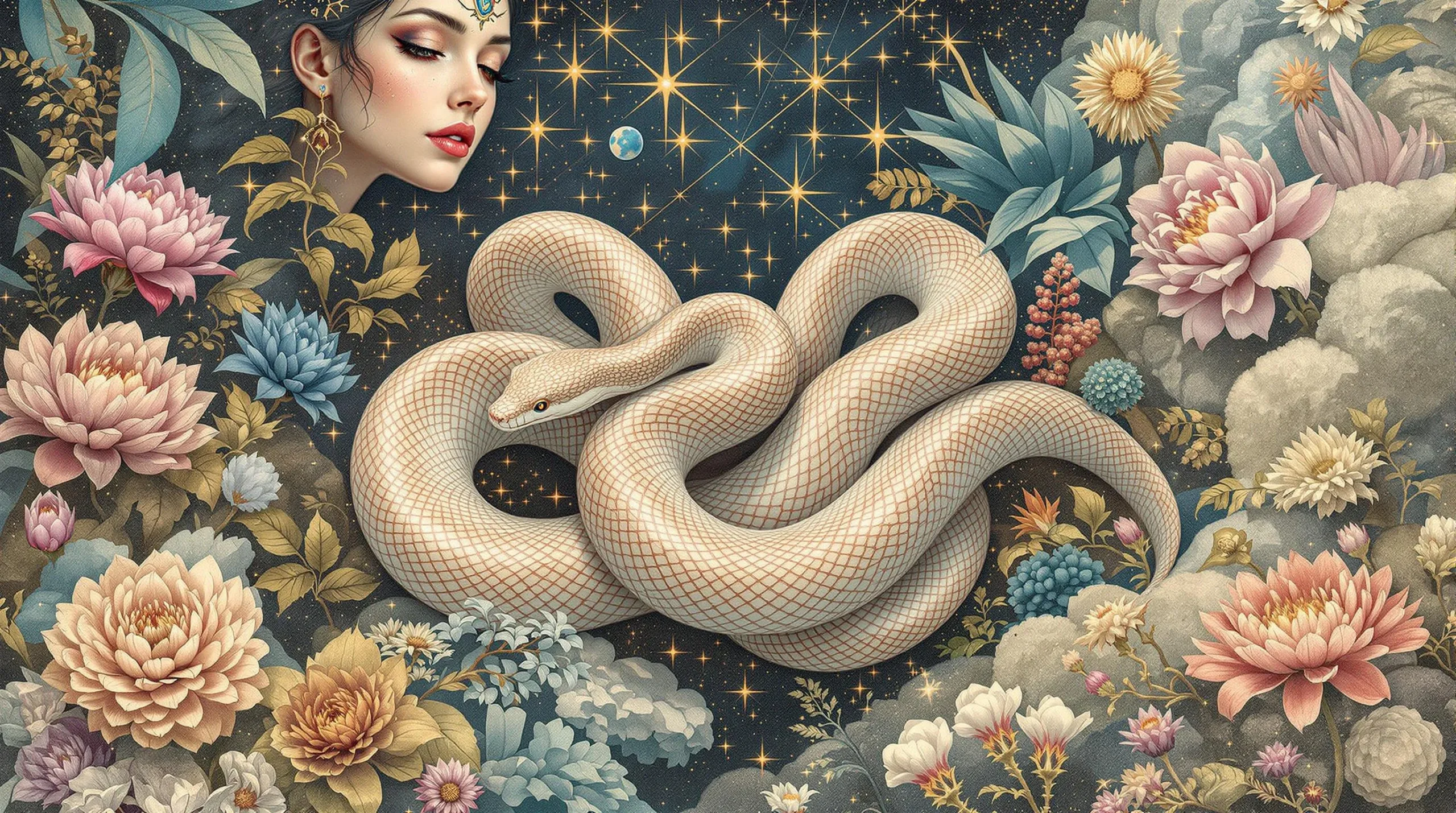


Snake Skin

Archetype Meaning & Symbolism

Shedding, renewal, transformation, residue, memory, outgrown, vulnerability, evidence, history, molting, release, ghost

  • Wear your past until it no longer fits, then leave it behind as a map for those who follow, and a ghost for those who knew you.

If Snake Skin is part of your personal mythology, you may...

Believe

  • My past is a museum I can visit, not a house I must live in.

    Growth is not achieved by adding things, but by subtracting what is no longer true.

    The moment just before a breakthrough, the moment of greatest discomfort, is the most sacred space.

Fear

  • That I will eventually become stuck in one version of myself, unable to change any further.

    That if I shed too much, I will discover there is nothing left at the core.

    That people only love the current skin I am wearing, and they will abandon me when I inevitably change.

Strength

  • Radical adaptability. You have an unparalleled ability to reinvent yourself and thrive in new circumstances.

    Non-attachment to the past. You can release former identities, mistakes, and grievances with unusual grace, allowing you to travel lightly through life.

    Deep empathy for those in transition. You recognize the signs of growth and struggle in others and can serve as a guide or a comforting presence.

Weakness

  • A tendency towards instability or rootlessness. The constant urge to shed can prevent you from forming lasting commitments or seeing difficult projects through.

    Impatience with stability. You may view periods of calm as stagnation and prematurely discard relationships, jobs, or homes that are merely challenging, not constricting.

    An emotional detachment that can keep others at a distance. People may feel they can never truly know you, as the version they connect with may soon be a ghost.

The Symbolism & Meaning of Snake Skin

The Snake Skin is not the snake: it is the beautiful, papery ghost the snake leaves behind. In a personal mythology, it may represent the profound idea that we are defined not by what we are, but by what we have the courage to outgrow. It is the artifact of transformation, the quiet testament to a chapter’s end. To have the Snake Skin archetype in your mythos is to see your life as a series of these sacred sheddings. The skin is the story, the evidence, the part of you that is honored but no longer carried. It is the residue of a former self, treated not as baggage but as a revered relic in the museum of your own becoming.

This archetype also holds the deep wisdom of vulnerability. The process of shedding, ecdysis, is a period of great risk; the new skin is tender and the snake is exposed. Likewise, the moments of our greatest transformation—leaving a job, a city, a belief system—are when we are most raw and undefended. The Snake Skin reminds us that this vulnerability is not a weakness to be avoided but the necessary price of liberation. It sanctifies the liminal space, the uncomfortable, itchy period between who we were and who we are becoming. It is the symbol of the tender new self, before it has hardened into its next form.

Finally, the Snake Skin is a powerful symbol of memory and history made tangible. It retains the patterns, the scars, the very shape of the life that inhabited it. For an individual, this could symbolize an ability to view one's past with clarity and non-attachment. You can examine the patterns of a former self—a past relationship, a discarded ideology—with the dispassionate curiosity of a naturalist. It is your history, undeniably, but it is not you. This allows for a unique relationship with memory, where the past is a source of information and even aesthetic beauty, rather than a chain that binds you to what you once were.


Snake Skin Relationships With Other Archetypes

The Archivist

The Archivist may have a complex relationship with the Snake Skin. Where the skin itself represents letting go, the Archivist’s impulse is to collect, categorize, and preserve. An individual with both archetypes might meticulously document their transformations, keeping journals, photos, and mementos of each “shed” self. The danger and the beauty of this pairing lies in the motivation: is the Archivist preserving the skins as a testament to growth, or are they hoarding them out of a fear of truly letting go, creating a museum that they can’t bear to leave?

The River

The River offers the Snake Skin a path to final release. A skin that falls into a river is carried away, dissolved, and returned to the great cycle. This relationship symbolizes a deep, cleansing form of transformation, one where you not only shed the past but surrender it to a force greater than yourself. It suggests a trust in the flow of time and a release so complete that the evidence itself is washed away. This pairing may indicate a person who moves on from their past selves cleanly, without a lingering need to revisit or analyze what has been left behind.

The Wind

The Wind interacts with the Snake Skin in a more chaotic, unpredictable way than the River. The Wind may pick up the fragile skin and scatter it to unknown places, a dissemination of the past rather than a dissolution. This could symbolize how the stories of our former selves travel, influencing others in ways we never intended or see. It points to a letting go that is less about cleansing and more about release into the world, accepting that the ghost of your past may have a life of its own, far from your awareness.

Using Snake Skin in Every Day Life

Navigating Career Transitions

When leaving a long-held profession, the Snake Skin archetype provides a powerful metaphor. You are not erasing your past, but consciously stepping out of a role that has grown too constricting. The “skin” of that professional identity—the jargon, the uniform, the worldview—is acknowledged as a part of your history, an artifact of a life chapter, but it is no longer what contains you. This allows for a departure that feels less like a failure or a loss and more like a necessary, natural evolution.

Healing from Past Relationships

After a significant relationship ends, one might feel lost, having merged their identity with a partner. The Snake Skin suggests that this shared identity was a skin you both inhabited. The healing process becomes an act of shedding, of carefully peeling away the habits, beliefs, and routines that belonged to that union. You can look upon the empty shape of that past relationship not with bitterness, but with a kind of detached tenderness for the self that lived there, before moving on, renewed and singular again.

Reinventing Personal Style

On a more literal level, this archetype can inform a conscious reinvention of one's outward presentation. A radical haircut, a completely new wardrobe, or the removal of a tattoo can be potent rituals. These are not merely superficial changes but acts of shedding a visual identity that no longer reflects the inner self. It is an alignment of the exterior with interior growth, leaving behind the ghost of a former aesthetic as clear evidence that a transformation has occurred.

Snake Skin is Known For

Shedding

It is the quintessential symbol of molting, the physical act of leaving an old form behind. The skin itself is the proof of this process, a tangible record of what has been outgrown.

Evidence of Growth

Unlike the transformation itself, which can be internal and invisible, the discarded skin is concrete evidence. It is a fragile document of a past life, proof that the creature has grown larger and moved on.

Fragility

The shed skin is a delicate, papery, and often translucent ghost of the snake that wore it. Its fragility speaks to the vulnerability of the past and the delicate nature of memory itself.

How Snake Skin Might Affect Your Personal Mythology

How Snake Skin Might Affect Your Mythos

When the Snake Skin is a central object in your personal mythos, your life story ceases to be a single, linear narrative. Instead, it becomes a collection of distinct epochs, each defined by a profound shedding. Your mythos is not about a static hero on a quest, but about a being whose primary characteristic is its capacity for renewal. You may structure your own history around these transformations: “That was the skin I wore in my twenties,” or “I shed my corporate skin in ‘22.” This creates a layered, palimpsest-like story where past selves are not erased but exist as transparent overlays, visible but no longer worn.

Furthermore, your mythos may grant a kind of sacred status to the act of leaving things behind. The climax of your stories might not be about acquisition—winning the prize, getting the partner—but about liberation. The triumphant moment is the one where the old skin finally splits and you step out, raw and new. Your narrative finds meaning in the empty spaces, the hollow forms you have evacuated. Your personal legend is written in the language of absences, each one a testament to your relentless forward movement and growth.

How Snake Skin Might Affect Your Sense of Self

Your perception of self could become remarkably fluid and non-attached. If the Snake Skin is your artifact, you may see your personality, your beliefs, and even your name as temporary garments. This can be profoundly liberating, freeing you from the tyranny of consistency. You may not feel the need to defend a past opinion or action because it belonged to a former self, a skin you have since shed. The core self is not the skin, but the process of shedding; the being that grows and discards.

This may also foster a deep attunement to your own cycles of growth. You could learn to recognize the subtle signs of an impending “shed”: a feeling of constriction, a chafing dissatisfaction, an itch for the unknown. Instead of viewing these feelings as anxiety or crisis, you might come to see them as a natural and even welcome prelude to your next evolution. You learn to be patient with your own discomfort, knowing it signals that a new, more expansive version of yourself is waiting to emerge.

How Snake Skin Might Affect Your Beliefs About The World

Your worldview might be predicated on the universal principle of transformation. You may see change not as a disruption to the norm, but as the norm itself. Societies, ideologies, and institutions are not, in your eyes, permanent monoliths. They are collective skins, destined to be outgrown and shed as consciousness expands. This can foster a deep sense of hope, even in the face of cultural upheaval, as you see it not as collapse, but as a painful, necessary molting process on a grand scale.

This perspective could also cultivate a unique and profound empathy. When you look at others, you may not see fixed, stable personalities but rather beings in various stages of inhabiting or shedding their own skins. This can dissolve judgment. Someone with rigid beliefs might not seem stubborn, but rather like someone in a skin that is too tight, perhaps afraid of the vulnerability that comes with shedding it. You may see the anger or fear in others as the friction of a soul against a life it has outgrown.

How Snake Skin Might Affect Your Relationships

In relationships, you may be acutely aware of the different “skins” a connection can wear over time. You might understand that the skin of heady infatuation must be shed for a partnership to mature into the skin of deep companionship. This allows you to navigate the natural evolution of relationships with more grace, seeing phase shifts not as failures but as necessary growth. The end of a friendship or romance could be framed not as a tragic loss, but as the shedding of a shared skin that no longer fits one or both parties.

However, this can also present challenges. You may have a tendency to outgrow people, or to perceive a partner’s stability as stagnation. Your own constant evolution could be unsettling for those who desire permanence. There is a risk of developing a pattern of serial connection, shedding partners, friends, and communities like old skins whenever the slightest friction arises, mistaking the normal challenges of intimacy for a sign that you must move on.

How Snake Skin Might Affect Your Role in Life

Your perceived role in life, family, or community is likely to be transient and dynamic. You might resist being typecast, instinctively recoiling from any role that threatens to become a permanent label. You could be the catalyst, the change agent who enters a system, provokes a necessary transformation, and then feels compelled to move on, leaving others to inhabit the new structure. Your life story might be one of serial roles: the scholar, then the traveler, then the entrepreneur, then the hermit. Each is a skin, fully inhabited for a season, then left behind.

This can lead to a sense of purpose that is not tied to a specific function but to the process of embodiment and release itself. Your contribution is not a single, life-long work, but the cumulative effect of the various selves you have been and the transformations you have modeled. You show others that it is possible to live many lives within one lifetime. Your role is not to be a pillar, but to be the force that demonstrates the pillar can be moved, reshaped, or gracefully left behind.

Dream Interpretation of Snake Skin

In a positive context, to dream of finding a complete, iridescent, and beautifully preserved snake skin is a powerful omen of successful transformation. It may suggest that a difficult period of growth you have been undergoing is now complete. You have successfully navigated a major life change—a career shift, a spiritual awakening, recovery from an illness—and you have done so gracefully. The dream affirms that you have left the past behind without destroying it, and that the evidence of your growth is a thing of beauty, a testament to your resilience.

In a negative context, a dream of a snake skin can be deeply unsettling. You might dream that you are trapped inside a skin that is too tight and suffocating, unable to break free. This could symbolize a feeling of being stuck in a job, a relationship, or an old version of yourself that you have intellectually or spiritually outgrown but cannot seem to escape in practice. Alternatively, you might dream of a messy, incomplete shed, with patches of old skin clinging painfully to the new. This may point to a resistance to change or a transformation process that is being hampered by fear, leaving you in a painful, vulnerable, and unresolved state.

How Snake Skin Archetype Might Affect Your Needs

How Snake Skin Might Affect Your Physiological Needs

While the Snake Skin archetype is primarily psychological, it may profoundly influence your relationship with your own body. You could develop a heightened awareness of the body’s constant, subtle processes of renewal: the shedding of skin cells, the growth of hair and nails, the healing of a wound. These small, physical transformations might be seen as microcosms of your larger, spiritual sheddings. The body becomes not just a vessel, but a living metaphor for your core mythos, a constant, tangible reminder of your capacity for renewal.

This connection may also manifest as a deep physiological need for freedom and a visceral aversion to physical constraint. Tight clothing, cramped spaces, or restrictive routines could feel not just uncomfortable but spiritually oppressive, as they mirror the horror of being trapped in a skin that no longer fits. You might find that your physical well-being is directly tied to your sense of autonomy and your ability to move, to breathe, and to inhabit your body without it feeling like a cage.

How Snake Skin Might Affect Your Ideas of Belonging

Your need for belongingness and love may be complicated by your transformative nature. You might find yourself belonging to a series of different groups or communities, fully integrating for a time, only to feel the inevitable pull to move on as you outgrow the collective “skin.” This can lead to a life rich with diverse connections but perhaps lacking a single, long-term tribe. The feeling of belonging is deep and genuine when it happens, but it may also be understood as temporary from the outset.

Ultimately, your deepest sense of belonging might not be with a place or a group, but with other individuals who also embody a transformative ethos. You may find your true kin among fellow “shedders,” people who understand the sacredness of the process and are not afraid of your changes. Love, in this context, is not about finding someone who promises to never change, but about finding someone who promises to witness and support your continuous becoming, loving the being who sheds, not just the skin it currently wears.

How Snake Skin Might Affect Your Feelings of Safety

For you, safety may not be found in walls, savings accounts, or stable routines. In fact, you might perceive such permanence as a trap. True security, from the perspective of the Snake Skin mythos, lies in your very ability to adapt and transform. Safety is the knowledge that no matter what situation you find yourself in, you possess the capacity to shed it and become something new. Your security is your adaptability, your chameleon-like ability to release one form and embrace another. It is a dynamic safety, rooted in motion rather than stillness.

However, the archetype also introduces the paradox that to achieve this ultimate safety, you must repeatedly pass through periods of profound vulnerability. The act of shedding is the moment of greatest risk. Thus, you may have a heightened awareness of the need for temporary sanctuaries or rituals that protect you during these transitions. Your need for safety becomes cyclical: long periods of resilient adaptation are punctuated by short, intense periods where you require a safe container—a trusted friend, a quiet space, a therapeutic relationship—to allow the new skin to emerge and harden.

How Snake Skin Might Affect Your Views of Esteem

Self-esteem, within the Snake Skin mythos, may be sourced directly from your courage and capacity for change. You might measure your worth not by your accomplishments or a static list of qualities, but by your resilience in the face of upheaval and your willingness to let go of what no longer serves you. Each successfully shed skin—each identity transcended, each limitation overcome—becomes a mark of honor, a private trophy that builds a deep, internal sense of competence and strength. Your pride is in your process, not your position.

On the other hand, this can create a fragile form of esteem. You might judge yourself harshly for any perceived failure to transform gracefully. A “messy” shed, where you cling to old habits or mourn a past self for too long, could trigger feelings of shame and stagnation. There can be an unforgiving internal pressure to be constantly evolving, where any period of stability is misread as a failure. Esteem becomes conditional on perpetual motion, which can be an exhausting standard to maintain.

Shadow of Snake Skin

The shadow of the Snake Skin manifests as a compulsive need for novelty masquerading as transformation. It is shedding not for growth, but for escape. This individual flees the moment a situation requires depth, commitment, or weathering a difficult phase, mistaking the normal friction of life for a skin that has grown too tight. They leave a trail of half-finished projects, confused partners, and abandoned communities. The transformation is a performance, a way to avoid the hard work of living. The skin is not shed, it is ripped off prematurely, revealing a self that is not renewed, but merely raw, restless, and running from itself.

Another manifestation of the shadow is the opposite: a complete inability to let go. This person hoards their shed skins, creating a suffocating prison of nostalgia and past identities. Their home, their conversation, their very soul is cluttered with the ghosts of who they used to be. They are haunted by the rustle of their own history, constantly comparing the present to a glorified past. They are trapped not in one skin, but in the weight of all the skins they have ever worn, unable to move forward, paralyzed by the museum they have built around themselves.

Pros & Cons of Snake Skin in Your Mythology

Pros

  • You possess a profound resilience, able to recover from setbacks by reinventing yourself and starting anew.

    You are not defined by past failures or outdated versions of yourself, giving you an incredible sense of freedom.

    You have a deep, intuitive understanding of life's cyclical nature, which reduces your fear of change and endings.

Cons

  • You can be perceived as unreliable, inconsistent, or emotionally unavailable by those who value stability and permanence.

    You may struggle with long-term commitments, sometimes leaving situations or relationships that could have deepened with time and effort.

    The periods of transformation can be isolating and confusing, leaving you feeling vulnerable and without a stable sense of self.