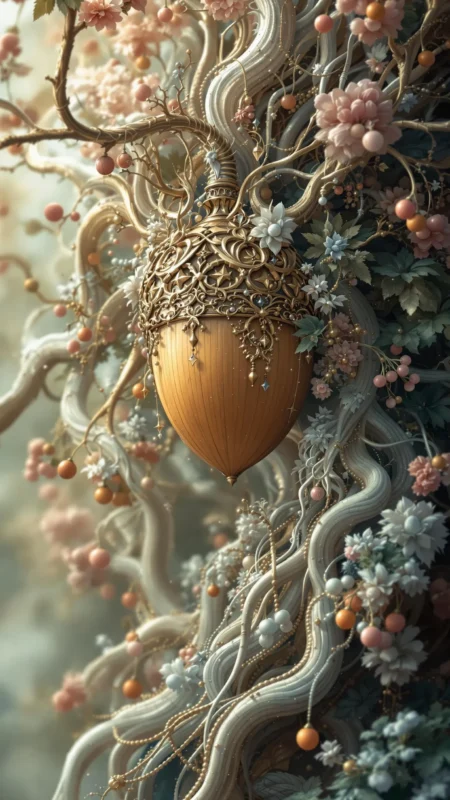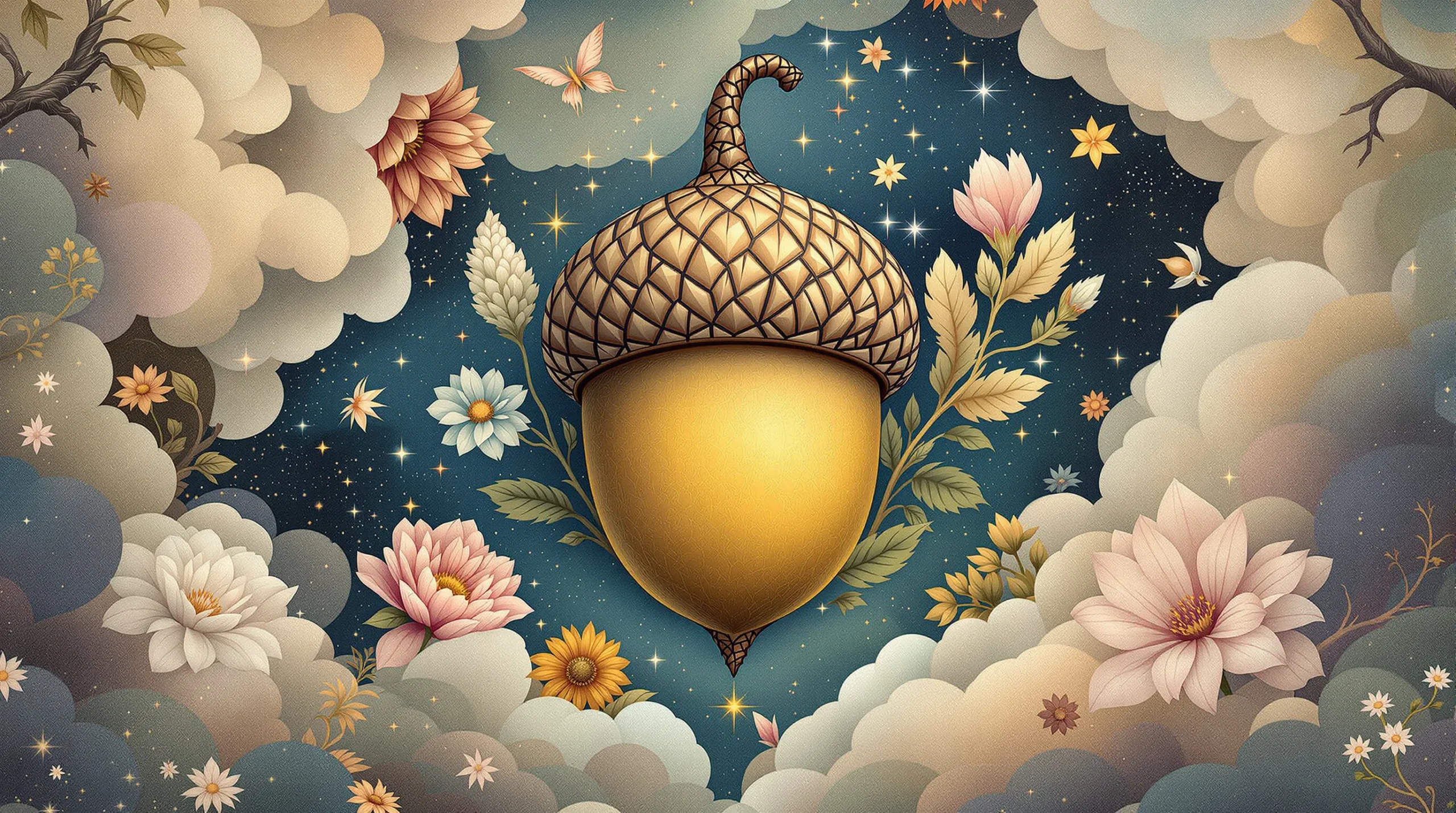


Acorn

Archetype Meaning & Symbolism

potential, latency, patience, compact, nascent, promising, stubborn, overlooked, self-contained, cyclical

  • Do not mistake my silence for absence; I am busy memorizing the shape of the sun from beneath the soil.

If Acorn is part of your personal mythology, you may...

Believe

  • My greatest work is done in silence and obscurity.
  • Patience is not passive waiting; it is the active, sacred process of gathering strength.
  • My current form is merely a vessel for the magnificent destiny I carry within.

Fear

  • That I will be consumed by the immediate needs of the world before I have a chance to grow.
  • That the conditions for my germination will never arrive, and I will remain a seed forever.
  • That I will crack open prematurely, exposing a potential that is not yet ready for the light and will wither.

Strength

  • An almost supernatural patience, allowing you to play the long game in all aspects of life.
  • A deep, self-contained resilience that is not dependent on external validation.
  • The ability to see the profound potential in overlooked people, ideas, and situations.

Weakness

  • A tendency towards procrastination, which can be easily disguised as 'patience.'
  • A difficulty living fully in the present, as your focus is always on a future state of becoming.
  • A stubborn refusal to compromise or adapt, insisting on 'perfect' conditions that may never materialize.

The Symbolism & Meaning of Acorn

To carry the Acorn in your personal mythology is to structure your life around the theme of becoming. You may not concern yourself with the person you are today, seeing it as a temporary shell, a necessary husk. Your identity is tethered to a future state, a magnificent, towering version of yourself that currently exists only as a secret promise. This is a mythos of faith, a belief in a destiny written in a language no one else can read. You may feel that your life's purpose is not to act, but to wait for the perfect conditions to activate the code you carry within, a process that requires a profound, almost cellular, patience.

The Acorn mythos sanctifies the darkness. Growth does not happen in the spotlight, but underground, buried, and away from the clamor of the world. Periods of retreat, isolation, or even depression may be reframed not as failures, but as the essential 'soil time.' You might believe your greatest work is done in secret, that your strength is gathered in the quiet decomposition of the old to make way for the new. This perspective turns suffering into process, seeing personal winters not as an end, but as the cold, dark womb required for your own eventual spring.

The archetype speaks to a radical self-containment. The Acorn holds everything it needs to become the oak; it needs the soil, but the instructions are already complete within. In your own myth, this could manifest as a deep-seated self-reliance, a belief that the answers you seek are already inside you. You may feel a certain wholeness even when you appear small or unproductive to the outside world, secure in the knowledge of your own internal, inviolable blueprint. This is the quiet confidence of knowing you are not empty, just unopened.


Acorn Relationships With Other Archetypes

The Squirrel

The Squirrel archetype represents frantic energy, short-term planning, and the anxiety of survival. To the Acorn, the Squirrel is a paradoxical figure of both annihilation and salvation. It can consume the Acorn, ending its potential for the sake of a day's meal. Yet, in its haste to bury its treasure, the Squirrel is often the very agent that plants the Acorn in the perfect spot for germination. In one's mythos, this relationship might symbolize how life's daily anxieties and external pressures, while seeming to threaten your long-term goals, may inadvertently place you in the exact circumstances needed for your growth.

The Oak Tree

The Oak is the Acorn's future self, its realized destiny. This is not a relationship of peers but of aspiration and inevitability. The Acorn is in constant, silent dialogue with the Oak, feeling the pull of its own magnificent future. For a person with the Acorn archetype, the Oak represents the ancestral wisdom and strength they are striving toward. The life story may feel like a pilgrimage toward this future self, a state of being that feels both fated and yet something that must be earned through patience and endurance. The Oak is the proof that the Acorn's quiet faith is justified.

The Soil

The Soil archetype is the context of transformation, the nurturing medium without which the Acorn remains just a hard, inert object. This relationship highlights a profound dependency on environment. The Acorn's potential is absolute, but its actualization is conditional. For the individual, this could translate into a lifelong quest for the right 'soil': the supportive community, the nourishing relationship, the intellectually stimulating job, or the safe home that will finally allow the hard shell of the self to crack open and release what is held within. It is the understanding that while your potential is your own, its unfolding belongs to the world that embraces you.

Using Acorn in Every Day Life

Navigating Career Stagnation

When a career feels stalled, when promotions are missed and your contributions feel invisible, the Acorn archetype offers a counter-narrative. It suggests this fallow period is not failure but a necessary burial. You may be in your 'soil phase,' gathering unseen strength, developing roots that others cannot see. Instead of frantic striving, you might focus on quiet skill acquisition, on deepening your craft in private. You are not stuck: you are germinating.

Embarking on a Creative Project

Every grand project begins as a small, hard, seemingly insignificant idea. The Acorn teaches that you do not need a fully formed oak tree to begin. You need only to protect the seed. When faced with a daunting creative endeavor, you could focus solely on encapsulating the core concept, the essential 'nut' of the idea. Trust that the entire blueprint for its grandest expression is already held within that humble beginning. The task is not to build a tree, but to plant the seed correctly.

Understanding a Child or Mentee

In mentorship or parenthood, it can be tempting to force growth, to demand results. The Acorn reminds one that potential cannot be cracked open by force; it must be nurtured into unfolding. This archetype encourages providing the 'soil' for others: the safety, nourishment, and patient faith they need to trust their own internal blueprint. It is the wisdom of knowing when to water and when to simply stand back and wait for the sprout to appear on its own terms.

Acorn is Known For

Potential

The Acorn is most famously a vessel of immense, condensed potential. It does not merely hint at a tree; it contains the entire biological and energetic blueprint for a massive oak within its tiny, hardened shell.

Latency

It is known for its period of dormancy, a required time of waiting and seeming inactivity. The Acorn must endure a 'winter' or be buried in darkness before it can begin its transformation, symbolizing the necessity of gestation periods in life.

Nourishment

While holding its own future, the Acorn is also a vital source of food for woodland creatures. This introduces a tension: its potential can be sacrificed for the immediate survival of another, a symbol of how one's own great plans can be consumed by the needs of others.

How Acorn Might Affect Your Personal Mythology

How Acorn Might Affect Your Mythos

When the Acorn shapes your personal mythos, your life story ceases to be a linear progression of external achievements. Instead, it becomes a narrative of latency and emergence, a slow-burn epic where the most important events happen out of sight. The plot is not 'what did you do?' but 'what were you becoming while you were quiet?' Your personal history might be punctuated by long periods of seeming dormancy, which in retrospect are revealed as crucial germination phases. You are the protagonist of a mystery whose central clue is your own potential, and the story's climax is the moment the first green shoot breaks the surface, retroactively giving meaning to all the silent years spent underground.

Your mythos may be organized around 'before the sprout' and 'after the sprout.' Early life might be interpreted as a period of being a hard, self-contained seed, waiting, being passed over, or being buried. The central conflict of your story could be the struggle to find the right conditions, to protect your potential from being consumed or cracked open prematurely. Victories are not counted in trophies or accolades, but in moments of finding the right 'soil' or surviving a 'winter.' The overarching narrative is one of profound trust in an unseen design, a life lived in service to a future self.

How Acorn Might Affect Your Sense of Self

Your perception of self may be split. There is the 'Acorn Self,' the small, tangible, present-day person, and the 'Oak Self,' the vast, powerful, future being that you are destined to become. This can create a strange and sometimes uncomfortable duality. You may feel a deep, unshakable confidence in your ultimate potential while simultaneously feeling insecure or insignificant in your current form. This internal landscape fosters a unique kind of resilience, as criticism of your 'Acorn Self' may not penetrate your core identity, which is firmly rooted in the 'Oak Self' to come.

You may view your own talents and abilities as seeds that have been planted within you. Your responsibility is not to create them, but to tend to them. This can lead to a humble yet potent sense of self, a feeling of being a custodian of a great gift. It may also lead to a feeling of pressure, a responsibility to not squander the immense potential you carry. The self is not a static entity but a process, a slow unfolding, and you may find peace in aligning with this natural, unhurried timeline rather than forcing a premature bloom.

How Acorn Might Affect Your Beliefs About The World

With an Acorn-informed worldview, you may see the world not for what it is, but for what it could be. You might look past the surface of people, institutions, and ideas, searching for the hidden blueprint of their potential. This perspective cultivates a profound patience with the world's imperfections, viewing them as signs of immaturity rather than permanent flaws. You may become a connoisseur of beginnings, a collector of nascent things, finding more beauty in a promising seed than in a flower in full bloom. The world becomes a forest in waiting.

This outlook may also breed a healthy skepticism towards things that appear powerful, polished, and complete. You might intuitively understand that what is large and visible is often at the peak of its strength and on the verge of decline, while true power resides in the small, the overlooked, and the dormant. Time itself is perceived differently: not as a resource to be spent, but as a medium to steep in. You may trust that great, world-changing movements start silently, underground, long before they become visible to the untrained eye.

How Acorn Might Affect Your Relationships

In relationships, you may be drawn to the potential you perceive in others. You might find yourself in the role of the nurturer, the one who provides the 'soil' of belief and patience for a partner to grow into their 'Oak Self.' This can be an act of profound love and generosity, seeing someone more deeply than they see themselves. However, it can also lead to relationships built on a future promise rather than a present reality, causing frustration if your partner has no desire to become the oak tree you envision for them.

You may also be a partner who requires this same patience. You might be slow to reveal your deepest self, needing to feel safely 'buried' in trust before you allow your shell to crack. Intimacy is not a sudden event but a slow germination. Potential partners who are impatient or demand immediate openness may be perceived as a threat. The ideal relationship is with someone who knows how to wait, who understands that your quietness is not emptiness, and who is willing to tend to the ground around you, trusting in the growth they cannot yet see.

How Acorn Might Affect Your Role in Life

Your perceived role in life, in your family, or in your career may be that of the 'Latent Power' or the 'Dark Horse.' You are likely not the one taking center stage in the first act. Your role is to hold potential in reserve, to be the quiet promise that things could be different. You may be consistently underestimated, a position you might consciously or unconsciously cultivate because it provides the safety and lack of pressure needed for germination. You are the keeper of the blueprint, the one who waits for the opportune moment to reveal the true scale of the plan.

This role can also be that of the 'Ancestor-in-Training.' You are living in a way that is meant to build something enduring, something that will provide shade and sustenance for future generations. Your life is not about your own comfort or glory, but about becoming a resource. This infuses your role with a sense of sacred duty and long-term purpose. You are not just building a life; you are growing a legacy, one patient, subterranean ring at a time.

Dream Interpretation of Acorn

In a positive context, to dream of an Acorn is to receive a message from the deepest part of your psyche about your own latent potential. Finding a perfect, intact acorn may signify the discovery of a new talent or purpose. Planting an acorn suggests a conscious and hopeful investment in your own future. Seeing an acorn sprout is a powerful omen of emergence; a project, a new phase of life, or a part of your identity that has been dormant is now ready to break into the light. The dream affirms that your period of waiting has been worthwhile.

In a negative context, acorns in dreams can signal squandered or blocked potential. Dreaming of a pile of rotting or cracked acorns could symbolize a fear that your talents are decaying from lack of use, or that your opportunity has passed. Being pelted with acorns might represent feeling overwhelmed by small, undeveloped ideas without committing to any of them. A squirrel stealing your last acorn could articulate a fear of your potential being consumed by the demands of others or by your own short-sighted survival anxieties, leaving your grander destiny unfulfilled.

How Acorn Archetype Might Affect Your Needs

How Acorn Might Affect Your Physiological Needs

From a mythological perspective, the Acorn archetype may influence you to treat your body as a vessel for stored energy. Your primary physiological need becomes the conservation of resources for a future, large-scale expenditure of growth. You may feel a deep, instinctual need for more sleep, rest, and quiet than others, viewing these not as indulgence but as a sacred duty to your potential. Your body is not a machine for constant output; it is a seed requiring periods of dormancy to gather strength.

Nourishment becomes about long-term fuel, not immediate gratification. You might prefer dense, simple, sustaining foods over complex or stimulating ones. The body's cycles, its rhythms of energy and fatigue, are not to be overridden but honored. There may be a profound acceptance of the body's need to lie fallow, to go through its own winters. Pushing through exhaustion may feel like a violation, a cracking of the shell before its time.

How Acorn Might Affect Your Ideas of Belonging

The need for belonging is transformed into a search for the right 'soil.' You do not seek to fit in with just any group; you seek the one specific environment that can facilitate your unique germination. This may lead to a feeling of being an outsider in many contexts, as you wait for the community or relationship that offers the right combination of nourishment, darkness, and patient faith. True belonging is not about being liked, but about being seen for the oak tree you carry within.

You may form small, intense bonds with the few people who understand your need for long periods of introspection and who do not pressure you to 'bloom' on their schedule. Belonging is felt with the 'gardeners' of the world: the mentors, partners, and friends who see your potential and are content to simply tend the ground around you. It is a quiet, rooted belonging, less about shared activities and more about a shared, patient belief in what is to come.

How Acorn Might Affect Your Feelings of Safety

Safety, for the Acorn mythos, is found in being small, hard, and overlooked. Your sense of security is not tied to high walls or visible strength, but to the protective power of obscurity. You may feel safest when you are underestimated, when no one is paying attention to you, because it is in that state of being ignored that you are free to develop without interference. The greatest threat is premature exposure: being forced into the light before your roots are deep enough.

This need for safety could manifest as a deep-seated secretiveness. Your most cherished plans, your most profound hopes, are kept under wraps, 'buried' in the soil of your private thoughts. Sharing them too early feels like a dangerous vulnerability. Security is the feeling of being a tightly sealed container, your immense potential protected by a humble, unassuming exterior. You are safest when you are a secret waiting to be told.

How Acorn Might Affect Your Views of Esteem

Self-esteem, through the lens of the Acorn, is derived not from external validation but from an internal, unwavering knowledge of your own blueprint. It is the quiet, profound confidence of the seed. Your worth is not diminished by your current smallness or lack of recognition because you are judging yourself by the standard of the oak tree you are becoming. This can create a formidable, self-contained ego that is resistant to both praise and criticism.

Esteem is nurtured in the dark, through the solitary work of self-development and the honoring of your own slow timeline. Accomplishments are measured internally: a new root of understanding, a deepening of a skill, a successful 'winter' endured. Your self-respect comes from the integrity of your own process, from the act of faithfully guarding the sacred potential that has been entrusted to you. It is the pride of being a well-kept promise.

Shadow of Acorn

The shadow of the Acorn archetype manifests as potential that curdles into a fossil. It is the person who endlessly prepares, gathers knowledge, and waits for the perfect moment that never comes. The shell of potential, which should be a temporary vessel, becomes a permanent prison. This individual may look down on those who have 'sprouted' under imperfect conditions, seeing their own inaction as a form of superior wisdom. They hoard their gifts, keeping them in a pristine, dormant state, forever safe from the risk of failure and forever useless. Their life becomes a monument to what might have been, a hard, impenetrable nut that refuses to surrender to the messy, vulnerable process of growth.

The other shadow is the 'embittered sprout.' This is the person who embraced their potential, began to grow, but was damaged by an early frost: a harsh criticism, a failed project, a brutal rejection. The tender shoot of their emerging self was broken. Instead of re-entering a dormant phase to heal and try again, they develop a cynical, defensive armor. They become advocates against hope, warning others not to risk the vulnerability of growth. Their personal mythos is one of being 'nipped in the bud,' and they spend their lives proving that the world is too harsh for beautiful things to survive, using their own story as the primary evidence.

Pros & Cons of Acorn in Your Mythology

Pros

  • You possess a deep well of resilience, viewing setbacks and quiet periods as necessary parts of your growth cycle.
  • You are not easily swayed by trends or the pressure for immediate results, allowing you to pursue goals of lasting value.
  • You maintain a quiet, unshakeable faith in your own internal design, which provides a stable source of self-worth.

Cons

  • You may be consistently underestimated, overlooked for opportunities that require a more immediate display of ability.
  • You can struggle with a persistent dissatisfaction with the present, a feeling of 'not-yet-ness' that hinders joy.
  • Your deliberate, slow pace may cause friction in relationships and workplaces that value speed and rapid iteration.