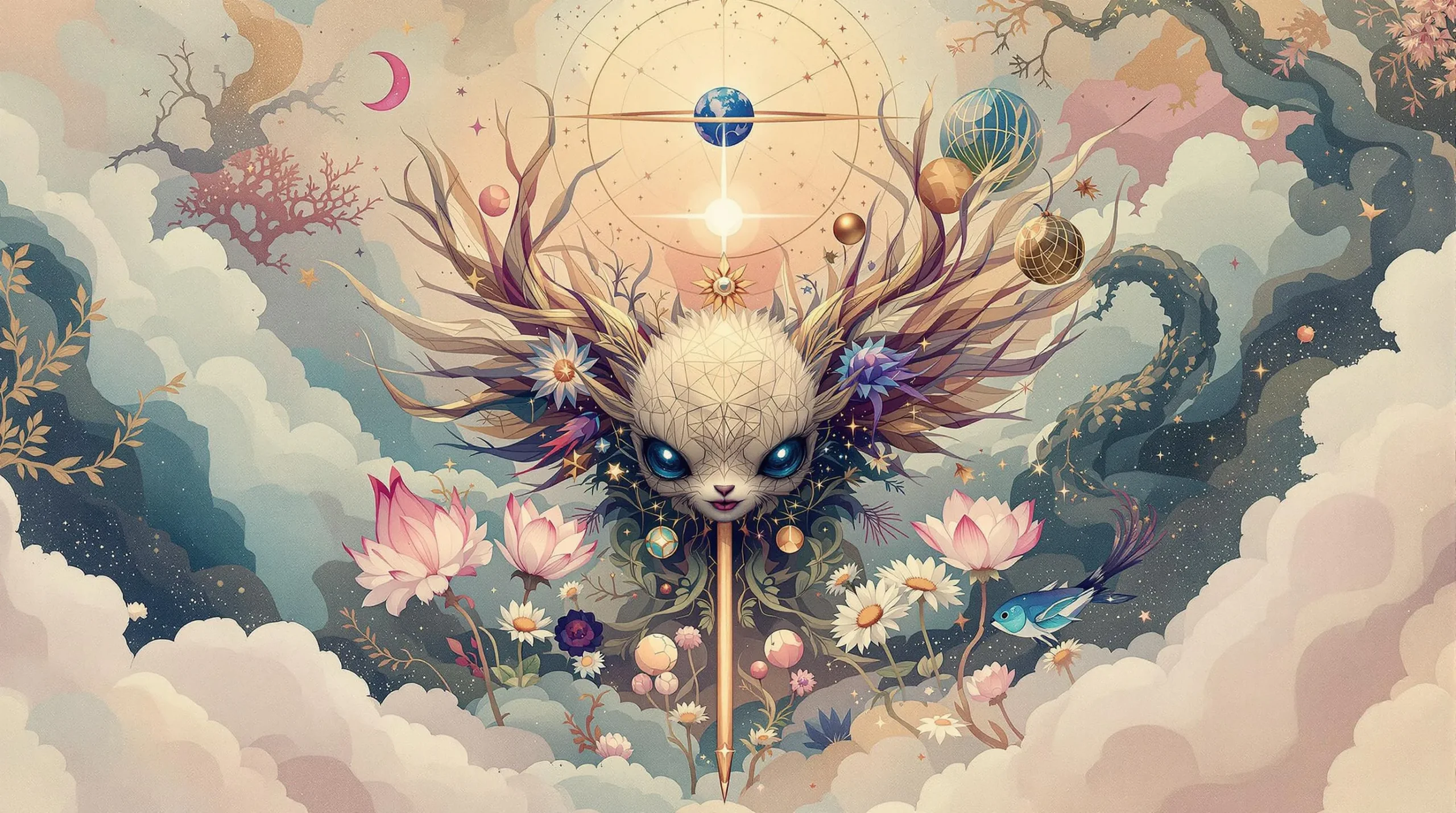


Drumstick

Archetype Meaning & Symbolism

Rhythmic, percussive, focused, impactful, driving, paired, expressive, resonant, insistent, simple

  • The right touch, at the right time, changes everything.

If Drumstick is part of your personal mythology, you may...

Believe

  • You may believe that direct, deliberate action is the only honorable response to life's challenges.

  • You may believe that everything, from relationships to corporations, has an underlying rhythm, and success comes from finding and aligning with it.

  • You may believe that clarity is kindness, and that ambiguity is a form of passive aggression.

Fear

  • You may fear chaos, randomness, and situations where there is no discernible pattern or structure.

  • You may fear losing your timing, falling behind, or becoming fundamentally out of sync with the world around you.

  • You may fear being ineffectual, making no impact, or being a silent instrument that is never played.

Strength

  • You have an exceptional capacity for focus, allowing you to execute tasks with a precision and efficiency that others envy.

  • You are a natural motivator and pacemaker, able to create the structure and drive that helps groups achieve their goals.

  • Your communication is often refreshingly clear and decisive, cutting through confusion and inspiring action.

Weakness

  • You can be deeply impatient with slower, more meandering processes and people, sometimes appearing blunt or dismissive.

  • Your reliance on structure and rhythm can make you rigid and ill-equipped to handle spontaneity or improvisation.

  • You may have a tendency to view others in terms of their utility to your 'rhythm,' struggling to appreciate people who don't fit into your beat.

The Symbolism & Meaning of Drumstick

In personal mythology, the Drumstick may symbolize a profound connection to agency. It is an object that is inert until wielded. It does not hum with latent energy like a crystal, nor does it grow on its own like a tree. Its meaning is forged in the act of impact. For an individual whose mythos is shaped by this archetype, life may not be something that happens to them, but something they happen to. They might believe meaning is not discovered but created, struck into existence through decisive action. Their life story could be a testament to the power of a single, focused will to impose a pattern on the silent potential of the world, to make the void resonate with a chosen beat.

The Drumstick is also the quintessential tool of timing. To embody it is to develop an intimate relationship with cadence, tempo, and the power of the pause. A life lived by this rhythm may be one of exquisite punctuation. Such a person might understand that a moment of silence can be as impactful as a cymbal crash, that the space between actions gives the actions themselves their meaning. Their personal mythology might not be a smooth, flowing narrative, but a percussive piece filled with staccato decisions, long rests of reflection, and driving, rhythmic periods of intense work. They may feel that success in any venture, from love to business, hinges on a simple, sacred principle: finding and holding the right beat.

Often found in pairs, the Drumstick speaks to the mythology of the necessary other. This is not necessarily about romantic partnership, but about the fundamental duality required for complex creation. It could be the interplay between the left and right hand, logic and intuition, action and stillness. A person with this archetype may constantly seek a counterpart to their own energy, not to feel complete, but to create more intricate rhythms. Their life could be a search for the perfect collaborator, the resonant surface, the other stick that allows for the polyrhythms of a truly rich existence, understanding that the most compelling music is rarely made alone.


Drumstick Relationships With Other Archetypes

The Drum

The relationship between the Drumstick and the Drum is one of profound, essential codependence: the active principle and the receptive potential. The Drum holds all possible sounds within its taut silence, but it requires the Drumstick's strike to give them voice. In a personal mythos, this could represent the dynamic between an idea (The Drum) and the action required to realize it (The Drumstick). An individual might feel they are the Drumstick, always seeking a worthy project or person (a Drum) to lend their energy to. Or they may feel like the Drum, full of potential but waiting for an external catalyst to make their mark. The health of this relationship within one's mythos determines whether creation happens at all.

Silence

The Drumstick’s sworn enemy and ultimate collaborator is Silence. Every beat it makes is a temporary conquest of stillness, a carving of sound into the vast expanse of quiet. A mythology centered on the Drumstick might frame life as a struggle against entropy and meaninglessness (Silence) by creating a constant, purposeful rhythm. Yet, the archetype in its wisdom understands that without the canvas of Silence, rhythm itself has no definition. The pauses between notes are what make the music. This relationship can become a sophisticated dance: using the beat to appreciate the quiet, and the quiet to give weight and significance to every single strike.

The Heart

The Heart archetype, with its own primal, involuntary beat, has a fascinating relationship with the willed rhythm of the Drumstick. The Heart is the body's internal, untaught drummer. A person aligned with the Drumstick may live in a state of constant negotiation with their own heart. They might try to impose a willed, disciplined tempo onto their life, their work, their emotions, while the untamable, deeper rhythm of the Heart beats on. Their personal mythology could be about this very tension: the attempt to align the conscious, chosen beat of the Drumstick with the deep, instinctual pulse of the Heart, a quest to make the rhythm of their life an authentic expression of the rhythm of their soul.

Using Drumstick in Every Day Life

Finding Your Focus

When faced with a multitude of tasks that feel overwhelming, the Drumstick archetype suggests a radical narrowing of intent. It is an instrument of singular purpose. You might choose one single goal and, like a drummer practicing a rudiment, apply focused, repetitive action toward it. The Drumstick reminds you that complexity is built from simple, repeated impacts. Instead of trying to conduct the whole orchestra of your life at once, you pick up one stick and strike one drum, cleanly and with purpose, until a rhythm emerges from the chaos.

Communicating with Impact

In conversations where your point is lost in nuance or hedging, embodying the Drumstick encourages a percussive clarity. It is not about being loud or aggressive, but about precision. It’s the difference between a muddled chord and a single, resonant tap that silences the room. You may choose your words to be like a well-aimed strike: brief, pointed, and timed for maximum effect. This could mean waiting for the perfect pause in a meeting to articulate a key idea, leaving no room for misinterpretation.

Navigating Partnerships

The Drumstick is often one of a pair, useless for a complex beat without its counterpart. This offers a lens for examining relationships. If a partnership, professional or personal, feels out of sync, the archetype asks where the rhythm is breaking. Perhaps one 'stick' is overpowering the other, or they are striking at cross-purposes. It invites a conscious effort to listen to the other’s cadence, to find a shared tempo where both partners can contribute to a rhythm more intricate and beautiful than either could create alone.

Drumstick is Known For

Creating Rhythm

Its primary purpose is to strike a surface in a patterned sequence, transforming time into a structured, felt experience. It is the agent of the beat.

Impact and Articulation

Known for its ability to produce a wide range of sounds based on how it strikes. A light tap versus a powerful crash, a strike on the rim versus the skin: it is an instrument of nuanced articulation through direct impact.

Conduit for Expression

It is an extension of the wielder's body and will. The Drumstick itself has no voice; it is a conduit, translating the drummer's internal pulse into an external, audible reality.

How Drumstick Might Affect Your Personal Mythology

How Drumstick Might Affect Your Mythos

When the Drumstick informs a personal mythos, the life story itself takes on a percussive structure. Key events are not seen as flowing transitions but as distinct strikes, moments of impact that changed the tempo forever. There is the sharp snare-hit of a critical decision, the deep kick-drum of a foundational loss, the shimmering cymbal-crash of a sudden success. The narrative is not a meandering river but a composed piece of music. The individual may recount their history in terms of beats and measures, seeing their twenties as a frantic punk-rock blast beat and their forties as a steady, reassuring backbeat. Their story is one of rhythm, of how a steady pulse was found, lost, and rediscovered amidst the noise of life.

Furthermore, the mythos may not be about being the hero, but about being the catalyst. The Drumstick is rarely the focus of the song; it is the force that enables the dance. A person with this archetype might see their role in the grand narrative as providing the essential, often unglamorous, beat that allows others to shine. Their myth is one of the pacemaker, the time-keeper, the one whose consistency and drive created the container for a family’s growth, a company’s success, or a social movement’s momentum. Their legacy is not the melody that people hum, but the unforgettable rhythm that got into their bones and moved them to action.

How Drumstick Might Affect Your Sense of Self

A sense of self shaped by the Drumstick may be deeply rooted in efficacy and direct impact. Identity is not a state of being but a result of doing. The question “Who am I?” is answered with “I am the one who makes things happen.” Self-worth might be measured by the clarity of the ‘sound’ one produces: the successful project, the clear boundary, the decisive action. This can cultivate a highly competent, focused, and reliable personality. The self is perceived as a tool of precision, and there is great pride in its ability to strike true, to bring order to chaos, and to be an unwavering source of drive and rhythm.

Conversely, this may lead to a view of the self as merely a conduit, an instrument played by a will that is not entirely its own. The individual might feel driven by a beat, a relentless need to produce and perform, that feels external or compulsory. This can create a distance from one's own feelings and a sense that the self is valuable only for its utility. There could be a nagging fear of what happens when the beat stops, a terror of stillness. The self, then, is not a person resting, but a pair of drumsticks waiting, anxiously, for the next downbeat, their identity held in suspense until the next impact.

How Drumstick Might Affect Your Beliefs About The World

A worldview informed by the Drumstick archetype may perceive the universe as a vast, silent drum waiting to be played. Reality is not a set of absolute truths to be discovered, but a field of potentials to be actualized through focused intent. Events are not random; they are part of a hidden rhythm, a cosmic tempo that one can either sync up with or clash against. This perspective sees patterns everywhere and believes that understanding the underlying beat of a system—be it social, economic, or natural—is the key to navigating it successfully. It is a profoundly structured and cause-and-effect view of the world: a strike here produces a sound there.

This may also cultivate a certain impatience with ambiguity and messiness. If the world is a composition, then dissonance, chaos, and arrhythmia are problems to be solved, not conditions to be accepted. The world might be divided into things that are 'on-beat' (orderly, efficient, clear) and 'off-beat' (chaotic, slow, unclear). This can lead to a belief that every problem has a point of impact, a single, precise intervention that can restore the proper rhythm. It's a view that prizes clarity and forward momentum above all else, sometimes at the expense of appreciating the complex, un-timed beauty of life's more meandering passages.

How Drumstick Might Affect Your Relationships

In relationships, the Drumstick archetype might manifest as a search for rhythmic compatibility. The primary question of connection is: “Do we move to the same beat?” This can mean shared values, similar energy levels, and a compatible pace of life. Communication is valued for its clarity and directness, like a clean paradiddle. There might be little patience for guessing games or unspoken tensions. The ideal is a relationship where both partners know the count, come in on time, and create a shared life rhythm that feels both grounding and energizing. This can lead to highly functional, synchronized, and productive partnerships.

However, this need for rhythmic precision can be challenging. An individual with this archetype may struggle with partners who are more improvisational, emotional, or fluid in their approach to life. A partner’s need for unstructured time might feel like a dropped beat, causing anxiety. There can be a tendency to try to “conduct” the relationship, to bring the other person into one’s own tempo, which can feel controlling. The paired nature of the sticks suggests a deep need for a counterpart, but if that need becomes rigid, it may lead to seeing partners as accessories to one’s own music rather than as fellow musicians with their own songs to play.

How Drumstick Might Affect Your Role in Life

The perceived role in life for someone with the Drumstick in their mythos is often that of the Pace-Setter. Whether in a family, a creative project, or a corporation, they may naturally assume the responsibility of providing the foundational beat. They are the ones who get things started, maintain momentum, and ensure that the group stays in sync. This is not necessarily a role of overt leadership, like the Conductor, but a more fundamental one. They are the engine room, the metronome, the steady pulse against which all other activity is measured. Their presence is felt as a driving, organizing force.

This archetype can also define one’s role as the Punctuator. This is the person who brings focus and finality. They may not be involved in the day-to-day rhythm, but they are called upon for the critical moments of impact. Their role is to deliver the decisive “no,” to articulate the galvanizing mission statement, or to mark a moment of transition with a clear, resonant action. They are the cymbal crash that announces the climax, or the final, single tap on the rim that signals the end. Their contribution is not in the quantity of their actions, but in their perfect, impactful timing.

Dream Interpretation of Drumstick

To dream of drumsticks in a positive context often speaks to a sense of agency and right timing in your waking life. If you are drumming with ease, creating a powerful and satisfying rhythm, it may suggest you have found your groove. The dream could be affirming that your actions are aligned with your intentions and that you are having the impact you desire on your environment. Finding a pair of pristine drumsticks might symbolize the arrival of a new, vital partnership or the discovery of a new talent for focused action. It is a dream of empowerment, clarity, and being perfectly in sync.

In a negative light, dreaming of drumsticks can signal a loss of control or a deep-seated frustration. A broken drumstick could symbolize a feeling of powerlessness or a tool you rely on (perhaps your voice, your intellect, or a relationship) having failed you. Drumming frantically and creating only a chaotic, arrhythmic noise might reflect a state of anxiety where your efforts feel scattered and ineffective. Dreaming of dropping your sticks, especially during a performance, can point to a fear of failure, of losing your grip, or of falling out of step with the demands of your life. It is a dream of dissonance between your will and the world.

How Drumstick Archetype Might Affect Your Needs

How Drumstick Might Affect Your Physiological Needs

From a personal mythology perspective, the Drumstick archetype can impose a rigorous, rhythmic order on the body's physiological needs. The body is not a vessel for messy, unpredictable appetites; it is a precision instrument that must be maintained. Sleep, diet, and exercise may become non-negotiable parts of a daily 'practice routine.' Meals are not just for hunger, they are timed fuelings. Sleep is not just rest, it is a scheduled restoration period. This can lead to excellent physical health and discipline, as the body is tuned and maintained with the dedication of a professional musician.

This rhythmic approach, however, can create a rigid disconnect from the body's actual, fluctuating needs. A person with this archetype might ignore genuine fatigue because it's not their scheduled 'rest' period, or force a workout when their body is asking for gentleness. The body’s own subtle, organic rhythms may be overridden by the mind's metronome. Illness or injury could be perceived as a catastrophic failure of the instrument, a betrayal by the body, rather than a natural part of life. The need for a perfect tempo can create a tyranny of routine that stifles the body’s own wisdom.

How Drumstick Might Affect Your Ideas of Belonging

The need for belongingness, seen through the Drumstick lens, is a quest to find the band. Love and friendship are experienced as the profound joy of syncing up with another person, of falling into a shared rhythm without effort. Belonging is the feeling of a group marching in time, of a conversation that flows like a perfect drum fill, of a partnership where two people function as a seamless percussion section. One seeks friends and partners who are 'on the beat,' who understand the importance of timing, reliability, and showing up. To belong is to be part of a rhythm larger than oneself.

This can also create a kind of rhythmic intolerance. It may be difficult to feel love for or a sense of belonging with people who are perceived as 'arrhythmic'—those who are chronically late, indecisive, or emotionally unpredictable. The desire to find a 'tight' band can lead to judging and excluding those who play to a different, perhaps more free-form, tempo. The need for belonging can become conditional: you can be in my band, but only if you follow my timing. This may wall one off from the rich, complex music of people whose rhythms are different from one's own.

How Drumstick Might Affect Your Feelings of Safety

For one who identifies with the Drumstick, safety is rhythm. Security, both financial and emotional, is built upon a foundation of predictable patterns and consistent, repeated actions. A steady job, a regular savings plan, a predictable daily routine—these are the steady backbeats that keep the chaos of the world at bay. Safety is an active process of creating and maintaining order. A secure home is one where everything has its place; a secure future is one that has been 'scored' and rehearsed through careful planning. The known beat is a fortress against the terrifying silence of the unknown.

The shadow of this is a profound fear of improvisation. An unexpected event—a job loss, a sudden move, a change in a relationship's dynamic—is not just an obstacle but a threat to the very structure of their perceived reality. It is a skipped beat that throws the entire song into question. This can lead to a state of high alert, where any deviation from the plan triggers anxiety. Safety becomes brittleness. The desire for a predictable rhythm can prevent the person from embracing the spontaneous, life-giving opportunities that always, by their nature, arrive off-beat.

How Drumstick Might Affect Your Views of Esteem

Esteem, for the Drumstick archetype, is directly tied to mastery and impact. Self-worth is earned through the flawless execution of a difficult task, the ability to make a clear and resonant point, or the successful driving of a project to completion. It is the esteem of the skilled craftsperson, the virtuosic performer. Praise is valued most when it recognizes precision, discipline, and effectiveness. To be seen as 'sharp,' 'on point,' or 'the driving force' is the highest compliment. The self is held in high regard not for what it is, but for what it can do with unerring focus.

The fragility of this esteem is its shadow. Because it is performance-based, self-worth can plummet with a single mistake. A clumsy presentation, a misunderstood comment, or a failed project is not just a setback but a reflection of a fundamental flaw in the self. There is little room for the grace of being a work-in-progress. This can create immense performance anxiety and a relentless inner critic who functions as a harsh bandleader, tapping impatiently for a perfection that is impossible to maintain. Esteem becomes a tightrope walk, where any slip threatens a fall into worthlessness.

Shadow of Drumstick

The shadow of the Drumstick emerges when the desire for impact curdles into a need for domination. The beat becomes a march. The rhythmic drive no longer invites others to dance but commands them to fall in line. Here, the Drumstick is a weapon, a bludgeon used to hammer home a point, to silence dissent, and to enforce a rigid, soulless order. Communication ceases to be about clarity and becomes about intimidation. It is the rhythm of the tyrant, the relentless pulse of a machine that has forgotten its human operator. The person living in this shadow creates systems of oppressive predictability, stamping out the beautiful, messy polyrhythms of life in favor of a monolithic, unyielding beat.

The other, more passive shadow aspect is the terror of making a mistake, which leads to a complete cessation of action. This is the dropped stick. Fearing the dissonance of a wrong note more than the emptiness of silence, the individual makes no sound at all. Agency collapses into paralysis. They become a perfectly polished, unused instrument, brimming with potential impact but terrified to make a mark. Their life becomes a long, held breath, a painful rest in a song that never resumes. The fear of an imperfect strike ensures that no strike is ever made, leaving a legacy of profound, resonant silence where a life's rhythm should be.

Pros & Cons of Drumstick in Your Mythology

Pros

  • You provide essential structure and momentum, often becoming the reliable backbone of any successful group endeavor.

  • Your directness and focus allow you to cut through complexity and solve problems with admirable efficiency.

  • You have a gift for creating predictable patterns and a sense of order, which can be deeply calming and reassuring to yourself and those around you.

Cons

  • Your focus on rhythm and precision can lead to you being perceived as rigid, controlling, or emotionally distant.

  • Your discomfort with ambiguity may cause you to struggle in complex emotional situations that lack a clear 'beat' or solution.

  • You might feel directionless or incomplete without a clear project to drive or a partner to sync with, risking a dependency on external validation for your sense of purpose.