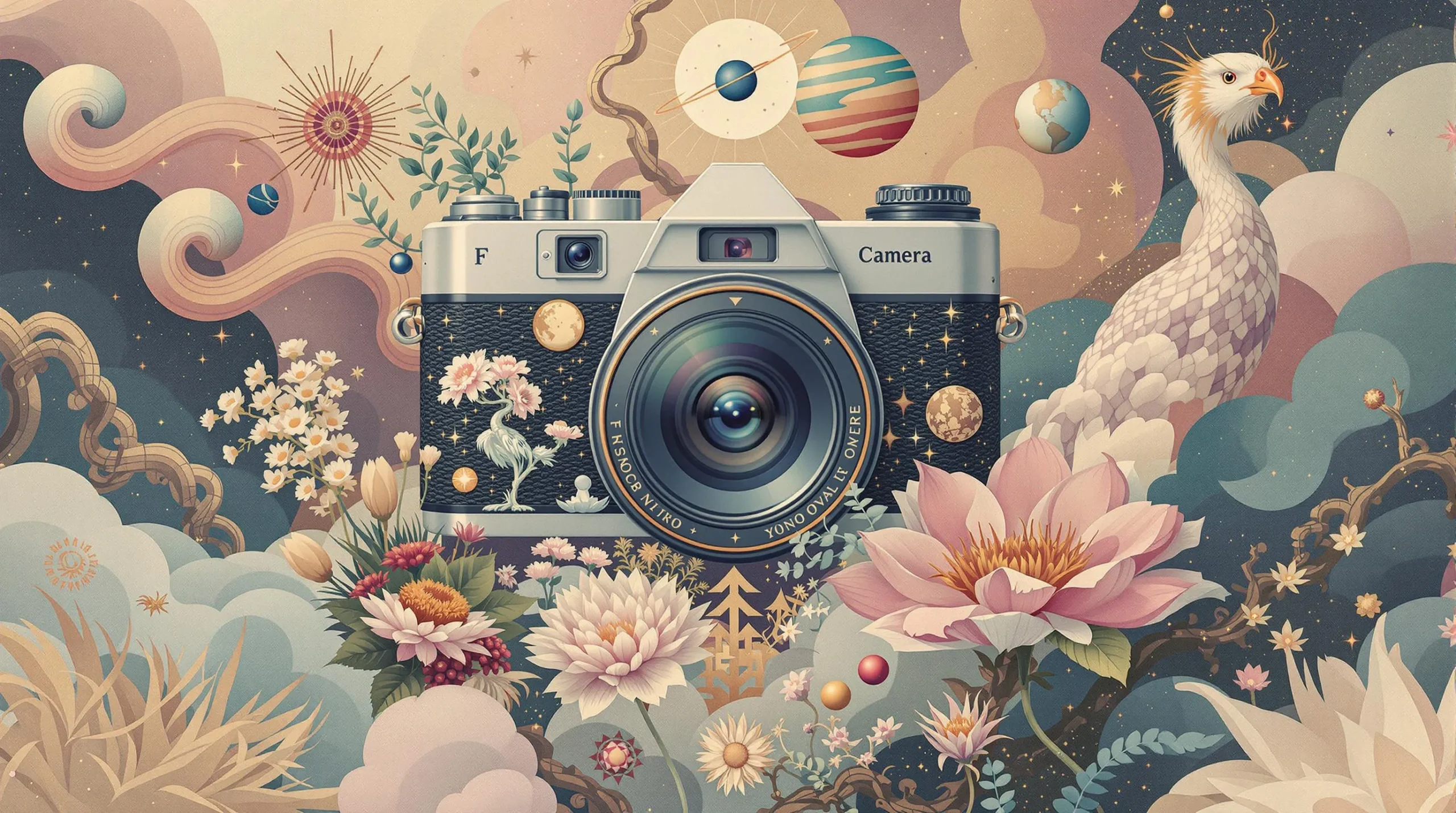


Camera

Archetype Meaning & Symbolism

observant, documentary, selective, framing, focused, mechanical, objective, intrusive, archival, fleeting, truthful, detached

  • What you choose to see is what becomes the story. What you leave out is also the story. Frame wisely.

If Camera is part of your personal mythology, you may...

Believe

  • You may believe that memory is not a fixed record but a creative act, and that the stories we tell ourselves are shaped by the moments we choose to frame.

    You may believe that objectivity is a useful fiction, and that every perspective, including your own, is inherently a partial and selective view.

    You may believe that to truly understand something—a person, a place, a problem—you must first create distance and observe it without immediate emotional entanglement.

Fear

  • You may harbor a deep fear that an experience not captured is an experience lost, that if a moment is not documented it might as well have never happened.

    You may fear true vulnerability, the state of being seen without the flattering angle, the perfect lighting, or the corrective filter.

    You may fear that in your quest to document life, you are forgetting to actually live it, becoming a spectator to your own existence.

Strength

  • You possess a refined ability to find and compose beauty in the overlooked corners of life, turning the mundane into the meaningful.

    You have a gift for emotional objectivity, allowing you to step back from turmoil and assess situations with a clarity that others lack.

    You are a natural archivist of joy, capturing and preserving moments that become anchors of happiness and gratitude for yourself and those you love.

Weakness

  • You may have a tendency to dissociate from direct experience, preferring to engage with the world through the safety of a screen or lens.

    You might be prone to curating a public persona that feels disconnected from your private self, leading to a sense of impostor syndrome.

    You may prioritize the acquisition of a memory over the living of it, treating experiences as objects to be collected rather than processes to be inhabited.

The Symbolism & Meaning of Camera

In personal mythology, the Camera often symbolizes the act of witnessing. It is the silent, ever-present observer, the part of the psyche that records without immediate judgment. To have the Camera as a central archetype suggests a life dedicated to, or at least preoccupied with, bearing witness—to one's own journey, to the lives of others, to the unfolding of history on both a grand and intimate scale. It implies a belief in the importance of the record, that an experience is somehow validated or made more real by its documentation. This creates a mythos in which the protagonist may also be the chronicler, their life story told through a series of carefully preserved scenes, each a testament to the fact: I was here. I saw this.

The Camera is also a profound symbol of perspective and the construction of narrative. The very act of taking a picture is an act of radical editing. You choose where to stand, what to include in the frame, what to exclude, what to bring into sharp focus, and what to leave blurry. In one’s personal mythology, this translates to an acute awareness of how stories are made. You may understand that your 'life story' is not a fixed, objective reality, but a narrative you are actively composing with every choice of what to emphasize and what to ignore. This can be empowering, giving you the authority of an author, but it can also be a burden, a constant pressure to frame your life in the most compelling or flattering way.

Finally, the Camera embodies the duality of exposure and concealment. The flash illuminates what was hidden in darkness, a metaphor for sudden insight, revelation, or the forced confession of a secret. It represents a drive for truth and transparency. Yet, the camera can also be used to create a facade. Through careful lighting, posing, and editing, it can construct an image of perfection that conceals a messy or painful reality. For the individual, this archetypal tension might play out as a conflict between a desire to be seen authentically and a deep-seated fear of being truly exposed, warts and all. It is the dance between the raw documentary and the polished portrait.


Camera Relationships With Other Archetypes

The Mirror

The Camera and the Mirror are siblings concerned with images, yet they operate in fundamentally different temporal realms. The Mirror reflects the immediate, fleeting present. It demands your presence right now and shows you what is, without memory or future. The Camera, however, takes that present moment and embalms it, turning it into an artifact of the past that can be viewed in the future. If the Mirror asks, 'Who are you now?', the Camera asks, 'Who were you then?'. In a personal mythos, this relationship might represent a tension between being present in one's life and being preoccupied with archiving it, a dialogue between the transient self and the permanent record.

The Judge

The Camera can serve as the chief evidence-gatherer for the inner Judge. It provides 'photographic proof' of past failings or triumphs, which the Judge then uses to pass sentence on the self. A photograph from a happy time can be presented by the Judge as evidence that 'you've lost your way,' while an unflattering snapshot can be used as proof of inadequacy. The relationship is one of information and interpretation. The Camera provides the seemingly objective data, but the Judge archetype is the one that imbues that data with meaning, often of a critical nature. A person living this dynamic might feel their past is not a source of nostalgia but a courtroom exhibit for their own prosecution.

The Map

While a Map provides a schematic for a potential journey forward, a Camera provides a record of the journey already taken. They are both tools of orientation, but one is prospective and the other is retrospective. The Map shows all possible routes, an abstraction of future choices. The Camera's collection of photos shows the one route that was actually traveled, a concrete record of past choices. In a life story, the Camera's 'album' may serve as a personal map, its images acting as landmarks of past terrains—places of joy, sorrow, or transformation. One might navigate the future by constantly referring to the visual atlas of their past, seeking patterns in the landscapes they have already traversed.

Using Camera in Every Day Life

Navigating Conflict

When mired in a personal dispute, invoking the Camera archetype may allow you to mentally 'pull back' from the immediate emotional fray. It encourages a shift in perspective, to see the scene not as a participant but as an objective observer. You might ask: What is the wider shot here? What details am I missing because my focus is too narrow? This allows for the observation of body language, tone, and the environmental context with a dispassionate eye, potentially revealing a path to resolution that was invisible from within the heat of the moment.

Cultivating Gratitude

The Camera archetype can be a powerful tool for building a practice of mindfulness and gratitude. It is the conscious decision to 'capture' moments of quiet joy or subtle beauty throughout the day: the specific way the late afternoon light falls on a bookshelf, the steam rising from a cup of tea, a shared, unguarded laugh. By mentally photographing these instances, you build an internal album of positivity, an accessible archive of small wonders that can serve as an antidote to anxiety or despair, reminding you that life, even when difficult, is composed of countless, frame-worthy details.

Making Difficult Decisions

Faced with a complex life choice, the Camera archetype offers the metaphor of adjusting focus. Many decisions are clouded by a cacophony of background noise: the expectations of others, societal pressures, irrational fears. To use the Camera is to consciously turn the focus ring until the essential subject—your own core values and desires—is sharp and clear, while the distracting elements blur into an indistinct background. It is an exercise in isolating what truly matters, in composing the future you want by deliberately choosing your focal point.

Camera is Known For

Capturing a Moment

It is known for its unique ability to freeze time, to excise a single, fleeting instant from the relentless flow of existence and preserve it indefinitely. It transforms the ephemeral into the permanent, an act that can feel like a small rebellion against mortality.

Framing Reality

A camera does not show the world; it shows a piece of the world chosen by its operator. It is fundamentally an act of selection, of drawing a rectangle around a portion of reality and declaring, 'This is what matters.' This act of framing is an act of narrative creation.

Mechanical Objectivity

Unlike the human eye, which is connected to a brain full of biases and emotions, the camera lens offers a cold, mechanical form of sight. It records light and shadow without judgment or interpretation, providing a record that can feel more 'true' than subjective human memory.

How Camera Might Affect Your Personal Mythology

How Camera Might Affect Your Mythos

When the Camera archetype is central to your personal mythos, your life story may cease to be a flowing, linear narrative and instead become a curated exhibition. Your history is not a river, but a series of distinct, framed moments, each laden with significance. The connective tissue between these moments—the mundane, the transitional, the unphotographed—may fade in importance. The mythos is built around 'key frames': the first day of school, the wedding kiss, the view from the summit, the final goodbye. This creates a powerful but potentially disjointed narrative, where life is understood as a collection of peak experiences and poignant scenes rather than a continuous, unfolding process. You become the curator of your own museum, and the story you tell is the one told by the arrangement of images on the gallery walls.

This archetypal influence can also define your role within your own mythos as that of the Official Observer. You are not necessarily the hero fighting the dragon, but the one documenting the fight from a safe distance. Your purpose is not to act, but to see and to record. This creates a mythos characterized by a certain detachment, a story told from a slight remove. The meaning of your life is found not in the visceral, direct experience, but in the analysis and arrangement of the recorded data afterward. Your sacred texts are your photo albums, your hard drives, your cloud storage. Your legendary quest is the pursuit of the perfect shot, the one image that will finally capture the ineffable truth of a moment.

How Camera Might Affect Your Sense of Self

Your sense of self may become deeply entwined with your visual archive. Identity is not an internal, fluid state, but something that is solidified and proven by the photographic record. You are the sum of your pictures. When you feel lost or uncertain about who you are, you might find yourself scrolling through old photos, not just for nostalgia, but for confirmation of your own existence and character. This can create a stable, if somewhat brittle, sense of self. The self is a collage of past moments, a composite of the person smiling in vacation photos and the person looking thoughtful in a candid shot. Who you are now is constantly being measured against this visual evidence of who you have been.

This may also foster a bifurcated self: the 'real' self and the 'photographed' self. There is the messy, spontaneous, un-posed person who lives life, and then there is the curated version who appears in the pictures. This can lead to a feeling of being an actor or a model in your own life, constantly aware of an imaginary lens and adjusting your behavior, expression, and even your feelings to be more 'photogenic.' The primary mode of self-awareness becomes aesthetic: 'How does this look?' This can create a profound sense of alienation from one's own authentic experience, as the pressure to present a perfect image overrides the freedom to just be.

How Camera Might Affect Your Beliefs About The World

A world viewed through the Camera archetype is a world of endless compositional possibilities. Reality is not just something to be lived in, but something to be framed. A walk in the woods becomes an exercise in observing light, texture, and leading lines. A city street is a canvas of geometry and human interaction. This worldview can cultivate a deep and abiding appreciation for aesthetics, a way of seeing beauty and order in places others might overlook. It transforms the passive act of seeing into the active process of composing. The world is a gallery, and every moment is a potential work of art waiting to be captured.

This can also foster a sophisticated, if sometimes cynical, understanding of truth. If all we ever see of an event is a photograph, and a photograph is by its nature a selective, edited frame, then any claim to absolute truth may seem naive. You might come to believe that reality is simply a collection of subjective perspectives, each as valid (or invalid) as the next. This can lead to a nuanced tolerance for ambiguity and a deep skepticism toward any person or institution that claims to have the 'full picture.' The world is not a single story but a billion different photographs of the same event, and the truth, if it exists at all, lies somewhere in the space between them.

How Camera Might Affect Your Relationships

In relationships, the Camera archetype can manifest as a powerful impulse to archive. Every date, every holiday, every milestone must be documented. This can be an act of profound love and care, creating a shared visual history that serves as a testament to the relationship's journey. These archives become sacred objects, proof of the love and time invested, a resource to turn to in times of difficulty to be reminded of the good. The act of taking a photo together can be a ritual of connection, a way of saying, 'This moment, with you, is worth preserving forever.' It solidifies the 'us' by making it a tangible image.

The shadow of this impulse, however, is the creation of distance. The person embodying the Camera archetype may find themselves constantly stepping out of the moment in order to record it. They watch their child's birthday party through a screen, they see the beautiful sunset on a romantic getaway through a viewfinder. By focusing on preserving the memory, they risk missing the actual experience. This can make a partner feel secondary to the documentation process, as if the image of the relationship is more important than the felt reality of it. The person behind the camera is observing the connection rather than participating fully within it, creating a subtle but persistent barrier.

How Camera Might Affect Your Role in Life

You may naturally assume the role of the Historian or Archivist within your family and community. You are the keeper of the visual record, the one who is trusted to capture the significant moments and preserve them for posterity. People turn to you for photos from the reunion, the wedding, the baptism. This is a role of quiet power and immense importance. You are the guardian of collective memory, ensuring that the stories of the tribe do not fade. Your work provides the visual anchors that hold the group's narrative together, connecting past, present, and future generations through a shared album.

Conversely, this archetype often assigns the role of the Outsider. By its very nature, the act of photographing a group separates you from it. You are rarely in the main shot because you are the one taking it. This can translate into a life role characterized by observation rather than full participation. You may feel perpetually on the edge of things, a vital witness to the party but never truly on the dance floor. This can lead to a sense of poignant loneliness, the feeling of being intimately connected to the lives of others but also fundamentally separate, seeing the world and its relationships through the isolating frame of a viewfinder.

Dream Interpretation of Camera

When a camera appears in a dream in a positive context—perhaps it is working perfectly, capturing a scene of great beauty, or developing a photograph that brings joy—it may symbolize a new clarity of vision in your waking life. This could suggest that you are ready to focus on what is truly important, to see a situation or yourself with newfound objectivity. It might represent the successful integration of a past memory, acknowledging its importance and preserving its wisdom. A dream of receiving a camera as a gift could signify the dawning of a new, more observant perspective on your world, an invitation from your psyche to pay closer attention.

A camera dream with a negative charge often involves malfunction or violation. A broken lens, a blurry image, or a camera that refuses to work can symbolize confusion, a distorted self-image, or an inability to see a situation clearly. It may point to a 'corrupted' or painful memory that you cannot process properly. Dreaming of being photographed against your will or by a hidden camera often speaks to fears of judgment, exposure, and a loss of privacy. It can reflect a waking-life feeling of being scrutinized, or a fear that your carefully constructed persona is about to be shattered and your hidden self revealed.

How Camera Archetype Might Affect Your Needs

How Camera Might Affect Your Physiological Needs

For an individual whose personal mythology is informed by the Camera, basic physiological needs may be filtered through a lens of documentation. The act of eating is not merely for sustenance; the meal must be aesthetically pleasing, worthy of a picture. The presentation of food, its colors and arrangement, might become as crucial as its nutritional value. This suggests a need to elevate even the most fundamental bodily functions into the realm of the curated narrative. The body is not just a biological organism requiring fuel; it is a subject, and its maintenance is part of the performance of a life, with each meal a potential scene to be captured and cataloged.

This archetype can also instill a hyper-awareness of the body’s ephemeral nature. Just as the camera freezes a fleeting expression, the individual may be acutely conscious that their physical form is a temporary state. This could lead to a meticulous documentation of the body's changes over time—through selfies, workout progress pictures, or detailed health tracking. It is an attempt to create a permanent record of a transient vessel, a way of fighting back against the inevitability of aging and decay by fixing the body in a series of static images. The physiological self becomes an ongoing project of archival against oblivion.

How Camera Might Affect Your Ideas of Belonging

A sense of belongingness and love can be powerfully constructed and reinforced through the artifacts created by the Camera. Group photographs, family albums, and a history of tagged photos on social media serve as the tangible evidence of connection. They are the visual proof of a shared life. In this personal mythos, belonging is not just a feeling; it is a documented fact. The ritual of gathering for a photo solidifies the identity of the group, and the resulting image becomes an icon of that bond, a touchstone that reaffirms, 'We belong to each other. Here is the proof.'

However, this same archetype can create a paradoxical sense of exclusion for the one who most often wields it. The designated photographer of the family or friend group is instrumental in creating the archive of belonging, yet they are often visually absent from it. Their role is to facilitate the memory of togetherness for others. This can cultivate a subtle but persistent feeling of being an outsider, essential to the group's story but not a visible character within it. They may feel a pang of loneliness when looking at the happy group photos they took, their own presence implied only by their point of view.

How Camera Might Affect Your Feelings of Safety

Safety may be equated with distance and the buffer of the lens. The Camera archetype can provide a psychological shield in overwhelming or threatening situations. By choosing to view a chaotic event through a screen or viewfinder, the individual can process it with a degree of emotional detachment. The act of recording creates a space between the self and the danger, transforming a visceral threat into a visual problem to be composed and captured. In this mythos, safety is not the absence of danger, but the ability to re-frame it as an object of observation rather than an immediate, personal experience.

Conversely, the need for safety can be profoundly threatened by the omnipresence of cameras. In a world of ubiquitous surveillance, from CCTV to smartphones, the camera symbolizes a constant potential for intrusion and exposure. This can foster a worldview where there is no truly safe, private space. The individual may feel perpetually watched, their every move potentially recorded, judged, or taken out of context. True safety, then, becomes the increasingly rare and precious state of being unrecorded, a place or moment free from the gaze of any lens, where one can exist without fear of becoming a permanent, and perhaps compromising, image.

How Camera Might Affect Your Views of Esteem

Esteem needs may be met through the curation and presentation of a visually appealing life. The individual's self-worth can become tied to the skill with which they frame their existence and the external validation this presentation receives. A photograph that garners praise for its artistry, or a series of images that depict a happy, successful, and beautiful life, can provide a significant boost to self-esteem. The admiration is not just for the photo, but for the life the photo represents. In this way, esteem is built upon one's perceived success as the director and cinematographer of their own life story.

This foundation for esteem can be precarious. It makes self-worth dependent on the constant performance and its reception. The pressure to maintain a flawless visual narrative can be immense, leading to anxiety and a fear of being 'found out.' Any crack in the facade—an unflattering photo, a lack of engagement, or a glimpse of the messy reality behind the scenes—can trigger a crisis of esteem. The person may come to believe that their true, unedited self is unworthy of love and admiration, and that their value is wholly contingent on the polished, filtered, and carefully cropped version they show to the world.

Shadow of Camera

In its shadow aspect, the Camera becomes an instrument of soulless consumption. It is the drive to capture without connecting, to turn life into 'content.' This shadow manifests as a voyeuristic impulse, treating people, cultures, and sacred moments as objects for a personal collection. The individual may travel the world but see it only through a viewfinder, accumulating thousands of images but few genuine experiences. This leads to a profound inner emptiness, a life that appears rich and fascinating from the outside but feels hollow and un-lived from within. The archive is full, but the soul is starved, because the act of capturing has completely replaced the act of participating.

Furthermore, the shadow Camera is a master of manipulation and deceit. It weaponizes the power of the frame to construct false narratives. This is the social media identity built on lies of omission, presenting a life of perpetual bliss and effortless success while actively hiding any trace of struggle, failure, or authentic vulnerability. It is the twisting of a shared memory by selectively showing only the 'evidence' that supports one's own biased version of events. This deliberate curation of a false reality not only deceives others but ultimately imprisons the self, creating an ever-widening chasm between the perfected image and the imperfect human being who must live behind it.

Pros & Cons of Camera in Your Mythology

Pros

  • Having the Camera in your mythology fosters a keen eye for beauty and significance, encouraging you to pay closer attention to the details of your world.

    It provides a powerful mechanism for self-reflection and personal growth, allowing you to review your past and understand your own story with greater objectivity.

    It allows you to serve as a valued historian for your loved ones, creating a legacy of shared memories that can strengthen bonds and endure for generations.

Cons

  • It can erect a barrier to full presence, filtering raw experience through a layer of technology and the desire to compose a perfect shot.

    It may lead to an unhealthy preoccupation with image and external validation, tying your self-worth to the reception of your curated life.

    It risks turning life into a scavenger hunt for moments to capture, rather than a journey to be lived, felt, and experienced with all your senses.