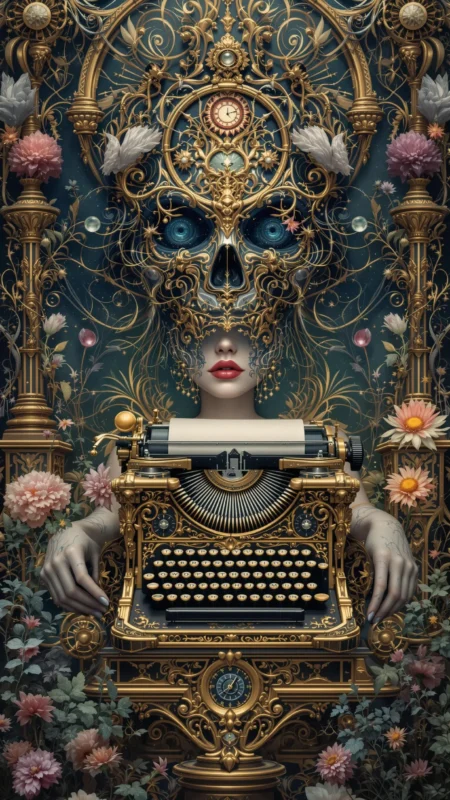


Typewriter

Archetype Meaning & Symbolism

Percussive, deliberate, indelible, mechanical, rhythmic, unyielding, vocal, permanent, laborious, articulate

  • Say what you mean, for every mark is final. There is no delete key for a life lived.

If Typewriter is part of your personal mythology, you may...

Believe

  • You may believe that words are not mere symbols but forces that shape reality; to articulate an idea is to give it power.
  • You may believe that clarity is a moral imperative and that ambiguity is a form of evasion or weakness.
  • You may believe that a life of meaning is one that is consciously composed, not one that is passively experienced.

Fear

  • You may fear the blank page more than anything: a symbol of your own emptiness, silence, and inability to make a mark.
  • You may fear being held accountable for words you no longer believe, trapped by the permanent record of a former self.
  • You may fear that your voice is ultimately insignificant, a clatter that no one will bother to read or remember.

Strength

  • You may possess an uncommon ability to articulate your thoughts with precision, power, and conviction.
  • You may have a formidable strength of will, able to commit to a path and see large, difficult projects through to their completion.
  • You may be a keeper of stories, a reliable witness whose words carry the weight of authority and truth.

Weakness

  • You may be dogmatic and inflexible, finding it difficult to revise your opinions or adapt to new information once you have made a declaration.
  • You may privilege speaking over listening, and accidentally overwrite the narratives of others with your own powerful voice.
  • You may suffer from a paralyzing perfectionism, where the fear of making a permanent mistake prevents you from making any move at all.

The Symbolism & Meaning of Typewriter

In a culture of infinite edits and ephemeral digital content, the Typewriter may emerge in a personal mythos as a symbol of consequence. It stands for the gravity of words and the permanence of choice. Each sentence typed is a pact with reality, an assertion that cannot be silently deleted. To have this archetype is perhaps to believe that your actions leave a tangible mark, that your life is not a draft to be endlessly revised but a final manuscript being written in real time. It represents a deliberate mode of being, one that values the considered statement over the impulsive comment, the committed act over the provisional gesture.

The Typewriter could also symbolize a profound connection to the labor of creation. It is the antithesis of the effortless, invisible work of the digital realm. Its heft, the resistance of its keys, and its noisy operation are constant reminders that bringing something new into the world requires force, effort, and rhythm. This archetype might speak to a part of you that craves a tangible relationship with your own productivity, a desire to hear and feel the output of your intellect. It is a link to a lineage of thinkers and creators who physically battled with their medium to give form to their thoughts.

Furthermore, the Typewriter can represent a particular kind of voice: declarative, resolute, and unapologetic. It is not a voice that whispers or suggests; it is a voice that states. This archetype might shape a personality that communicates with stark clarity, that builds arguments with the percussive force of conviction. In your personal mythos, you may not be just a character in the story, but the narrator, the one whose function is to impose order on the chaos of events, to frame the narrative, and to pronounce, with authority, what things mean.


Typewriter Relationships With Other Archetypes

The Blank Page

The Blank Page is the Typewriter’s necessary other: its canvas and its existential dread. The Page is pure potential, a silent, white void that taunts with its emptiness. The Typewriter’s purpose is to confront this void, to violate its pristine surface with the black ink of story and statement. Their relationship is one of creative tension, an enactment of the fundamental myth of order being imposed upon chaos. For a person with this pairing, life may feel like a constant, necessary struggle to mark the emptiness with meaning.

The Editor

The Editor, especially in its modern sense of revision and refinement, exists in a complicated relationship with the Typewriter. The Typewriter commits; the Editor reconsiders. The Typewriter produces a flawed but finished artifact; the Editor pursues a flawless but perhaps never-finished ideal. Someone with a strong Typewriter archetype in their mythos may find themselves at odds with the part of themselves or others that wants to constantly tweak, polish, and second-guess. They may value the authentic, mistake-ridden first draft of an experience over a heavily curated and revised memory.

The Ghost

The Typewriter’s relationship with the Ghost archetype could be one of mediumship. The Ghost represents the unspoken, the ancestral memory, the story that haunts the present without a voice. The Typewriter provides the physical mechanism for that Ghost to speak. Its clattering keys may be the sound of a secret being brought to light, a forgotten history being recorded. The person living this myth may feel a profound duty to give tangible form to the intangible narratives that drift through their family or culture, transforming a spectral presence into a text that can be read and known.

Using Typewriter in Every Day Life

Finding Your Voice

When you feel your own story is being written by others, the Typewriter archetype may call for a deliberate, forceful expression. It is not about shouting, but about making each word count, each statement a physical act impressed upon the world. It teaches that a voice finds its power not in volume, but in the undeniable weight of its chosen words.

Committing to a Path

Faced with the paralyzing freedom of infinite choices, the Typewriter may inform a path of commitment. Each key strike is a decision made permanent, a sound that cannot be unheard. This archetype could encourage moving forward, accepting the so-called imperfections of a chosen path, and building a narrative one decisive, irrevocable action at a time, rather than languishing in the what-ifs.

Breaking Through Creative Silence

The rhythmic clatter of the keys can become a mantra against the silence of a creative block. The archetype may invite you to simply begin, to create the percussion of progress without immediate concern for perfection. It suggests that a story, or a life, builds not from a flawless first sentence but from the steady, mechanical accumulation of keystrokes, each one a small victory against the void.

Typewriter is Known For

The Indelible Mark

Unlike the ephemeral glow of a screen, the Typewriter's work is a physical artifact. It is known for creating permanent records, for a commitment to language that stains the page and cannot be easily erased or revised away into nothingness.

Percussive Creation

The sound is inseparable from the act. It is known for its rhythmic, almost violent process of creation, where each letter is hammered into existence through focused force, announcing its own arrival with a sharp, satisfying clack.

Mechanical Honesty

There is no spellcheck, no undo, no silent deletion. The Typewriter is known for a raw, unfiltered honesty. Mistakes, hesitations, and changes of heart remain visible on the page, a testament to the messy, authentic reality of any creative process.

How Typewriter Might Affect Your Personal Mythology

How Typewriter Might Affect Your Mythos

When the Typewriter informs your personal mythos, your life story may cease to be a series of accidental happenings and instead become a crafted document. Events are not just lived; they are inscribed. Your narrative might acquire a sense of deliberation and permanence, as if each major decision were a new chapter being consciously typed into existence. You may view your past not as a hazy memory but as a collection of finished pages, complete with their typos and crossed-out lines, all part of the unchangeable record.

This can imbue your personal mythos with a feeling of destiny, but one of your own making. You are the author. This perspective fosters a sense of accountability for the plot of your life. The story does not simply unfold; it is composed, one percussive choice at a time. The central theme of your mythos might become the act of creation itself: the struggle to articulate a meaningful narrative from the raw, chaotic material of daily existence, and to produce a life that reads as a coherent and impactful tale.

How Typewriter Might Affect Your Sense of Self

Your view of self may be inextricably linked to your voice and your power of expression. The Typewriter archetype could foster an identity built on the foundation of authorship: you are what you declare yourself to be. This might lead to a strong, clearly defined sense of self, one that is articulated with confidence and conviction. You may see your personality not as an innate essence but as a character you are actively writing, and you take pride in the consistency and strength of that character’s voice.

However, this can also lead to a self-concept that feels rigid and unforgiving. Because the Typewriter’s marks are permanent, you may feel defined by past statements and outdated versions of yourself. The inability to silently delete a former belief or a mistaken declaration can make personal evolution feel like a messy, public revision process. You might struggle to reconcile the person you are now with the person you ‘published’ yourself as in the past, the old text haunting the new.

How Typewriter Might Affect Your Beliefs About The World

The world, seen through the lens of the Typewriter, may appear as a grand, unfolding manuscript. History is a library of published works, social movements are declarative statements, and political discourse is a battle of competing narratives. You might believe that reality is not something to be discovered, but something to be constructed and articulated. Truth, in this worldview, is forged in the forceful act of stating it clearly and defending it against revision.

This perspective could foster a critical eye for the polished narratives of power. You may be keenly aware of the difference between a clean, revised official story and the messy, authentic rough draft. This might lead to a certain skepticism towards slick presentations and a deep appreciation for raw, unfiltered accounts. The world is not a finished, glossy book; it is a cacophony of typewriters, each hammering out its own version of the story, and you are determined to make your version heard.

How Typewriter Might Affect Your Relationships

In relationships, you may operate with a profound need for clarity and declaration. Ambiguity can feel like a threat, and unspoken feelings a form of withholding. The Typewriter archetype could drive you to define terms, to seek explicit commitment, and to articulate love, anger, and desire in unambiguous language. You might believe that a healthy relationship is one with a clear, co-authored narrative, where both parties know their roles and the plot they are creating together.

This insistence on articulation can sometimes manifest as a lack of patience for the unsaid or the evolving nature of human connection. A harsh word, once spoken, feels like it has been permanently etched into the relationship’s history, making forgiveness difficult. You may struggle when a partner needs space to figure out their feelings, interpreting their silence as a refusal to contribute to the story. Relationships may be strained by your need to have everything ‘on the record,’ leaving little room for the fluid, non-verbal poetry of intimacy.

How Typewriter Might Affect Your Role in Life

Your perceived role in life might be that of the Chronicler, the Witness, or the Declarer of Truths. You may feel a deep-seated responsibility not just to live, but to record, to interpret, and to give voice to the experiences of yourself and your community. Whether in your family, your workplace, or your social circle, you could be the one who crafts the official history, who gives the rousing speech, who writes the letter that clarifies the group’s position. Your purpose feels tied to the act of articulation.

This role can feel like both a privilege and a profound burden. The weight of being the designated narrator, the one who must find the right words to make sense of triumph and tragedy, can be isolating. There might be a feeling that you are serving the story above all else, sometimes at the expense of your own spontaneous participation in it. You are the scribe in the corner of the throne room, diligently recording the proceedings, but never allowing yourself to simply join the dance.

Dream Interpretation of Typewriter

In a positive dream context, a smoothly operating Typewriter may symbolize a powerful creative or communicative breakthrough. The clear, rhythmic clacking of the keys could represent your own voice finding its cadence, your ideas flowing unimpeded into tangible form. Such a dream might suggest you have achieved a new level of clarity about your life's purpose or are ready to confidently ‘publish’ a core part of your identity to the world. It is a dream of articulate power and the deep satisfaction of making one's mark.

Conversely, to dream of a dysfunctional Typewriter—one with jamming keys, a tangled ink ribbon, or that types only gibberish—often points to profound frustration and blockage. It may represent a feeling of being silenced or an inability to express a vital truth. This dream could symbolize a deep-seated fear of permanence, the terror of making a mistake that cannot be undone. It might also suggest that your current methods of communication or ways of thinking are outdated and obstructive, preventing you from writing the next chapter of your life.

How Typewriter Archetype Might Affect Your Needs

How Typewriter Might Affect Your Physiological Needs

The Typewriter archetype may translate physiological needs into a craving for rhythm and tangible effort. The basic need for a stable existence could manifest as a desire for a life with a steady, percussive cadence: a predictable routine of work, rest, and creation that feels grounding. The physical act of striking keys, of feeling the machine respond to your force, can become a proxy for the direct connection between labor and survival. The sound of the typewriter becomes the sound of your own life-sustaining work, a confirmation of your productive existence.

This can also foster a physiological need for structure as a prerequisite for well-being. Just as paper must be precisely aligned to receive the ink, you may feel physically disordered or unwell in chaotic environments. A lack of clear sequence or predictable patterns can feel not just mentally jarring, but physically disruptive. Your body's sense of calm may be directly tied to the orderliness of your surroundings and the mechanical predictability of your daily life, where each action follows the last in a sensible, comforting procession.

How Typewriter Might Affect Your Ideas of Belonging

Belonging, for one with the Typewriter mythos, is about being written into a shared story. Love and friendship are solidified through the creation of a collective history: the exchange of letters, the telling and retelling of common memories, the articulation of mutual vows. You feel you belong when your name is on the roster, your voice is included in the minutes, and your role in the group’s narrative is clear and acknowledged. Connection is an act of co-authorship.

This can make exclusion feel particularly brutal. To be ‘written out’ of the story—to be ignored, have your contributions erased, or be rendered a footnote in the collective memory—is the ultimate rejection. There may be an underlying anxiety about conforming to the group’s dominant plotline in order to maintain your place. The need to belong can become a pressure to self-censor, to avoid becoming a dissenting voice that the group might choose to edit out of its official history.

How Typewriter Might Affect Your Feelings of Safety

From a Typewriter perspective, safety is not an ambient state but a constructed one, built with the indelible ink of language. Security is found in the clearly defined contract, the written law, the explicitly stated boundary. You may feel safest when expectations are on the record and commitments are formalized, leaving no room for the dangerous ambiguity of interpretation. Safety is a document you draft to protect yourself from the chaos of the unsaid and the unreliable nature of verbal promises.

Consequently, a threat to safety often arises from what is unspoken, implied, or ephemeral. A person with this archetype may harbor a deep suspicion of handshake deals and verbal assurances, believing that only what is written down can be trusted. This can lead to a constant drive to document, to archive, to get things in writing, not out of pedantry, but from a core belief that the unrecorded world is an fundamentally unsafe place, and that language is the only reliable shield.

How Typewriter Might Affect Your Views of Esteem

Self-esteem may be directly tethered to the act of production and the authority of authorship. Your worth could be measured by your tangible output: the cogent essay, the finished project, the life story that reads with purpose. Esteem is built with each clack of the key, each completed page. Recognition from others is important, but it is secondary to the self-respect that comes from the disciplined act of creation itself, from knowing you have the power to articulate your inner world and give it form.

This makes esteem incredibly vulnerable to creative blockage or criticism. A period of unproductivity is not just a lull; it can feel like a crisis of self-worth. Negative feedback on your words or ideas may feel like a direct refutation of your very being, because your work and your self are so deeply intertwined. The fear of producing something flawed and permanent can become a paralyzing force, where the only perceived way to protect your fragile esteem is to stop writing altogether, leaving the page forever blank.

Shadow of Typewriter

When the Typewriter falls into shadow, it becomes a tyrannical inner censor. Its percussive rhythm is no longer the sound of creation but the relentless drumbeat of judgment. Every action is scrutinized, every spoken word is instantly critiqued for its clumsiness or error. Life becomes a grim manuscript of failures, and you are its unforgiving editor, circling every flaw in red ink. This shadow fosters a state of creative paralysis and self-loathing, where the fear of producing an imperfect, permanent record ensures that nothing is produced at all.

Another manifestation of the shadow is the propagandist. The Typewriter's power to create a definitive text is warped into a tool for control and manipulation, both of the self and of others. The personal mythos becomes a heavily censored document, a piece of state-run media presenting a heroic but false narrative. In this state, one may use their articulate force to dominate conversations, to invalidate others' experiences, and to insist that their version of reality is the only one that gets published, creating a world of ink-stained lies.

Pros & Cons of Typewriter in Your Mythology

Pros

  • You are likely to possess a clear, powerful voice and the ability to express yourself with memorable force.
  • You treat your life and choices with a seriousness that can lead to building a legacy of substance and meaning.
  • Your deliberate nature allows you to commit to a path and follow through, turning abstract ideas into tangible realities.

Cons

  • You can be rigid and unyielding, trapped by your own past declarations and resistant to necessary change.
  • Your demand for verbal clarity and commitment in relationships can feel like pressure, leaving little room for nuance or silent understanding.
  • You may be haunted by past mistakes, unable to grant yourself the grace of a 'delete' key for the typos in your life's story.