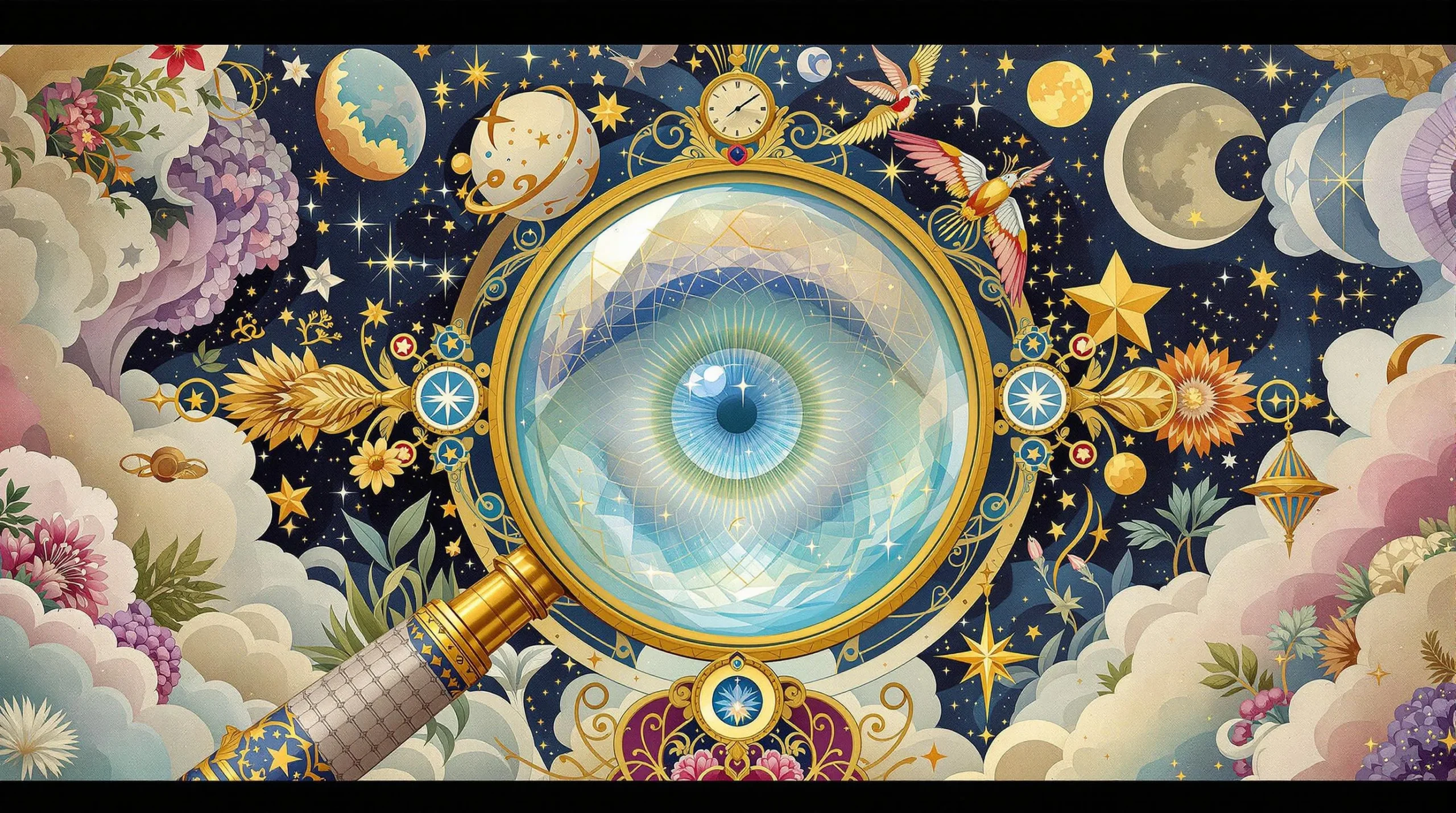


Magnifying Glass

Archetype Meaning & Symbolism

Focused, scrutinizing, detailed, obsessive, clarifying, intense, revealing, analytical, pedantic, illuminating

  • Look closer. Reality is not a billboard, it is a microdot. What you seek is already there, simply too small for a passing glance.

If Magnifying Glass is part of your personal mythology, you may...

Believe

  • The truth is always in the details; grand statements are merely lazy summaries.

    A problem, no matter how large, can be solved if it is broken down into small enough pieces.

    To truly look at something is a moral act; to glance over it is a form of disrespect.

Fear

  • That a tiny oversight or a missed detail will lead to catastrophic failure.

    Being perceived as superficial, unintelligent, or unobservant.

    That after all the analysis, you'll discover you've been focusing on the wrong thing entirely.

Strength

  • An exceptional ability to focus, allowing you to solve problems and master skills that others find daunting.

    A deep perceptiveness that can translate into profound empathy and understanding in relationships.

    The capacity to find endless wonder and beauty in the ordinary world by noticing its intricate details.

Weakness

  • A tendency towards “analysis paralysis,” where the sheer volume of details prevents you from making a decision or taking action.

    In focusing on the minutiae, you may frequently miss the emotional tone of a situation or the larger strategic picture.

    You can come across as critical, pedantic, or aloof to others who do not share your intensity for detail.

The Symbolism & Meaning of Magnifying Glass

The Magnifying Glass is the patron saint of the particular. In a world that prizes the big picture, the grand gesture, the sweeping summary, this archetype champions the profound power of the specific. To have the Magnifying Glass in one's personal mythos is to possess a worldview predicated on the belief that the universe is not in the grain of sand, it *is* the grain of sand. It symbolizes a way of knowing that is empirical, patient, and deeply attentive. This is the power of clarification, of cutting through the fog of generalization to see a thing exactly as it is. It represents the focused mind, capable of shutting out the noise of the periphery to devote its entire capacity to the subject under its lens. It is the instrument that finds the fatal flaw in the contract, the telltale clue at the crime scene, the single cancerous cell in the tissue sample. Its presence suggests a life path dedicated not to breadth, but to depth.

Yet, the lens does not merely clarify; it also transforms. By altering scale, it alters significance. A tiny crack, under its gaze, becomes a chasm. A passing comment becomes a Rosetta Stone for an entire relationship. This power of enlargement is a creative and potentially dangerous force. It allows one to find immense beauty in the filigree of a dragonfly's wing but can also lead to an obsession with a minor personal flaw until it eclipses all else. The Magnifying Glass mythology is therefore a delicate balance: one must learn when to apply its focus to illuminate, and when its intense gaze begins to distort and burn. It is the tool that can reveal the intricate pattern of the snowflake just before it melts.

Furthermore, the archetype carries the symbolism of ignition. Its ability to concentrate light into a point of heat speaks to the power of focused intention. A scattered mind, like diffuse sunlight, is pleasant but lacks potency. The Magnifying Glass teaches that by concentrating one's will, knowledge, and energy onto a single point, one can spark a revolution, create a masterpiece, or achieve a breakthrough. It is the mythology of the specialist, the master craftsperson, the scientist on the verge of discovery. It suggests that true power doesn’t come from having all the answers, but from focusing all of one’s being on a single, vital question until the world catches fire with a new understanding.


Magnifying Glass Relationships With Other Archetypes

The Detective

The Magnifying Glass is the quintessential partner to The Detective archetype. Where The Detective represents the drive for truth and the narrative mind that assembles the story, the Magnifying Glass is the very faculty of perception that makes this possible. It is the eye that does not glaze over. For The Detective, the world is a text full of clues, and the Magnifying Glass is the ability to read the fine print. This relationship highlights a mythos where problems are not solved by force or intuition alone, but by a patient, rigorous application of focused observation, piece by tiny piece.

The Labyrinth

The Labyrinth represents life’s overwhelming complexity, its confusing paths and dead ends. The Magnifying Glass offers a unique, if sometimes flawed, strategy for navigation. Instead of trying to see the whole maze from above, this archetype encourages an intense focus on the path immediately ahead. It examines the texture of the walls, the dust on the floor, the subtle changes in the air. This relationship may grant the individual a way to move through immense confusion without despair, by focusing only on the next correct step. The danger, of course, is that in scrutinizing the path, one may not see the Minotaur waiting around the bend.

The Sun

The Sun is a source of raw, universal power, insight, and vitality, but its energy is diffuse and unfiltered. The Magnifying Glass archetype has a potent, dependent relationship with The Sun. It does not create its own light; it must channel a greater power. It represents the intellect, the ego, or the conscious will that takes the boundless energy of the Self (The Sun) and focuses it toward a specific end. Without The Sun, the lens is inert. Without the lens, The Sun’s power can remain a generalized warmth rather than a force for specific creation or revelation. Their dynamic is a metaphor for harnessing inspiration with discipline.

Using Magnifying Glass in Every Day Life

Deconstructing a Personal Habit

When a persistent, unwanted habit resists change, the Magnifying Glass archetype invites a shift from broad resolutions to microscopic observation. Instead of vowing to “be less anxious,” one might use the lens to examine the single moment before anxiety spikes: the specific thought, the subtle clench in the jaw, the scent in the air. By enlarging this single frame of experience, the entire mechanism of the habit may be revealed, not as a monolithic character flaw, but as a series of tiny, discrete, and ultimately manageable steps.

Mediating a Conflict

In a disagreement between friends or colleagues, the story often becomes a battle of sweeping narratives. The Magnifying Glass archetype could be employed to set aside the grand, emotional claims and focus on a single, verifiable point of contention. It’s a tool for asking: what exact words were used? At what specific time? By isolating and clarifying one small, solid fact from the chaos of perception and memory, a single point of agreement may be established, a foundation upon which a larger resolution could be built.

Finding Beauty in the Mundane

This archetype may be used to combat feelings of ennui or disenchantment with daily life. It is an invitation to pause on a walk and examine the intricate geometry of a single leaf, the universe of lichen on a stone wall, or the complex play of light on a puddle of oil. By focusing intense awareness on one small, ordinary thing, the lens transforms it. The mundane becomes miraculous, a reminder that the world is saturated with detail and wonder, available to anyone willing to stop and truly look.

Magnifying Glass is Known For

Enlargement

Its primary function is to make the minute appear grand. In personal mythology, this translates to the ability to see the profound importance of seemingly small events, words, or feelings, granting them the significance they deserve.

Focusing Light

It can gather diffuse rays of sunlight and concentrate them into a single, powerful point capable of creating fire. This symbolizes the power of the focused mind to channel scattered thoughts or energies into a potent force for creation, insight, or even destruction.

Investigation

Associated with detectives and scientists, the Magnifying Glass is the archetypal tool for inquiry. It represents a commitment to evidence over assumption, and the belief that truth is not revealed, but painstakingly uncovered through close examination.

How Magnifying Glass Might Affect Your Personal Mythology

How Magnifying Glass Might Affect Your Mythos

When the Magnifying Glass is a central object in one's personal mythos, the life story ceases to be an epic of grand battles and becomes a chronicle of profound discoveries. The protagonist of this myth is not the one who conquers kingdoms, but the one who deciphers the map, who understands the intricate mechanics of the castle gate, who notices the single poisoned berry in the bunch. The narrative arc may revolve around a central mystery, not necessarily a crime, but perhaps the mystery of a parent's true nature, the hidden rules of a social group, or the subtle, underlying pattern of one's own recurring failures. Victories are moments of dawning clarity, of “Eureka!” rather than “Hallelujah!”

The story's texture becomes dense with detail. Meaning is not found in the destination but in the careful observation of the journey. This mythos might be punctuated by moments where a seemingly insignificant detail, overlooked by all others, becomes the pivot upon which the entire plot turns. It is a story that honors the quiet, patient work of understanding. The core conflict is often internal: the struggle to maintain focus against distraction, the temptation to accept a simple, comforting lie over a complex, difficult truth, and the heroic effort to see things not as one wishes they were, but exactly as they are, in all their glorious and terrifying specificity.

How Magnifying Glass Might Affect Your Sense of Self

The self-concept shaped by this archetype may be one of a perceiver, an analyst, a knower of secrets. One’s identity could be deeply entwined with the ability to see what others miss. There can be a quiet pride in being the person who “gets it,” who can sit with a complex problem and untangle it. This can foster a strong sense of intellectual independence and self-reliance. You may not see yourself as the life of the party, but as the one who understands the party’s hidden dynamics. The self is a precision instrument, valued for its clarity and sharpness.

However, this same lens can be turned inward with unforgiving intensity. Self-worth may become fragile, dependent on being correct or insightful. Every personal flaw, every mistake, every awkward moment can be placed under the glass and enlarged to monstrous proportions. This can lead to a state of perpetual self-critique, a feeling of being a flawed specimen under one’s own microscope. The challenge for the self in this mythos is to learn to use the lens for compassionate self-understanding rather than harsh self-judgment, to appreciate the intricate patterns of one's own being without obsessing over every perceived imperfection.

How Magnifying Glass Might Affect Your Beliefs About The World

To view the world through the Magnifying Glass is to see it as a vast, intricate, and ultimately knowable machine. It is a perspective that may reject broad, unsubstantiated beliefs in favor of what can be observed and verified. Truth is not a matter of faith but of evidence. This can lead to a worldview rich with wonder at the sheer complexity of existence, from the biomechanics of an insect's leg to the subtle layers of meaning in a line of poetry. The world is not a stage for dramas, but a library of information waiting to be read. This perspective fosters a deep appreciation for expertise, craft, and precision in all its forms.

This worldview could, however, curdle into a form of reductive cynicism. By focusing exclusively on the mechanistic details, one might miss the spirit, the holistic meaning, or the emergent beauty of the whole. A forest becomes just a collection of trees, a symphony just a sequence of frequencies, a person just a bundle of predictable psychological tics. The world, when over-analyzed, can appear drained of its magic, a deterministic system with no room for surprise or genuine mystery. The constant search for flaws and hidden mechanisms may lead to a default state of skepticism, even paranoia, where nothing can be taken at face value.

How Magnifying Glass Might Affect Your Relationships

In relationships, the Magnifying Glass archetype can manifest as a profoundly attentive and perceptive partner. This is the lover who remembers the smallest details of your stories, who notices the slightest shift in your mood, who understands your unspoken needs because they are paying such close attention. They may express love through acts of meticulous care: researching the perfect solution to your problem, planning a trip down to the last detail, or offering a nuanced insight into your struggles that makes you feel deeply seen and understood. Connection is built on a foundation of shared, detailed knowledge of one another.

Conversely, the same intense focus can feel like interrogation. A partner with this archetype may over-analyze every word, every text message, every silence, searching for hidden meanings and potential problems. This scrutiny can create an atmosphere of pressure, where the other person feels they are constantly being evaluated and judged. The relationship can become a subject to be dissected rather than an experience to be lived. The individual may struggle with trust, as their lens is constantly searching for the hairline crack, the subtle evidence of betrayal, transforming intimacy into a forensic investigation.

How Magnifying Glass Might Affect Your Role in Life

The role one assumes in the world is often that of the Specialist, the Analyst, or the Sage. You may be the person in your family, workplace, or community that others turn to when a situation requires not a broad opinion, but a deep dive. You are the one who reads the manual, who checks the sources, who understands the nuance. This role is defined by depth rather than breadth. You might not be the leader who inspires the charge, but you are the strategist who understands the terrain in granular detail, making the charge possible. Your contribution is precision, clarity, and the revelation of hidden facts.

This can also lead to a role as the Critic or the Pedant. Because you see the details so clearly, you also see the flaws with equal clarity. You might become known as the person who always points out what's wrong, who corrects minor errors, who can’t seem to let a small inconsistency slide. While this can be a valuable service, it can also be socially isolating. The individual may feel a sense of duty to point out the truth as they see it, but struggle when this role is perceived by others as negative or unnecessarily contrarian. The challenge is to embody the role of the wise analyst without falling into the trap of the joyless critic.

Dream Interpretation of Magnifying Glass

To dream of a Magnifying Glass in a positive context often suggests a message from the subconscious to pay closer attention. It may appear when you are overlooking a crucial detail in your waking life, whether in a relationship, a work project, or a matter of self-understanding. The dream could be an encouragement to slow down, to stop generalizing, and to focus your awareness on something specific that holds the key to your progress. Finding something beautiful or fascinating through the lens—like the pattern on an insect's wing—can symbolize the rewards of this focused attention, suggesting that joy and insight await if you are willing to look more closely at your own life.

In a negative context, a dream involving a Magnifying Glass may symbolize feelings of being scrutinized, judged, or exposed. You might be the one holding the glass, indicating a tendency towards obsessive analysis or harsh judgment of others or yourself. Alternatively, you may feel that a giant lens is being held over you by a faceless entity, representing a fear of social judgment, performance anxiety, or a sense that your flaws are on public display. A dream where the magnifying glass distorts what you see, or burns it, can be a potent warning that your focus has become destructive, warping your perception of reality or causing harm with your intense analysis.

How Magnifying Glass Archetype Might Affect Your Needs

How Magnifying Glass Might Affect Your Physiological Needs

When the Magnifying Glass informs one's mythos, physiological needs are approached with analytical precision. The body is not just a vessel to be inhabited; it is a complex system to be understood, measured, and optimized. This can manifest as a meticulous approach to diet and health, perhaps involving detailed tracking of macronutrients, sleep cycles, or heart rate variability. Every physical sensation might be scrutinized for meaning: a slight ache is not just an ache, but a data point, a clue to an underlying imbalance that must be investigated and solved. The goal is a kind of somatic enlightenment through information.

This intense focus can create a disconnect from the body's more holistic, intuitive wisdom. The reliance on external data and analysis might drown out the simple, direct signals of hunger, fatigue, or pleasure. There's a risk of treating the body like a machine to be fine-tuned rather than a living, feeling part of the self. This can lead to health-related anxiety, where every minor physical anomaly is magnified into a potential catastrophe. The drive for physiological optimization can paradoxically create a state of mental stress that is detrimental to the very system one is trying to perfect.

How Magnifying Glass Might Affect Your Ideas of Belonging

A sense of belonging, for one guided by the Magnifying Glass, may be found not in large, boisterous crowds, but in small groups where deep, analytical conversation is the currency. They find their tribe among fellow specialists, theorists, cinephiles, or dedicated hobbyists—anyone who shares their passion for a deep dive. Belonging is feeling understood in one's complexity. True intimacy is not just shared emotion, but shared understanding; the feeling that a partner or friend sees and appreciates the intricate details of one's mind and character. Love, for them, may be expressed through the act of paying close, sustained attention to another person.

This need for depth can make superficial social interactions feel alienating and exhausting. Small talk may seem like a waste of time, a frustrating refusal to engage with what is real and specific. This can lead to social isolation or a reputation for being aloof or overly intense. They may struggle to feel a part of any group that values harmony over truth, or broad strokes over fine details. The desire for a connection based on meticulous mutual understanding can set a bar so high that few relationships seem to measure up, leaving them feeling like a perpetual outsider looking in.

How Magnifying Glass Might Affect Your Feelings of Safety

For the individual whose mythos includes the Magnifying Glass, safety is synonymous with information. A sense of security is achieved not through physical barriers or blind faith, but through rigorous analysis and the elimination of unknowns. Before traveling, they may research crime statistics, read every hotel review, and study maps in granular detail. Before signing a contract, they will examine every clause of the fine print. Safety lies in anticipating every possible risk, no matter how small, and having a contingency plan. This creates a feeling of control in a chaotic world; the belief that if you look closely enough, you can foresee and forearm yourself against danger.

This pursuit of safety through scrutiny can easily metastasize into hyper-vigilance. The world, under this intense lens, can transform from a place of opportunity into a minefield of microscopic threats. The focus on what *could* go wrong can eclipse the ability to be present and enjoy what *is* going right. Instead of creating a feeling of safety, this constant scanning for danger can generate a persistent, low-grade anxiety. The very tool used to achieve security becomes the source of insecurity, as the lens always finds another potential flaw, another looming risk, another detail that requires obsessive attention.

How Magnifying Glass Might Affect Your Views of Esteem

Esteem needs are likely met through acts of intellectual or perceptual mastery. Self-worth is built upon the foundation of being the one who sees, who understands, who figures it out. Solving a difficult puzzle, offering an insight that changes the group's perspective, or successfully navigating a complex system are the moments that affirm one's value. Their esteem is not tied to being liked, but to being right; not to being popular, but to being perceptive. They feel worthy when their analytical skills are recognized and validated by others, or when their focused attention yields a tangible, successful result.

This makes their self-esteem particularly vulnerable to intellectual failure or dismissal. Being proven wrong on a matter they have scrutinized can feel like a deep, personal failing. Having their carefully considered insights ignored or glossed over can be more hurtful than a direct insult. There is a persistent fear of missing something, of having a fatal blind spot in their analysis. If their core value lies in their ability to see clearly, then any instance of perceptual error can trigger a profound crisis of self-worth, making them question the very foundation of their identity.

Shadow of Magnifying Glass

The shadow of the Magnifying Glass emerges when the clarifying lens becomes a distorting mirror. In its shadow form, focus curdles into obsession. The individual becomes trapped in a loop of analysis, scrutinizing a minor problem, a past mistake, or a partner's perceived flaw until it expands to fill their entire reality. This is the realm of the paranoid conspiracist who connects unrelated details into a terrifying but illusory pattern, or the hypochondriac who interprets every bodily sensation as a symptom of a fatal disease. Here, the tool of insight becomes an engine of anxiety, building intricate cases for a reality that does not exist. The search for truth devolves into a desperate hunt for evidence to confirm one's deepest fears.

Furthermore, the shadow manifests in the archetype's ability to burn. The same focused light that can spark insight can be used to inflict pain with cruel precision. The shadow-wielder knows exactly what to say to hurt someone most effectively because they have studied that person's vulnerabilities in minute detail. They use their analytical skills not for understanding, but for manipulation and control. This is the critic who doesn't just critique the work but dismantles the artist's confidence. It is the dark side of clarity: a cold, detached intelligence weaponized, proving that sometimes, the most painful burns are the ones that come from a single, concentrated point of light.

Pros & Cons of Magnifying Glass in Your Mythology

Pros

  • You possess a powerful tool for cutting through ambiguity and discovering the truth of a matter.

    Your meticulous attention to detail makes you an invaluable asset in any complex project and a deeply considerate friend or partner.

    You are rarely bored, as you can find a universe of complexity and interest in the most mundane subjects.

Cons

  • You are highly susceptible to analysis paralysis, getting so lost in the details that you are unable to make a decision.

    Your intense focus can be perceived as judgment or criticism by others, potentially straining your personal and professional relationships.

    There is a constant risk of missing the forest for the trees, losing sight of the larger emotional or strategic context.