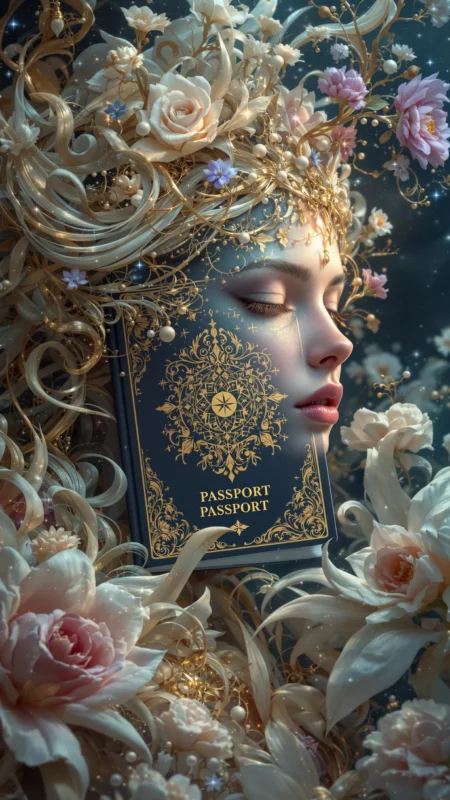


Passport

Archetype Meaning & Symbolism

Authorizing, transitional, liminal, official, bureaucratic, worldly, coveted, validating, fragile, restrictive

  • Your truest home is not a place on a map, but the story you carry within these pages.

If Passport is part of your personal mythology, you may...

Believe

  • Identity is not something you are born with, but something you collect over a lifetime of journeys.
  • The greatest freedom is the freedom to move, to leave, and to cross into the next territory of being.
  • Every border, whether geographical or personal, is an invitation to understand what it means to be both an insider and an outsider.

Fear

  • Being trapped, whether in a physical place, a job, a relationship, or a single version of yourself.
  • Rejection at a critical gateway; being told by an authority 'you are not valid here' or 'you may not enter.'
  • Losing your 'papers'—the symbols of your identity and access—and being rendered invisible, unrecognized, or stateless.

Strength

  • An uncommon adaptability, allowing you to be comfortable and resourceful in new and unfamiliar environments.
  • A broad and nuanced perspective, born from direct experience with diverse cultures and systems of thought.
  • A talent for navigating complex systems, whether they be bureaucracies, social hierarchies, or institutional protocols.

Weakness

  • A deep-seated restlessness that may prevent you from forming deep roots or lasting commitments.
  • A tendency to keep people and experiences at an emotional distance, treating life as a tourist rather than a resident.
  • An over-reliance on external markers of experience—the 'stamps'—for your sense of self-worth.

The Symbolism & Meaning of Passport

In the personal mythos, the Passport is the primary symbol of sanctioned identity and the possibility of transformation. It is not who you are, but who you are allowed to be, and where. Its flimsy pages hold the immense power of passage, the difference between stasis and movement, between being a resident and being a visitor. To have the Passport as part of your inner landscape suggests a life narrative structured around departures and arrivals, of seeing the self as a traveler whose identity is authenticated and expanded with each metaphorical border crossing. It is the belief that one's story is written in transit, in the spaces between fixed points.

This archetype also speaks profoundly to the concepts of privilege and access. A well-stamped passport may be a badge of honor, a testament to a life rich with experience, but it is also an emblem of the resources—financial, temporal, and political—that make such movement possible. It forces a confrontation with the reality of global inequality, where the color and crest on the cover of this small book can dictate one's entire destiny. In a personal mythology, this can manifest as a deep appreciation for one's freedom, or a persistent 'survivor's guilt' over the mobility one enjoys. The Passport is a constant reminder that freedom of movement is not a universal right, but a carefully guarded privilege.

Ultimately, the Passport symbolizes a specific kind of becoming. It suggests that the self is not a fortress to be defended but a territory to be explored, and that true growth requires leaving the familiar 'homeland' of one's comfort zone. Each new experience, challenge, or relationship is a new 'country' that requires a visa of courage and an entry stamp of commitment. The Passport-bearer may believe that the most authentic self is the one that is constantly in dialogue with the world, the one whose biography is written not in a single language or location, but is a palimpsest of every place it has been permitted to go.


Passport Relationships With Other Archetypes

The Map

The Passport maintains a relationship of potential versus permission with the Map archetype. While the Map lays out the entire world in all its sprawling, tantalizing possibility, the Passport dictates which of those possibilities are actually accessible to you. The Map is the dream of everywhere; the Passport is the bureaucratic reality of where you are allowed to go. For a person whose mythos includes both, there may be a constant tension between the desire for boundless exploration (The Map) and the frustrating, often arbitrary, limitations of identity and circumstance (The Passport).

The Key

The Passport is a highly specialized variant of the Key archetype. A Key opens a specific lock: a house, a chest, a diary. The Passport, however, unlocks conceptual barriers of immense scale: national borders, legal systems, cultural spheres. Its power is both greater and more precarious. While a Key's function is purely mechanical, the Passport's power is social and political, subject to the whims of unseen authorities. It is a Key that can be rendered useless not by a change in the lock, but by a change in the rules, making its holder acutely aware that access is always conditional.

The Border Guard

The relationship between the Passport and the Border Guard is one of tense, symbiotic necessity. The Passport is the tribute offered to the Guard, the only token the Guard is trained to recognize and respect. The Guard, in turn, is the figure that gives the Passport its power; without the Guard's authority to deny entry, the Passport would be a meaningless booklet. In a personal mythos, this pairing could represent the dynamic between one's ambitions (The Passport) and the external (or internal) authorities that sit in judgment of them, demanding the correct credentials before allowing passage to the next stage of life.

Using Passport in Every Day Life

Navigating Career Transitions

When facing a shift from one profession to another, the Passport archetype serves as a reminder that you must acquire the right 'visas': new skills, certifications, and a network of contacts. The old career is a country you are departing; the new one has its own customs and language. Your resume becomes the passport itself, each line item a stamp granting you passage, proving you have done the work to be allowed entry into this new territory of expertise.

Healing from Grief

Moving through the landscape of loss may be framed as a journey for which a passport is required. Each stage of grief, from denial to acceptance, can be seen as a difficult border crossing. The passport here is your resilience, your permission slip to yourself to leave the 'country' of acute sorrow. Its stamps are not destinations but milestones: the first day you laughed again, the moment a memory brought comfort instead of pain, the choice to form a new tradition. It authenticates your survival and your right to enter a future not defined solely by what was lost.

Exploring New Belief Systems

For the individual questioning a long-held faith or philosophy, the Passport archetype offers a model for exploration without immediate commitment. It allows you to be a visitor in new intellectual or spiritual 'lands.' You can learn the language of Buddhism, study the customs of stoicism, or appreciate the art of atheism without needing to immediately declare citizenship. It grants the freedom to travel through ideas, collecting insights like stamps, enriching your worldview before you decide where, or if, you wish to build a permanent home.

Passport is Known For

Authentication of Identity

It is a pocket-sized, officially sanctioned declaration of selfhood. It answers the fundamental, bureaucratic question of 'Who are you?' with a name, a date, and a place, providing a reality check against the fluid, often chaotic, nature of internal identity.

Granting of Passage

The Passport is a key, not for a single door, but for the conceptual gates between nations. Its primary function is to permit movement across sovereign borders, transforming a citizen of one place into a temporary, sanctioned alien in another.

A Record of Journeys

Through its collection of stamps and visas, the Passport becomes an accidental diary, a physical ledger of where one has been. Each ink mark is a ghost of an arrival or departure, a miniature monument to a moment of transition, telling a story of movement over time.

How Passport Might Affect Your Personal Mythology

How Passport Might Affect Your Mythos

When the Passport is a central object in your personal mythos, your life story may cease to be a linear progression and instead becomes an atlas of experiences. The narrative arc is not about climbing a single mountain but about traversing a series of varied landscapes. Major life events are not chapters in a book, but stamps in a passport: 'The Year I Lived in the Country of Grief,' 'The Short Visit to the Republic of New Love,' 'The Extended Layover in the Kingdom of a Dead-End Job.' This perspective frames you as the perpetual traveler, the protagonist of an epic journey whose purpose is not to arrive at a final destination but to collect the wisdom of the road.

Furthermore, your mythos may be deeply concerned with themes of identity, citizenship, and belonging. The central conflicts in your story might revolve around questions of authenticity and access. 'Am I valid here?' 'Do I have the right papers to enter this social circle, this career, this state of being?' Your heroic quests may involve searching for a lost or stolen passport—a crisis of identity—or seeking a visa for a desired land, a metaphor for striving toward a significant life goal. Your personal history becomes a testament to your ability to navigate complex systems and cross daunting thresholds, making you an explorer in the vast, interconnected world of human experience.

How Passport Might Affect Your Sense of Self

To see the self through the lens of the Passport is to view your identity as both official and fluid. There is the 'cover' identity—the name, nationality, and face that the world officially recognizes. This is the self that is static, documented, and presented for approval. But beneath this cover is the collection of 'stamps'—the experiences, relationships, and skills you have collected that form a deeper, more nuanced, and ever-changing portrait of who you are. This can foster a resilient self-concept, one that is not shattered by a change in circumstance because it is defined by its adaptability and richness of experience.

This archetype, however, can also cultivate a sense of being perpetually 'foreign.' If identity is a collection of places you have been, you may feel you have no true homeland. This can manifest as a sophisticated, worldly persona that is comfortable anywhere but belongs nowhere. There may be a persistent feeling of being an observer rather than a participant, a visitor who knows the customs but does not feel the deep, instinctual connection of a native. The self becomes a curated collection of influences, a walking embassy of a nation of one, which can be both powerfully unique and profoundly lonely.

How Passport Might Affect Your Beliefs About The World

With the Passport as a guide, one's worldview may be structured around systems, borders, and the rules of passage. You may become acutely aware of the invisible lines that divide people, cultures, and opportunities. The world is not a seamless globe but a patchwork of sovereignties, each with its own criteria for entry. This can cultivate a cynical or pragmatic understanding of power: that access is granted not always by merit, but by possession of the correct credentials. It fosters a 'systems thinking' approach, a knack for understanding protocol and navigating bureaucracy, seeing life as a series of checkpoints to be cleared.

This perspective also imbues the world with a sense of immense possibility, albeit conditional. Every foreign film, every news report from a distant land, every person with a different accent is a reminder of a place you could potentially go, a world you could experience, provided you have the right passport. It fuels a deep curiosity and a rejection of provincialism. The world is seen as a vast library, and you hold the library card. This can lead to a profound appreciation for diversity and a recognition that your own culture is just one of many equally valid ways of being, but it may also carry the risk of viewing other cultures as destinations for consumption rather than as complex, living societies.

How Passport Might Affect Your Relationships

In the realm of relationships, the Passport archetype may incline you to see people as new countries to explore. There is an initial thrill of 'arrival,' of learning their personal customs, their private language, their emotional geography. This can make for a deeply curious and attentive partner or friend, one who approaches others with the respectful wonder of a seasoned traveler. You may value the 'stamps' that different relationships add to your soul, appreciating how each person you connect with expands your understanding of the world and yourself.

Conversely, this archetype carries the significant risk of fostering a transient approach to intimacy. If people are countries, relationships can become 'visits.' There may be a subconscious reluctance to fully 'immigrate' into another person's life, to unpack your bags and apply for permanent residency. The allure of the next destination, the next novel experience, can make long-term commitment feel like a kind of confinement. You may become a collector of emotional souvenirs rather than a builder of shared homes, always holding your passport at the ready for the next departure.

How Passport Might Affect Your Role in Life

Your perceived role in the world may be that of the Ambassador, the Messenger, or the Bridge. You are not meant to stay in one place, but to move between different worlds, carrying ideas, stories, and understanding from one culture to another. Your purpose is found in translation and connection, in explaining the ways of one tribe to another. You may not feel like a leader or a builder in the traditional sense, but rather a vital node in a network, facilitating flow and exchange. Your value lies in your mobility and your unique, cross-pollinated perspective.

Alternatively, you might adopt the role of the Exile or the Refugee, even if only metaphorically. You may feel that you don't truly have a 'home country' or that you have been cast out of your place of origin, whether it be a family, a community, or a belief system. In this case, the passport is not a tool of joyful exploration but a precious, precarious symbol of your very right to exist somewhere, anywhere. Your life's work might then become about the search for asylum, for a place where your identity is finally and fully accepted, and where you can, at last, put your passport away.

Dream Interpretation of Passport

In a positive context, dreaming of a Passport often symbolizes readiness and new potential. To be handed a fresh, empty passport in a dream could signify that a new chapter of your life is beginning, free from the constraints of the past, with a blank slate for you to write your own story. A dream where your passport is being stamped with approval at a border crossing may suggest that you are successfully navigating a major life transition and that you feel validated and accepted in your new role or environment. Finding a lost passport in a dream can point to a rediscovery of a core part of your identity that you thought was gone.

In a negative context, a dream involving a Passport often speaks to anxieties about identity and access. Dreaming that your passport is lost, stolen, or expired as you approach a border could represent a deep-seated fear of being trapped or of missing a crucial opportunity. A dream in which a border guard rejects your passport, perhaps because the photo doesn't look like you, may symbolize a profound crisis of identity or a feeling of being an imposter. These dreams can surface when you feel that you lack the necessary qualifications—internal or external—to move to the next desired stage of your life, leaving you feeling powerless and illegitimate.

How Passport Archetype Might Affect Your Needs

How Passport Might Affect Your Physiological Needs

When the Passport informs your mythology, your relationship with your body's basic needs may adopt a traveler's pragmatism. The need for food, water, and shelter is viewed through the lens of fuel for the journey. Meals may be less about comfort and tradition and more about efficient energy for the next task. The body itself is the vessel that must be maintained to cross the next desert or climb the next mountain; its health is a prerequisite for movement. It’s not about creating a cozy nest, but about ensuring the ship is seaworthy.

This perspective may also lead to a certain detachment from bodily comforts. One might develop a high tolerance for spartan conditions, seeing luxury as unnecessary baggage. Sleep is not a retreat into a sanctuary, but a necessary layover to recharge for the next leg of the trip. This can foster resilience and adaptability, but it could also lead to a neglect of the body's need for deep, restorative rest and the kind of grounding that only comes from true settlement and stability, treating the body more like a vehicle than a home.

How Passport Might Affect Your Ideas of Belonging

Belonging becomes a complex and often poignant theme under the influence of the Passport. Since home is not a fixed location, belonging is not found with a single tribe. Instead, you may find your sense of community in transitional spaces: among fellow expats, in the quiet camaraderie of an airport lounge, or with other perpetual travelers who understand the bittersweet freedom of rootlessness. Love and friendship are based on a shared trajectory rather than shared roots.

This can make deep, long-term intimacy challenging. A partner may be a wonderful 'traveling companion' for a time, but the underlying mythos of movement can create an unconscious barrier to true entanglement. The quest for belonging may become a search for someone whose passport has visas for the same future destinations as yours. The deepest sense of love might be found not in putting down roots together, but in the mutual respect for each other's freedom to depart.

How Passport Might Affect Your Feelings of Safety

Safety, in a world governed by the Passport archetype, is not about walls, locks, or weapons; it is about having the correct documentation. Security is mobility. The greatest sense of safety comes from knowing you can leave a dangerous situation, that you have the right of passage and a place to go. The fear is not of invasion but of detainment. Your security lies in your legitimacy in the eyes of authority, your ability to present the right papers at the right time.

This can create a life where one is meticulously careful with official documents, where the fear of losing a wallet or passport is paramount. Safety needs may manifest as a deep-seated drive to maintain a clean record, to secure citizenships or residencies, and to understand the rules of the systems one inhabits. The ultimate threat is not physical harm but a legal or bureaucratic state of limbo: being declared stateless, having a visa revoked, or being trapped in a place you don't want to be. Security is the freedom to cross the line when you need to.

How Passport Might Affect Your Views of Esteem

Esteem, for one who identifies with the Passport, may be sourced from worldliness, adaptability, and the sheer breadth of one's experiences. Self-worth is built on the courage to enter the unknown and the skill to navigate it successfully. The 'stamps' in your metaphorical passport are your badges of honor; they are proof that you have lived, seen, and survived. You may feel a quiet pride in your ability to be a chameleon, to fit in anywhere, and to possess a perspective enriched by exposure to many different ways of life.

However, this can also make esteem dangerously contingent on external validation and perpetual motion. A period of stasis or a 'rejected visa'—a professional or personal failure—can feel like a fundamental invalidation of the self. Your self-worth might become tethered to how interesting your story is, how many 'countries' you have visited. The shadow of this is a fear of being boring, of having an empty passport. The challenge is to build an intrinsic sense of worth that is not dependent on the next trip or the next stamp of approval.

Shadow of Passport

The shadow of the Passport emerges when the traveler becomes a collector, and people and cultures are reduced to trophies. In this dark aspect, experience is not for wisdom but for consumption, a way to build a more interesting ego. The Passport holder may become a name-dropper of places, using their mobility to assert superiority over those who are more 'provincial.' There is a hollowness to this existence; it is a frantic movement designed to outrun an inner emptiness, a belief that the next destination will finally provide the meaning that the last one did not.

An even darker shadow appears when the Passport fosters not worldliness, but a heightened, fearful tribalism. Here, the Passport is not a key to the world but a shield against it. It becomes a symbol of exclusion, a tool to enforce a rigid 'us versus them.' This individual may be obsessed with the purity of their own 'national' identity, becoming judgmental and xenophobic. They fear contamination by the foreign and use their own status as a citizen to look down upon the immigrant, the refugee, the traveler—the very figures they would be without their own precious booklet. In this shadow, the freedom to travel becomes a rationale for denying that freedom to others.

Pros & Cons of Passport in Your Mythology

Pros

  • Cultivates a genuine open-mindedness and a global perspective that enriches your understanding of humanity.
  • Promotes a resilient, fluid sense of self that is not easily shattered by change or crisis.
  • Unlocks access to a vast range of experiences, knowledge, and personal growth opportunities that a stationary life might not afford.

Cons

  • Can engender a chronic sense of rootlessness and an inability to feel truly at home anywhere.
  • May lead to an identity that is superficial or dependent on performance, always needing the next experience for validation.
  • Risks fostering a privileged or consumerist mindset, where the world and its cultures are seen as a playground for personal enrichment.