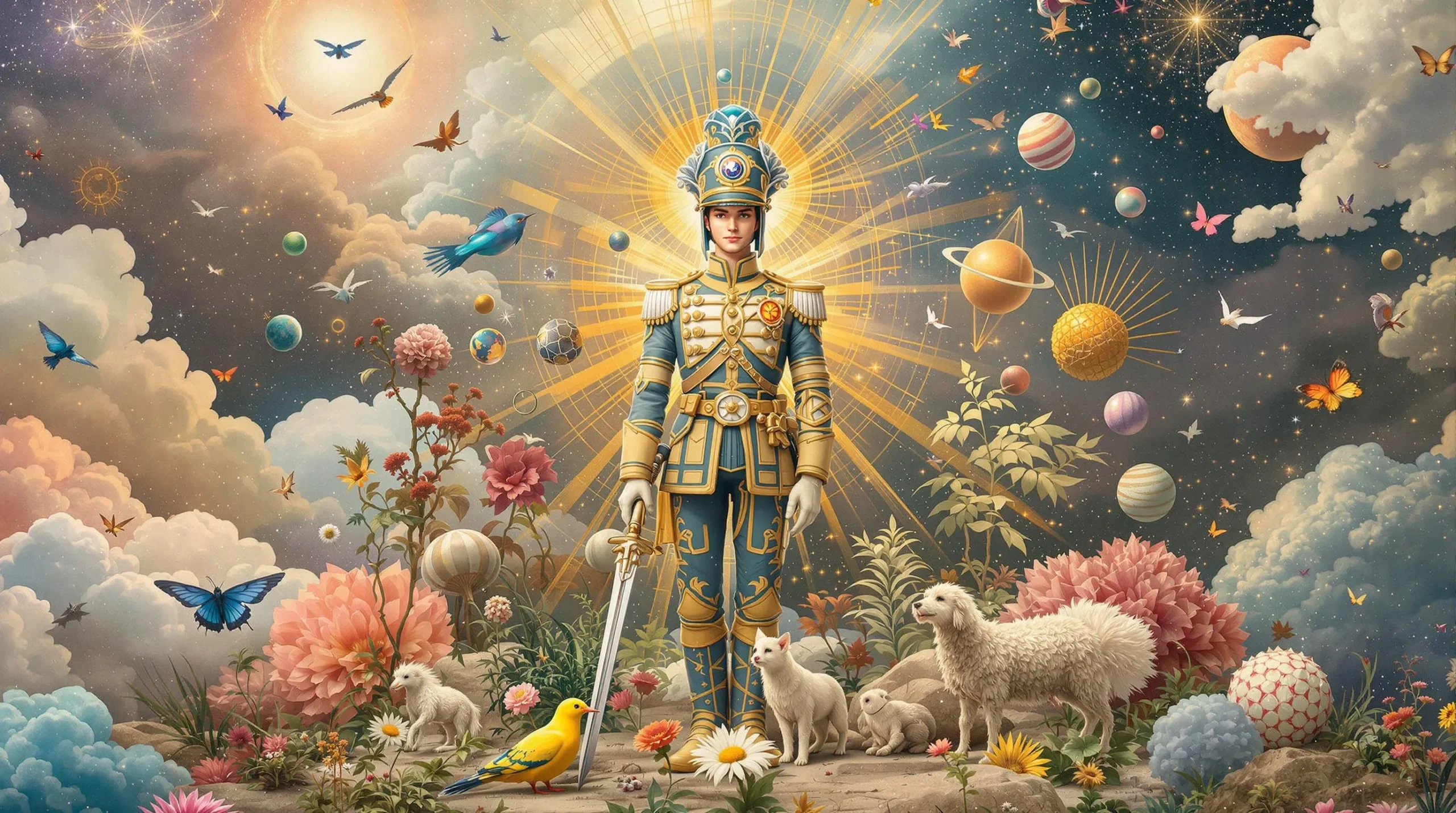


Toy Soldier

Archetype Meaning & Symbolism

Dutiful, rigid, loyal, miniature, silent, uniform, brave, expendable, watchful, ornamental

  • Stand your ground. The universe may be vast and chaotic, but this small patch of shelf is yours to defend.

If Toy Soldier is part of your personal mythology, you may...

Believe

  • That there is profound honor in fulfilling a designated role, no matter how small or seemingly insignificant.

    That discipline, order, and structure are the ultimate virtues, creating a necessary bulwark against the terrifying tide of chaos.

    That one's true purpose is not something to be discovered through introspection, but something to be received and executed with fidelity.

Fear

  • Being out of position, breaking rank, or being singled out from the comforting anonymity of the group.

    That the 'game' will end and you will be put back in the box, your skills and discipline rendered obsolete and meaningless.

    That the hand that moves you is careless, cruel, or has forgotten you entirely on some forgotten shelf of the world.

Strength

  • An unwavering sense of duty and reliability; you are the person who can always be counted on to hold the line when others falter.

    An immense, almost supernatural patience and the ability to endure long periods of waiting, uncertainty, or inactivity without complaint.

    A deep and abiding capacity for loyalty to a cause, a group, or a person, placing the collective good far above personal comfort or desire.

Weakness

  • A critical lack of personal agency and a profound difficulty with improvisation, independent thought, or acting without clear orders.

    An emotional rigidity that serves as armor but also prevents true intimacy, making it difficult to express vulnerability or connect on a deeply personal level.

    A dangerous tendency to see oneself as expendable, leading to the neglect of personal needs, dreams, and overall well-being in the service of a role.

The Symbolism & Meaning of Toy Soldier

The Toy Soldier, standing at attention on a dusty shelf or half-buried in a sandbox, is a paradox of purpose. It embodies duty in its purest, most inert form. Its existence is a testament to a role it can never truly fulfill; it is a warrior that will never fight, a guard that will never face a real threat. In a personal mythos, this may resonate with a sense of readiness for a life-altering event that is perpetually imminent but never arrives. It is the archetype of the understudy, forever prepared, whose identity is forged in the discipline of waiting. This figure symbolizes a commitment to a principle or a person that is absolute, existing outside of circumstance. It is a loyalty that does not require action to be real, a silent, painted-on fidelity.

Furthermore, the Toy Soldier may represent the individual's relationship with systems of power. It is an object created for a purpose by an external force: the manufacturer, the child, the collector. This could inform a worldview where one feels like a pawn in a larger game, subject to the whims of incomprehensible forces. There's a certain freedom in this: a release from the burden of choice. Yet, it's also a profound cage. The soldier's value is not its own. It is measured by its place in the formation, its condition, its role in the diorama. This can speak to a life lived according to external expectations, where self-worth is tied to performance within a predefined structure, and the greatest fear is being deemed broken, obsolete, or simply put back in the box.

The archetype also carries the memory of childhood, of how we first learn to process complex ideas like conflict, order, and mortality. By shrinking war down to the scale of a playroom floor, we attempt to control it. The Toy Soldier in one's personal mythology might suggest a sophisticated, lifelong strategy for managing overwhelming realities by miniaturizing them. It is the practice of creating small, orderly representations of chaotic truths. It symbolizes the part of the self that seeks to impose neat lines and clear rules on the messy, unpredictable nature of human experience, finding comfort not in solutions, but in a well-ordered tableau of the problem itself.


Toy Soldier Relationships With Other Archetypes

The Dollhouse

The Toy Soldier often exists adjacent to The Dollhouse, acting as either its incongruous protector or an invader. This relationship highlights the clash between the rigid, masculine-coded world of conflict and the fluid, feminine-coded world of domestic narrative. In a personal mythos, this tension might play out as a struggle between one's public duties and private life, or a feeling that the sanctuary of home is perpetually threatened by the demands of the outside world. The soldier's fixed purpose is a stark contrast to the Dollhouse's invitation for imaginative play, a dynamic that questions whether one’s role is to guard the story or to disrupt it.

The Chess Piece

A close cousin, The Chess Piece, shares the Toy Soldier’s fate of being moved by an unseen hand across a contested space. Both are units in a game, their value often sacrificial. The difference is one of abstraction versus representation. The Chess Piece is a function—a knight, a pawn—while the Toy Soldier is a tiny effigy of a person. Someone with both archetypes in their mythos may feel this duality acutely: a sense of being both a faceless cog in a grand, strategic game (the Pawn) and a specific, uniformed individual expected to show bravery and hold a pose (the Soldier). It is the feeling of being simultaneously a statistic and a story.

The Giant Child

The ultimate authority in the Toy Soldier's universe is often The Giant Child. This relationship is a powerful metaphor for one's connection to fate, destiny, or a higher power that is perceived as whimsical, irrational, and terrifyingly intimate. The Giant Child can be loving, arranging soldiers in magnificent parades, but it can also be cruel, melting them with a magnifying glass or abandoning them in the rain. For the Toy Soldier, this means existence is contingent on the shifting moods of a god it cannot comprehend. This archetype may surface a deep-seated feeling of powerlessness before the arbitrary nature of fortune, where all one's discipline and readiness can be undone by a moment of cosmic playfulness.

Using Toy Soldier in Every Day Life

Facing a Creative Block

The Toy Soldier stands ready, unmoving, until the command is given. This could translate into a period of patient preparation, a disciplined gathering of resources and ideas without forcing the creative act. It suggests a trust that the moment for action will arrive, and that readiness is its own form of progress, a quiet marshaling of forces before the charge.

Establishing Personal Boundaries

Like a sentry at a palace gate, the Toy Soldier holds a fixed position. One might embody this archetype to define non-negotiable personal lines, learning to stand firm against intrusion not with aggression, but with the quiet, unshakeable resolve of a guard on duty. The power is not in the fight, but in the simple, profound act of occupying one's own designated space.

Navigating Bureaucracy

The archetype embodies following orders and understanding one's role within a larger, often inscrutable, structure. This could become a strategy for navigating complex systems: to perform your specific function with precision and excellence, understanding that you are one piece of a much larger machine. It is a release from the need to understand the whole, focusing instead on the honor of perfecting one's part.

Toy Soldier is Known For

Unwavering Stillness

The soldier's primary state is a readiness that appears as absolute motionlessness, a potent symbol of potential energy and disciplined patience, of a will held in perfect check.

Uniformity

Dressed identically to its comrades, the Toy Soldier represents the subsuming of individual identity for a collective purpose or aesthetic, the self willingly lost to the regiment.

Miniature Scale

Its smallness is key: a representation of a grand, violent concept made safe, manageable, and part of a child's world. It is a microcosm of larger conflicts, observed from a godlike distance.

How Toy Soldier Might Affect Your Personal Mythology

How Toy Soldier Might Affect Your Mythos

When the Toy Soldier marches into a personal mythos, it brings with it a narrative defined by duty and position. The life story may cease to be a quest for self-discovery and become, instead, a tour of duty. Major life events are not seen as choices but as postings, assignments from an unseen commander. The central theme becomes one of service: to a family, a company, an ideal. This mythos finds honor in being a small, reliable part of a much larger story, whether that story is a family legacy, a corporate mission, or a social cause. The narrative arc is not about changing the self, but about holding the self steady against the pressures of the world.

This personal story might also be one of profound patience and stillness. It is a mythos of the vigil, of waiting for the signal, the battle, the promotion. There can be a quiet dignity in this narrative, a life spent in a state of potent readiness. However, it may also be a tragic story, one where the call to action never comes. The soldier remains on the shelf, a monument to untapped potential, its purpose unfulfilled. The personal mythos becomes a chronicle of what might have been, a life defined by the discipline of its own inertia, its value determined by its pristine, unused condition.

How Toy Soldier Might Affect Your Sense of Self

To see oneself through the lens of the Toy Soldier is to view the self as an instrument of a will greater than one's own. Self-worth is intrinsically linked to one's utility and reliability. There can be a deep sense of pride in this: the pride of being the one who never breaks, who always holds the line, who can be counted on in a crisis. The identity is forged in the crucible of discipline, and the internal landscape may be orderly, regimented, and clear of the clutter of excessive emotion or frivolous desire. The self is the uniform.

This perspective, however, may cultivate a profound disconnect from one's own agency and individuality. If the self is a role, what happens when the play is over? There can be a persistent fear of being without orders, a quiet terror of the freedom to choose. Spontaneity may feel like a dereliction of duty. The self-image is one of strength and resilience, but it is the strength of something rigid, not flexible. It can withstand immense pressure, but if it bends too far, it may not bend back; it may simply break.

How Toy Soldier Might Affect Your Beliefs About The World

A worldview shaped by the Toy Soldier is one in which the universe is, or should be, a highly structured place. Reality is perceived as a grand diorama, a complex but ultimately comprehensible system of hierarchies, rules, and battle lines. There is a deep respect for authority and tradition, as these are the forces that create order from the terrifying chaos of raw existence. Events are not random; they are maneuvers in a vast, strategic game. One's place in the world is to understand the rules of engagement for their specific quadrant of the board and to act accordingly.

This perspective may also foster a kind of fatalism. If the world is a game board and you are a piece, then your path is largely determined by the players. This can lead to a sense of detachment from outcomes. You do your duty, you hold your position, and the rest is in the hands of the gods, the generals, or the giant child playing on the floor. There is a comfort in this, a release from the anxiety of ultimate responsibility. The world is a place of grand forces and one's role is not to command them, but to stand firm and bear witness from a designated post.

How Toy Soldier Might Affect Your Relationships

In relationships, the Toy Soldier archetype might manifest as an unwavering, almost militant, loyalty. To be loved by the Soldier is to have a guard at your back, a sentry for your secrets. They express affection through acts of service and protection, by maintaining stability and order. They are the reliable partner who remembers the logistics, the friend who shows up, on time, every time. Their commitment is a fixed position, a promise silently renewed each morning.

However, this same archetype may create a profound emotional distance. The uniform that provides strength also serves as armor. Intimacy requires vulnerability, a breaking of rank, which can feel deeply threatening to the Soldier's sense of self. Emotional expression may be seen as a form of disorder, a messy variable in the clean equation of duty. Relationships can become transactional, based on defined roles and mutual obligations rather than spontaneous connection. The Soldier may love fiercely but from behind a barricade, guarding a heart they don't know how to share.

How Toy Soldier Might Affect Your Role in Life

This archetype powerfully shapes one's perceived role in the world into one of steadfast service. You may find yourself drawn to professions, social circles, or family dynamics where the expectations are clear and the structure is solid. You might be the ultimate employee, the keeper of institutional knowledge, the quiet pillar of a family. The role is a sanctuary, a pre-fabricated identity that provides security and purpose. There is comfort in knowing your precise function, in being the dependable cog that allows the great machine to turn.

The shadow of this is the potential for the role to become a cage. The uniform, once a source of pride, can feel like a costume you can't take off. There may be a growing sense that your entire life is a performance of a part you were assigned, not one you chose. This can lead to a quiet desperation, a yearning for a self beyond the job title or the family function. The greatest challenge for the Toy Soldier is to learn that their worth is not solely defined by their post, and that it is possible to be off-duty without being out of purpose.

Dream Interpretation of Toy Soldier

In a positive context, dreaming of Toy Soldiers may symbolize a growing sense of order, discipline, and control in one's waking life. Seeing them arranged in neat, orderly rows could suggest that you are successfully marshaling your inner resources, preparing for a future challenge with a feeling of competence and readiness. You may be in command of your own small army of talents and strengths. The dream could be an affirmation that your patience and preparation are building a solid foundation, and that you are ready for the 'command' to move forward on a project or life goal.

In a negative light, dreaming of Toy Soldiers can evoke feelings of powerlessness, depersonalization, and expendability. If the soldiers are broken, scattered, or being manipulated by a careless force, it may reflect a fear that you are a mere pawn in someone else's game, a casualty in a conflict that is not your own. Melting soldiers could symbolize a loss of identity or a collapse of the structures you rely upon for security. Such a dream might be a warning from the subconscious that your rigid adherence to a role is causing your true self to dissolve, or that you have ceded too much of your agency to external authorities.

How Toy Soldier Archetype Might Affect Your Needs

How Toy Soldier Might Affect Your Physiological Needs

From a mythological perspective, the Toy Soldier archetype may inform a highly disciplined, almost ascetic relationship with the body's needs. Sustenance is not for pleasure but for fuel; sleep is not for rest but for readiness. The body is an instrument, a rifle to be kept clean and operational. This can lead to rigorous, regimented health and fitness routines, a life where the physical self is optimized for performance and endurance. There is a pride in mastering the body's base demands, in proving the will's dominion over the flesh.

Conversely, this same archetype can lead to a view of the body as fundamentally expendable. If the soldier's purpose is to serve and, if necessary, to be sacrificed, then personal comfort and even long-term health may be seen as secondary to the mission at hand. This could manifest as neglecting physical needs in the service of a goal: skipping meals to finish a project, ignoring pain to fulfill an obligation. The body is merely part of the uniform, and its quiet complaints are subordinate to the call of duty.

How Toy Soldier Might Affect Your Ideas of Belonging

Belongingness, for the Toy Soldier, is found in the unity of the platoon. It is the deep, unspoken camaraderie of the uniform, the sense of being an integral part of a larger whole. Individuality is often the price of admission; one subsumes personal quirks and desires for the sake of group cohesion. Love and friendship are expressed through shared duty, mutual reliance, and the quiet nod of respect between those who serve the same cause. It is a powerful bond, forged in the silent understanding of a shared purpose.

This can make other forms of intimacy feel foreign and unsettling. The vulnerability required for deep romantic love or emotionally expressive friendships may feel like a breach of discipline. The Soldier may struggle to connect without a shared mission, feeling adrift in social situations that prize spontaneity and self-revelation. They may love their family or partner profoundly, but show it by 'guarding the perimeter' and ensuring logistical stability, while remaining emotionally at attention, and at a distance.

How Toy Soldier Might Affect Your Feelings of Safety

For one influenced by the Toy Soldier, a sense of safety is derived not from comfort or the absence of threat, but from order and predictability. Safety is knowing your exact position in the formation, understanding the rules of engagement, and having clear orders from a trusted commander. The greatest danger is not the enemy across the field, but chaos within the ranks: a breakdown in the chain of command, a sudden change of plans, the ambiguity of a new situation. Safety is the rigid certainty of the barracks, the familiar weight of the pack.

This need for structure means that true security is psychological rather than physical. The Soldier might feel safer on a metaphorical front line with a clear objective than in a peaceful setting that lacks definition. The unknown is the true enemy. This can create a life where risks are taken, but only within a pre-approved framework. The fear is not of being harmed, but of being lost, of being a soldier without a post, a guard with nothing to protect, adrift in a world without battle lines.

How Toy Soldier Might Affect Your Views of Esteem

Esteem needs are met through the flawless performance of one's duty. Self-worth is not derived from who you are, but from what you do, and how well you do it. Accolades for creativity or unique personality may feel hollow, but praise for reliability, for holding one's post under pressure, for being a 'good soldier'—this is the bedrock of self-esteem. The internal measure of worth is a checklist: Were orders followed? Was the line held? Was the mission advanced? A 'yes' to these questions builds a formidable, if brittle, sense of value.

Consequently, esteem can be highly dependent on external validation from the 'commanding officer'—be it a boss, a parent, or a partner. A failure to perform a duty perfectly can trigger a catastrophic loss of self-worth. There is little room for grace or learning from mistakes, as any error is seen as a failure of one's fundamental purpose. This makes the Soldier's ego a fortress with a fatal flaw: it is strong against external attack, but vulnerable to a single crack in its own foundation of performance.

Shadow of Toy Soldier

The shadow of the Toy Soldier manifests in two terrifying forms: absolute, unthinking obedience or a complete, chaotic rebellion. In its first shadow aspect, the Soldier becomes the perfect instrument for any ideology, no matter how destructive. It is the part of a person that follows orders without question, that carries out a task without engaging its own moral compass. This is the 'good soldier' who becomes a cog in a machine of cruelty, their personal virtue of loyalty curdling into a vice of complicity. The discipline that was once a source of strength becomes a mechanism for abdication of personal responsibility.

The other, less common shadow is that of the soldier who deserts. When the rigid structure that defines the Toy Soldier's entire existence breaks, it does not gracefully adapt; it shatters. This shadow aspect is not one of gentle freedom but of violent opposition to all forms of order. Having known only the logic of the barracks, its only model for rebellion is a scorched-earth campaign against all rules, all loyalties, all duties. It becomes a rogue element, sowing chaos not out of a desire for liberation, but because it has been fundamentally broken by the very system it once embodied, capable only of destruction.

Pros & Cons of Toy Soldier in Your Mythology

Pros

  • You possess a profound and grounding sense of purpose, finding deep security in structure and clearly defined roles, which shields you from existential angst.

    Your steadfastness and unwavering reliability make you an invaluable and trusted member of any team, family, or community.

    You have a unique and powerful capacity for patience, allowing you to weather emotional, professional, and spiritual storms that would break more volatile spirits.

Cons

  • You may sacrifice your authentic identity, personal desires, and potential for growth for the sake of fulfilling a role, leading to a quiet sense of emptiness.

    Your mental and emotional rigidity can make it incredibly difficult to adapt to life's inevitable changes or to connect with others in emotionally fluid and vulnerable ways.

    You are susceptible to a deep and pervasive sense of powerlessness, believing your fate is entirely contingent on the whims and orders of others.