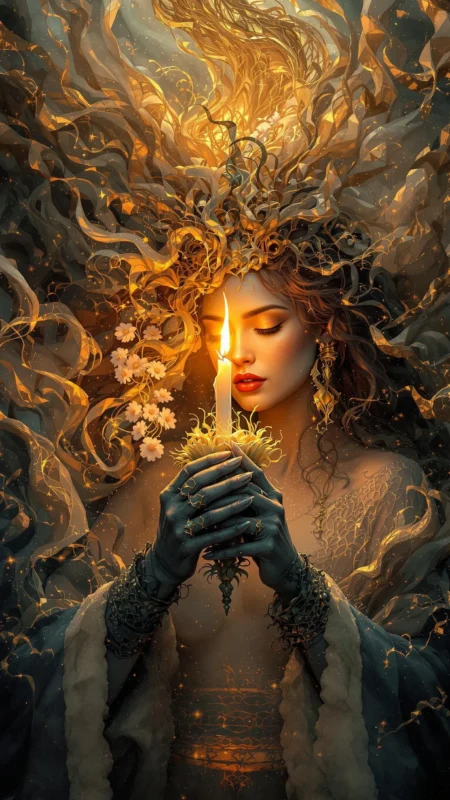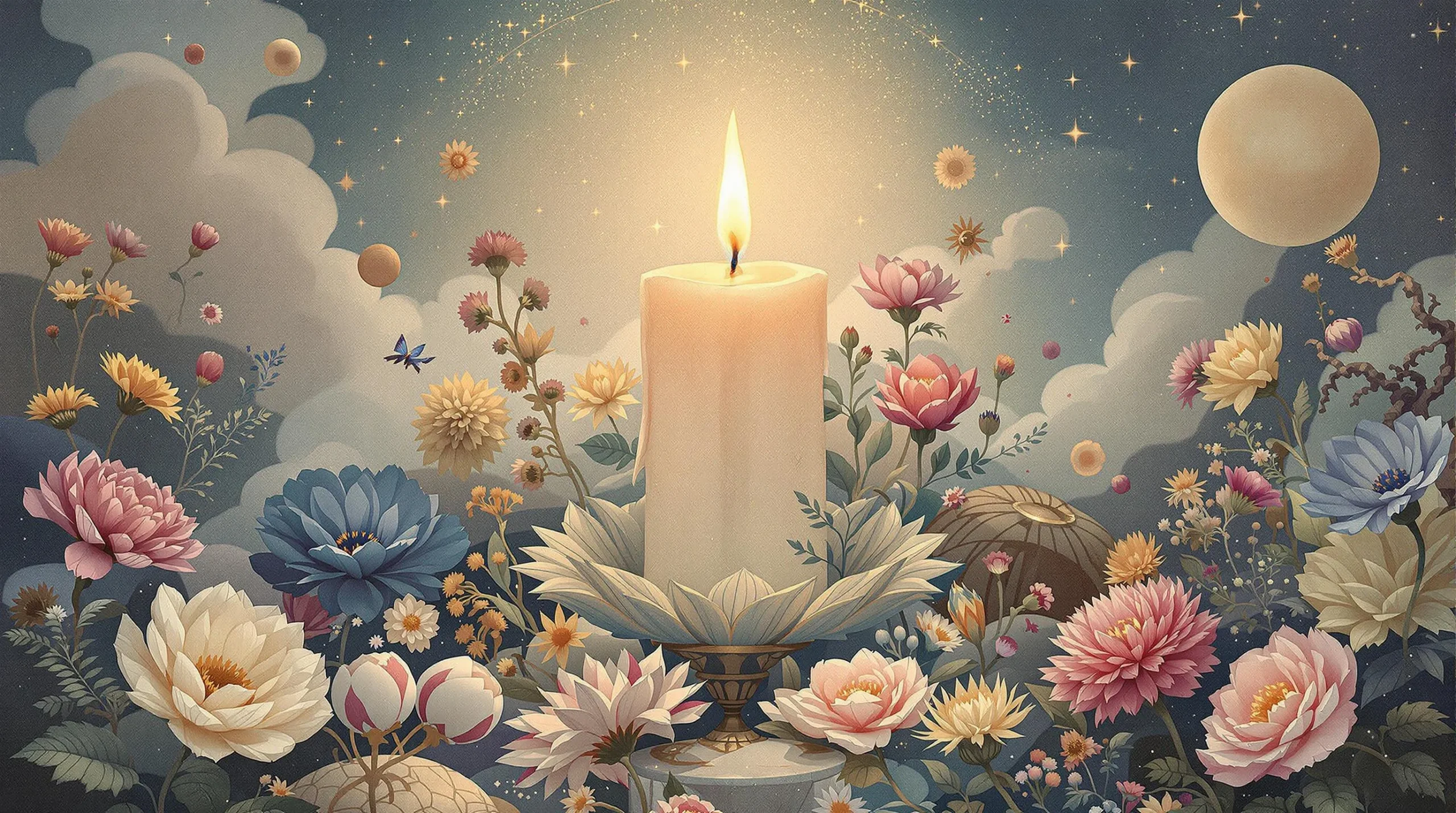


Candle

Archetype Meaning & Symbolism

Illumining, ephemeral, warm, focused, sacrificial, fragile, steady, spiritual, watchful, consuming

  • Do not mourn my diminishing: my purpose is fulfilled not in permanence, but in the light I give while I last.

If Candle is part of your personal mythology, you may...

Believe

  • A single, focused light holds more power than a vast and undefined darkness.

    My value is not in my permanence, but in the warmth and clarity I offer while I exist.

    To be consumed in the service of something beautiful is not an end, but a glorious transformation.

Fear

  • Being extinguished suddenly by a careless force, leaving my purpose unfulfilled.

    Burning in an empty room, wasting my finite light and warmth with no one to witness or receive it.

    That my flame is weak and smoky, creating more confusion than clarity.

Strength

  • An unwavering ability to focus on a single point of light amid overwhelming chaos.

    The capacity to create moments of sacredness and intimacy in the most ordinary of settings.

    A profound and peaceful acceptance of impermanence, finding beauty in the transient.

Weakness

  • An extreme vulnerability to your environment and the emotional carelessness of others.

    A tendency toward a martyr complex, believing your only worth lies in being completely used up.

    Difficulty functioning in open, unpredictable, or chaotic situations that feel too “windy” for your flame.

The Symbolism & Meaning of Candle

The Candle is a paradox: it destroys itself to create. Within your personal mythology, this may signify a life dedicated to a consuming passion, where the self is the fuel for the work. Your narrative might not be about building an empire, but about the intensity of the flame you tend. You may see your energy, your time, and even your peace as wax to be purposefully melted in the service of art, knowledge, or love. It’s a quiet heroism, one measured not in acquisitions but in the quality of the light produced, however briefly it may burn. This archetype reframes burnout not as failure, but as the inevitable, noble cost of illumination.

Its solitary flame could also represent the individual consciousness against the vast, collective darkness of the unknown. The Candle does not pretend to illuminate the entire world; it accepts its sphere of influence is small, intimate, and fragile. This might manifest as a worldview that cherishes the local, the personal, the tangible moment. Your mythos may be one of finding profound meaning in a small circle of influence: a family, a community, a single, perfect piece of work. It is an argument against the need for global impact, suggesting that the most sacred act is to keep one small flame burning brightly against the draft.

Furthermore, the Candle is often a marker of the sacred, of time set apart. It is lit for prayers, for vigils, for romantic dinners, for birthdays. When this archetype is active in your mythos, you may have a heightened sense of ritual. You might believe that intention can make any moment sacred, that the simple act of lighting a candle can draw a line between the profane and the profound. Your life story might be punctuated by these small ceremonies, moments where you consciously create an atmosphere of significance, reminding yourself that even in the rush of modern life, there are spaces for stillness, for memory, and for magic.


Candle Relationships With Other Archetypes

The Wind

The relationship between the Candle and The Wind is one of profound vulnerability and generative tension. The Wind is the embodiment of unseen forces: gossip, social change, sudden crisis, or the simple passage of time. A careless gust can extinguish the Candle's purpose in an instant, representing a mythos where one feels perpetually at the mercy of external events. Yet, a controlled draft can make the flame dance, suggesting that some chaos is necessary for dynamism. For the Candle soul, learning to relate to The Wind is about building just enough shelter to protect the core flame without sealing oneself off from the animating currents of life.

The Moth

The Moth and the Candle are locked in a tragic ballet. The Moth, an archetype of instinct and irresistible attraction, seeks the Candle's light as its ultimate truth, its salvation. For the Candle, this relationship might represent the awesome and terrifying responsibility of being a source of guidance. You may find that people are drawn to your warmth and clarity, but you fear their attraction is a self-destructive one. Your personal myth could involve navigating the dilemma of being a beacon: how to illuminate without incinerating those who fly too close to your truth.

The Darkness

The Candle does not perceive The Darkness as an enemy to be vanquished. It is, perhaps, its collaborator, the very canvas that gives it meaning. Without the deep, velvet backdrop of the unknown, the unsaid, and the unseen, the Candle’s light would be invisible, pointless. This relationship suggests a mythos that embraces mystery. You may not seek to solve every problem or answer every question. Instead, your purpose is to create a small, defined space of meaning within the vast, unknowable expanse, accepting that the darkness gives your light its precious, beautiful shape.

Using Candle in Every Day Life

Navigating a Creative Block

When faced with the paralysis of a blank page or an unsolved problem, the Candle archetype suggests a ritual of reduction. Instead of trying to light up the whole cavern of the issue, you might light a single, real candle. Its solitary flame becomes a focal point, a permission to ignore the vastness of the unknown and concentrate only on the small circle of what is visible right now: the next sentence, the next line of code, the next possible step. It is an exercise in finding progress in the particular, not the panoramic.

Holding Space in Grief

In moments of loss, words often fail. The Candle archetype offers a way to be present without the pressure of providing solutions. To embody the Candle is to simply 'be' with someone in their darkness, offering a steady, silent, warm presence. Your role is not to banish their night but to sit within it, creating a small, safe radius of shared stillness. It is a form of compassion that is about witnessing, not fixing, a quiet testament that they are not alone in the dark.

Embracing Purposeful Sacrifice

When a project or relationship demands more of you than you feel you have to give, the Candle provides a mythic framework. It recasts sacrifice not as a loss, but as a transformation of energy. Your time, your focus, your emotional reserves: this is the wax. By consciously choosing to let it be consumed for a purpose you deem worthy, you are not being depleted. You are being transfigured into light and warmth, turning your very substance into an offering that illuminates a path or provides comfort for another.

Candle is Known For

Illumination

Its primary function is to defy the dark, not by conquering it, but by creating a pocket of clarity. It reveals faces, texts, and paths, making the immediate world knowable.

Transience

It is a living clock. Its form is impermanent by design, and its diminishing stature is a constant, visible reminder of the passage of time, the cost of energy, and the finite nature of all things.

Atmosphere

It has the power to alter a space, to transform a mundane room into a sacred grove, a dining table into a conspirator's den, or a dark corner into a place of vigil. Its light is not merely functional; it is emotional.

How Candle Might Affect Your Personal Mythology

How Candle Might Affect Your Mythos

When the Candle becomes a central object in your personal mythos, your life story may shift from a narrative of accumulation to one of transformation. The plot is no longer about how high you can build your tower, but about the quality of the light you can emit. Your mythos may be defined by a series of intense, luminous episodes rather than a steady, linear progression. You might see your life as a vigil: a period of watchful, dedicated service to an idea, a person, or a craft. The climax of your story might not be a victory, but a moment of perfect, self-consuming expression where you burn your brightest, knowing it cannot last.

Your personal history could be reinterpreted through this lens. Periods of intense work or emotional expenditure are no longer just “hard times”; they are the moments the wax was melting, fueling something important. A failed project was not a waste, but a candle that burned out, having served its purpose of lighting the way to the next thing. This archetype imbues a sense of sacred purpose into impermanence, making your life a story not of what you have left behind in stone, but of the warmth and light you offered while you were here.

How Candle Might Affect Your Sense of Self

To see yourself through the Candle archetype is to embrace a self-concept rooted in purposeful fragility. You may perceive yourself as a source of quiet guidance and warmth for those in your immediate circle, a steady presence in the disorienting dark. This can foster a strong sense of purpose, a feeling that your existence has a clear, albeit consuming, function. Your identity is not tied to your resilience in the face of storms, but in your quiet persistence in a sheltered space.

However, this self-perception is also imbued with an acute awareness of your own limits. Like a candle, you know you are finite. This could lead to a highly conscious and deliberate use of your energy, a refusal to waste your “flame” on trivialities. It may also bring a certain melancholy, a constant, low-level awareness of your own diminishment. You might feel a pressure to be constantly “on,” to be burning, because your worth is intrinsically tied to the act of giving light, making rest feel like a failure of purpose.

How Candle Might Affect Your Beliefs About The World

A worldview informed by the Candle archetype is one that finds immense power in the small and the specific. You might look upon the vast, chaotic world not with despair, but with a quiet resolve. The goal is not to fix everything, an impossible task, but to light your one small flame. This fosters a belief that individual acts of consciousness, kindness, and creation have profound significance, creating pockets of warmth and clarity in an otherwise indifferent universe. The world is not a battlefield, but a vast, dark room waiting for someone to strike a match.

This perspective may also lead to a deep appreciation for intimacy and atmosphere. You might believe that the most significant events happen not on the world stage, but in the hushed, close circles where a few people gather. Your view of progress might be less about technological leaps or political revolutions and more about the slow, cumulative effect of countless small, intentional moments of connection and understanding. You see the world not as something to be conquered, but as a space to be warmed, one conversation, one work of art, one shared meal at a time.

How Candle Might Affect Your Relationships

In relationships, the Candle archetype fosters a profound desire for intimacy and shared vulnerability. You may seek to create a “circle of light” with your partners and friends, a sacred space where the harsh winds of the outside world are kept at bay. Your way of showing love is to be a steady, unwavering presence, offering your warmth and light to help others see themselves and their paths more clearly. You likely value deep, quiet connection over boisterous, large-group socializing, as true communion happens in the close-held space a candle can illuminate.

The challenge in this relational style is its inherent fragility. You may feel that your emotional energy, your “wax,” is constantly being consumed by the needs of others. A careless word or a thoughtless act can feel like a gust of wind that threatens to extinguish you completely. This can lead to a guardedness, a need to carefully curate your environment and your company. There's also a risk of creating co-dependent dynamics, where you become the sole source of light for someone, a burden that accelerates your own consumption and prevents them from learning to find their own flame.

How Candle Might Affect Your Role in Life

Your perceived role in life, through the lens of the Candle, is likely not that of a leader or a builder, but of a witness, a keeper, or a beacon. You may feel your purpose is to hold space for others, to facilitate moments of meaning, and to keep alive the memory of things past. It is a role defined by presence rather than action. You are the one who sits with the sick, who listens through the night, who remembers the anniversary, who keeps the vigil. Your contribution is atmospheric, essential but often unnoticed until it is gone.

This can be a deeply fulfilling role, providing a sense of quiet, spiritual purpose. However, it can also feel passive or secondary. In a world that glorifies grand, visible achievements, the Candle’s role can be undervalued, even by the self. You may struggle with feeling that you are not “doing” enough, that your steady, quiet flame is insignificant compared to the world’s bonfires. Your journey might be to fully embrace the profound power of your quiet, illuminating presence, recognizing it as an active and vital force in its own right.

Dream Interpretation of Candle

In a positive dream context, a candle symbolizes hope, intuition, and the dawning of insight. To be handed a lit candle in a dream might suggest you are being given a key piece of knowledge or a new sense of purpose from your unconscious. Walking through a dark passage guided by a single flame could represent your trust in your own inner guidance through a period of confusion or transition. A room full of steadily burning candles may signify a harmonious connection to your spiritual side, a sense of community, or the successful integration of many different aspects of yourself.

Conversely, a candle appearing in a negative or anxious dream context often points to fears of depletion or meaninglessness. A sputtering flame that threatens to go out could symbolize burnout, a failing hope, or a fear that your life force is waning. To find a candle and have no match to light it may represent a feeling of untapped potential or a frustrating inability to enact your purpose. The most unsettling image might be a candle that casts distorted, frightening shadows, suggesting that your attempts to illuminate a situation are inadvertently creating more fear and confusion, or that your own inner light is being used to deceive yourself or others.

How Candle Archetype Might Affect Your Needs

How Candle Might Affect Your Physiological Needs

When the Candle informs your personal mythology, your physiological needs may be viewed through a metaphor of fuel. Food, water, and sleep are not simply for comfort or health; they are the very wax and wick required for your flame to burn. This can lead to a mindful, almost sacred approach to self-care, where you consciously replenish your resources to continue your work. You might understand that the quality of your wax, your physical well-being, directly impacts the brightness and steadiness of your flame, your mental and spiritual output.

The danger, however, is in seeing the body as merely a resource to be consumed. The Candle archetype can glorify self-expenditure to the point of self-neglect. You may push your body to its absolute limit, believing this is a noble sacrifice for your purpose. This mythos can justify ignoring signals of exhaustion or illness, viewing them as inconvenient interruptions rather than essential feedback. The narrative of “burning the candle at both ends” becomes not a warning, but a romanticized ideal, leading to a physiological crash when the wax inevitably runs out.

How Candle Might Affect Your Ideas of Belonging

The need for belongingness, when shaped by the Candle archetype, is a search for a circle of fellow flame-keepers. You likely crave intimacy, not just company. Belonging is found in small groups huddled together for warmth, where vulnerability is possible because the environment is safe and the light is soft. Love and friendship are acts of shared illumination, where you help others see their own beauty and they, in turn, help you see yours. You seek those who understand the value of a quiet flame and will protect it as fiercely as they protect their own.

This can lead to incredibly deep and meaningful connections. However, it can also foster a kind of exclusivity or cliquishness. You may be wary of newcomers or larger groups, as they introduce unpredictable currents that could disturb the carefully cultivated atmosphere. The feeling of belonging is so tied to this shared, sheltered space that you may struggle to feel a part of any wider community or movement, always preferring the profound connection of the few over the diffuse energy of the many.

How Candle Might Affect Your Feelings of Safety

For one with the Candle in their mythos, the need for safety is less about physical fortification and more about atmospheric control. Safety is a space free from the “drafts” of chaos, criticism, and emotional turbulence that threaten to extinguish one's fragile flame. You may find security not behind high walls, but in quiet rooms, curated social circles, and predictable routines. Your primary drive for safety is to protect your inner light, your sense of purpose, because its extinguishment feels like a form of death.

This need for a controlled environment can become a significant vulnerability. The world is inherently windy and unpredictable. A fear of being “snuffed out” can lead to avoidance, isolation, and a shrinking of one's world to only what feels manageable and safe. True security, from this perspective, may involve learning not just how to build shelters, but how to cup your hands around your flame and carry it, however tremulously, through the inevitable winds of life, learning to relight it when it goes out.

How Candle Might Affect Your Views of Esteem

Esteem, for the Candle archetype, is derived almost entirely from a sense of usefulness and purpose. Self-worth is not measured by praise or status, but by the quiet knowledge that your presence provides light and warmth to others. Your pride comes from being consumed well: from spending your energy on a worthy cause, illuminating a difficult text for a student, or offering a steady presence to a friend in turmoil. Esteem is the feeling of a flame burning cleanly and brightly, fulfilling its function.

This can create a very stable, internal locus of self-worth, independent of external validation. The shadow side, however, is that your esteem is conditional upon your continuous output. During periods of rest or inactivity, you may feel worthless, like an unlit candle in a box. There is a deep-seated fear of becoming useless. This can drive a relentless, exhausting cycle of self-sacrifice, as you constantly feel the need to be “burning” to justify your own existence, tying your entire sense of value to the act of being spent.

Shadow of Candle

The shadow of the Candle emerges when the desire to illuminate becomes a tool for control and manipulation. In its shadow form, the Candle does not offer light for clarity, but uses it to cast deep and deceptive shadows. It reveals only the flaws in others, highlighting their insecurities while keeping its own motives hidden in the dark. This shadow Candle becomes a passive-aggressive martyr, its steady flame a constant, silent accusation. It provides warmth that is not comforting but suffocating, creating dependency in others and making them feel guilty for any attempt at independence that might introduce a “draft” into its controlled world. Its self-sacrifice is performative, a way to accrue emotional debt from those around it.

In its more extreme shadow, the gentle flame becomes a conflagration. The fear of being insignificant or being extinguished prematurely can twist into a desperate need to burn everything down. If its small light is not appreciated, it will become an inferno that cannot be ignored. This is the Candle that seeks to expose every secret, burn away every structure, and force a painful, total illumination upon the world. It is a puritanical, destructive fire born from the fear that its gentle light was never enough, a tragic transformation from a quiet beacon to an agent of arson.

Pros & Cons of Candle in Your Mythology

Pros

  • You possess a rare ability to bring focus, calm, and a sense of reverence to your environment.

    You live with a clear sense of purpose, which provides meaning and direction even in difficult times.

    You are a master of creating intimacy, making others feel safe, seen, and deeply understood in your presence.

Cons

  • You are highly susceptible to burnout, as your self-worth is deeply tied to the act of being consumed for others.

    Your inherent fragility can make you overly cautious, causing you to avoid new experiences or relationships for fear of being “extinguished.”

    You may feel that your quiet contributions are consistently overlooked in a world that rewards volume and permanence, leading to feelings of insignificance.