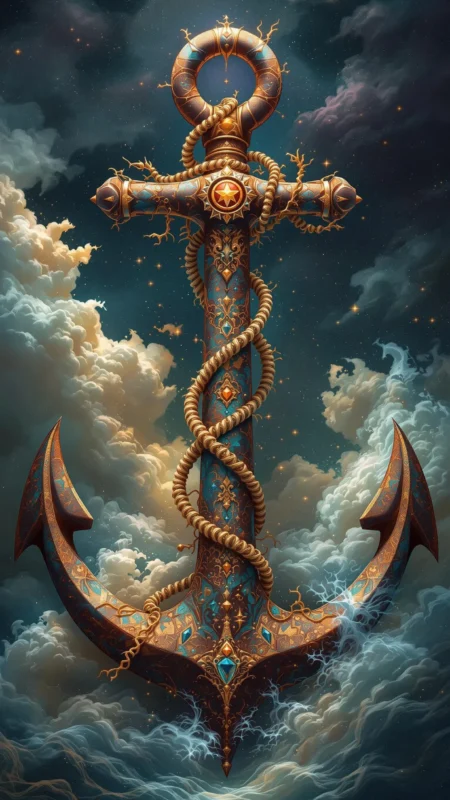
Rusty Anchor

Archetype Meaning & Symbolism

Grounding, steadfast, historical, stagnant, heavy, dependable, corroded, deep, resolute, forgotten

  • Let the currents of the world rage. My truth is in my weight, my place in the silt of time.

If Rusty Anchor is part of your personal mythology, you may...

Believe

  • That true progress is not linear but circular, a deepening of understanding rather than a race to a finish line.
  • That the past is not a burden to be escaped but a foundation upon which the present is built and the future secured.
  • That stillness is not emptiness but a form of profound power, and that to be steadfast is a radical act in a restless world.

Fear

  • Being unmoored, cast adrift in a sea of meaninglessness without a place to call home or a principle to hold onto.
  • The erosion of history and tradition, watching the things that provide meaning and context be washed away by a tide of relentless novelty.
  • That your stability will be mistaken for stagnation, and that the world, and the people you love, will eventually sail on without you.

Strength

  • An unshakable sense of self that provides a deep well of calm for yourself and others, especially in times of chaos.
  • Profound loyalty and dependability, making you a cornerstone in your relationships and a keeper of long-term bonds.
  • A deep, intuitive connection to history, story, and your own roots, giving you a rich internal world and a powerful sense of context.

Weakness

  • A potent resistance to necessary change, which can lead to missing opportunities for growth and new experiences.
  • A tendency to become mired in the past or stuck in unhealthy situations, mistaking endurance for martyrdom.
  • An emotional inability to let go, whether of people, places, or ideas, even when holding on is causing harm.

The Symbolism & Meaning of Rusty Anchor

In the personal mythos, the Rusty Anchor symbolizes a profound, and perhaps resistant, relationship with permanence. It is the psychic weight we carry, the sum of our history, that grants us stability in the churning seas of modern life. To have the Rusty Anchor in your story is to honor the beauty of the patina, to see the corrosion of time not as a flaw but as a testament to endurance. It suggests a life script where meaning is not discovered on a grand voyage to new lands, but in the deep exploration of a single, hallowed spot. This archetype asks us to consider what is worth holding onto, what values are so heavy with truth that they can secure us against the most powerful currents of doubt and change.

The anchor is a paradox: it is an instrument of freedom and of bondage. It frees a vessel from the tyranny of the tide, allowing it to rest safely in a chosen harbor. Yet, it also prevents the journey, holding the ship back from the call of the open ocean. In one's life, this may manifest as a deep sense of home and belonging that is both a comfort and a cage. The symbolism of the rust itself is crucial; it speaks to a strength that is not pristine or polished, but has been tested, weathered, and proven. It is the wisdom that comes from staying put, from bearing witness, and from allowing the world to leave its mark upon you.

This archetype challenges the contemporary obsession with movement, progress, and self-reinvention. It proposes a radical alternative: self-acceptance through stillness. It is the quiet confidence that everything you need is already within you, buried in the silt of your own experience. The Rusty Anchor may represent a connection to ancestors, to a piece of land, or to a core principle that defines one's existence. It is the part of the personal narrative that doesn't change, the gravitational center around which all the stories of our lives orbit. It is the silent, heavy truth at the bottom of our personal ocean.


Rusty Anchor Relationships With Other Archetypes

The Ship

The Ship is the anchor's most intimate partner, a symbol of the journeying, conscious self. The Ship desires experience, horizon, and narrative, while the Rusty Anchor represents the unconscious, the need for rest, and the pull of origin. Their relationship is the central tension of many life stories. Without the anchor, the Ship is lost to the endless, meaningless drift of the currents. Without the Ship, the anchor is just a forgotten lump of metal at the bottom of the sea. For the individual, this dance may represent the constant negotiation between ambition and contentment, between exploring the world and cultivating a home, between the ego's voyage and the soul's deep longing for place.

The Wind

The Wind is the archetype of change, inspiration, and chaos. It is the force that propels the Ship, but it is also what threatens to dash it against the rocks. The Rusty Anchor is, in many ways, the Wind's antithesis. It offers resistance, a deliberate and heavy counterpoint to the Wind's fickle nature. This relationship is not merely oppositional; it is symbiotic. The anchor’s stability allows one to harness the Wind's power without being destroyed by it. In a personal mythos, this could symbolize a personality that is grounded enough in its principles (the anchor) to be able to engage with radical new ideas (the wind) without losing its fundamental sense of self.

The Treasure Chest

The Treasure Chest and the Rusty Anchor are both artifacts of the deep, keepers of value. However, they signify different kinds of wealth. The Treasure Chest holds extrinsic value: gold, jewels, the spoils of adventure. It represents worldly success and acquired riches. The Rusty Anchor holds intrinsic value: the weight of experience, the strength of endurance, the stories embedded in its very corrosion. It is the treasure of a life deeply lived, not of treasures collected. In a person's story, this might highlight a conflict or choice between pursuing external validation and cultivating internal, unshakable worth. One is a prize to be won; the other is a state of being to be embodied.

Using Rusty Anchor in Every Day Life

Navigating Emotional Storms

When faced with turbulent emotions or external chaos, one might invoke the Rusty Anchor not to suppress the feelings, but to find the point of stillness within. It is the act of asking: what part of me is unmoved by this gale? By focusing on this internal, heavy, quiet place, one may find the capacity to endure the storm without being swept away, allowing the emotional weather to pass over a self that remains fundamentally grounded.

Connecting with Ancestry

The Rusty Anchor may serve as a potent symbol for exploring one's roots. Its layers of rust and marine life are like generations of family history, layered one upon the other. Meditating on this archetype could be a method for feeling a connection to the past, not as a collection of stories, but as a felt presence: the weight of their trials, the strength of their endurance, all contributing to the person you are today. It is a way to feel your history in your bones.

Breaking Creative Blocks

Instead of frantically searching for inspiration, one could embody the Rusty Anchor. This means ceasing the struggle and sinking into a state of deep observation. From this place of stillness, the world's currents—ideas, images, conversations—flow past. The anchor doesn't chase; it waits and it holds. This practice may allow for a different kind of creativity, one that emerges from profound stillness and accumulated experience rather than a desperate hunt for novelty.

Rusty Anchor is Known For

Immovability

It is known for its fundamental purpose

to hold fast against the immense power of wind and water. This represents a deep, internal resolve, a commitment to a place, a person, or a principle that withstands external pressures.

Corrosion

The rust is not just decay; it is a visible record of every storm weathered, every tide turned. It is a testament to endurance, a patina of experience that tells a story of survival and time spent in the harsh, transformative depths.

Connection to the Depths

It is a link between the visible world of the ship and the unseen, mysterious world of the seabed. The anchor touches a realm of subconscious, of memory, and of the unknown, grounding the conscious self in a reality that is deeper and older than its immediate awareness.

How Rusty Anchor Might Affect Your Personal Mythology

How Rusty Anchor Might Affect Your Mythos

When the Rusty Anchor features in a personal mythos, the narrative structure may shift from a linear quest to a deepening gyre. The protagonist's journey is not across a map, but downward, into the layers of self, history, and place. The great challenge is not to slay a dragon, but to withstand the storm; the ultimate prize is not a golden fleece, but a profound sense of peace in one's own patch of seabed. This mythos values endurance over achievement, and memory over ambition. Life events are not stepping stones forward, but accretions, like barnacles and rust, that add texture, weight, and history to a central, unmoving core.

The story one tells about oneself may become a saga of resilience. The plot points are the gales survived, the winters weathered. The self is cast as a keeper of traditions, a living repository of stories that might otherwise be washed away. This personal myth could lack the dramatic arcs of heroic journeys, favoring instead a narrative of quiet, powerful presence. It is the story of the ancient tree in the town square, or the stone in the riverbed: its significance comes not from where it has been, but from the simple, profound fact that it is still here.

How Rusty Anchor Might Affect Your Sense of Self

One's self-concept may be built upon a foundation of stability and deep-seated identity. There could be a quiet confidence that emanates not from accomplishments, but from a powerful sense of one's own unshakeable nature. You may see yourself as a source of calm for others, the person to whom people turn when their own worlds are in turmoil. This can foster a rich inner life, where solitude is not loneliness but a cherished opportunity to commune with the deep, quiet parts of the soul. The self is not something to be perpetually improved or reinvented, but a core truth to be honored and lived from.

This may also cultivate a self that is resistant to superficiality. There might be a deep skepticism towards trends, quick fixes, and the relentless pressure to change. The self is viewed as a historical artifact, not a blank slate. Its flaws and imperfections, the very rust of its being, are not blemishes to be polished away but integral parts of its story and strength. This can lead to a powerful form of self-acceptance, but it could also create a blind spot, where a refusal to change becomes a refusal to grow, mistaking a rusty shackle for a noble anchor.

How Rusty Anchor Might Affect Your Beliefs About The World

The world, seen through the lens of the Rusty Anchor, may appear less as a landscape of opportunity and more as a sea of currents. It is a place of powerful, often chaotic forces to be navigated and, ultimately, withstood. Wisdom lies not in mastering the sea, but in choosing a good harbor and setting one's anchor deep. This perspective may foster a deep appreciation for things that last: old friendships, timeless art, enduring ideas. It can breed a certain conservatism, a belief that what has been proven by time holds more value than what is merely new.

A worldview shaped by this archetype might prioritize depth over breadth. Instead of seeking to experience everything, the focus could be on understanding a few things profoundly. Meaning is not found in the novelty of the next port of call, but in the intricate ecosystem that develops around a fixed point. This can lead to a powerful sense of connection to a specific place or community, but it may also foster a suspicion of the foreign and the unknown, seeing the wider world as a potential threat to the stability and sanctity of one's own small, anchored reality.

How Rusty Anchor Might Affect Your Relationships

In relationships, the Rusty Anchor archetype may manifest as profound loyalty and unwavering dependability. A person embodying this archetype could be the steadfast partner, the reliable friend, the child who never moves far from home. They provide a secure harbor for the people they love, a place of rest and safety from life's storms. These bonds are not forged in fleeting passions, but are built slowly, over time, layered with shared history until they possess an immense, quiet strength. To be loved by the Rusty Anchor is to know you have a place in the world where you will always be held.

However, this anchoring tendency has a shadow. It can create a relational gravity that resists necessary change. The anchor may struggle to let go, holding onto relationships—be they romantic, platonic, or familial—long after they have become unhealthy or restrictive. The desire for stability can become a fear of solitude, causing one to cling to a familiar vessel even if it is sinking. The noble act of holding fast can become a desperate refusal to release, preventing both themselves and their loved ones from navigating toward new, healthier waters.

How Rusty Anchor Might Affect Your Role in Life

The perceived role in life may become that of the Guardian, the Historian, or the Pillar. It is not the role of the swashbuckling hero or the visionary leader who charts a new course. Rather, it is the vital, often unsung role of the one who preserves, protects, and provides foundation. This individual may feel a deep responsibility to maintain the stability of their family, their community, or their workplace. Their power is not active or declarative, but passive and gravitational. They lead not by charging ahead, but by being so immovably present that others can orient themselves around them.

This role is defined by being rather than doing. One's value is not measured by a list of achievements but by the quality of one's presence and the reliability of one's character. In a group, they are the keeper of the institutional memory, the one who remembers the old stories and cautions against repeating past mistakes. While this provides an essential service, it can also be limiting. The person may feel trapped in this role of pure stability, yearning for a journey of their own but feeling obligated to remain the anchor for everyone else's ship.

Dream Interpretation of Rusty Anchor

In a positive context, dreaming of a Rusty Anchor may signal a deep psychic need for grounding and stability. Finding and setting a large, heavy anchor could symbolize a successful effort to find your footing during a period of emotional turmoil or rapid change. It might represent a reconnection with family roots, a commitment to a core value, or the discovery of a profound sense of inner peace. The rust in the dream is not negative; it suggests that this newfound stability is authentic, earned, and has the wisdom of experience. It is the soul's declaration that it has found its harbor.

In a negative context, the Rusty Anchor can be a symbol of stagnation and entrapment. Dreaming of being chained to an anchor, or trying desperately and failing to lift it from the seabed, often points to feelings of being stuck. It may represent a job, a relationship, or a mindset from the past that is preventing personal growth. The anchor is no longer a tool for safety but a dead weight, dragging you down into the mud of old habits and fears. It is a powerful image from the subconscious, warning that what once provided security may now be the primary obstacle to your life's voyage.

How Rusty Anchor Archetype Might Affect Your Needs

How Rusty Anchor Might Affect Your Physiological Needs

The Rusty Anchor archetype may translate the body's basic needs into rituals of profound stability. There could be a deep, physiological craving for rhythm and predictability: the same meal on the same day of the week, a non-negotiable bedtime, a path worn into the floorboards of a cherished home. These routines are not matters of mere preference; they are physical expressions of the anchor's need for a stable seabed. Change, such as travel or a disruption in schedule, might feel physically jarring, a somatic experience of being unmoored.

The body itself may be perceived as an anchor, a heavy, reliable vessel for the spirit. There could be a comfort in its weight and its limitations, rather than a constant striving to reshape it. Health might be defined by endurance and resilience, the ability to withstand illness or hardship, rather than by metrics of peak performance. This mythos prioritizes rest and recovery, seeing stillness not as laziness, but as a vital physiological process of settling back into the body's natural, grounded state.

How Rusty Anchor Might Affect Your Ideas of Belonging

Belongingness is not about being liked by many, but about being deeply rooted with a few. The need for love and connection is met through deep, historical ties: lifelong friendships, close-knit families, and fierce loyalty to one's hometown or heritage. Social circles may be small and difficult for outsiders to penetrate, because belonging is a matter of shared history, of having weathered the same storms together. The Rusty Anchor doesn't join groups; it forms the bedrock upon which a group is founded.

This creates an incredibly powerful sense of place and community, a feeling of being an integral and immoveable part of a social fabric. The love received and given is dependable, patient, and unconditional. The shadow side of this is a potential clannishness or resistance to outsiders. New people or new ideas can be perceived as a threat to the established order. The deep need to belong to one's chosen group can make it difficult to form connections outside of it, or to leave the group even when it becomes constricting.

How Rusty Anchor Might Affect Your Feelings of Safety

For a person with this archetype, safety is synonymous with permanence. The core need for security is met not by preparing for every possible danger, but by creating a reality so stable that it feels impervious to the outside world. This manifests in a deep attachment to a physical home, which becomes more than a shelter: it is the anchor's chain, the tangible link to security. Financial safety is pursued through slow, steady accumulation—a pension, a savings account, a paid-off mortgage—rather than through risky, high-reward ventures.

The primary fear is not physical harm, but the terror of being set adrift. The true threat is instability: losing one's job, being forced to move, or the dissolution of a core relationship. Safety is a deep, internal feeling of being held in place. This can lead to a life of immense security and peace. However, it can also mean that opportunities for growth are rejected because they come with a degree of uncertainty, prioritizing the safety of the known harbor over the potential rewards of the open sea.

How Rusty Anchor Might Affect Your Views of Esteem

Esteem, for the Rusty Anchor, is derived from intrinsic qualities: reliability, integrity, and endurance. Self-worth is not built upon a pyramid of external achievements or the applause of a crowd. It is the quiet, internal knowledge of one's own solidity. The greatest source of pride is being the person others can count on, the rock in the storm. The rust and barnacles are worn as badges of honor, each flaw a testament to a challenge overcome, a story of survival. Esteem comes from being, not from doing.

This provides a powerful immunity to the whims of public opinion and the fleeting nature of success. However, it can also lead to a form of quiet pride that resists feedback or help. If one's esteem is entirely wrapped up in being the unshakable one, it can be devastating to admit vulnerability or the need for support. The esteem need is met by being the provider of stability, which can make it incredibly difficult to accept that, sometimes, you are the one in need of a safe harbor.

Shadow of Rusty Anchor

The shadow of the Rusty Anchor emerges when stability curdles into absolute stagnation. It is the archetype in its most suffocating form, where the need for security becomes a death grip on the known. This is not the noble anchor holding a ship safely in harbor, but the forgotten anchor that has been left so long it has dragged a once-seaworthy vessel down into the silt to rot. In this shadow aspect, the person refuses to leave a toxic job, a dying relationship, or a limiting belief system, not out of loyalty, but out of sheer terror of the unknown. The commitment to place becomes a prison sentence.

The rust is no longer a sign of honorable experience; it is the mark of active decay, of potential being eaten away by inaction. The shadow anchor actively resists any force that might bring life or movement, sabotaging opportunities and pushing away people who challenge its immobility. It may try to chain others down with it, using guilt and obligation as its links. It is the voice that whispers, "It is better to be miserable and safe than to risk the open sea." It is stability weaponized against the very possibility of life itself.

Pros & Cons of Rusty Anchor in Your Mythology

Pros

  • It provides a powerful, internal source of grounding and security, making you resilient in the face of life's storms.
  • It fosters the creation of deep, lasting, and intensely loyal relationships built on a foundation of trust and shared history.
  • It encourages the development of a rich inner life and a profound connection to one's personal and ancestral stories.

Cons

  • It can lead to a fearful stagnation, where a resistance to change prevents necessary personal growth and evolution.
  • It may cause you to cling to people, places, or situations that are unhealthy or have run their course, simply because they are familiar.
  • Your steadiness can be perceived by more adventurous archetypes as stubbornness, a lack of imagination, or a boring refusal to engage with life's possibilities.