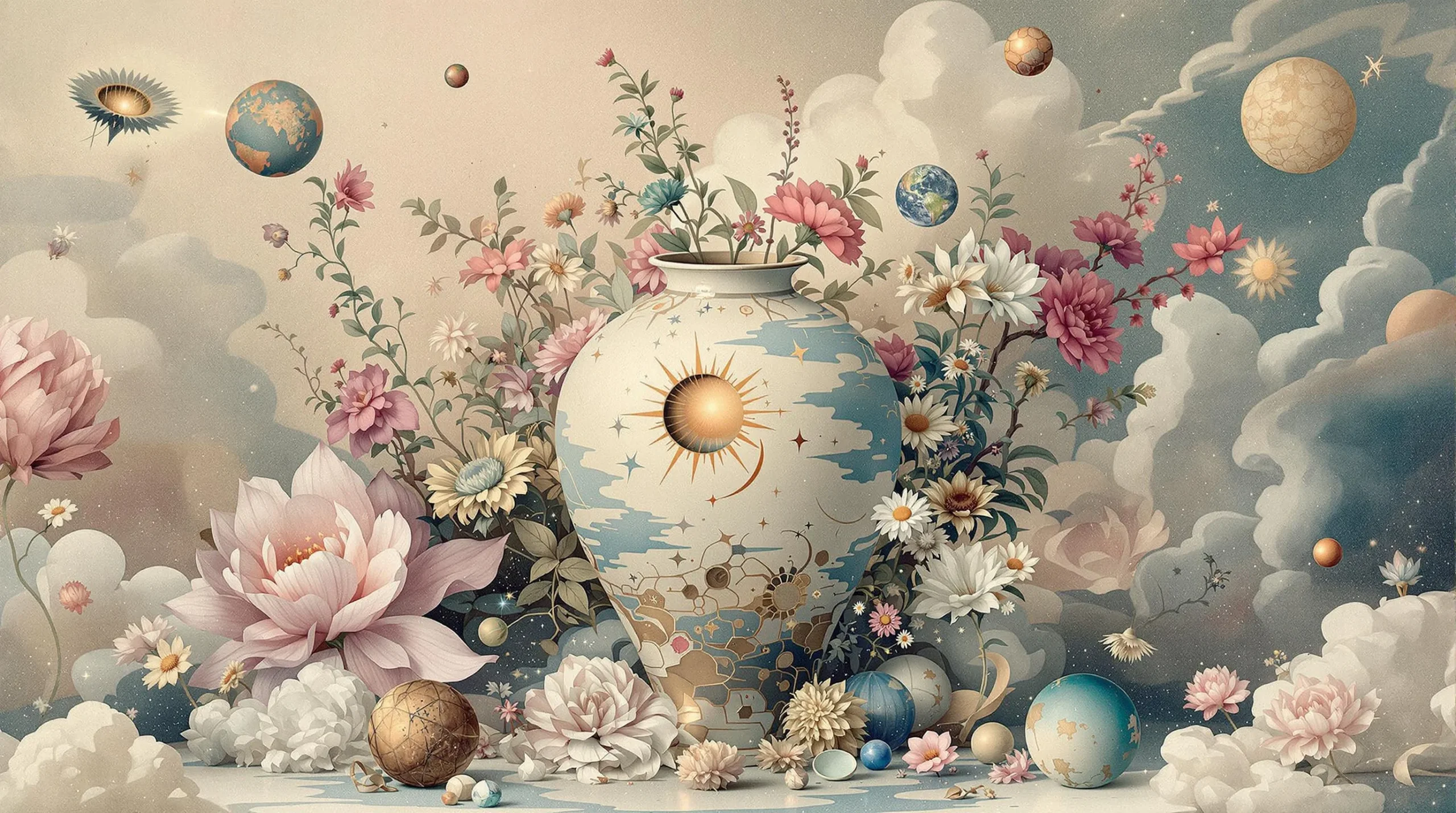


Shattered Vase

Archetype Meaning & Symbolism

Fragmented, resilient, historical, reconfigured, delicate, sharp, precious, mosaic, remembered, narrative

  • Do not mourn my original form. The gold that holds me together now tells a much better story.

If Shattered Vase is part of your personal mythology, you may...

Believe

  • You may believe that a scar is a more honest testament to life than an unblemished surface.
  • You may believe that true strength isn't the ability to resist breaking, but the courage to reassemble oneself afterward.
  • You may believe that meaning is not found, but forged in the fires of loss and repair.

Fear

  • You may fear that you are too fragile to be truly loved or handled without being broken again.
  • You may fear that some essential piece of you was lost forever in the shattering and can never be recovered.
  • You may fear that your mended form is a deception and that underneath the gold, you are just a collection of broken pieces waiting to fall apart.

Strength

  • You possess a profound empathy for the suffering of others, born from direct experience.
  • You have the ability to find and create beauty in the most damaged of places, people, and circumstances.
  • You embody a resilience that is not brittle, but flexible and creative, capable of integrating trauma into a stronger whole.

Weakness

  • You may have a tendency to romanticize pain, believing that meaning can only be found through suffering.
  • You might maintain a defensive fragility, keeping others at a distance with your 'sharp edges' to avoid further hurt.
  • You may struggle to trust stability, feeling more at home in chaos or recovery than in periods of simple, unbroken peace.

The Symbolism & Meaning of Shattered Vase

To find the Shattered Vase in your personal mythos is to confront the idea that breakage is not the end of use, but the beginning of meaning. It symbolizes a life altered by a singular event, a trauma, or a profound loss that leaves one feeling fragmented, useless, and forever changed. The initial symbolism is one of grief: for the loss of wholeness, of a perceived perfection, of a future that now seems impossible. It is the silent, sharp-edged reality of what has been irrevocably broken. The vase on the floor is a map of catastrophe, its pieces scattered like the parts of a self after a disaster, each one holding a tiny, sharp memory of the impact.

Yet, the archetype’s deeper meaning unfolds in the quiet act that follows. It is about the gathering of the self, the patient and often painful process of picking up the pieces. This phase may represent therapy, introspection, or the slow work of mourning. It demands that you look at each fragment, understand its shape, and see how it relates to the others. This is where the story begins to shift from one of loss to one of potential reconstruction. There may be a temptation to discard the pieces, to declare the object ruined. The Shattered Vase mythos insists on their value, suggesting that even the smallest sliver is essential to the new whole.

Ultimately, the Shattered Vase stands for a radical, beautiful form of resilience. It is the embodiment of post-traumatic growth. The final, reassembled form, perhaps traced with gold, is not a restoration of the original but the creation of something new and arguably more beautiful. It does not hide its scars; it illuminates them. This symbolism suggests that a person's character is not defined by their ability to avoid damage, but by how they integrate their history of being broken. The lines of repair become a testament to the life lived, the impacts survived, and the profound beauty that can only be found in what has been mended.


Shattered Vase Relationships With Other Archetypes

The Mender:

The Mender is the artisan, the healer, the patient hand that gathers the shards of the Shattered Vase. This relationship is symbiotic: the Vase provides the Mender with purpose, a canvas for their art of restoration, while the Mender gives the Vase a future, a new form, and a new meaning. In a personal mythos, the Mender could be a therapist, a loving friend, a creative practice, or even the conscious, compassionate part of the self that decides to heal rather than remain broken. The Mender’s touch is what turns the cracks from wounds into golden rivers of story.

The Curator:

The Curator is the one who recognizes the value of the Shattered Vase not despite its damage, but because of it. Where others see a broken pot, the Curator sees history, resilience, and a unique object of beauty. This archetype might manifest as the part of your psyche that archives your experiences, that builds the museum of your life. It is the force that allows you to display your mended self with pride, to tell your story without shame. The Curator's gaze validates the Vase’s journey, affirming that its worth has increased, not diminished, through its ordeal.

The Ghost:

Every Shattered Vase is haunted by the Ghost of its former self: the perfect, unblemished vessel it once was. This archetype represents memory, nostalgia, and the ache for a lost innocence. The Ghost may whisper of what could have been, tempting one to compare their mended state to an idealized past. The relationship is a constant negotiation. To honor the Ghost is to remember the past, but to be ruled by it is to live in a state of perpetual mourning, unable to appreciate the new beauty of the present form. The challenge for the Shattered Vase is to integrate the Ghost as a part of its history, not as the standard against which it must always fail.

Using Shattered Vase in Every Day Life

Navigating a Career Setback:

When a project fails or a position is lost, this archetype reframes the event not as a career-ending failure but as a necessary shattering. The pieces of your experience, skills, and newfound humility can be reassembled. This might mean pivoting to a new field where your unique combination of broken and learned parts forms an unexpected expertise, your 'cracks' filled with the gold of wisdom gained through loss.

Healing from a Relationship's End:

A significant breakup can feel like a complete shattering of one's identity. The Shattered Vase archetype allows you to sit with the pieces: the memories, the shared dreams, the parts of yourself that seemed to exist only in relation to the other. Instead of trying to revert to a 'before' self, you consciously choose which pieces to keep and how to arrange them into a new, single, more intricate identity, acknowledging the relationship's permanent mark as part of your design, not a flaw.

Reconciling with Personal Trauma:

This archetype provides a powerful metaphor for post-traumatic growth. It honors the reality of the traumatic event, the 'shattering,' without demanding a return to an impossible state of innocence. The work becomes about gathering the fragmented parts of the self and, with immense care, binding them together. The focus shifts from erasing the damage to integrating it, creating a self-narrative where the lines of trauma become conduits for empathy, strength, and a complex, hard-won beauty.

Shattered Vase is Known For

The Irreversible Event

It is known for representing a singular, defining moment of breaking. This is the fall from the mantle, the slip of the hand, the impact that irrevocably changes the original form. This event becomes a cornerstone of the personal mythos, a 'before and after' that colors all subsequent narratives.

The Art of Repair:

The Shattered Vase is intimately associated with the art of beautiful repair, particularly the Japanese art of Kintsugi. This is the practice of mending broken pottery with lacquer dusted or mixed with powdered gold, silver, or platinum. The philosophy treats the breakage and repair as part of the object's history, rather than something to disguise.

Holding Memories:

Though it can no longer hold water, it holds something far more precious: a story. Each shard is a piece of the past, and each golden line of repair is the evidence of healing and transformation. It is a vessel for narrative itself.

How Shattered Vase Might Affect Your Personal Mythology

How Shattered Vase Might Affect Your Mythos

When the Shattered Vase becomes a central object in your personal mythos, your life story ceases to be a linear tale of progress and becomes a narrative of rupture and beautiful repair. The major plot points of your life may be defined by the moments of breaking: the end of a great love, the failure of a cherished dream, the diagnosis that changed everything. These are not seen as deviations from the path but as the events that give the path its character and depth. Your mythos is not about how you stayed whole, but about how you became whole again in a new and more interesting way.

The narrative arc may follow the Kintsugi process. There is the life before the break: a time of wholeness, perhaps a bit naive. Then comes the shattering impact, a moment of chaos and fragmentation. This is followed by a long, quiet period of gathering the pieces, a journey into the self to recover lost parts. Finally, there is the act of mending, where the fractures are not hidden but highlighted, and you emerge not restored to the original, but transformed into a new creation whose very scars are the source of its beauty and strength. Your personal legend becomes a testament to the idea that the most profound stories are written in the repairs.

How Shattered Vase Might Affect Your Sense of Self

Your concept of self may be intrinsically linked to your own history of damage and repair. You might not see yourself as a pristine, finished product, but as a work in progress, a mosaic of experiences held together by the gold of wisdom and resilience. This can lead to a radical form of self-acceptance, where perceived flaws and past traumas are not sources of shame but integral parts of your identity, contributing to a unique and complex beauty. You may feel a deep connection to your own story, viewing your scars, both literal and metaphorical, as a map of your journey.

Conversely, this archetype could foster a persistent feeling of fragility. You may see yourself as inherently breakable, always one careless moment away from shattering again. This could create a sense of cautiousness, a hesitancy to be placed in vulnerable situations. The self is not a fortress but a precious, reassembled object that must be handled with care. There may be a constant internal negotiation between the pride in one's mended strength and the fear of the original weakness that allowed the break to happen.

How Shattered Vase Might Affect Your Beliefs About The World

You may view the world through a lens of wabi-sabi, finding beauty in imperfection, transience, and incompletion. A world of polished surfaces and flawless facades might seem sterile or dishonest. Instead, you could be drawn to the old, the worn, the repurposed, and the scarred. Crumbling ruins, peeling paint, and weathered faces tell a more interesting story to you than pristine newness. This worldview doesn't shy away from the brokenness of the world but leans into it, seeking the meaning and beauty within the damage.

This perspective may also lead to a profound sense of compassion. Seeing the world as full of other shattered vases, you may approach global conflicts, social problems, and environmental decay not with despair, but with the patient question: how can we mend this? This view suggests that societies, like individuals, are not ruined by their traumas but are given an opportunity to rebuild in a more conscious, beautiful, and equitable way. Perfection is not the goal; resilient, thoughtful repair is.

How Shattered Vase Might Affect Your Relationships

In relationships, you may not seek a 'perfect' partner but rather someone whose broken pieces fit with yours. You may be deeply attracted to people who have their own stories of rupture and repair, finding a common language in shared vulnerability. Relationships are not about preserving a flawless image, but about creating a safe space where both people can be their authentic, mended selves. You might believe that true intimacy is found in showing someone your cracks and trusting them to trace them with gentleness and admiration.

This can also mean you have little patience for superficial connections. You may crave a depth that can only be found when people are willing to be honest about their damage. However, you might also have a tendency to try and 'fix' broken people, seeing every wounded soul as a vase you are meant to mend. A challenge could be learning to differentiate between a partner whose history enriches them and one who is unwilling to pick up their own pieces, leaving you to be cut by their sharp edges.

How Shattered Vase Might Affect Your Role in Life

You may see your role in the world as a storyteller of survival or a healer of the broken. Your own experience of shattering and mending equips you with a unique empathy and a credible message of hope. You might become a therapist, an artist, a writer, or simply the person in your community that others turn to when their own lives fall apart. Your purpose is not to offer easy platitudes but to sit with others in the wreckage and show them, by your own example, that it is possible to reassemble a life of beauty and meaning.

This archetype could also cast you in the role of the keeper of history. You are the one who remembers the breaks, who honors the scars, and who insists that the past, with all its pain, not be forgotten or glossed over. You may find yourself as the conscience of a family or a community, reminding them of difficult truths not to cause pain, but because you understand that true strength comes from integrating, not ignoring, the most painful parts of the story. Your role is to ensure the gold lines of repair are always visible.

Dream Interpretation of Shattered Vase

In a positive context, dreaming of a Shattered Vase that is beautifully mended, perhaps with glowing golden seams, is a powerful symbol of integration and healing. This dream may suggest that you are successfully processing a past trauma or personal failure. You are no longer defined by the breaking event but by your resilient and creative response to it. Finding or being given such an object in a dream could signify a dawning self-acceptance and the realization that your 'scars' are now a source of strength and unique beauty. It is an affirmation from the subconscious that your healing journey is creating something more valuable than what was lost.

In a negative context, dreaming of a vase shattering, or of trying and failing to reassemble the pieces, can signal a current life crisis or the resurfacing of an old, unresolved trauma. You may feel that your life or your sense of self is falling apart and you are powerless to stop it. Dreaming of cutting yourself on the sharp shards could indicate that your unhealed wounds are causing you, or others, pain. It may be a warning from your psyche to handle a fragile situation with more care, or a sign that you are terrified of another 'impact' that you do not believe you can survive.

How Shattered Vase Archetype Might Affect Your Needs

How Shattered Vase Might Affect Your Physiological Needs

This archetype may instill a profound connection between your psychological and physical self, where the body is viewed as the vase. Scars, wrinkles, stretch marks, and other physical 'imperfections' are not flaws but the visible history of a life lived. They are the crazing on the glaze, the lines of repair that tell a story of survival, childbirth, illness, or accident. You may honor your body not for its youthful perfection but for its resilience, its ability to carry you through the breaks and continue on. There is an acceptance of the body's eventual decay as a natural and even beautiful part of its story.

Simultaneously, you may experience a heightened sense of your body's fragility. You could be acutely aware of its vulnerability to illness, injury, and the simple passage of time. This might manifest as carefulness, a deep attunement to the body's signals, or at times, a form of hypochondria or anxiety about physical safety. Every ache and pain might be interpreted as the beginning of a new crack, a sign of impending shattering. The physiological experience becomes a delicate balance between celebrating resilience and managing the anxiety of inherent breakability.

How Shattered Vase Might Affect Your Ideas of Belonging

A sense of belonging may be found not among the pristine and the perfect, but in the company of the beautifully scarred. You might feel a profound kinship with others who have endured their own shattering, creating communities based on shared vulnerability and mutual respect for each other's journey of repair. Love and belonging are not about being admired on a pedestal but about being held, cracks and all. You seek relationships where you don't have to hide your history of being broken, but where it is seen as a vital part of who you are.

This can also make it difficult to feel a sense of belonging in environments that value superficial perfection and deny the existence of pain. Corporate settings, social circles focused on status, or families that refuse to acknowledge past traumas might feel profoundly alienating. You may feel like an outsider, a piece of patched pottery in a showroom of flawless porcelain. Your need for authentic connection, one that acknowledges the reality of suffering and resilience, may lead you to reject many traditional forms of community in search of something more real.

How Shattered Vase Might Affect Your Feelings of Safety

Safety is not defined by the construction of impenetrable walls or the avoidance of all risk. Instead, a sense of safety may be derived from the deep, internal knowledge that you can survive being broken. True security lies not in preventing the fall, but in your proven ability to pick up the pieces and mend yourself afterward. This fosters a courageous and resilient approach to life, allowing you to engage with the world more fully, knowing that even the worst impacts are survivable and can be integrated into your story.

However, the memory of the shattering can also create a hyper-vigilance toward safety. You might constantly scan your environment for potential threats, for anything that could 'drop' you again. This could lead to a fear of instability, whether in relationships, careers, or living situations. You may seek out predictability and control as a way to prevent another break. Safety becomes a precarious state, a constant effort to protect a precious, reassembled object from a world full of hard surfaces and careless hands.

How Shattered Vase Might Affect Your Views of Esteem

Esteem is not derived from flawlessness or from meeting external standards of perfection. Instead, your self-worth may be rooted in the courage it took to face your own fragmentation and the creativity you employed to become whole again. You might take immense pride in your 'golden seams,' viewing them as badges of honor, evidence of battles won. Your esteem is built on a foundation of resilience. You value yourself not for being unbreakable, but for your profound capacity to be mended.

On the other hand, there may be lingering esteem issues tied to the original break. A part of you might always feel 'less than' the original, unbroken version of yourself or others who appear unscathed. You may struggle with feelings of being damaged goods, fearing that your cracks are, in fact, unforgivable flaws. This can create a duality in your self-esteem: immense pride in your survival coexisting with a deep-seated shame for having been broken in the first place. True esteem comes when the pride in the mended form fully eclipses the grief for the original.

Shadow of Shattered Vase

The shadow of the Shattered Vase emerges when the identity becomes wholly defined by the break, refusing the art of repair. In this state, the individual does not mend; they weaponize their brokenness. The sharp edges are not smoothed but used to cut others, to keep intimacy at bay, and to justify a cynical or cruel worldview. They may endlessly recount the story of their shattering not as a tale of resilience, but as a permanent indictment of the world, using their pain as a shield against responsibility and growth. This shadow aspect clings to the identity of 'victim,' believing that to heal would be to lose the only thing that makes them special or worthy of attention.

Another shadow aspect is the obsession with perfection in the repair, a desperate attempt to completely erase the cracks. This isn't Kintsugi; it's a frantic cover-up. This can manifest as a form of toxic perfectionism, an inability to accept any flaw in oneself or others. The individual becomes a brittle, over-glued version of themselves, terrified of any new impact. They may project this onto others, judging them harshly for their own imperfections. The lesson of the vase, that beauty lies in the history of the repair, is lost. Instead, there is only a panicked, fragile performance of wholeness.

Pros & Cons of Shattered Vase in Your Mythology

Pros

  • It fosters a deep, unshakable resilience rooted in real-world experience.
  • It allows for the creation of a unique and profound personal narrative where beauty and meaning are born from adversity.
  • It cultivates a rare form of empathy, allowing for deep and authentic connections with others based on shared vulnerability.

Cons

  • There is a risk of becoming defined by one's trauma, unable to move beyond the identity of being 'broken.'
  • A persistent feeling of fragility can lead to risk-aversion and a fear of engaging fully with life.
  • The 'sharp edges' of unresolved pain can inadvertently hurt loved ones or be used to keep them at a distance.