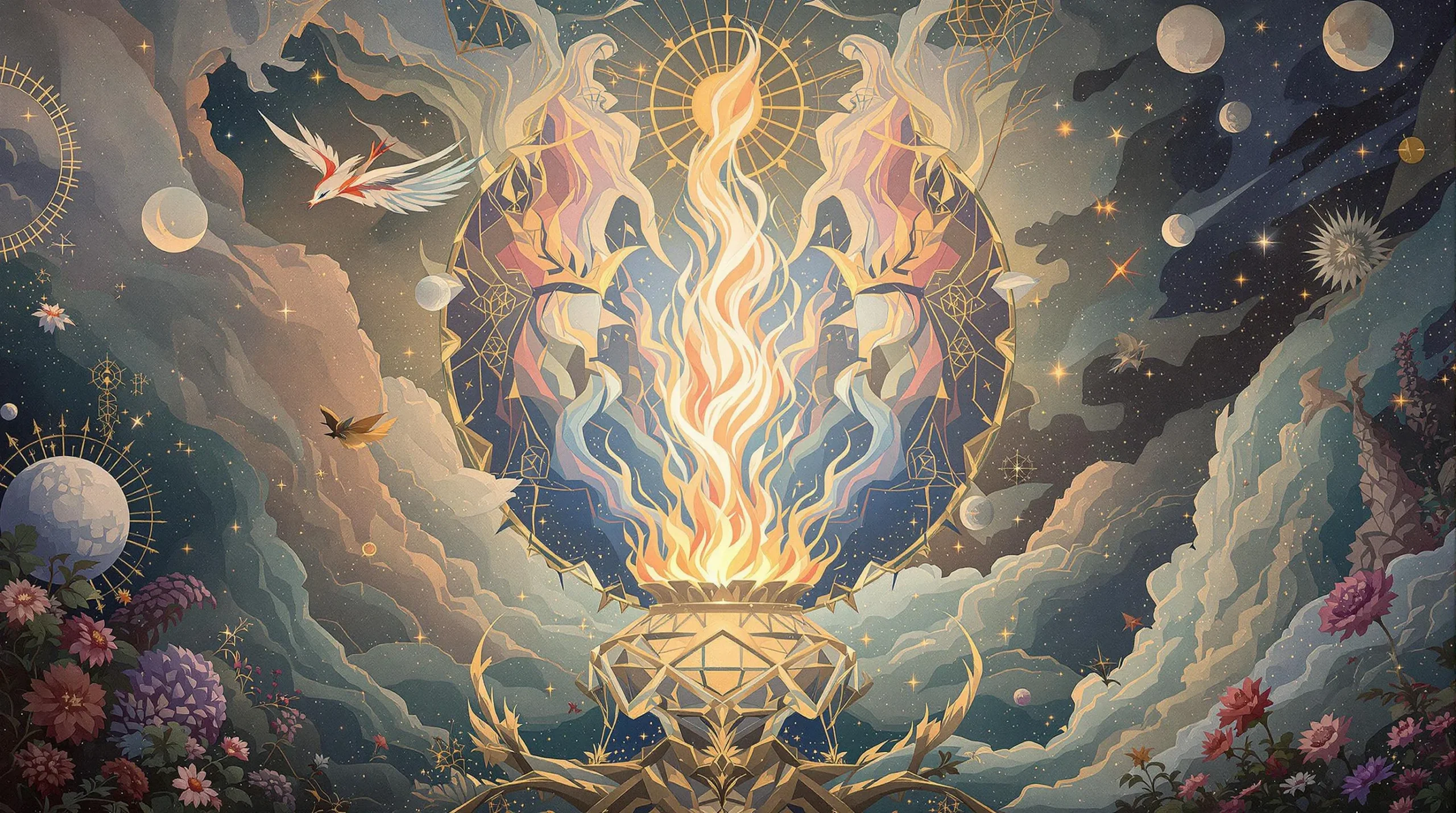


Eternal Flame

Archetype Meaning & Symbolism

Unwavering, Radiant, Enduring, Consuming, Guiding, Primal, Perilous, Sacred, Tenacious, Uncontainable

  • I am not a fleeting thought. I am the question that burns away all answers but one: what endures?

If Eternal Flame is part of your personal mythology, you may...

Believe

  • You may believe that a life is defined not by its breadth of experience, but by its depth of devotion to a single, worthy cause or truth.

    You may believe that passion is not a fleeting emotion but a fundamental state of being, the engine of all meaningful action and creation.

    You may believe that certain principles are absolute and that compromise on these core tenets is a form of spiritual death.

Fear

  • You may fear extinguishment above all else: the utter loss of purpose, passion, or hope that would leave you in cold darkness.

    You may fear a life of mediocrity and lukewarm sentiment, an existence devoid of the intensity you equate with being truly alive.

    You may fear your own power, the possibility that your inner fire could become a conflagration, destroying yourself and everything you hold dear.

Strength

  • You may possess an unwavering resolve, a profound source of resilience that allows you to endure hardships that would break others.

    You may have an inspirational presence, an innate ability to offer light and hope to others, guiding them through their own times of darkness.

    You may experience a profound clarity of purpose, a life largely free from the paralysis of indecision because you are guided by a central, non-negotiable principle.

Weakness

  • You may be prone to a deep-seated rigidity, an inability to adapt, change your mind, or accept new truths that challenge your foundational beliefs.

    You may have a combustive nature that inadvertently burns bridges, pushing others away with a level of intensity they cannot comprehend or withstand.

    You may be susceptible to a unique form of exhaustion, a soul-deep burnout that comes from the relentless internal pressure to 'burn brightly' at all times.

The Symbolism & Meaning of Eternal Flame

In a personal mythology, the Eternal Flame may symbolize the indestructible core of the self. It is the singular passion, the foundational belief, or the sacred memory around which the rest of your identity constellates. Its light is the light of your unwavering purpose; its heat is the intensity of your most profound convictions. To have this archetype is to feel that somewhere, deep within the architecture of your being, there is a chamber that no storm can breach, where a single light burns. This flame may not always be felt, it can be obscured by the smoke of daily life or the dampness of sorrow, but the belief in its persistence is a foundational aspect of your existence. It suggests a life story not of becoming something new, but of constantly returning to, and clearing the path toward, this primal source.

The meaning of the flame is also one of peril. Fire provides warmth, but it also consumes. An Eternal Flame within one’s mythos could represent a devotion so complete it borders on the fanatical, a love so intense it threatens to incinerate the beloved, or a creative drive so powerful it leads to self-destruction. It is the beautiful, terrible bargain of permanence. To hold something as eternally sacred may require you to burn away other parts of yourself, to sacrifice the potential for change on the altar of consistency. The flame does not negotiate; it simply is. It demands a purity of purpose that can feel, to the outside world, like rigidity or even madness.

Ultimately, this archetype speaks to a search for the absolute in a world of relativism. It is a rebellion against the transient nature of things. While others build narratives of adaptation and flow, your story may be one of guardianship. Your purpose is not to travel a winding river of change but to tend to the lighthouse, ensuring its beam never falters. The flame is your truth, your burden, and your glory, a piece of living divinity you are tasked with keeping alive in a mortal world, a sun that rose once and will never set.


Eternal Flame Relationships With Other Archetypes

The River:

The relationship between the Eternal Flame and the River is one of elemental tension and surprising harmony. The River, representing the flow of time, emotion, and change, would seem the natural enemy of a flame that is, by definition, unchanging. Water quenches fire. Yet, the River can also reflect the flame’s light, carrying its image into new territories and multiplying its presence. For an individual, this dynamic might manifest as a conflict between a core, unyielding principle (the Flame) and the necessity of emotional adaptation (the River). They might fear that engaging with their emotions will extinguish their purpose, or conversely, that their rigid passion prevents them from truly living in the flow of life.

The Scribe:

The Scribe seeks to capture truth in language, to record history and fix it on the page. The Eternal Flame, however, represents a truth that exists beyond articulation. It is a pre-verbal, experiential state of being. The Scribe’s work is fragile; ink fades, paper burns, and language changes. The Flame simply endures. A person holding both archetypes in their mythos may feel a constant frustration: the inability of their words to ever truly capture the intensity and purity of their inner fire. They might be a poet who writes endlessly about a single, ineffable feeling, or a historian obsessed with a moment in time whose living essence can never be fully documented, only honored.

The Abyss:

The Abyss is the ultimate void, the endless, formless dark of non-existence or absolute despair. The Eternal Flame’s relationship with it is one of definition and defiance. The flame does not, and cannot, defeat the Abyss, for the darkness is infinite. But by its very existence, it gives the Abyss shape. It creates a boundary, a small, sacred circle of light where meaning is possible. For a person, the Abyss may be a profound trauma, a deep-seated nihilism, or the fear of meaninglessness. Their Eternal Flame is the act of rebellion against this, the conscious choice to maintain a single point of light, hope, or purpose, not because it will fill the darkness, but because it proves the darkness is not all there is.

Using Eternal Flame in Every Day Life

Navigating Creative Blocks:

When inspiration feels absent, the Eternal Flame archetype serves as a reminder of a core, inexhaustible source. You might not seek a new idea but instead return to the foundational passion that ignited your creative path in the first place. The work becomes not about finding a spark, but about clearing away the ash that suffocates the ever-present embers of your primary motivation.

Enduring a Personal Crisis:

In times of profound loss or failure, when the structures of life crumble, the Eternal Flame may represent the one part of you that cannot be destroyed. It is the pilot light of the soul. To connect with it is to find a reason to continue that exists independent of circumstance, a promise of light and warmth that persists even in the wreckage of your current reality.

Defining Core Values:

When faced with a difficult moral or ethical choice, the Eternal Flame acts as your truest compass. You could hold the options up to its light. The one that causes the flame to dim or flicker is likely a betrayal of your essential self, while the one that makes it burn brighter, clearer, and taller is the path aligned with your most fundamental principles, regardless of its difficulty.

Eternal Flame is Known For

Unwavering Presence

It is known, above all, for its constancy. Unlike a simple fire that requires fuel and eventually dies, the Eternal Flame is defined by its perpetual nature, a beacon that burns without consumption, representing a truth or memory that never fades.

Symbol of Remembrance:

Across cultures, it is the chosen symbol for honoring the fallen, the past, or a sacred vow. Its light is a vigil, a defiance against the darkness of forgetting, promising that what was important will always be illuminated.

Source of Illumination:

It provides light where there is none. This is not just a physical act but a metaphorical one. The flame represents enlightenment, a guiding principle, or a singular hope that cuts through the confusion and despair of the unknown.

How Eternal Flame Might Affect Your Personal Mythology

How Eternal Flame Might Affect Your Mythos

When the Eternal Flame is central to your personal mythos, your life story ceases to be a narrative of acquisition or discovery and becomes one of maintenance and revelation. The central drama is not about finding yourself, for you believe your core self has always existed, a steady point of light. Instead, your myth is about protecting this flame. The antagonists in your story are not people, but concepts: doubt, compromise, apathy, the passage of time. These are the winds and rains that threaten to extinguish what is most sacred. Your epic moments are not victories over external foes, but moments of successfully shielding your flame from a storm, or of uncovering it after it has been buried under the ash of despair.

This shapes your narrative arc into a cycle of remembrance and dedication. Your journey is a spiral, not a line, always returning to the central fire to find warmth and guidance before venturing back out into the cold, transient world. The climax of your story may not be achieving a goal, but rather a profound moment of recommitment to your core principle in the face of a temptation to abandon it. Your legend is not written in deeds, but in the unwavering quality of your light. You are the Vestal Virgin, the Tomb Guard, the Lighthouse Keeper of your own soul, and your mythos is the long, quiet, heroic story of your vigil.

How Eternal Flame Might Affect Your Sense of Self

Your perception of self may be anchored in a profound sense of continuity. While others see themselves as a collage of experiences, ever-changing and evolving, you might perceive a singular, unalterable identity at your core. This provides a powerful defense against existential dread; you are never truly lost, because you can always find your way back to the flame. This can manifest as a deep-seated self-assurance, an inner knowing that is impervious to outside opinion. Your identity is not a social construct but a metaphysical fact, a constant in the equation of your life.

However, this may also create a schism between your essential self and your manifest self. You may feel a painful distance between the pure, bright flame within and the flawed, complicated person who navigates the world. This can lead to a kind of internal perfectionism, a constant striving to live in a way that is worthy of your inner light. Failure to do so doesn't just feel like a mistake; it feels like sacrilege, a betrayal of your own sacred core. This could foster a sense of being an imposter in your own life, perpetually falling short of the radiant being you know yourself to be.

How Eternal Flame Might Affect Your Beliefs About The World

You may view the world as a place of shadows and flickering, temporary lights, where most things are transient and ultimately meaningless. In this chaotic theater, only a few things possess the substance of reality: unwavering principles, enduring love, sacred truths. Your worldview could be a search for these eternal things in the world around you. You might categorize people, ideas, and movements based on whether they serve a temporary purpose or an eternal one. This can result in a deeply moral, if somewhat stark, perspective on life, one that prioritizes depth and endurance over novelty and breadth.

This can also cultivate a certain detachment from the day-to-day dramas of the world. If your focus is on the eternal, the temporal may seem trivial. The rise and fall of trends, the shifting political landscapes, the petty squabbles of society might seem like so much smoke, obscuring what truly matters. This could grant you a serene, philosophical calm in the face of turmoil. Or, it could lead to a disengaged cynicism, a sense that nothing is worth investing in unless it promises to last forever, which, in your estimation, very little does.

How Eternal Flame Might Affect Your Relationships

In relationships, you may be drawn to intensity and profound connection, seeking others who can either withstand the heat of your flame or who carry a similar light within themselves. You might evaluate potential partners and friends based on their perceived capacity for endurance and devotion. Superficial connections may hold little interest; you are seeking a fellow guardian for a shared hearth, not a temporary companion for a single night's bonfire. This can lead to deeply loyal, powerful, and lifelong bonds, relationships that become legends in their own right.

The shadow side of this is a potential for inadvertent destruction. Your intensity can feel like pressure to others, your unwavering conviction like judgment. You may unconsciously demand that loved ones orbit your flame, providing fuel or affirmation, and feel betrayed when they express their own, different needs. There is a risk of becoming a sun around which others must revolve, a position that creates warmth but also prevents them from cultivating their own sources of light. You might struggle to love what is transient, to appreciate the beauty of a fleeting connection, seeing it as a failure rather than a gift.

How Eternal Flame Might Affect Your Role in Life

Your perceived role in any group, family, or community is often that of the Beacon or the Heart. You are the one who remembers the original mission, who upholds the core values, who provides the moral or spiritual center when others lose their way. This role is not necessarily one of leadership in a traditional sense; you may not give orders, but your presence serves as a constant reminder of what is important. You are the keeper of the institutional memory, the one who knows why the journey was begun in the first place.

This role can feel like both a sacred duty and a terrible weight. You might feel an immense responsibility to burn brightly for others, to be the unwavering source of hope and strength even when you yourself feel depleted. This can lead to a lonely existence, a feeling that you must be the strong one, that you are not allowed a moment of flickering doubt. There is a danger of your role becoming your prison, where the needs of the community to see your light prevent you from attending to the needs of the person who must tend the flame.

Dream Interpretation of Eternal Flame

In a positive context, dreaming of a steady, bright, and contained Eternal Flame often signifies a powerful connection to your core self and purpose. It may appear during times of confusion or doubt as a profound reassurance from your subconscious. The dream affirms that your inner vitality, your hope, or your primary passion is intact and safe, regardless of external circumstances. Seeing others gathered warmly around the flame in your dream can suggest that your role as a source of strength and light for your community is recognized and valued, fulfilling your need for belongingness.

In a negative context, the flame’s appearance is often distorted. A dream of a sputtering, weak, or dying flame could signal a deep fear of burnout, a loss of faith, or the feeling that your life's purpose is slipping away. An out-of-control flame, a wildfire spreading from the eternal source, may represent a core passion that has become a destructive obsession, a righteous anger turned to blind rage, or an intensity that is consuming your relationships and well-being. To dream of the flame being extinguished is perhaps the most potent nightmare, symbolizing a confrontation with utter despair or the loss of what you hold most sacred.

How Eternal Flame Archetype Might Affect Your Needs

How Eternal Flame Might Affect Your Physiological Needs

Your physiological needs may be interpreted through a metaphorical lens: you require “fuel” to keep your inner flame burning. This is not just about caloric intake, but about the quality and nature of your consumption. You might feel a deep, physical need for experiences that are intense, meaningful, and aligned with your core purpose. Mundane or soulless activities may leave you feeling literally cold, lethargic, or drained, as if your internal temperature has dropped. Your well-being could be tied to a diet of powerful ideas, profound art, and deep conversations.

There may also be a heightened sensitivity to your environment. A chaotic, cynical, or apathetic atmosphere might feel physically oppressive, like being in a room with no oxygen. You may find yourself seeking out spaces, both physical and psychic, that feel sacred, pure, or resonant with your own intensity. Your body is not just a vehicle; it is the temple, the brazier, that houses the flame. Therefore, its needs for rest, clean sustenance, and a harmonious environment are paramount to fulfilling your mythic role.

How Eternal Flame Might Affect Your Ideas of Belonging

Belonging is found not in proximity, but in resonance. You may feel a profound sense of kinship with people from entirely different backgrounds, cultures, or eras, simply because you recognize a similar flame burning within them. Your true tribe are the other keepers of fire, wherever they may be found. Conversely, you might feel deeply alienated from your immediate family or community if they do not share or respect your intensity. The search for belonging is a search for a hearth, a place where your light contributes to a greater bonfire.

This can create a powerful, albeit sometimes small, network of incredibly deep connections. You do not need a crowd; you need a circle of fellow believers. The love you seek is one that can withstand great heat and that cherishes your light without trying to control it. This may mean that true belonging is rare and precious, something to be guarded as fiercely as the flame itself. You might feel a sense of responsibility to offer warmth and light to other wanderers, creating a space of belonging for those who are also drawn to the fire.

How Eternal Flame Might Affect Your Feelings of Safety

Safety is not primarily about physical security; it is about protecting the flame. The greatest danger in your personal mythos is not bodily harm, but the threat of extinguishment. This reorients your entire approach to safety. You might engage in physically risky behavior if it serves your core purpose, yet be incredibly cautious and defensive when it comes to your foundational beliefs. Your walls are built not around your body, but around your heart and mind.

This can lead to the creation of immense psychological or ideological fortifications. You might avoid people, information, or experiences that you perceive as a threat to your inner fire. The need for safety becomes a need for purity of principle. This can provide a powerful sense of security, the knowledge that the most important part of you is well-guarded. However, it can also lead to a self-imposed prison, where the fear of being doused prevents you from ever stepping out into the rain of new ideas and transformative experiences.

How Eternal Flame Might Affect Your Views of Esteem

Your self-esteem is likely tied not to external achievements, but to internal consistency. You feel good about yourself when you are living in alignment with your core passion or principle. Your sense of worth is generated from the inside out, measured by the brightness and steadiness of your flame. A promotion, a compliment, or a public victory may feel hollow if it was achieved through a compromise of your core values. Your greatest pride comes from moments of private integrity, when you chose to protect the flame against great pressure.

This makes you remarkably resilient to criticism from those you do not respect, but devastatingly sensitive to your own perceived failings. When you feel your flame is burning brightly, your esteem is high and unshakable. But when you feel it sputter with self-doubt or guilt, your sense of worth can plummet. Your esteem is not something you build, but something you tend to. It requires constant vigilance, self-reflection, and the courage to live a life that is a worthy vessel for the light you carry.

Shadow of Eternal Flame

The shadow of the Eternal Flame manifests when its nature as a guiding light is corrupted. In its 'too much' form, the flame becomes a wildfire. The unwavering principle turns into fanaticism. The passionate devotion becomes a consuming obsession. The sacred fire meant to provide warmth becomes an inferno of rage or self-righteousness that destroys everything in its path, including the keeper. This shadow self justifies any action in the name of its sacred cause, burning away nuance, empathy, and relationships. It is the zealot, the obsessive artist who destroys their family for their work, the revolutionary who becomes a tyrant, all fueled by a light that has lost all perspective and become a force of pure, indiscriminate consumption.

The 'too little' or inverted shadow is just as perilous. It is the terror of the flame going out. This fear creates a jealous, miserly keeper. Instead of sharing its light and warmth, this shadow-self hoards it, cupping its hands around a tiny, sputtering ember. It becomes paranoid, refusing to engage with the world for fear of being extinguished. It rejects new ideas, new people, and new experiences, creating a cold, dark fortress around a flickering light. This is the path of bitterness, isolation, and spiritual starvation, a life spent in the dark for fear of a breeze that might snuff out the last, precious spark.

Pros & Cons of Eternal Flame in Your Mythology

Pros

  • Having this archetype grants you access to a powerful, internal locus of meaning and control that is independent of external circumstances.

    It provides an incredible capacity for endurance, allowing you to weather profound storms of loss and despair by holding fast to a core of unassailable hope.

    It can create a charismatic and magnetic personality, as others are naturally drawn to the warmth, light, and certainty that you exude.

Cons

  • It can lead to a profound sense of isolation, as few people may be able to understand or match the intensity with which you live your life.

    It carries a significant risk of burnout, as the perceived responsibility to maintain a constant, brilliant inner fire can be spiritually and emotionally exhausting.

    It can foster an ideological inflexibility that prevents personal growth, learning, and the ability to empathize with those who hold different truths.