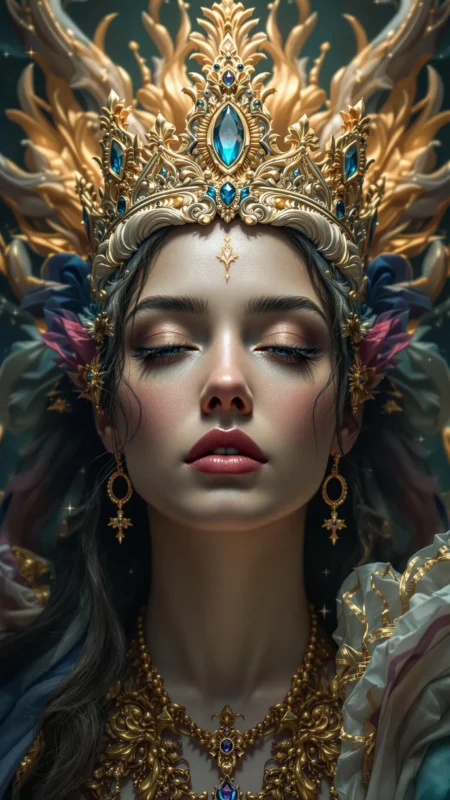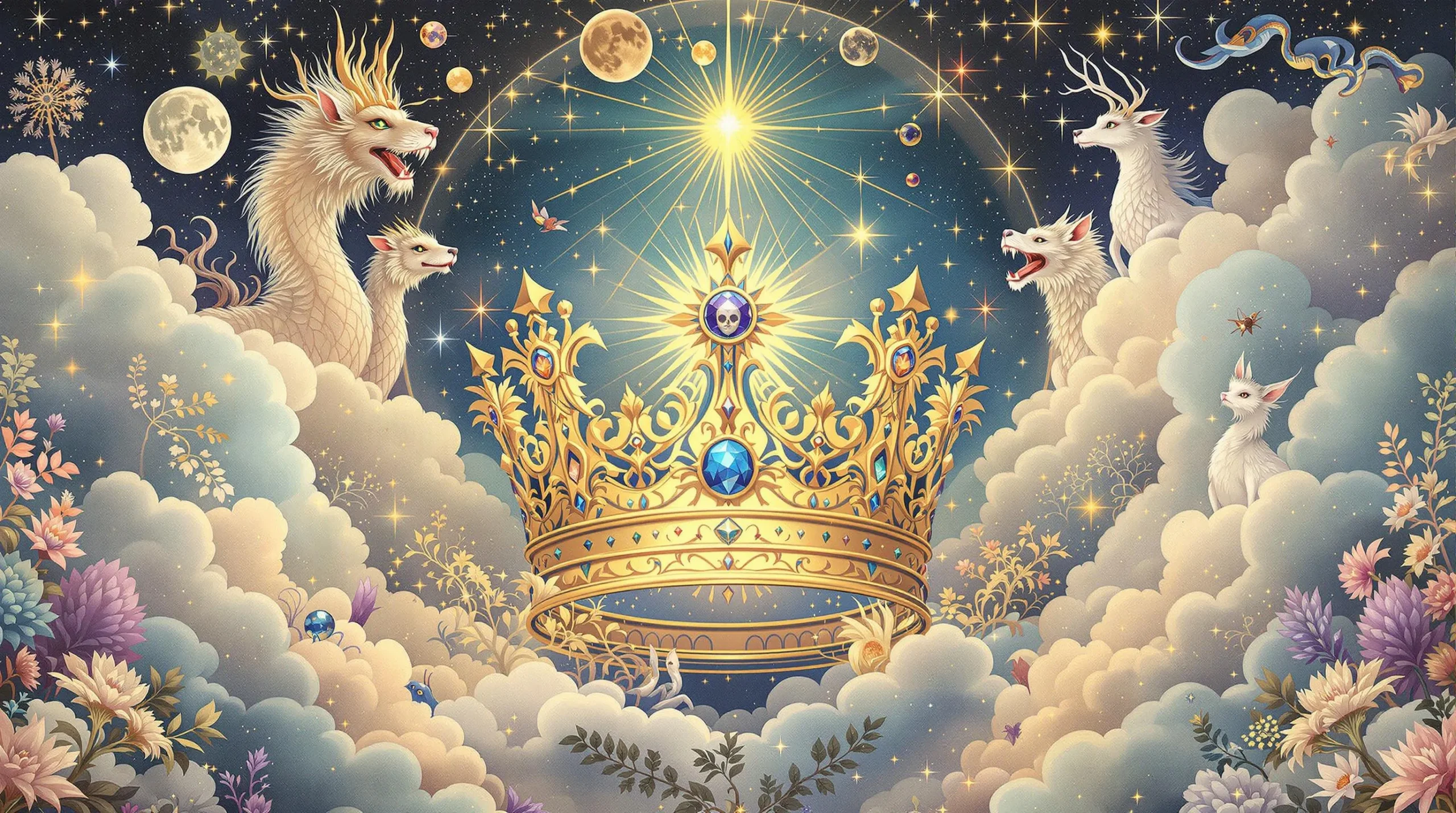


Crown

Archetype Meaning & Symbolism

Authoritative, Responsible, Burdened, Legitimate, Ornate, Conspicuous, Rigid, Inherited, Divine, Heavy

  • Do not seek to wear me; seek to be worthy of what I represent. The weight is not in the metal, but in the mandate.

If Crown is part of your personal mythology, you may...

Believe

  • Certain responsibilities are not chosen, but are mine to bear.

  • My actions have consequences that extend far beyond myself.

  • There is a correct and orderly way for things to be, and it is my duty to uphold it.

Fear

  • Being deemed a fraud or unworthy of my position.

  • The chaos that would ensue if I were to fail or abdicate my duties.

  • Losing myself to the role, becoming a symbol with no person left underneath.

Strength

  • A powerful sense of purpose and direction that guides your decisions.

  • The ability to make difficult decisions for the greater good, even at personal cost.

  • Inspiring loyalty and confidence in others through your stability and conviction.

Weakness

  • A tendency towards rigidity, authoritarianism, and an inability to adapt to change.

  • Emotional distance and difficulty connecting with others on an equal footing.

  • A vulnerability to pride and the intoxicating allure of power.

The Symbolism & Meaning of Crown

In the personal mythos, the Crown is rarely about literal monarchy. It is, perhaps, about the sovereignty of the self. To have the Crown as a core archetype is to be engaged in a lifelong coronation, a gradual process of claiming dominion over one's own impulses, beliefs, and destiny. It symbolizes the principle that reigns supreme in your inner kingdom: perhaps it is creativity, or justice, or love. This ruling principle dictates the laws of your life, organizes your priorities, and gives you a central, unifying purpose. The Crown is the gleaming, heavy truth of what you have chosen to serve, a circle with no beginning and no end, symbolizing a total and unending commitment.

The symbolism is also deeply dualistic: a thing of profound beauty and unbearable weight. Its jewels may represent the highest values and brightest talents, but its metallic structure signifies a rigid, unyielding responsibility. For every bit of privilege it grants, it demands a commensurate sacrifice. The Crown in one's mythos could point to an inherited legacy, a family business or a cultural expectation that feels both like a gift and a sentence. It raises the question of legitimacy: is your authority earned through trial and wisdom, or is it a hollow heirloom, a role you perform without true ownership? It forces an examination of power, not as a tool for self-gratification, but as a sacred trust.

Ultimately, the Crown is a symbol of the lonely pinnacle. It sits on one head alone. For the individual whose story is shaped by this archetype, there might be a persistent sense of being set apart, of carrying a burden that cannot be fully shared. It is the paradox of being highly visible yet fundamentally unknowable, of being a symbol for the collective while experiencing a unique and solitary journey. Your personal myth is not just a story of adventure, but a chronicle of statecraft, a careful and deliberate ruling over the complex, often rebellious, territory of the self.


Crown Relationships With Other Archetypes

The Throne

The Crown’s authority is made manifest only in relation to The Throne. The Crown is the principle of power, but the Throne is the seat of power, the grounded, stable reality of its execution. Without the Throne, a Crown is merely an ornate object, a concept without a context. In a personal myth, this relationship speaks to the necessity of having a foundation—a stable career, a secure home, a consistent set of practices—from which to exercise one’s inner sovereignty. Your great idea (The Crown) needs a business plan and a place to work (The Throne). Your principled stand needs a community or a platform from which to be heard. One without the other is incomplete: authority without a place to enact it is impotent.

The Jester

The Jester is the Crown's essential irritant, its institutionalized chaos. Where the Crown represents order, hierarchy, and the gravity of consequence, The Jester is the anarchist of truth, using humor and absurdity to puncture pretense. The Jester is the only voice that can tell the king he is naked and live to tell the tale. In a personal mythology, the presence of the Crown necessitates a relationship with one’s inner Jester. It is the capacity for self-deprecation, the ability to laugh at one's own seriousness, and the wisdom to listen to the disruptive, unconventional truths that keep power from becoming tyranny. A person too identified with their Crown, without a Jester to keep them humble, may become rigid, dogmatic, and blind to their own folly.

The Sword

The Sword is the sharp, active extension of the Crown’s will. The Crown decrees; The Sword enacts. This relationship explores the critical link between principle and action, between law and enforcement. A Crown that exists without a Sword may have moral authority but lacks the means to protect its kingdom or enforce its vision. It is all philosophy, no practice. Conversely, a Sword without a Crown is mere violence, unguided by a higher purpose. For an individual, this may represent the connection between their core values (The Crown) and their ability to assert boundaries, make difficult choices, and cut away what no longer serves them (The Sword). It is the courage to not only know what is right but to actively and decisively bring it into being.

Using Crown in Every Day Life

Navigating Impostor Syndrome

When the feeling of being a fraud descends, the Crown archetype invites you to distinguish between the role and the self. You may feel inadequate, but the Crown persists. It asks you to consider that the authority you hold may not be about your personal perfection, but about your commitment to a principle or a duty. You are the temporary steward of a permanent ideal. The focus shifts from 'Am I good enough?' to 'Am I serving the purpose I've been given?'

Defining Your Legacy

The Crown is a constant, tangible reminder of legacy. When facing choices about career, family, or creative work, invoking this archetype prompts the question: What kingdom am I building? It frames decisions not in terms of immediate gain but in terms of the long, slow arc of a life's story. It is the difference between building a tent for a night and laying the foundation for a cathedral that will outlast you. The Crown insists on a perspective measured in generations, not moments.

Exercising Authority with Grace

In moments requiring leadership, whether in a boardroom or a family crisis, the Crown offers a model beyond mere command. It suggests that true authority is not taken, but conferred. It is heavy, meant to be worn with humility and an awareness of its cost. Instead of issuing dictates, one might use its influence to create a space of order and clarity where others can thrive, understanding that the role of a sovereign is to ensure the flourishing of the realm, not the aggrandizement of the ruler.

Crown is Known For

Symbol of Sovereignty

The Crown is the ultimate, visible emblem of supreme authority and the right to rule. It separates the monarch from the populace, a physical manifestation of a divine or legal mandate to hold power.

Burden of Responsibility

Known colloquially as 'heavy is the head that wears the crown,' this object symbolizes the immense, often isolating weight of duty, decision-making, and the welfare of a people or a principle.

Object of Legitimacy

The act of coronation, the placing of the Crown, is a performative rite that confers legitimacy. It is the artifact that transforms a person into a monarch, a symbol into a sovereign, closing the gap between the individual and their ordained role.

How Crown Might Affect Your Personal Mythology

How Crown Might Affect Your Mythos

When the Crown is a central object in your personal mythology, your life story may cease to be a simple tale of growth and become a narrative of governance. Your mythos is not about finding yourself, but about forging a kingdom. Major life events are not just experiences; they are crises of state, succession plans, border disputes, and royal decrees. A new job is not just a job, it's an ascension. A difficult breakup is an abdication or a coup. Your personal narrative might be framed as the story of a reluctant ruler learning to accept their destiny, or a just sovereign defending their realm against chaos, or even a deposed monarch plotting to reclaim their rightful place.

The very structure of your story may shift. Instead of a linear path of adventure, it could feel more like a reign, with distinct periods marked by different governing policies. There might be an 'Era of Expansion,' where you acquired new skills and relationships, followed by a 'Period of Fortification,' where you focused on securing what you had built. The core conflict in your mythos might be the tension between the person and the position, the individual's desires versus the duties of the office. Your legend is not about what you did for yourself, but what you built, what you protected, and what you will leave behind: the state of the realm upon your departure.

How Crown Might Affect Your Sense of Self

To see oneself through the lens of the Crown is to internalize a profound sense of responsibility. Your identity may become fused with your role or your primary duty. You are not just a person; you are a steward, a guardian, a leader. This can instill a powerful sense of purpose and direction, a North Star for all decisions. The self is viewed as a vessel for something larger: an ideal, a family, a community, a creative vision. Personal wants and fleeting emotions may be subjugated to the long-term health of this 'kingdom.' This can lead to remarkable self-discipline and integrity.

However, this fusion can also create a dangerous distance from one's own humanity. You might begin to see yourself as a symbol, an office-holder, rather than a flawed and feeling individual. The pressure to be infallible, to always embody the dignity of the Crown, can be isolating. It may become difficult to be vulnerable, to admit weakness, or to ask for help, as these actions might feel like a betrayal of the role. There can be a deep loneliness in this self-perception, a sense that no one can truly understand the weight you carry, because they only see the gleaming, impassive surface of the Crown and not the weary head beneath it.

How Crown Might Affect Your Beliefs About The World

A worldview shaped by the Crown archetype may be one that prizes order, structure, and hierarchy above all else. The world is not a chaotic jumble of random events, but a system, a cosmos that can and should be governed by principles. You may have an innate sense of how things 'ought to be' and feel a personal responsibility to help bring about that order, whether in your home, your workplace, or your community. You see the architecture of power everywhere: in social dynamics, institutional structures, and the flow of history. You may be naturally drawn to systems thinking, understanding that a small change in one part of the kingdom can have far-reaching consequences.

This perspective can also foster a kind of benevolent paternalism. You might view others as subjects within your realm of influence, people to be guided, protected, and managed for their own good. This can be a source of great stability and leadership for those around you, but it can also be perceived as controlling or condescending. There may be an impatience with messiness, rebellion, and dissent, as these things represent a threat to the stability of the realm. The world is seen as a territory to be responsibly administered, and chaos is the ultimate enemy. True freedom, from this point of view, is not the absence of rules, but the flourishing that happens within a well-ordered, just, and protected state.

How Crown Might Affect Your Relationships

In relationships, the Crown archetype can manifest as a dynamic of stewardship. You might feel an immense responsibility for the well-being of your partners, family, and friends. You are the provider of stability, the maker of difficult decisions, the one who holds the long-term vision for the collective. Relationships are not just about affection; they are alliances, compacts built on loyalty, duty, and shared purpose. You may evaluate potential partners based on their suitability as a 'consort,' someone who understands and supports the mission of your kingdom.

This can also create an inherent inequality, a subtle distance that is difficult to bridge. It is hard to be a peer when you are wearing the Crown. You may struggle to receive care, as your identity is so wrapped up in being the caregiver. Vulnerability can feel like a threat to your authority, making true emotional intimacy a challenge. Others might feel that they are in your orbit rather than by your side, subjects rather than equals. Love and loyalty can become tangled with fealty and duty, and you may fear that people are drawn to the power you represent rather than the person you are.

How Crown Might Affect Your Role in Life

The Crown archetype casts you, unequivocally, in the role of the Sovereign. This does not necessarily mean being the boss or the person in charge, but rather, the one who holds the ultimate principle for a given system. You may be the moral compass of your family, the keeper of institutional knowledge at your job, or the uncompromising visionary in a creative project. Your role is to be the still point around which others orient themselves. It is a position defined by stability and endurance; you are the one who is expected to remain when others leave, to hold the line when others falter.

This perceived role is a heavy mantle. It assumes you have the answers, the strength, and the foresight to guide the way. It is a role of service, but from a position of authority. You may feel that your personal desires are irrelevant in the face of your duties. Your function is to embody the law, to be the living representative of the values your 'kingdom' is built upon. This can lead to a life of immense significance and impact, but it can also feel like a gilded cage, a pre-written part in a play that you must perform with flawless dedication until the final curtain.

Dream Interpretation of Crown

In a positive context, dreaming of a Crown—whether you are finding it, receiving it, or wearing it with ease—is a powerful symbol of self-realization and earned authority. It may suggest that you are stepping into a new phase of personal sovereignty, successfully integrating your ambitions, values, and actions into a cohesive whole. Finding a lost Crown could signify the rediscovery of a core purpose you had forgotten. Being coronated by a respected figure might represent an external validation that aligns with your own sense of readiness. If the Crown feels light and fits perfectly, it suggests you are in harmony with your power and responsibility, ruling your inner kingdom with wisdom and grace.

Conversely, a dream featuring a Crown in a negative light often speaks to anxieties about power, legitimacy, and control. A Crown that is too heavy to bear, crushing your head, signifies that the weight of your responsibilities is overwhelming you. If it is slipping from your head or if you are frantically trying to keep it on, it may point to a deep-seated impostor syndrome or a fear of losing your position or control. A stolen or tarnished Crown could symbolize a betrayal, a compromise of your principles, or a sense that your authority has been corrupted or usurped. Dreaming of a hollow, fake, or crumbling Crown might be your subconscious telling you that the power you hold, or seek, is illusory and without substance.

How Crown Archetype Might Affect Your Needs

How Crown Might Affect Your Physiological Needs

From the perspective of the Crown, basic physiological needs are not just personal requirements; they are matters of state. Food, water, shelter, and sleep are the foundational resources required to keep the ruler—and by extension, the kingdom—functioning. There might be a disciplined, almost detached approach to the body. Eating is for fuel, sleep is for restoration of command. The body is not a site of pleasure so much as an instrument of will, something to be maintained in optimal condition to perform its duties. Neglecting these needs is not just self-harm; it is a dereliction of duty, an act that jeopardizes the entire realm.

Furthermore, this archetype may extend this view to others within its sphere of influence. A person with a strong Crown archetype might feel a deep, abiding responsibility to ensure the physiological needs of their family, employees, or community are met. They are the provider, the one who ensures there is food on the table and a roof over everyone's head. This is not just generosity; it is a core function of their sovereignty. The stability of their kingdom depends on the well-being of its citizens, and so attending to these basic needs becomes a primary, strategic concern.

How Crown Might Affect Your Ideas of Belonging

Belonging, for the Crown, is a profound paradox. You are the center of the collective, the very symbol of its identity, and in that sense, you belong completely. You belong *to* your people, your family, your cause. Yet, this very centrality creates an unbridgeable distance. The Crown sets one apart. It is difficult to forge peer relationships when you occupy a position of ultimate responsibility. Intimacy is complicated by power dynamics; friendship is tinged with the politics of court. Who can you trust completely? Is their affection for the person or for the position?

This can lead to a deep and abiding loneliness, the isolation of the pinnacle. Love and acceptance may be filtered through the lens of duty and loyalty. One might seek a consort, a partner who understands the burdens of the office, rather than simply a companion. The need for belonging is met not by being one of the crowd, but by being the revered and respected heart of it. The trade-off is stark: you may gain the adoration of many, but forfeit the easy, egalitarian camaraderie of a few. You are of the group, but never truly in it.

How Crown Might Affect Your Feelings of Safety

For the Crown, safety transcends the personal. It is about the security of the realm, the defense of its borders, and the stability of its institutions. A threat is not just a danger to the self, but an existential risk to one's legacy, principles, and the people under one's care. This can manifest as meticulous planning: robust financial savings, secure housing, multiple backup plans for any contingency. The world is assessed for potential threats, and metaphorical walls, moats, and watchtowers are constructed to protect the kingdom within.

This constant vigilance can create a life of profound security, but it can also lead to a siege mentality. The focus on defending against external threats can foster suspicion and an inability to trust outsiders. This person may struggle with spontaneity, as every action must be risk-assessed. Personal safety becomes intertwined with the preservation of order. The ultimate fear is not harm, but chaos. The loss of control is paramount to the fall of the kingdom, and so every measure must be taken to ensure the reign of law and predictability is never compromised.

How Crown Might Affect Your Views of Esteem

Esteem for the Crown archetype is intrinsically linked to the successful performance of duty. Self-worth is not derived from being liked or admired for personal qualities, but from being respected for one's integrity, wisdom, and leadership. The Crown demands that you be worthy of it. Therefore, high esteem comes from making a just decision, providing stability in a crisis, or upholding a core principle in the face of temptation. It is the quiet, internal satisfaction of a job well done, a kingdom well-managed.

The shadow side of this is that esteem can become dangerously externalized, dependent on the symbols of power and the deference of others. The person may need constant validation of their authority to feel worthy. Furthermore, the pressure to be infallible is immense. A single mistake is not just a mistake; it is a crack in the foundation of their legitimacy, a stain on their reign. This can create a fragile ego, perpetually anxious about being found wanting, about being revealed as an impostor who is unworthy to wear the Crown.

Shadow of Crown

The shadow of the Crown is tyranny. It emerges when the sense of duty corrupts into a sense of divine right, when the burden of responsibility sours into the pleasure of control. The shadow ruler believes their will is law simply because it is theirs. They demand loyalty but offer none, hoard resources, and see their people not as a responsibility but as an instrument. This is the Crown worn for vanity, its gleam used to blind others to the ruler’s inadequacies. It is the despot who silences all dissent, mistaking fear for respect, and isolates themselves within an echo chamber of flatterers. The kingdom, under this shadow, becomes a prison, and the Crown, a brand of ownership.

There is another shadow, equally destructive: the shadow of abdication. This is the person who is given the Crown but refuses its weight. They flee from responsibility, leaving a power vacuum that invites chaos and conflict. This is the reluctant heir who shirks their duties, allowing the kingdom to fall into ruin through neglect. Theirs is a sin of omission. By refusing to rule their own inner kingdom, they allow their worst impulses—fear, apathy, indulgence—to seize control. The empty throne becomes a symbol of their failure, a testament to the chaos that ensues when one refuses to claim their personal sovereignty and take responsibility for their own life.

Pros & Cons of Crown in Your Mythology

Pros

  • Provides a profound sense of meaning and a clear, guiding purpose for your life.

  • Empowers you to create order, stability, and security for yourself and those you care about.

  • Encourages a long-term perspective, focusing on legacy and lasting impact rather than fleeting gratification.

Cons

  • The immense pressure and weight of responsibility can lead to burnout, anxiety, and profound loneliness.

  • Can create a rigid and hierarchical view of the world and relationships, stifling spontaneity and equality.

  • The risk of becoming disconnected from your own humanity, seeing yourself and others as roles rather than people.