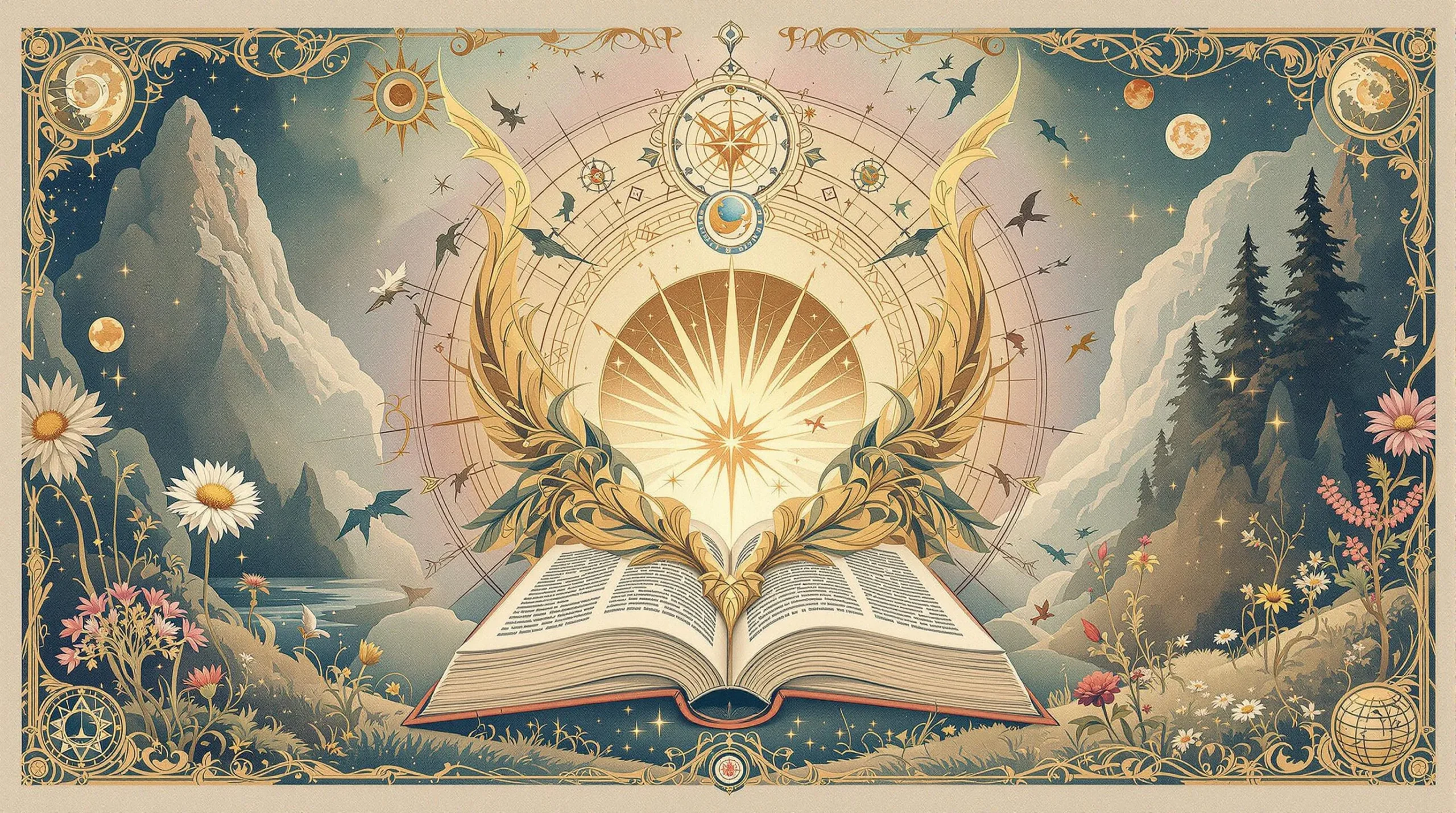


Book

Archetype Meaning & Symbolism

knowledgeable, structured, secretive, historical, finite, narrative, fragile, authoritative, linear, revealing

  • My spine holds worlds, but it is in the turning of my pages that you learn how to bear your own.

If Book is part of your personal mythology, you may...

Believe

  • That every life, including your own, has a coherent narrative structure and purpose, even if it is not immediately apparent.
  • That the answers to life's most important questions exist in recorded form and can be discovered through diligent study.
  • That the past is a fixed text that serves as the unchangeable foundation for the present and future.

Fear

  • That your life story is ultimately meaningless, insignificant, or will be forgotten entirely.
  • The erasure of knowledge through censorship, destruction, or simple neglect; to be fundamentally misread.
  • The blank page: a future devoid of purpose, a sudden loss of identity, or the terror of pure, unstructured potential.

Strength

  • A profound capacity for seeing patterns and creating coherent, meaningful narratives out of disparate or chaotic events.
  • A deep love of learning and a reverence for the wisdom, history, and stories of the past.
  • A methodical, structured, and thoughtful approach to understanding the world and solving problems.

Weakness

  • A tendency towards rigidity, finding it difficult to deviate from the 'script' or accept information that contradicts your established worldview.
  • A temptation to live in the abstract world of stories and ideas, potentially neglecting the unscripted, embodied reality of the present moment.
  • An inability to cope with ambiguity, spontaneity, and situations that lack clear rules or precedent.

The Symbolism & Meaning of Book

The Book is, perhaps, civilization's most potent symbol for contained order. Within its covers, chaos is given syntax, and the sprawling, infinite nature of thought is disciplined into sentences and chapters. To find this archetype resonant in one's personal mythology could suggest a deep need for structure, for a world that can be read and, therefore, understood. It is a portal, not of magic in the fantastical sense, but of perspective: it allows entry into another's mind, another's time, another's meticulously constructed reality. The very act of reading is an intimate communion, a silent conversation between the author's past and the reader's present. The Book promises that knowledge is attainable, that stories have meaning, and that something of us can be made permanent.

In a personal mythos, the Book may represent the known self, the story of you that has been written thus far. It is your history, your collection of beliefs, the established laws of your own psychology. It could be a sacred text, providing unwavering moral and spiritual guidance, or it might be a secret diary, holding the unvarnished truth of your inner life. This archetype speaks to a belief in linearity, in cause and effect, in the steady progression of a plot. Life is not a series of random happenings but a narrative unfolding, and difficulties are not obstacles so much as plot twists, necessary for the development of the protagonist: you.

Furthermore, the Book symbolizes both authority and accessibility. It can represent the Law, the Scripture, the Canon: the established truths of a culture that demand reverence and study. Yet it is also a profoundly personal object. The dog-eared page, the underlined passage, the marginalia scrawled in a moment of insight: these mark the intersection of the universal text and the individual soul. The Book archetype in one’s life may foster a belief that while great truths exist, they only become fully alive when they are personally wrestled with, interpreted, and integrated into one’s own unique story.


Book Relationships With Other Archetypes

The Scribe

The Book’s relationship with the Scribe is one of child and parent, vessel and creator. The Book is the culmination of the Scribe’s labor, the tangible form of their discipline and thought. For a person in whom both archetypes are active, there may be a profound, almost compulsive need not just to learn or experience, but to document. Their life might feel incomplete unless it is recorded, its lessons articulated and preserved. The Book gives the Scribe's fleeting insights a home, a body, a chance at immortality; the Scribe gives the Book its soul, its voice, its reason for being.

The Library

In relation to the Library, the individual Book confronts its own singularity and finds its place in a vast, silent chorus. The Library is the society of Books, the collective unconscious made manifest on shelves. A single Book may contain a truth, but the Library contains the conversation about it, the rebuttals, the commentaries, the divergent narratives. For a person with the Book archetype, an encounter with the Library archetype might be humbling and expansive. It is the realization that one’s personal story, one’s sacred text, is part of a much larger, unending dialogue. Belonging, then, is finding one's correct shelf, the context that illuminates one's own text.

Fire

Fire is the Book’s primal antagonist. Where the Book represents preservation, structure, and the endurance of memory, Fire represents purification through destruction, chaotic transformation, and the untamable present moment. Fire consumes the Book, turning knowledge to ash and stories to smoke. This relationship highlights the ultimate fragility of the record. In a personal mythos, this tension may manifest as a fear of censorship, of being forgotten, or of having one's legacy erased. It could also symbolize a necessary conflict: sometimes, old books and the outdated laws they contain must be burned to make way for new growth, a painful but necessary iconoclasm to escape the prison of a dead text.

Using Book in Every Day Life

Navigating a Transition:

When facing a significant life change, such as a career pivot or a move to a new city, the Book archetype offers the metaphor of chapters. You may find solace in ritually marking the end of one chapter, acknowledging its lessons and its closure, before intentionally beginning the next. This reframes the anxiety of the unknown into the anticipation of a new plot development, allowing you to become the deliberate author of your next phase, rather than a passive character swept along by events.

Processing the Past:

For grappling with personal history or trauma, the Book serves as a powerful container. Viewing a difficult memory as a 'read' chapter allows for a degree of separation. You are not reliving it: you are referencing a text. This perspective may permit you to analyze its themes, its characters, and its impact on the overall narrative of your life without being consumed by the raw emotion of the moment. The story is fixed, but your understanding of it, your critical foreword, can always be rewritten.

Seeking a Path Forward:

In moments of uncertainty or when seeking personal growth, the Book archetype can act as a sacred guide. You might treat your life as a text to be studied, looking for patterns, foreshadowing, and recurring motifs that reveal a deeper purpose. This transforms daily life into a field of symbolic reading, where encounters and challenges are not random but are, perhaps, part of a curriculum designed for your own enlightenment. The goal becomes not just to live, but to comprehend the text of your existence.

Book is Known For

Containing Knowledge

The Book is a vessel, a technology for holding and transmitting information across time and space. It represents the structured, retrievable thought that outlasts the thinker.

Telling Stories:

Beyond mere data, the Book is the quintessential home of narrative. It organizes the chaos of human experience into the comprehensible arcs of story: with beginnings, middles, and ends.

Preserving History:

As a physical object, the Book is a tangible record. It is a piece of the past held in the present, a testament to what was, offering a stable point of reference in a constantly changing world.

How Book Might Affect Your Personal Mythology

How Book Might Affect Your Mythos

When the Book is a central object in your personal mythology, your life story may cease to feel like a series of improvisations and begin to feel like a text being revealed. You might look for foreshadowing in your youth, for recurring motifs in your relationships, for the narrative arc that connects disparate events into a cohesive plot. Your personal mythos is not just lived; it is read. This can lend a powerful sense of destiny and meaning to your existence. Every hardship could be a necessary conflict, every success a chapter climax, all building toward some final, meaningful denouement. You are the protagonist of a story you are simultaneously living, reading, and perhaps, writing.

This archetype may also sculpt your mythos into distinct volumes or chapters. There is the slim volume of childhood, the dense and complicated trilogy of early adulthood, the reflective epilogue of later years. Transitions are not just changes; they are page-turns. This structuring can be a profound tool for making sense of a life, allowing you to contain and understand periods of chaos or joy by binding them with a title and a theme. The danger, of course, is that you might try to force a narrative onto events that resist it, or you may feel that your story is already written, robbing you of the agency to create a different ending.

How Book Might Affect Your Sense of Self

Your sense of self may be deeply intertwined with the story you tell about yourself. If life is a book, then you are its central character, and self-esteem might be tied to how compelling or virtuous that character is. Self-discovery could be framed as an act of reading: you look to your past actions and recorded memories as a fixed text from which you must decipher your own nature. This can create a stable, coherent sense of identity, a feeling of being known to yourself. You are the sum of your preceding chapters, a logical continuation of what came before.

Alternatively, this can lead to a feeling of being trapped by your own history. If your past is a text, it can feel immutable, its early chapters defining all that follow. You might struggle to believe you can change, feeling like a character whose traits are already established. The self becomes a known quantity, a finished story, which can be a source of security but also a profound limitation. The challenge becomes learning to see the self not as a book that is already printed and bound, but as a manuscript open to a radical edit, a surprising new chapter, or an entirely different genre.

How Book Might Affect Your Beliefs About The World

With the Book archetype shaping your perception, the world itself may appear as a grand, sprawling library of texts waiting to be deciphered. You might believe that answers to the deepest questions exist, written down somewhere, if only one could find the right volume. History is not a chaotic jumble of events, but a narrative with lessons and morals. Science, philosophy, and spirituality are different sections of the same cosmic library, each offering a system for reading the world. This worldview privileges order, logic, and established knowledge over raw, uninterpreted experience.

This perspective fosters a deep respect for tradition, expertise, and the wisdom of the ages. However, it may also foster a subtle distrust of the new, the unwritten, the spontaneous. Experience that doesn't fit into a known category or narrative might be dismissed or ignored. There can be a tendency to believe that what is not written is not real, leading to a kind of intellectual chauvinism where lived experience is seen as less valid than textual evidence. The world becomes a problem to be read correctly, rather than a mystery to be lived in.

How Book Might Affect Your Relationships

In relationships, the Book archetype could lead you to see other people as texts to be read and understood. You might pride yourself on your ability to 'read' people, to understand their backstories and motivations. A deep connection might be defined by the moment you feel someone has truly read your book and you have read theirs: a mutual, intimate understanding of each other's core narratives. The phrase 'being on the same page' becomes a literal aspiration for harmony and connection. You may seek partners who are 'open books' and grow frustrated with those who are more cryptic or edited.

This can also create challenges. People are not static texts; they are constantly revising themselves. A tendency to categorize a person based on an initial 'reading' can lead to misunderstanding when they inevitably act out of character. You might try to 'plot' the course of a relationship, expecting a conventional narrative arc of meeting, rising action, climax, and resolution. When relationships prove to be more like messy, contradictory poetry than a well-structured novel, it can be a source of profound disappointment. The desire for narrative closure can make you ill-equipped to handle the beautiful, unresolvable ambiguities of human connection.

How Book Might Affect Your Role in Life

Your perceived role in the world might be that of a keeper or interpreter of texts. You may feel called to be a historian, a scholar, a teacher, a storyteller, a librarian, or a chronicler. Your purpose is not necessarily to create something new out of whole cloth, but to preserve, understand, and transmit the knowledge that already exists. There could be a deep sense of responsibility to the past and to the future: to honor the stories that came before you and to ensure they are available for those who will come after. Your role is that of a custodian of meaning.

This can also translate into a feeling that your own role in life is scripted. You may see yourself as a character with a specific part to play in a larger drama. Whether that part is the Hero, the Mentor, the Martyr, or the Witness, you might feel a sense of duty to play it faithfully. This can provide a powerful sense of direction and purpose. However, it can also feel limiting, as if you are merely reciting lines written by someone else—be it culture, family, or fate. The personal quest becomes finding the freedom to improvise or even rewrite your assigned part.

Dream Interpretation of Book

In a positive context, dreaming of a book may signal the arrival of new knowledge or a coming chapter in your life. Finding a beautiful, ancient tome could suggest the discovery of a deep, hidden truth about yourself or the world, a piece of ancestral wisdom becoming available to you. To be writing in a book with ease in a dream might symbolize a newfound sense of agency and creativity; you are no longer just a reader of your life's story but its active author. Reading a book with brilliant clarity could represent a moment of profound insight, where a complex problem in your waking life is suddenly understood.

In a negative context, the Book can manifest as a source of anxiety. Dreaming of a book with blank pages might point to a fear of the future, a feeling of purposelessness, or a loss of identity. A book that is locked, written in an indecipherable language, or whose words rearrange themselves as you try to read could represent a feeling of being alienated from your own story or a sense of being fundamentally misunderstood by others. To dream of books burning is a potent symbol of loss: it could be the fear of forgetting a crucial memory, the destruction of a legacy, or the painful realization that a belief system you held sacred is no longer viable.

How Book Archetype Might Affect Your Needs

How Book Might Affect Your Physiological Needs

When the Book informs the mythos, the body itself may be regarded as the physical binding for the text of the soul. Physiological needs are the prerequisites for the story's continuation. Food and water are the ink and paper, without which no new sentences can be written. Sleep is the space between chapters, necessary for comprehension and integration. The body is the vessel, the hardware required to run the software of the mind and its unfolding narrative. This view can lead to a disciplined, almost academic approach to health: the body must be maintained in good condition to protect the precious text it carries.

However, this can also foster a profound sense of mind-body dualism, a detachment from corporeal reality. The body might be seen as a mere conveyance for the mind, its sensations and needs a distraction from the more important work of thinking and knowing. There could be a tendency to ignore physical signals, to 'read through the pain,' treating the body as a workhorse that exists only to serve the story. This risks viewing the self as a disembodied intellect, forgetting that the ink and paper are not separate from the story but are, in fact, the very medium through which it exists.

How Book Might Affect Your Ideas of Belonging

A sense of belongingness may be deeply tied to shared texts. To belong is to be 'on the same page' with others, to subscribe to the same story. This can be a religious community united by a holy book, a nation by its constitution, a family by its cherished stories and photo albums, or a friendship by a trove of shared references and inside jokes. Love and intimacy are acts of mutual readership, of being granted access to another’s most private text and, in turn, sharing your own. You feel you belong when your story is read with empathy and understanding.

Conversely, isolation might feel like being a book written in a dead language, present but illegible to everyone around you. The pain of being misunderstood is the pain of being 'misread.' You might struggle to connect with those whose personal 'genres' are wildly different from your own—the realist with the fantasist, the poet with the engineer. A deep fear could be that your book, your essential self, will remain on the shelf, unread and unknown. Belonging is the joy of being a book taken down from the shelf, its spine cracked, its pages read with loving attention.

How Book Might Affect Your Feelings of Safety

Safety, through the lens of the Book archetype, is found in the written word: in laws, contracts, scriptures, and manuals. Security is a well-defined script, a predictable plot. It is the comfort of knowing the rules, of having a map for the territory of life. The unknown is threatening precisely because it is unwritten. Safety lies in precedent, in following a path that has been documented by others. A safe life is one that adheres to a proven narrative, avoiding radical departures from the established text.

This can create a deep-seated fear of chaos and improvisation. Unforeseen events are not opportunities but terrifying plot holes that threaten the coherence of the entire story. A person strongly influenced by this archetype may seek safety by attempting to control every variable, to script every interaction, to live a life so thoroughly planned that no surprises can intrude. The ultimate terror is the blank page, the moment when the map runs out and one must proceed without a guide. Safety is equated with the known, and the known is what has been written.

How Book Might Affect Your Views of Esteem

Esteem, for one influenced by the Book, is often a matter of narrative quality. Self-worth may be measured by the story of one's life. Is it an epic of great deeds? A comedy of wit and resilience? A tragedy of noble suffering? The pressure is to live a life that will make for a good read. Accomplishments might be valued less for the experience of them and more for how they will look as a line in your biography. Esteem is derived from being a protagonist worthy of the reader's admiration.

Furthermore, esteem can be built on the foundation of knowledge. The more books you have read and understood, the more valuable you may feel. Intellect and wisdom become the primary currencies of self-worth. You are what you know. This can build a strong, confident sense of self, rooted in intellectual competence. The shadow of this is intellectual elitism, or the fragile ego that shatters when confronted with ignorance or a contrary text. Self-esteem becomes contingent on having the final word, on possessing the definitive edition of the truth.

Shadow of Book

The shadow of the Book manifests as a prison of text. When its influence becomes too great, the individual may become a dogmatist, a fundamentalist who clings to one book—be it religious, political, or personal—as the sole and absolute truth. The Book ceases to be a tool for understanding and becomes a weapon for judging. New information is not integrated; it is rejected if it contradicts the sacred text. This is the intellectual arrogance that mistakes reading for living and knowledge for wisdom. It is the scholar who cannot see the world beyond the library walls, whose theories are pristine because they have never been tested against the messy reality of human experience.

The shadow also appears as a form of narrative paralysis. The person may become so obsessed with 'reading' their own life for meaning or trying to write the 'perfect' next chapter that they forget to live. They are perpetually editing, outlining, and footnoting, but never turning the page. Life becomes a theoretical exercise. The shadow of the Book is the story that traps its protagonist, forcing them into an endless loop, rereading the same tragic chapter because they are too afraid to write a new one, terrified that any ending they write themselves will be inferior to the one they imagine has been preordained.

Pros & Cons of Book in Your Mythology

Pros

  • Grants a powerful framework for finding order, meaning, and a sense of purpose in the apparent chaos of life.
  • Fosters a deep and abiding respect for knowledge, history, and the power of story to connect human beings across time.
  • Encourages a life of thoughtful introspection and the conscious, deliberate construction of a personal identity and legacy.

Cons

  • Risks fostering a passive or deterministic worldview, where one feels more like a character in a pre-written story than its active author.
  • Can create a significant disconnect from embodied, present-moment experience in favor of living in the abstract realms of ideas and narratives.
  • May lead to dogmatism, intellectual rigidity, and an inability to adapt when lived experience inevitably contradicts the established 'text'.