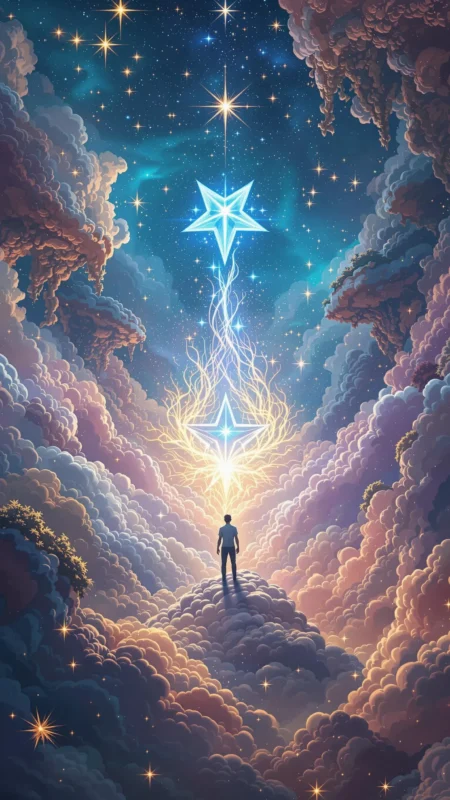
Star

Archetype Meaning & Symbolism

Guiding, distant, brilliant, ancient, cyclical, radiant, constant, mythic, aspirational, aloof

  • Do not merely wish upon me; become the light you seek, for every atom of your being was forged in a heart like mine.

If Star is part of your personal mythology, you may...

Believe

  • You may believe that your life has a specific, grand purpose, a destiny that is written in the cosmos and is slowly revealing itself to you.

  • You may believe that inspiration is a divine or cosmic force, a form of light that one must be open to receiving and channeling into the world.

  • You may believe that you are meant to be a source of guidance and hope for others, a fixed point of light to help them navigate their own darkness.

Fear

  • Obscurity: The terror of being unnoticed, of living and dying without your unique light ever being truly seen or appreciated by others.

  • Burnout: The deep-seated fear of collapsing under the relentless pressure to shine, of being utterly consumed by the very fire that makes you who you are.

  • Irrelevance: The anxiety that your work, your message, your very light, will fade or become meaningless before it can have a lasting impact on the world.

Strength

  • Unwavering Vision: A powerful and resilient sense of purpose that can act as an internal compass, guiding you through the most disorienting periods of life.

  • Inspirational Presence: The natural ability to motivate and guide others, not through force of will, but by embodying a clear and authentic commitment to your own path.

  • Cosmic Perspective: The capacity to see beyond immediate, terrestrial troubles and understand your place in a much larger, more meaningful story, which grants patience and wisdom.

Weakness

  • Emotional Distance: A tendency to remain aloof or disconnected from the messy, everyday concerns of others, making true intimacy a challenge.

  • Pressure to Perform: A relentless internal and external demand to be brilliant, extraordinary, and inspirational at all times, leaving no room for vulnerability or rest.

  • Detachment from Reality: A potential to become so focused on grand, cosmic ideals that you lose touch with the practical, grounded realities of life and relationships.

The Symbolism & Meaning of Star

Within personal mythology, the Star is rarely just an object of distant admiration; it is a piece of one's own soul projected onto the cosmic canvas. It could represent a destiny one feels pulling them forward, a purpose so profound it feels pre-written. To have the Star in your mythos is to feel, on some level, that your life is not a random series of events but a constellation taking shape, each major joy and sorrow a point of light contributing to a greater, meaningful pattern. This archetype whispers of legacy, not in the sense of monuments or wealth, but in the transmission of light: the idea that your actions, your kindness, your art, will ripple outward long after you are gone, traveling through the darkness to touch someone you will never meet.

The Star also speaks to the paradox of being simultaneously significant and insignificant. Gazing at the night sky, one feels the humbling scale of the universe, a sense that personal anxieties are but dust motes in the celestial wind. Yet, the Star archetype insists on a countervailing truth: that you, too, are a source of light. You are composed of the same material as those distant suns. This could foster a unique kind of confidence, one that is not arrogant but deeply rooted, a quiet certainty in one's own inner brilliance. It is the belief that you have a unique light to offer the world, and a responsibility to keep it from being extinguished by doubt or despair.

This archetype may also symbolize a certain kind of isolation. Stars are islands of immense fire separated by unfathomable voids. A person whose mythos is shaped by the Star might feel a similar sense of apartness. They may be admired from afar, seen as inspirational or brilliant, yet feel that few can truly comprehend the immense pressures and fires that burn within them. Their path is often a solitary one, guided by an internal compass oriented toward a goal that others may not see or understand. The Star is the patron of the visionary, the lonely genius, the leader who must stand apart to see the whole picture.


Star Relationships With Other Archetypes

The Night Sky

The Star's very existence as a symbol is predicated on its relationship with the Night Sky archetype. The Sky is the vast, silent, receptive canvas, the context of infinite darkness that allows the Star's pinpoint of light to have meaning. Without the Sky's profound emptiness, the Star’s brilliance would be lost in a sea of undifferentiated light. In a personal mythos, this relationship might signify that one's own talents or 'light' can only be truly seen and appreciated when there is space, quiet, and a receptive environment. It suggests a need to embrace periods of emptiness or 'darkness' as necessary conditions for one's own brilliance to emerge and be recognized.

The Moon

The Star and the Moon are celestial siblings with fundamentally different natures. The Moon governs the immediate, the cyclical, the emotional tides, and the inner, shadowy world, shining with a borrowed, gentle light. The Star, by contrast, is a source of its own light, representing the distant, the constant, the universal, and the aspirational. A person might have a relationship with both: the Moon helps them navigate the intimate, personal waters of their heart, while the Star guides their larger life purpose. Their relationship is a dance between the personal and the universal, the emotional and the rational, the cyclical and the eternal.

The Explorer

To the Explorer archetype, the Star is not just a beautiful object but a vital tool and a sacred destination. The Star is the 'X' on the cosmic map, the fixed point that allows the Explorer to chart a course through uncharted territory, be it a physical wilderness or the wilderness of the soul. For a mythos containing both, life may feel like a grand expedition toward a distant, luminous goal. The Star provides the 'why' for the Explorer's journey, the ultimate purpose that makes the hardship and uncertainty of the road worthwhile. The Explorer's journey, in turn, is what gives the Star's distant light immediate, practical relevance.

Using Star in Every Day Life

Navigating a Career Crossroads

When faced with a paralyzing choice between a safe path and a risky passion, you could invoke the Star archetype. This isn't about looking for a sign. It is about becoming the fixed point yourself. You might meditate on the qualities of a distant star: its constancy, its slow, deliberate journey across eons. This perspective may help you realize that the 'correct' choice is less important than the internal direction you align with. The Star teaches that you can navigate by your own luminescence, your core values, even when the path ahead is shrouded in fog.

Cultivating Creative Vision

For the artist or innovator stuck in a fallow period, the Star archetype could offer a way out of the mire. You might consider the physics of starlight: a photon travels for millions of years, unchanged, to reach an observer. This could reframe your creative work. Each piece is not a fleeting gesture but a particle of light sent into the future. This long view may relieve the pressure for immediate acclaim, fostering a patient, enduring commitment to your vision, trusting that its light will find its audience when the time is right.

Processing Grief

In the profound darkness of loss, the Star may act as a symbol of continuance. One might reflect on the fact that we see the light of stars that may have died long ago. Their brilliance persists across time and space. This metaphor could provide a vessel for grief. The person lost is not gone, but has become like a star whose light, memory, and influence continue to travel, illuminating your life from a distance. Their presence transforms from a physical immediacy to a guiding principle in your personal cosmos.

Star is Known For

Navigation

For millennia, stars, particularly Polaris, have served as celestial waypoints. They offer a fixed, reliable map in the vast, featureless expanse of the ocean or desert, symbolizing unwavering guidance and a constant source of direction in the face of the unknown.

Elemental Creation

Stars are the universe's foundries. Through the process of stellar nucleosynthesis, they forge heavier elements from lighter ones in their fiery cores. In a very real sense, the carbon, oxygen, and iron in our bodies were created inside a star, making them a symbol of cosmic ancestry and creation.

Light in Darkness

As the primary source of light in the night sky, stars represent hope, wonder, and the triumph of illumination over shadow. They are a visual metaphor for insight, inspiration, and the persistence of beauty even in the most profound blackness.

How Star Might Affect Your Personal Mythology

How Star Might Affect Your Mythos

When the Star archetype embeds itself in your personal mythos, your life story may cease to feel like a linear progression and begin to resemble a constellation. Key events—a chance meeting, a sudden insight, a devastating loss—are no longer seen as random occurrences but as fixed points of light that, when connected, reveal a hidden image, a secret meaning. Your narrative becomes one of destiny, not of the rigid, predetermined sort, but one of emergent purpose. You might interpret your own biography as the gradual discovery of this personal constellation, a pattern you were always meant to embody.

Furthermore, this archetype infuses the personal myth with a sense of immense time and scale. Your story is not just your own; it is connected to something ancient and enduring. You might see your own struggles and triumphs as echoes of cosmic events: a period of depression as a 'black hole,' a creative breakthrough as a 'supernova.' This celestial metaphor doesn't diminish personal experience but elevates it, framing your life within an epic, universal context and suggesting that your personal light is a vital part of the cosmic fabric.

How Star Might Affect Your Sense of Self

To view oneself through the lens of the Star is to internalize a profound paradox. On one hand, it can cultivate a powerful sense of uniqueness and intrinsic worth. You may believe you possess a special 'light'—a unique talent, insight, or purpose that is yours alone to share. This is not simple arrogance; it is a quiet, deep-seated conviction in your own luminous core. It fosters resilience, for even in moments of doubt, the belief in this inner light can serve as an unquenchable source of hope and motivation.

On the other hand, the Star archetype can foster a feeling of profound isolation. A star is a solitary body, separated from its brethren by unimaginable distances. You might feel admired but not understood, seen but not truly known. There can be a sense of being 'on a different wavelength,' inhabiting a reality that others cannot fully access. This may lead to a feeling of being perpetually on the outside looking in, a celestial observer of the more terrestrial, interconnected world of humanity.

How Star Might Affect Your Beliefs About The World

A worldview shaped by the Star archetype is often one of grand, elegant design. The universe is not a chaotic accident but an intricate, interconnected web of light and meaning. You might be inclined to see patterns everywhere, to believe in synchronicity, fate, or a higher guiding intelligence. This perspective can provide immense comfort, transforming life's hardships from meaningless suffering into necessary steps in a much larger, purposeful dance. Problems may seem less overwhelming when viewed against the backdrop of cosmic time and space.

This perspective may also cultivate a sense of detached observation. Like an astronomer charting celestial bodies, you might view world events, social dynamics, and even your own life with a certain coolness and objectivity. The immediate, frantic pace of human affairs can seem trivial when compared to the silent, patient turning of the cosmos. This can lead to great wisdom and clarity, but also carries the risk of disengagement from the pressing, messy, and urgent needs of the world right here on the ground.

How Star Might Affect Your Relationships

In relationships, the Star archetype can manifest as a powerful inclination toward idealism and destiny. You might believe in 'soulmates' or 'twin flames,' connections that feel 'written in the stars.' There could be a tendency to project an idealized brilliance onto a partner, seeing them as a perfect, luminous being rather than a complex, flawed human. This can create incredibly romantic and deeply meaningful bonds, but it also sets the stage for disillusionment when the terrestrial reality of the person fails to match the celestial ideal.

This archetype can also create a dynamic of distance within intimacy. Just as a star provides light but not warmth from afar, you may offer inspiration, guidance, and unwavering support to loved ones, yet struggle with day-to-day emotional closeness. You might prioritize your 'mission' or 'purpose' over the relationship's immediate needs, creating a situation where a partner feels they are in orbit around you rather than standing beside you. They may admire your light but shiver from a lack of intimate, personal heat.

How Star Might Affect Your Role in Life

If the Star is a core part of your mythos, you may feel an innate calling to a role of guidance and inspiration. This need not be a formal leadership position; you could be the artist whose work illuminates a hidden truth, the teacher who sparks a student's passion, or the friend whose quiet constancy provides a fixed point in others' lives. You feel a responsibility to shine, not for your own glory, but because you believe your light helps others navigate their own darkness. Your perceived role is to be a beacon.

This carries the immense weight of expectation, both internal and external. You may feel a relentless pressure to be 'on' at all times: to be wise, to be brilliant, to be unwavering. The role of the Star allows for no dim days. There is a fear that if you show weakness or uncertainty, you will not just be letting yourself down, but failing all those who look to you for direction. This can lead to a carefully curated public self that hides the volatile, explosive reality of the inner stellar furnace.

Dream Interpretation of Star

In a positive dream context, seeing a star, especially a particularly bright or beautiful one, could be a powerful affirmation from your subconscious. It may symbolize clarity, hope, and a connection to your deepest purpose. Following a star in a dream might suggest you are on the right path in your waking life, confidently moving toward your destiny. Discovering a new constellation could represent the dawning of a new understanding, connecting disparate parts of your life into a meaningful whole. It is the psyche's way of saying: 'You are guided. You are luminous. Trust the path you are on.'

Conversely, a dream featuring a star in a negative context could signal deep-seated anxieties. A falling or shooting star might not be a sign of a wish come true, but a symbol of a shattered hope, a lost ideal, or a fear of a sudden fall from grace. A dim, flickering, or dying star could point to a fading sense of purpose, creative burnout, or a growing fear of insignificance. Being lost in a starless night might represent a profound sense of disorientation and despair, a feeling of being utterly alone and without guidance in the darkness of your current circumstances.

How Star Archetype Might Affect Your Needs

How Star Might Affect Your Physiological Needs

When the Star archetype takes hold, one's relationship with the body and its fundamental needs may become tenuous. Physiological needs for sleep, food, and rest can seem like terrestrial inconveniences, secondary to the higher calling of a great project or a burning inspiration. The individual might adopt a 'burn the midnight oil' mentality, treating the body not as a home to be cared for but as a vehicle or a vessel for a brilliant mind or creative force. Sustenance is found not in food but in ideas; rest is found not in sleep but in the completion of a task. The body's signals of exhaustion are often ignored, pushed aside by the will to shine.

This can lead to a life lived in cycles of intense, fiery output followed by periods of collapse and burnout. There may also be a heightened physiological sensitivity to light and darkness, a deep connection to circadian rhythms that feels almost spiritual. The person might feel most alive and creative in the dead of night, the traditional time of the stars, or feel a palpable shift in energy with the changing of the seasons. The body is not just a biological machine; it is a small, personal cosmos that mirrors the greater one.

How Star Might Affect Your Ideas of Belonging

The need for belongingness is complicated by the Star archetype. There can be a profound sense of loneliness, a feeling of being an island of light in a vast emptiness. While you may attract a following or a group of admirers, this often creates a dynamic of adoration from a distance rather than true, mutual belonging. You might feel more kinship with historical figures, distant artists, or the cosmos itself than with the people in your immediate vicinity. The search is not for a group to fit into, but for the other 'stars' in the sky, the rare souls who seem to burn with the same fire.

Love and connection are often sought on a grand, cosmic scale. The ideal is a 'soul family' or a 'twin flame,' a relationship that feels divinely ordained and telepathically understood. This can lead to deep, powerful, and life-altering bonds when such a connection is found. However, it can also lead to a chronic sense of dissatisfaction with ordinary, terrestrial relationships, which may feel mundane or lacking in the requisite cosmic significance. The desire is to belong not to a tribe on Earth, but to a constellation in the heavens.

How Star Might Affect Your Feelings of Safety

Safety, for one guided by the Star, may be defined in existential rather than physical terms. There could be a curious lack of concern for conventional safety, a willingness to take great risks based on a deep-seated belief in one's own destiny. This isn't recklessness; it is a faith that the universe will protect what is essential to its grand design. The true fear is not physical harm, but the extinguishment of one's light. The greatest threat to safety is not an accident or an attack, but mediocrity, obscurity, and the horror of a life lived without purpose.

Consequently, safety-seeking behaviors are channeled toward preserving one's legacy and impact. This could manifest as a meticulous archiving of one's work, a desperate drive for recognition, or an obsession with creating something that will outlast the self. The core vulnerability is the fear of being forgotten, of having one's star collapse into a black hole of insignificance. Safety is found in the belief that one's light will continue to travel through time, reaching future generations long after the physical body is gone.

How Star Might Affect Your Views of Esteem

For the Star-led individual, esteem is inextricably linked to the act of shining. Self-worth is derived from the successful expression of one's inner light, whether through creative work, intellectual insight, or inspirational leadership. The validation sought is not mere praise, but recognition of one's unique contribution and purpose. High self-esteem feels like being a bright, clearly visible star in the night sky, confident in one's place and brilliance. It is a quiet, powerful sense of alignment with one's destiny.

Conversely, low self-esteem is experienced as a crisis of purpose. It is the feeling of being a dim, forgotten star in a crowded galaxy, or worse, a collapsed star, a black hole absorbing light rather than emitting it. Failure is not just a personal setback; it is a cosmic tragedy, a betrayal of one's potential. This makes the individual highly sensitive to criticism or lack of recognition, as it can feel like the world is confirming their deepest fear: that their light was never very bright to begin with.

Shadow of Star

When the Star archetype falls into shadow, its light curdles into a black hole of narcissism. The quiet confidence in one's inner brilliance mutates into a demanding arrogance. The individual no longer seeks to guide others but to command their orbit, insisting on being the gravitational center of every room and relationship. The need for admiration becomes a ravenous hunger, and other people are no longer seen as fellow travelers but as satellites, their only purpose to reflect the Star's glory. This shadow Star consumes the energy and light of others to fuel its own ego, leaving a wake of exhausted and devalued souls. It is the 'diva' complex, where the belief in one's specialness becomes a justification for entitlement and emotional tyranny.

The other shadow expression is that of the Fallen Star. This occurs when the individual's grand ambitions are thwarted or their brilliance fails to gain the recognition they feel it deserves. Crushed by the weight of their own perceived failure, their light doesn't just dim; it inverts. They become cynical, bitter, and filled with resentment. They may actively try to extinguish the light in others, casting scorn on hope and ambition wherever they find it. The Fallen Star is haunted by what could have been, and their worldview becomes a dark, starless sky where they were meant to be the brightest light. They radiate not inspiration, but the cold gravity of a collapsed dream.

Pros & Cons of Star in Your Mythology

Pros

  • You possess a profound and resilient sense of purpose and direction that can provide a powerful source of motivation and stability against life's challenges.

  • You may have a natural ability to inspire hope and offer clarity to those who feel lost or in despair, simply by embodying your own truth.

  • Your unique and often brilliant perspective can lead to great creativity, innovation, and the ability to see patterns and solutions that others miss.

Cons

  • A potential for deep loneliness and isolation, stemming from a feeling of being fundamentally different from or intellectually above others.

  • The immense, often self-imposed, pressure of living up to a perceived destiny can lead to chronic anxiety, performance issues, and eventual burnout.

  • There is a significant risk of developing a superiority complex or becoming so detached from practical, everyday life that you struggle to function effectively within it.