 Believe
 Fear
Fear Strength
 Weakness
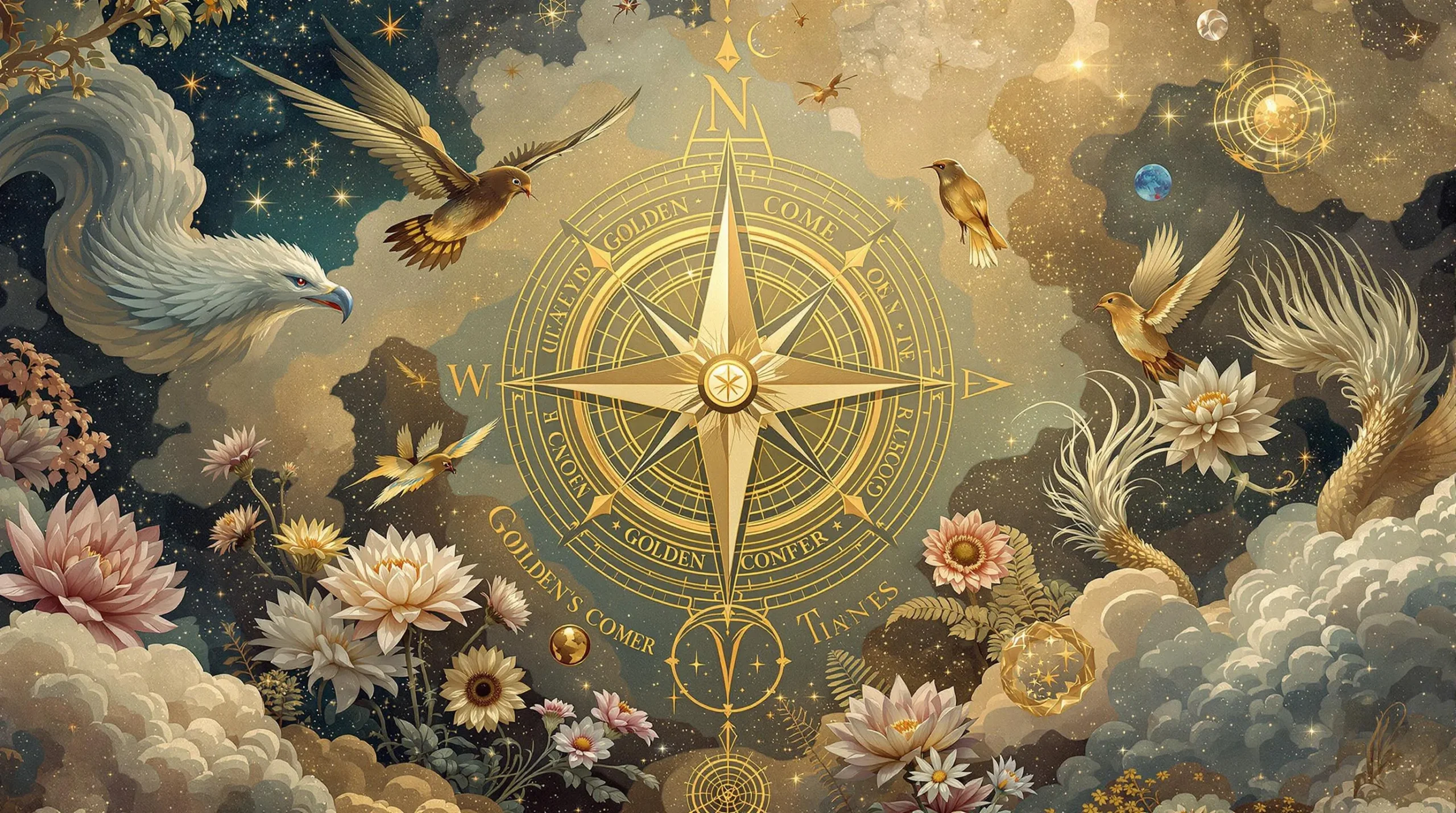
In a world saturated with data, the Golden Compass archetype represents a radical form of knowledge. It is the quiet antithesis to the algorithm, a personal oracle in an age of mass information. Its symbolism in one’s mythology suggests a reverence for a truth that is felt rather than calculated. It whispers that the most profound answers are not found in external metrics but in the subtle alignment of one’s own inner world. To carry this compass is to posit that you are an instrument of perception, that your consciousness is a sensitive needle capable of registering the invisible currents of meaning that flow beneath the surface of the mundane. It champions a mode of being that is receptive, patient, and deeply attentive.
The Compass symbolizes the intricate, often paradoxical, nature of truth itself. It is not a simple binary of true or false, but a layered, multifaceted reality represented by the device's 36 symbols. In a personal mythos, this could translate to a worldview that embraces complexity and rejects easy answers. It suggests that truth is not a static fact to be possessed but a dynamic reality to be courted and understood through a symbolic lens. It asks you to become a poet of your own life, interpreting the omens in the everyday, seeing the universe not as a collection of objects but as a web of correspondences, a story waiting to be read.
Furthermore, this archetype speaks to the sacred marriage of mechanism and spirit. It is a machine, a thing of gears and crystal, yet it is useless without the human element of focused intuition, what Philip Pullman called a state of grace. This could symbolize a belief that our highest potential is reached not by abandoning our rational, structured minds, but by infusing them with a deeper, quieter wisdom. It honors the intricate clockwork of the universe while insisting that its deepest secrets are only accessible through a state of being that is anything but mechanical. It is the perfect symbol for a life that seeks to integrate the analytical with the intuitive, the seen with the unseen.