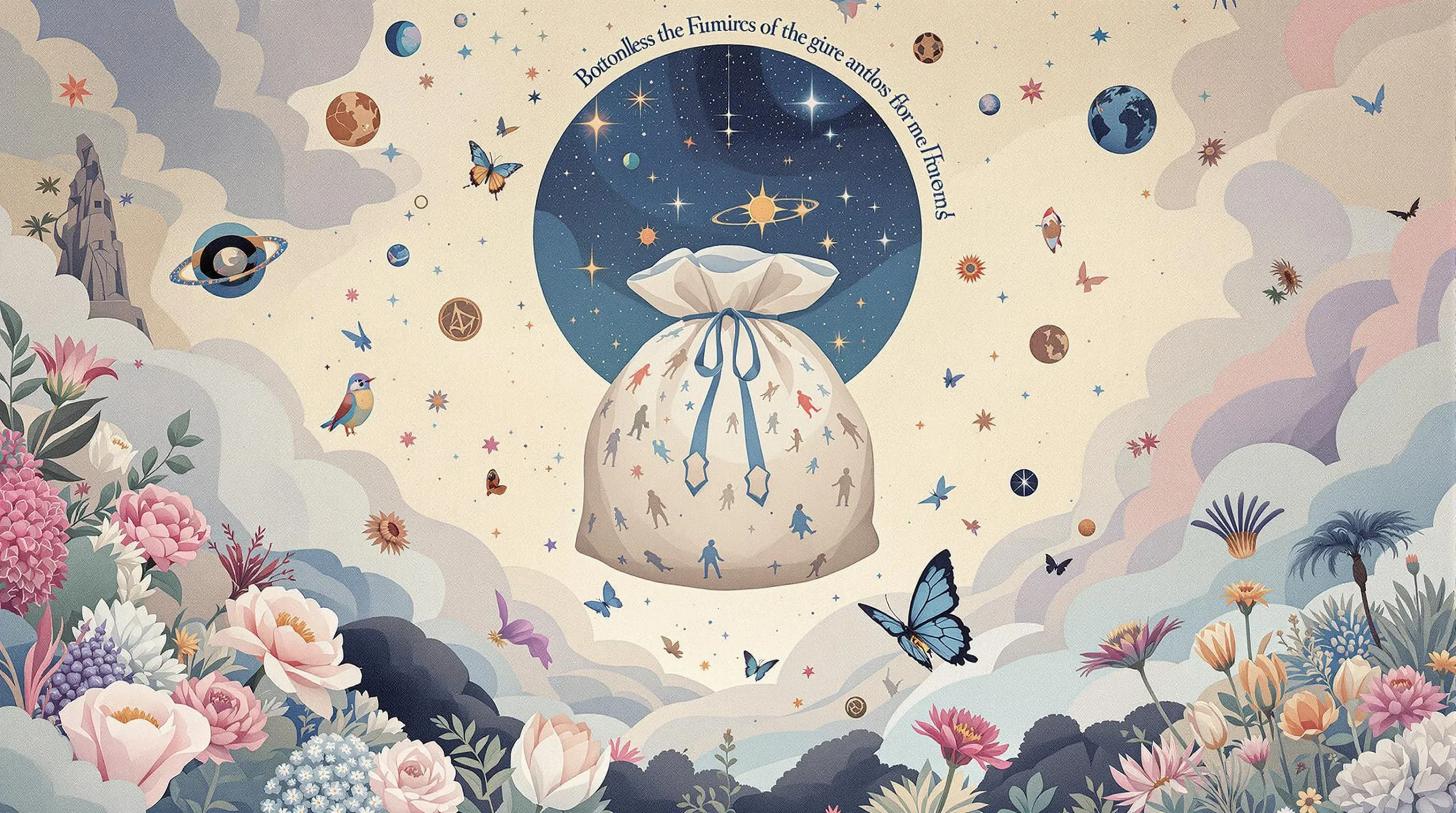


Bottomless Bag

Archetype Meaning & Symbolism

Prepared, resourceful, infinite, burdensome, cluttered, mysterious, supportive, chaotic, deep, potential

  • Reach inside. The answer to your present was packed in your past.

If Bottomless Bag is part of your personal mythology, you may...

Believe

  • You may believe that every problem has a solution, and that the resources for that solution are closer than you think.

    You may believe that your past is not baggage, but an armory of tools and wisdom waiting to be used.

    You may believe that being prepared is the highest form of caring for yourself and others.

Fear

  • You may fear being caught unprepared, that a situation will arise for which you have no tool, answer, or resource.

    You may fear losing your 'bag,' and with it, your identity, your competence, and your sense of security.

    You may fear that you are valued only for what you can provide, not for who you are.

Strength

  • Resourcefulness: an uncanny ability to find a way, to make do, to solve problems with the tools at hand.

    Self-Reliance: a deep-seated trust in your own ability to handle challenges without needing external help.

    Generosity: a readiness to share your resources, whether they be material, emotional, or intellectual, to help others.

Weakness

  • Inability to travel light: a difficulty in letting go of past issues, old grudges, or useless skills, carrying everything 'just in case.'

    Over-responsibility: a tendency to take on the burdens of others, to solve problems that are not yours to solve.

    Lack of Spontaneity: a reluctance to embrace the unknown or act without a plan, as it falls outside the realm of your prepared-for contingencies.

The Symbolism & Meaning of Bottomless Bag

A Bottomless Bag in one's personal mythology is a potent symbol of innate resourcefulness and untapped potential. It suggests that you carry within you everything you could ever need, a dense repository of skills, memories, solutions, and even personality facets that can be retrieved in a moment of crisis or opportunity. It's the antithesis of lack. This archetype whispers that the external world is not the sole source of salvation or tools; the most vital provisions are the ones you have been carrying all along, often unknowingly. Its presence in your story may hint at a deep-seated trust in your own capacity to handle whatever life presents, a faith rooted not in arrogance, but in a quiet, lived knowledge of your own depth.

The object itself, often unassuming on the outside, represents the deceptively simple container of the self: the body, the mind, the personal history. Its cavernous, perhaps chaotic, interior is a map of the subconscious, a place where forgotten strengths and unresolved issues coexist. To reach inside is to engage in an act of self-reflection, an excavation. What you pull out might surprise you. It might be a perfect, polished gem of an idea, or it might be a tangled mess of old anxieties. The Bag doesn't discriminate; it holds everything. It teaches that preparedness is not about anticipating every possible future, but about having such a rich and varied inner world that you can improvise a solution for any future that arrives.

Furthermore, the Bottomless Bag carries the weight of its own contents. It may be a source of infinite resource, but it is also a burden. To carry everything is to be unable to travel light. It symbolizes the weight of the past, the responsibility of potential, and the psychic toll of being the one who is always prepared. It could point to a tendency to hold on to things, people, and memories long after they have served their purpose, all under the guise of potential utility. The bag is both a gift and a challenge: can you learn to organize its contents, to find what you need without being overwhelmed by the clutter, and to perhaps, occasionally, set it down?


Bottomless Bag Relationships With Other Archetypes

The Wanderer:

The Bottomless Bag is the quintessential companion to The Wanderer. While The Wanderer is driven by a need for movement, experience, and the horizon, the Bag provides the means for the journey's continuation. It ensures The Wanderer is never truly destitute, pulling out a map for the lost, a meal for the hungry, or a story to trade for lodging. Their relationship is symbiotic: The Wanderer gives the Bag purpose and motion, while the Bag gives The Wanderer resilience and freedom from want. This pairing in a personal mythos may suggest a life narrative where one feels free to explore the unknown precisely because of a deep, internal sense of security and preparedness.

The Hoarder:

The Hoarder is the shadow reflection of the Bottomless Bag. Both archetypes are about accumulation, but their intent is vastly different. The Bottomless Bag collects resources for potential future use, its contents oriented toward action and problem-solving. The Hoarder, however, accumulates for the sake of accumulation, driven by a fear of lack so profound that the objects themselves become a fortress against the world, never to be used. When a person with the Bag mythos leans into their shadow, they might become The Hoarder, their bag of potential becoming a tomb of stagnant possibility. The once-useful items become clutter, the preparedness curdles into paralysis, and the fear of losing anything prevents them from using anything.

The Magician:

The Bottomless Bag could be seen as The Magician's primary prop, the source of every rabbit, scarf, and puff of smoke. The Magician understands that transformation and wonder require the right tools at the right time. The Bag is the physical manifestation of The Magician's access to unseen realities and hidden resources. For a person, this relationship might symbolize a connection between their practical, prepared nature (the Bag) and their ability to create change and manifest their will in the world (The Magician). It suggests that true 'magic' in one's life may not be conjured from thin air, but rather assembled from the deep, often-ignored, resources they already possess.

Using Bottomless Bag in Every Day Life

Facing a Creative Block:

When inspiration feels barren, you might not need to look outward for a muse. The Bottomless Bag suggests you reach into the repository of your own experiences, memories, and forgotten skills. You could find that a half-remembered conversation from years ago, a peculiar object you once owned, or a specific, mundane sensory detail from childhood holds the exact key to unlock your current project. The solution isn't new; it's just been waiting at the bottom of the bag.

Navigating Emotional Turmoil:

In moments of crisis, there may be a tendency to feel unequipped. The Bottomless Bag as a personal myth suggests a different truth. You could rummage through your past triumphs and failures, not as baggage, but as a collection of proven tools. You might pull out the resilience learned from a past heartbreak, the patience forged during a long wait, or the specific coping mechanism you developed to handle a different kind of stress. You have already packed what you need to survive this.

Making a Major Life Decision:

When at a crossroads, the path forward can seem obscured. The archetype of the Bottomless Bag invites a kind of internal inventory. Instead of just weighing pros and cons, you could metaphorically empty the bag to see what you're carrying. What values, beliefs, and hidden desires have you been toting around? Seeing them all laid out might reveal a pattern, showing you that you've been unconsciously collecting resources for one path all along, making the choice less a leap of faith and more a recognition of your own preparation.

Bottomless Bag is Known For

Infinite Capacity

It is known for holding a seemingly impossible amount of objects, defying the physics of its external appearance. It represents the vast, often untapped, potential within a person or a situation.

Timely Provision:

It is famous for producing the exact item needed at the exact moment it is required, whether it's a rope, a sandwich, or a forgotten key. This points to a kind of intuitive rightness or cosmic preparedness.

Mysterious Contents:

No one, perhaps not even the owner, knows everything that resides within it. Its contents are a mix of the mundane and the magical, the useful and the absurd, symbolizing the depths of the subconscious mind.

How Bottomless Bag Might Affect Your Personal Mythology

How Bottomless Bag Might Affect Your Mythos

When the Bottomless Bag is a core object in your personal mythos, your life story may not be one of a hero forging new weapons, but of an archivist finding the perfect, forgotten tool for the job. Your narrative arc might be defined by moments of profound, surprising self-sufficiency. You are the character who, when trapped in a dungeon, discovers they've had the key in their pocket all along. This can shape your mythos into a tale of inner discovery rather than external conquest. The central conflicts in your story may not be about acquiring new powers, but about learning to access and trust the powers you already hold. Your life might be seen as a series of opportunities to excavate your own depths.

The narrative might also carry an undercurrent of weight and responsibility. Your myth could be that of the eternal Quartermaster, the one who carries the burdens for the whole party. Your greatest challenges might not be external monsters, but the internal struggle to manage your own vast inventory, to sort the useful from the obsolete, and to learn that you cannot carry everything forever. Your personal legend may be a quiet one: not about the battles won, but about the quiet, consistent miracle of having what was needed, right when it was needed, pulled from a source no one else could see.

How Bottomless Bag Might Affect Your Sense of Self

Your sense of self might be deeply intertwined with a feeling of competence and preparedness. You may see yourself as a self-reliant individual, someone who can handle emergencies because you have a deep well of resources to draw from. This can lead to a quiet confidence, a sense that you are your own safety net. You might identify strongly with your skills, your knowledge, and your past experiences, viewing them as a tangible toolkit that defines who you are. The self is not a static entity but a vast, explorable space, a personal universe of potential solutions and latent talents waiting to be rediscovered.

Conversely, this archetype could also foster a self-identity that feels cluttered and weighed down. You may feel that your present self is obscured by the sheer volume of your past. There might be a fear that without your 'bag' of tricks, memories, and contingency plans, you are nothing. This can create a reluctance to be truly present or spontaneous, as every action must first be filtered through an internal inventory of what you're carrying. The self could feel less like a person and more like a vessel, a storage unit for potential that is rarely, if ever, fully expressed.

How Bottomless Bag Might Affect Your Beliefs About The World

You may view the world not as a place of scarcity, but as a place of hidden abundance. Problems are not impassable walls; they are locks for which you probably, somewhere, have the key. This can foster a profoundly optimistic and proactive outlook. The world is a series of puzzles to be solved, and you trust that the necessary pieces are within your reach. You might see others as having their own bottomless bags, leading to a patient and curious view of people, wondering what amazing things they carry inside them, unknown even to themselves.

This perspective may also lead to a worldview where nothing is ever truly new. Every idea could seem like a remix of something you've already encountered; every crisis, a variation on a theme you've already prepared for. While this provides a sense of stability, it might also drain some of the wonder and novelty from life. The world could seem predictable, its mysteries merely problems that haven't yet had the right tool applied. There might be a subtle cynicism, a sense that genuine surprise is impossible for one who has packed for every contingency.

How Bottomless Bag Might Affect Your Relationships

In relationships, you may be the designated 'provider,' though not necessarily in a material sense. You are the one friends call in a crisis, the one who has the right advice, the comforting memory, or the practical solution. This can make you a deeply valued and central figure in your social circles, the reliable anchor in any storm. You may demonstrate love through acts of service and preparedness, showing you care by anticipating needs and having the resources ready to meet them. You provide a sense of security and stability to those you love.

However, this role can create an imbalance. You might find it difficult to be vulnerable or to admit when your own bag is empty, or when you simply cannot find what you need. This can lead to relationships where you are always the caregiver and rarely the one who is cared for. Others may come to expect your infinite resourcefulness, taking it for granted and failing to see the person carrying the bag. You might also inadvertently disempower others by always solving their problems for them, robbing them of the chance to develop their own resourcefulness.

How Bottomless Bag Might Affect Your Role in Life

Your perceived role in life, in your family, or in your community may be that of the 'Fixer,' the 'Planner,' or the 'Resource.' You are the person who holds things together, the one with the emergency kit, the backup plan, and the institutional memory. This can be a role of quiet power and immense importance, the stable pillar around which more volatile elements can safely orbit. You may find purpose and meaning in being indispensable, in knowing that your foresight and preparation make life smoother and safer for those around you.

This role, however, can feel limiting and burdensome. You might feel trapped by the expectation of competence, unable to be messy, spontaneous, or unprepared. There is a risk of your identity becoming fused with your function. You are not a person who is resourceful; you are The Resourceful One. This can make it difficult to explore other facets of your personality. A desire to play, to be carefree, or to be dependent for a time may feel like a betrayal of your fundamental role in the world, leading to a life that is functional and secure, but perhaps lacking in lightness and joy.

Dream Interpretation of Bottomless Bag

In a positive context, dreaming of a Bottomless Bag often involves a moment of need followed by a satisfying discovery. You might dream you are searching for something specific—a key, a passport, a comforting object from childhood—and after a moment of gentle rummaging, you find it. This kind of dream could signify a dawning awareness of your own inner resources. It may suggest that the solution to a waking-life problem is already within you, accessible through intuition and self-reflection. It's a dream of reassurance, self-sufficiency, and the successful integration of past experiences to solve present challenges.

In a negative context, the dream becomes a nightmare of frustration and anxiety. You might be frantically digging through the bag for something vital while danger approaches, but your hands only pull out junk, tangled cords, and meaningless trinkets. Or, the bag could feel like a black hole, your arm swallowed to the shoulder with no bottom in sight. Another variation is the bag ripping open, spilling an endless, embarrassing, or incriminating stream of contents for all to see. Such dreams could point to feelings of being overwhelmed by your own past, your emotional baggage, or your responsibilities. It may symbolize a fear that your preparedness is an illusion and that when truly tested, you will be found wanting and disorganized.

How Bottomless Bag Archetype Might Affect Your Needs

How Bottomless Bag Might Affect Your Physiological Needs

From the standpoint of personal mythology, the Bottomless Bag archetype directly addresses physiological needs by fostering a deep-seated belief in provision. You may not consciously worry about hunger, thirst, or shelter because your narrative identity is that of someone who has, somewhere in their bag, a snack, a water bottle, or the means to make a fire. This isn't about literal preparedness so much as a psychological state of non-scarcity. Your body may feel less tense, your baseline anxiety lower, because the story you tell yourself about yourself is one where basic needs are always, somehow, met. The bag is the mythic answer to the body's primal fears of lack.

However, this can also manifest as a disregard for the body's immediate signals. You might push yourself past exhaustion or ignore hunger cues, believing you can simply pull 'more energy' from the bag later. It may create a disconnect from your physical self, seeing the body as just another resource to be managed rather than a home to be inhabited. The myth of infinite supply could lead you to neglect the real, finite needs of your physiology, assuming you can always compensate with a tool from the bag, whether that's a caffeine pill, a sugar fix, or just sheer willpower.

How Bottomless Bag Might Affect Your Ideas of Belonging

The Bottomless Bag can be a powerful tool for forging connections. You may be the person who always has the perfect, thoughtful gift, the corkscrew at the picnic, or the tissues for a crying friend. By meeting the needs of others, you create bonds of gratitude and reliance, securing your place within a group. Your ability to provide can be a primary way you express and receive love, making you a central, valued member of your tribe. Belonging is earned through your utility and thoughtfulness, your bag being the very source of your social glue.

Yet, this can foster relationships based on utility rather than genuine intimacy. People may love what you can do for them more than they love you for who you are. You might fear that if you showed up 'empty-handed,' without a solution or a comforting provision, you would no longer belong. This can create a profound loneliness, the feeling of being a beloved vending machine. The need to be needed can prevent you from expressing your own needs, making it difficult to form reciprocal relationships where you, too, are cared for.

How Bottomless Bag Might Affect Your Feelings of Safety

Your need for safety and security may be profoundly met by this archetype. The bag is a portable fortress of contingency plans. Its presence in your mythos suggests a worldview where threats can be neutralized by having the right tool. This creates a sense of control and security. You might feel safe not because the world is benign, but because you are capable. The fear of the unknown is mitigated by the belief that you carry the means to handle it. This could translate to practical habits like having a well-stocked first-aid kit or a savings account, but its root is the mythic conviction that you are fundamentally prepared for disaster.

This constant focus on preparedness, however, can also heighten the sense of ambient threat. To be prepared for anything, you must first imagine everything that could go wrong. Your mind might be a catalog of potential disasters, each with a corresponding item in your metaphorical bag. This can lead to a state of hyper-vigilance, where the world seems like a more dangerous place because you have spent so much time planning for its dangers. Safety, in this case, is not a state of peace but a state of readiness, which can be exhausting. You may feel safe, but you may never feel truly at ease.

How Bottomless Bag Might Affect Your Views of Esteem

Esteem needs may be met through the constant validation of your own competence. Every time you pull the right solution from the bag, you receive a hit of self-respect. You are capable, you are reliable, you are smart. This creates a robust sense of self-esteem built on a foundation of proven success. Others look to you for answers, reinforcing your identity as a capable and important person. Your self-worth is tied to your resourcefulness, a quality you can demonstrate to yourself and others time and time again.

Conversely, your esteem might become fragile, wholly dependent on your ability to be prepared. A single instance of failure, of not having the answer, could trigger a crisis of self-worth. You may struggle with imposter syndrome, feeling that your competence is a fluke and that one day your bag will be revealed as empty. Furthermore, by sourcing your esteem from your 'bag,' you may neglect to build self-worth based on innate qualities: your kindness, your humor, your simple presence. Esteem becomes something you must constantly re-earn through performance, rather than something you inherently possess.

Shadow of Bottomless Bag

When the Bottomless Bag archetype falls into shadow, its resourcefulness curdles into a compulsive, anxious hoarding. The individual no longer packs for a potential future but attempts to barricade themselves against it. The bag ceases to be a source of timely provision and becomes a chaotic, unnavigable landfill of anxieties. Every object, every memory, every shred of information is kept, not because it's useful, but because of a terrifying fear of future lack. Reaching into the bag no longer produces a solution but rather a mess of tangled, irrelevant junk, inducing panic instead of confidence. This shadow aspect is the person who cannot throw anything away, whose home and mind are so cluttered with 'potential' that there is no room for actual life to be lived.

The other facet of the shadow is a manipulative or codependent giving. The person with the shadow Bag uses their resources to create dependency in others, becoming the indispensable provider to feel powerful and in control. Their giving is not generous; it is a transaction designed to indebt the recipient. They might swoop in to solve every problem, not out of kindness, but to prevent others from developing their own competence. This ensures their own central importance. The bag becomes a weapon of control, a way of keeping people small and needy, ensuring that they will never be abandoned because they are simply too useful to leave.

Pros & Cons of Bottomless Bag in Your Mythology

Pros

  • You possess a profound sense of security, believing you can handle nearly any situation that arises.

    You are an immense asset to your friends, family, and community, known for your reliability and generosity.

    You are highly adaptable and creative, skilled at seeing solutions where others see only problems.

Cons

  • You may feel weighed down by the physical and psychic burden of your own preparedness and the expectations of others.

    You can struggle to live in the present moment, as your mind is often occupied with planning for future contingencies.

    Relationships can become unbalanced, with you perpetually in the role of provider, making it difficult to show vulnerability or receive care.