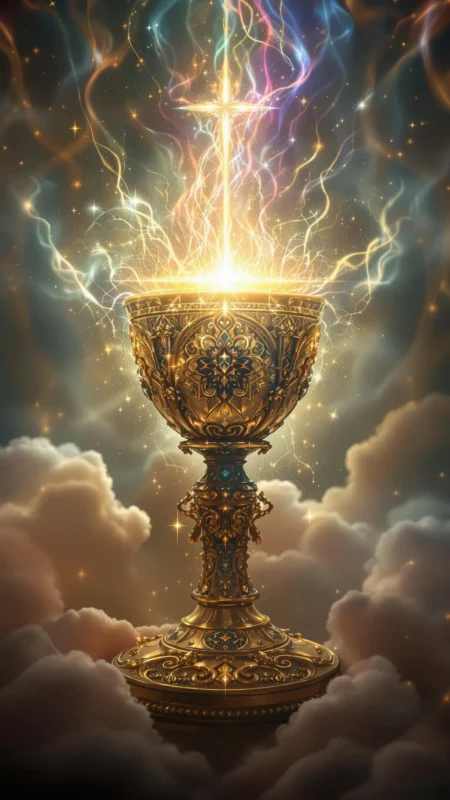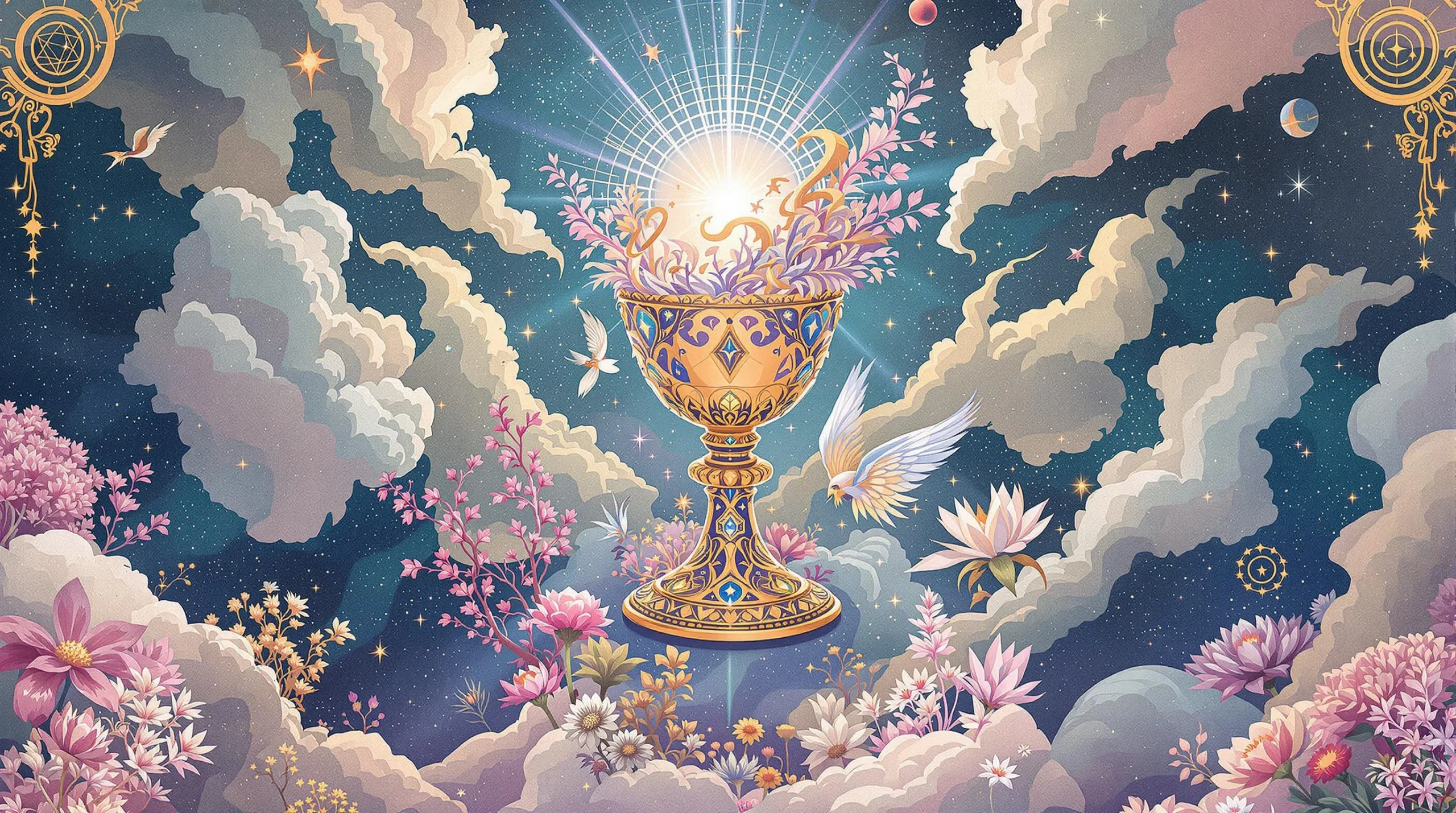


Sacred Chalice

Archetype Meaning & Symbolism

Receptive, containing, nurturing, transformative, passive, empty, fertile, sacred, vulnerable, patient

  • Do not seek to be filled. Seek only to be a worthy vessel, and the nectar of the cosmos may find its own level within you.

If Sacred Chalice is part of your personal mythology, you may...

Believe

  • You may believe that true power lies in reception, not in action.
  • You may believe that the most profound things in life must be held, not grasped.
  • You may believe that your presence, when pure and focused, is the greatest gift you have to offer.

Fear

  • You may fear an inner emptiness, a state of being a vessel with nothing of value to contain or offer.
  • You may fear being shattered by a devastating experience or a toxic relationship, leaving you unable to hold anything at all.
  • You may fear being contaminated by the negativity of others, becoming a vessel for bitterness and poison rather than for grace.

Strength

  • You may possess an immense patience, an ability to hold space for people and processes to unfold in their own time.
  • You may have a deep and intuitive capacity for empathy, able to contain the emotions of others without being consumed by them.
  • You may act as a powerful catalyst for transformation, as your receptive presence allows others to find their own truth.

Weakness

  • You may exhibit a passivity that can be misinterpreted as weakness, leading to being overlooked or taken for granted.
  • You may have a tendency to absorb the emotional states of others to a detrimental degree, blurring the lines between their feelings and your own.
  • You may have a deep-seated fear of self-assertion, preferring to receive what comes rather than actively seeking what you want or need.

The Symbolism & Meaning of Sacred Chalice

To find the Sacred Chalice within one's personal mythology is to shift the central metaphor of life from a journey of acquisition to one of reception. It suggests a power that resides not in doing, but in being; not in speaking, but in listening. In a culture that prizes the clenched fist, the Chalice offers the open palm. It is the recognition that the self can be a container for something greater: an idea, a community's sorrow, another person's secret joy, a moment of grace. This archetype may ask you to value your own emptiness not as a lack, but as a prerequisite for being filled. It is the fertile void, the silent room into which music can enter, the stillness that allows for profound movement.

Your mythology may revolve around the quality of your vessel and its contents. The work of life becomes about keeping the cup clean, strong, and ready. It is a symbolism of profound responsibility. To be a Chalice for another is to offer a space free of judgment, a container of trust. To be a Chalice for an idea is to nurture it with patience and protect it from cynicism. There's a deep vulnerability here: a chalice can be chipped, cracked, or worse, filled with poison. The personal myth, then, could be a story of learning to protect the rim, to discern what is worthy of being held, and to accept that sometimes the cup must be emptied to receive anew.

Ultimately, the Chalice symbolizes the divine potential of the inner world. It proposes that the most sacred temple you will ever enter is your own consciousness. Your life story may not be written in trophies and conquests, but in the quality of the silence you can keep, the depth of the love you can hold, and the transformations you can facilitate just by providing a space for them to occur. The Chalice is a quiet rebellion against a loud world, a testament to the idea that the greatest miracles are not forged in fire, but received in stillness.


Sacred Chalice Relationships With Other Archetypes

The Questing Knight

The Chalice has a magnetic, symbiotic relationship with The Questing Knight. The Knight represents the active principle: striving, seeking, journeying outward. The Chalice is the receptive principle: being, waiting, holding sacred space. The Knight's entire mythos is often defined by the search for the Chalice. In a personal mythology, this could manifest as a dynamic tension between your own drive to achieve and your deep need to simply be. You may feel a constant pull between the part of you that must conquer the next hill and the part that knows the treasure is found by sitting still at the center of the garden.

The Alchemist

The Alchemist requires a vessel for the Great Work, and the Sacred Chalice is the perfect crucible. While The Alchemist is the agent of change, the one who mixes the elements and speaks the incantations, the Chalice is the theater where the transformation occurs. It is the silent partner in creation. If The Alchemist is part of your mythos, you might find that your brilliant ideas and plans for change (the Alchemist's fire) are useless without a corresponding ability to create a safe, contained, and patient environment (the Chalice) in which they can develop. The two together represent the perfect fusion of active intelligence and receptive wisdom.

The River

The River archetype symbolizes flow, life force, and the relentless current of experience. The Chalice exists to receive what The River provides. This relationship speaks to a trust in abundance. The Chalice does not need to go out and find water; it positions itself to be filled. In a personal narrative, this could mean an orientation toward life where you trust that what you need will come to you, that opportunities and grace will flow your way, as long as you remain open and ready. The danger, of course, is when The River becomes a flood: you may feel overwhelmed by the sheer volume of life's demands if you have not cultivated the strength and boundaries of your own vessel.

Using Sacred Chalice in Every Day Life

Deep Listening

In conversation, you may consciously become the Chalice. Instead of formulating a reply, you create a silent, receptive space within yourself. You hold the other person's words, their pauses, their unspoken emotions, without judgment. This is not passive hearing: it is an active containment that allows the speaker to truly discover what they mean, seeing their own thoughts reflected in the still water of your attention.

Navigating Creative Blocks

When an idea is nascent, fragile, and not yet ready for the harsh light of critique or action, the Chalice archetype offers a method. You may hold the idea within you, like a cup holding water. You don't force it, you don't agitate it, you simply contain it. This period of quiet gestation allows the concept to mature, to gather its own strength, until it is ready to be poured out into the world as a finished work.

Processing Grief

Instead of fighting sorrow or trying to expel it, you might allow yourself to be the vessel that holds it. You recognize that the Chalice is made to hold both elixirs and bitters. By containing the grief, you give it shape and dignity. You permit yourself to feel its weight and texture without being shattered by it, trusting that the vessel is strong enough, and that in time, this containment may transform the poison of loss into the medicine of wisdom.

Sacred Chalice is Known For

Containing the Uncontainable

The Chalice is famed for its capacity to hold that which seems formless: spirit, love, divine grace, life force. It gives shape to the intangible and provides a sanctuary for the sacred, making it not just a cup, but a tangible point of contact with mystery.

The Object of the Quest

Perhaps most famously, the Chalice is the goal. It is the Holy Grail at the end of the knight's journey. This suggests that the ultimate destination is not a place of action, but a state of being: one of perfect, grace-filled receptivity. The quest for the Chalice is the quest for one's own soul.

A Crucible of Transformation

What goes into the Chalice is rarely what comes out. It is a vessel of metamorphosis. Water may become wine, ignorance may become wisdom, and raw experience may become soul. It is a quiet furnace where the mundane is alchemized into the magical simply by being held in a sacred space.

How Sacred Chalice Might Affect Your Personal Mythology

How Sacred Chalice Might Affect Your Mythos

When the Sacred Chalice features in your personal mythos, your life story ceases to be a linear tale of conquest and becomes a circular map of deepening presence. The key events in your narrative may not be battles won, but moments of profound reception: the secret you were trusted to keep, the creative insight that arrived in a moment of stillness, the relationship that was nurtured into being through patient listening. Your epic is not about slaying the dragon, but about offering it a pool of cool water and seeing it transform. Your heroism is quiet, measured by the weight of the trust you can carry and the quality of the silence you can offer a noisy world.

The trajectory of your myth is likely inward. The great quest is not for a golden fleece in a faraway land, but for the integrity of your own inner vessel. Your trials may involve learning to discern what to receive and what to refuse, how to mend cracks in your own spirit caused by betrayal, or how to pour out what you hold for the nourishment of others without leaving yourself empty. The climax of your story might be a moment of perfect, unadulterated stillness, where you feel completely filled with a sense of purpose or grace, not because of something you did, but because of what you allowed yourself to become: a worthy container.

How Sacred Chalice Might Affect Your Sense of Self

Your sense of self may be rooted in your capacity rather than your capability. You may not define yourself by a list of accomplishments, but by the depth of your empathy, your patience, your ability to hold complexity and contradiction without breaking. This can lead to a quiet, unshakable self-worth that is independent of external validation. You may see yourself as a sanctuary, a safe harbor for the people and ideas you care about. Your identity is not a fortress to be defended, but a vessel to be maintained.

This perspective could also bring a unique form of self-criticism. You might judge yourself harshly for moments of impatience, for failing to listen deeply, or for feeling emotionally cluttered. A fear of inner emptiness can be a powerful motivator, or a source of deep anxiety. The question “What do I contain?” becomes central. Is it wisdom, love, and light, or is it resentment, fear, and stagnant water? Your self-perception is thus a constant process of curation, of tending to the contents of your own being.

How Sacred Chalice Might Affect Your Beliefs About The World

You may view the world not as a resource to be exploited, but as a fountain of meaning to be received. The universe is not a chaotic, random assortment of matter, but a source of constant, flowing grace, information, and beauty, available to anyone who can become quiet and receptive enough to notice it. Your worldview prizes stillness and listening. You might believe the answers to the world's greatest problems lie not in more action and more noise, but in creating collective spaces of deep, contemplative listening, much like a council of elders gathered around a sacred object.

This could lead to a certain detachment from the frantic pace and competitive ethos of modern life. You might perceive the endless striving for more—more money, more status, more stimulation—as a tragic misunderstanding of where true value lies. Your philosophy could be one of sufficiency: a belief that a single cup filled with pure water is infinitely more valuable than a shallow ocean. The world, to you, is not a problem to be solved, but a mystery to be held in appreciative awe.

How Sacred Chalice Might Affect Your Relationships

In relationships, you may instinctively adopt the role of the container. You are the listener, the confidante, the emotional anchor. People may feel safe with you, sensing that they can pour out their troubles, dreams, and contradictions without fear of judgment or rejection. You may create relationships that are sanctuaries, where others can be their most authentic selves. Your way of showing love is through your presence, offering the precious gift of your undivided, receptive attention.

However, this can also create an imbalance. You might attract people who are emotional “spillers,” who use your receptive nature without ever offering to replenish you. The Chalice must have boundaries, a firm rim, to avoid becoming a mere receptacle for the unprocessed emotions of others. You may need to consciously learn to be filled, to receive care, and to ask for your own needs to be met, lest you find your own vessel perpetually drained in the service of others, a noble but ultimately unsustainable state.

How Sacred Chalice Might Affect Your Role in Life

Your perceived role in life might be less the protagonist and more the sacred center around which the story unfolds. You may not be the king, but the king's trusted advisor. You may not be the artist, but the muse who inspires the masterpiece. You are the keeper of the hearth, the heart of the community, the quiet space where wisdom congregates. This role is defined by its gravitational pull rather than its forward momentum. People and events may seem to be drawn to you, seeking the stability and containment you offer.

This can be a deeply fulfilling role, one of quiet influence and profound impact. You may feel your purpose is to be a catalyst for others' growth and a keeper of collective memory and meaning. The challenge is that this role can be invisible. Its power is subtle and often unacknowledged in a world that celebrates more overt forms of leadership. You may have to find your own validation, recognizing that being the space where things happen is just as crucial as being the one who makes things happen.

Dream Interpretation of Sacred Chalice

To dream of a Sacred Chalice in a positive context, perhaps one that is whole, luminous, and filled with clear water or glowing light, could signal a period of spiritual or emotional readiness. It may suggest that you have cultivated a state of receptive grace, and you are prepared to receive a new blessing: a profound insight, a new love, or a surge of creative inspiration. Drinking from such a Chalice might symbolize the integration of this new grace, a deep and soul-quenching nourishment. It could be an affirmation from your psyche that your inner work of self-acceptance and patience is bearing fruit.

Conversely, dreaming of a Chalice that is broken, cracked, dirty, or filled with poison or sludge could point to a spiritual crisis or a state of emotional contamination. A broken Chalice might represent a feeling of being shattered by life, unable to hold yourself together. A dirty or poisoned cup could be a warning that you have absorbed toxic emotions, beliefs, or relationships, and your inner space needs cleansing. An empty, dusty Chalice might reflect a fear of spiritual barrenness or a feeling of being drained and without purpose. The dream may be urging you to examine what you are “taking in” and to reinforce your boundaries or engage in a process of purification.

How Sacred Chalice Archetype Might Affect Your Needs

How Sacred Chalice Might Affect Your Physiological Needs

Your connection to your physiological needs may be deeply intuitive and receptive. Rather than imposing a rigid diet or exercise regimen upon the body, you may find yourself listening to what it asks for: rest, specific nutrients, gentle movement. The body itself is the first Chalice, the vessel for the spirit, and your primary responsibility is to keep it clean, strong, and honored. You might be more sensitive to how foods, environments, and even moods affect your physical state, seeing them as things that either honor or desecrate the vessel.

This attunement means that states of physiological imbalance—illness, fatigue, hunger—may be experienced not as mere mechanical failures but as signals from the soul. Fatigue isn't just a lack of sleep; it's the body demanding a period of emptiness and rest. Hunger isn't just a need for calories; it's a call to be filled with life-giving energy. Your health may be a direct reflection of your ability to listen to and honor the sacred container of your own physical form.

How Sacred Chalice Might Affect Your Ideas of Belonging

Your need for belongingness is fulfilled not by joining a multitude, but by becoming the heart of a chosen few. You create belonging for others. Your gift is the ability to form a circle of trust around yourself, where people feel seen, heard, and accepted. You may find your place as the confidante in a friendship, the anchor of a family, or the quiet, stable presence in a community group. Love, for you, is both what you hold for others and what you are willing to receive.

Belonging is a matter of resonance. You feel you belong when the contents of your Chalice—your values, your love, your attention—are honored and appreciated. You may feel a profound sense of alienation in environments that are superficial, transactional, or loud, as they offer nothing worthy of being held. The quest for love and belonging is the quest for those rare souls and communities that recognize the sanctity of the vessel and wish to pour something beautiful and true into it.

How Sacred Chalice Might Affect Your Feelings of Safety

Safety, for you, is less about external fortifications and more about the integrity of your own boundaries. The primary threat is not physical attack, but contamination. Your sense of security may depend on your ability to discern what you allow into your energetic and emotional space. A barbed comment, a toxic news cycle, or a manipulative friend are not just unpleasantries; they are potential poisons that can contaminate the contents of your Chalice. Your safety practices may involve curating your social circles, your media intake, and your environment with meticulous care.

The greatest fear is not being broken by a single, dramatic blow, but being slowly cracked by constant pressure or eroded by carelessness. Safety is found in maintaining a strong but flexible rim: the ability to say “no,” to protect your solitude, and to differentiate your own emotions from those you absorb from others. You may feel safest not in a crowd, but in a small, trusted circle, or in the sanctum of your own well-tended inner world.

How Sacred Chalice Might Affect Your Views of Esteem

Esteem is not derived from what you achieve, but from what you contain. Your self-worth is directly tied to the quality of your inner contents and the integrity of the vessel itself. You may derive immense pride from your ability to hold a friend's confidence, to nurture a fragile idea into fruition, or to maintain a state of inner peace amidst chaos. You respect yourself when you feel your inner Chalice is clean, whole, and filled with something precious, be it wisdom, love, or creativity.

Conversely, your esteem can plummet when you feel you have been compromised. If you betray a trust, absorb negativity, or act with impatience, you may feel as though you have tarnished or cracked your own vessel. The path to restoring esteem involves a process of purification: seeking forgiveness, setting new boundaries, and once again curating the contents of your inner world with care. Your esteem is an inside job, a matter of spiritual and emotional hygiene.

Shadow of Sacred Chalice

When the Sacred Chalice falls into shadow, it can manifest in several distorted forms. One is the Leaky Vessel. This is the individual who cannot hold anything: not a secret, not a commitment, not a feeling. They are porous, constantly draining and being drained, unable to accumulate any wisdom or sustain any deep connection. They may crave intimacy and meaning but find themselves perpetually empty, their life force seeping away through the cracks of their own inattention and lack of psychic integrity. They are a promise of containment that is never fulfilled, leaving both themselves and others feeling depleted.

Another shadow is the Poisoned Goblet. This is the Chalice that consciously or unconsciously chooses to hold and serve bitterness, resentment, and manipulation. Instead of being a vessel for grace, it becomes a container for grudges and toxic narratives. This individual may present a beautiful, inviting exterior, but what they offer is tainted. They may use their receptive qualities to gather secrets to use as weapons or to absorb others' pain only to relish it. This is the archetype twisted into its most cynical form: a sacred object used for profane ends, offering not life, but a slow-acting poison to all who drink from it.

Pros & Cons of Sacred Chalice in Your Mythology

Pros

  • You cultivate exceptionally deep and meaningful relationships built on trust and authentic presence.
  • You are often a source of calm, stability, and wisdom for your friends, family, and community.
  • You possess a rich inner life, finding profound fulfillment in contemplation, creativity, and the quiet reception of beauty.

Cons

  • You may be highly susceptible to emotional burnout and codependent dynamics in relationships.
  • You can struggle with decisive action and self-advocacy, preferring to wait and receive rather than go out and take.
  • Others may project their own needs onto you, seeing you as an emotional utility or a blank slate rather than a whole person with your own needs.