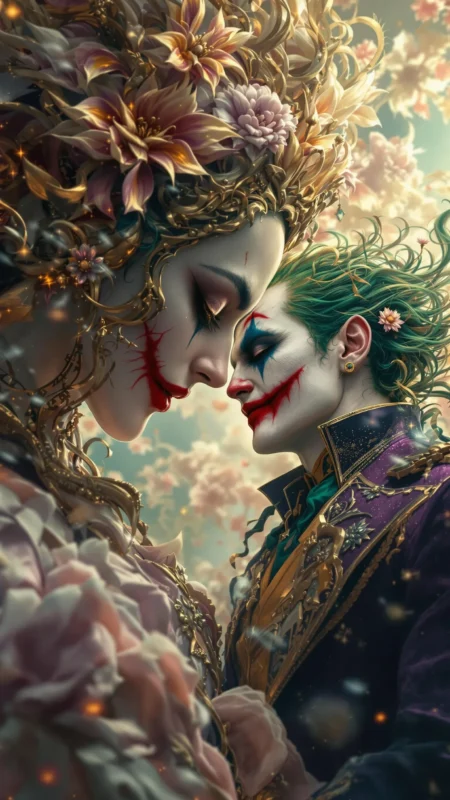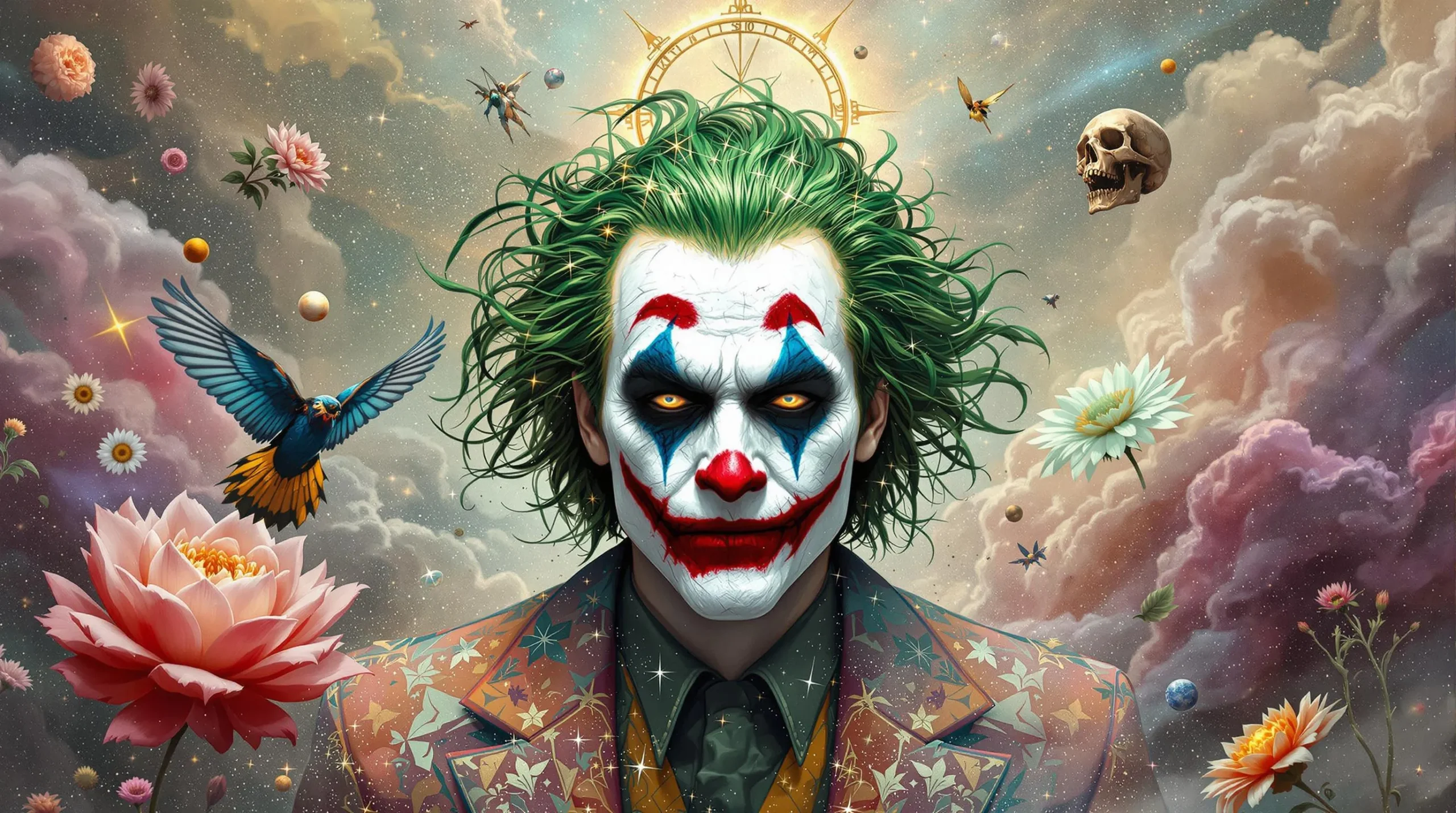


Joker

Archetype Meaning & Symbolism

chaotic, unpredictable, liberated, nihilistic, brilliant, provocative, theatrical, disruptive, insightful, anarchic

  • Introduce a little anarchy. Upset the established order, and everything becomes chaos. I'm an agent of chaos. Oh, and you know the thing about chaos? It's fair.

If Joker is part of your personal mythology, you may...

Believe

  • You may believe that all systems of order—social, moral, political—are arbitrary and inherently fragile, and that poking them is a form of philosophical inquiry.

  • You may believe that sanity is merely the consensus of the majority, and that a departure from it is not madness but a form of heightened, more honest perception.

  • You may believe that chaos is the natural state of the universe, and that embracing it is more creative, more authentic, and ultimately more liberating than fighting it.

Fear

  • You may secretly fear boredom and mediocrity more than death itself, dreading a life of quiet routine and predictable stability.

  • You may fear that beneath all the layers of performance, philosophy, and chaos, there is an essential hollowness, a void of genuine self or feeling.

  • You may fear being understood, figured out, or rendered predictable, as this would mean you have lost the game and become just another part of the system you despise.

Strength

  • You likely possess a radical, unconventional creativity, an ability to generate ideas and solutions that defy all established logic.

  • You may have an extraordinary resilience to crisis and uncertainty; where others see chaos and panic, you see a familiar, stimulating environment.

  • You may have the power to be a catalyst for liberation, using your provocative nature to shatter calcified norms and free others from their own mental cages.

Weakness

  • You may have a powerful self-destructive streak, a tendency to sabotage your own successes and relationships for the sheer thrill of watching them burn.

  • You may find it nearly impossible to build anything lasting—be it a career, a home, or a relationship—due to your innate distrust of stability and commitment.

  • You may risk having your philosophical provocations decay into simple cruelty, hurting others not to make a point, but because you've lost the thread of your own purpose.

The Symbolism & Meaning of Joker

The Joker is the ghost in the machine of civilization, a specter born from the cracks in our collective sanity. He symbolizes the suppressed, chaotic impulse that lurks beneath the veneer of every orderly society. In personal mythology, he may represent a necessary destructive force: the part of the psyche that must tear down old, rigid belief structures to allow for something new to grow. He is the personification of the idea that sometimes the only way to fix a broken system is to introduce a little anarchy, to light a match and see the rot burn away. He is not merely evil; he is a philosophical position, a walking, laughing refutation of the idea that life has inherent meaning or purpose outside of what we choose to impose upon it.

He is also the sacred trickster taken to its terrifying, urban conclusion. Where the coyote or Loki might steal fire or shift shapes to teach a lesson, the Joker uses a car bomb or a televised murder. His lesson is always the same: your rules are a joke, your safety is an illusion, your identity is a mask. To integrate this archetype into one's mythos could be an attempt to confront the terrifying freedom this implies. It is to dance with the void. He asks the question: what would you do if you truly believed nothing mattered? Would you collapse into despair, or would you find it liberating, a blank canvas for a new, more authentic, albeit more dangerous, way of living?

Ultimately, the Joker may symbolize a profound and painful honesty. He is the living embodiment of the shadow of the Enlightenment's promise of reason and progress. He suggests that for every meticulously constructed system of logic, there is an equal and opposite force of exhilarating madness. In a personal narrative, he could be the catalyst for a brutal self-assessment, forcing one to confront the comforting lies they tell themselves about their own goodness, the stability of their world, and the sanity of their choices. He is the funhouse mirror that shows not a distorted reflection, but the distortion that was already there.


Joker Relationships With Other Archetypes

The Batman Archetype

The Joker’s relationship with the Batman archetype may be seen as one of the great symbiotic antagonisms in modern myth, a kind of cultural yin-yang painted in grime and neon. They are, perhaps, the negative and the print of the same photograph, each giving the other form and abyssal depth. Where Batman seeks to impose a rigid, albeit melancholic, order upon the chaos of the city, the Joker exists as a solvent to that very order, a cackling entropy that proves the rules are merely a fragile suggestion. Their conflict is less a battle and more an inescapable philosophical dialogue, a danse macabre where each partner leads and follows in turn. The Joker, in this light, could be the twisted key that fits only one lock—the dark, bat-shaped chamber in the city’s heart—forever testing its integrity not to open it, but to hear the satisfying click of a perfectly matched mechanism.

The Phoenix Archetype

With the Phoenix, that ancient sigil of cyclical rebirth, the Joker may share a relationship not of kinship, but of causation—he is, perhaps, the alchemical fire that reduces all to ash. The Joker does not seek renewal; he is the evangelist of the final, meaningless punchline that is the pyre itself. His existence could be a precondition for the Phoenix’s rise, a necessary devastation that clears the stage for a dramatic, unwanted miracle. He is the midwife to a violent rebirth whose purpose he mocks, holding up the smoking, fragile shell of the old world and asking if the new one, born from such a joke, could possibly be taken seriously. The Joker may create the ashes from which the Phoenix must emerge, but he lingers only to whisper that the entire cycle of fall and resurrection is the most hilarious absurdity of all.

The Cheshire Cat Archetype

In the Cheshire Cat, the Joker could find a kind of spectral ancestor, a purer form of the maddening logic he espouses. Both archetypes are defined by a disembodied grin, a floating signifier of amusement at a world that has come untethered from its own sense. The relationship might be that of a ghost to its haunting. The Cheshire Cat offers riddles that unravel reality from a safe, fey distance, but the Joker has dragged that same metaphysical mischief into the street and given it a razor’s edge. He is, perhaps, the grin that has descended from the trees, found a human host, and learned the heft and purpose of a crowbar. He represents the terrifying materialization of abstract absurdity, the moment the philosophical joke puts on a purple suit and decides to prove its point in the most visceral, intimate way imaginable.

Using Joker in Every Day Life

Challenging a Stifling Career

When your professional life feels like a sterile, fluorescent-lit prison of arbitrary rules, the Joker archetype might offer a blueprint for a jailbreak. This doesn't necessarily mean a dramatic resignation, but perhaps a subtle introduction of playful sabotage: questioning pointless procedures in meetings, proposing wildly creative solutions that expose the absurdity of the accepted ones, or simply refusing to participate in the charade of corporate seriousness. It is about becoming the unpredictable variable in a predictable equation.

Breaking Creative Blocks

For the artist, the writer, the creator stuck in a rut, the Joker represents the annihilation of the inner critic. He is the voice that whispers to throw paint at the canvas without a plan, to write the chapter that derails the plot, to pursue an idea not because it's good but because it's interesting. Invoking this energy could mean setting aside all goals and simply playing with your medium, delighting in the unexpected results and finding genius in the glorious, chaotic mess.

Navigating Personal Grief

In the face of profound, nonsensical loss, where platitudes of order and meaning ring hollow, the Joker archetype offers a strange solace. It allows for the acknowledgment of the universe's sheer absurdity. It gives permission to laugh at the bleakest of moments, not out of cruelty, but as a radical act of defiance against despair. This may be the moment you see the tragedy not as a chapter in a coherent story, but as a random, cosmic prank, and in that perspective, find a bizarre and potent form of freedom.

Joker is Known For

The Antithesis of Order

His existence is a symbiotic knot with his opposite, the Batman. He is known not as a criminal seeking wealth or power, but as a philosophical terrorist whose primary goal is to prove that order, justice, and morality are fragile, ridiculous constructs.

Agent of Chaos

The Joker is famous for his method

unpredictable, often theatrical acts of violence and disruption. He doesn't want to rule the world; he wants to watch it burn, just to see what new, twisted shapes might emerge from the ashes. His plans are elaborate jokes with deadly punchlines.

The Maniacal Laugh

More than any visual, his signature is his laugh. It is a sound that signifies a complete psychic break from shared reality, a terrifying and ecstatic expression of someone who has seen the joke at the heart of existence and can never be serious again.

How Joker Might Affect Your Personal Mythology

How Joker Might Affect Your Mythos

When the Joker enters your personal mythology, the narrative arc may shatter. The traditional hero’s journey, with its clear stages of call, trial, and triumphant return, could curdle into a tragicomedy of errors and absurdities. Your life story may no longer be about becoming someone, but about unbecoming: shedding the roles, expectations, and identities you thought defined you. The quest may shift from a search for meaning to a revelry in meaninglessness. The defining moments of your mythos might not be achievements or victories, but instances of spectacular failure, moments where the facade dropped and a raw, chaotic truth was revealed. Your story could become less of a linear progression and more of a series of existential improvisations.

Furthermore, this archetype could recast the protagonist’s role from hero to anti-hero, or perhaps, to the story's necessary villain. You might see your purpose not in upholding the status quo of your own life, but in disrupting it. The central conflict of your mythos could become an internal one: a war between the part of you that craves order, stability, and sense, and the Joker within, who laughs at that craving and pushes for chaos and experience for its own sake. Your personal legend ceases to be a tale told to comfort and inspire; it becomes a cautionary tale, a philosophical proof, a dark joke told to provoke and destabilize.

How Joker Might Affect Your Sense of Self

Embracing the Joker archetype might lead to a profound deconstruction of the self. The idea of a stable, core identity could dissolve, replaced by the notion of the self as a performance, a series of masks worn for different occasions, with perhaps no true face underneath. This can be profoundly liberating, freeing you from the tyranny of being “true to yourself” when you don't know who your self is. You may feel empowered to experiment with identities, to be contradictory, to contain multitudes without apology. You are no longer a noun, but a verb: a process of continuous, chaotic creation.

However, this fluid sense of self may also border on the pathological. The liberation from a fixed identity can slide into a state of dissociation, a feeling of being a spectator to your own life. The Joker within might convince you that your actions have no real consequence for your “true” self, as that self doesn't exist. This can lead to a dangerous detachment from your own emotions, your own body, and the impact of your behavior on others. The freedom to be anyone could become the prison of being no one at all, a hollow man defined only by his own laughter.

How Joker Might Affect Your Beliefs About The World

With the Joker as a guiding archetype, one’s worldview may undergo a radical inversion. The institutions and authorities that structure society—governments, corporations, religions, traditions—could suddenly appear not as pillars of stability, but as elaborate, fragile jokes. You may begin to see the world as a grand, absurd theater, where people earnestly play out ridiculous roles, convinced of their own importance. This perspective can grant a certain cynical wisdom, an ability to see the strings behind the puppet show and a refusal to be manipulated by appeals to order or decency.

The danger of this worldview is its potential slide into a corrosive nihilism. If everything is a joke, then nothing is sacred. If all systems are corrupt, then any action is permissible. This can lead to a belief that a better world is not only impossible but undesirable, as its struggles and hypocrisies are the very source of the cosmic comedy. It may foster a profound distrust of any and all attempts at collaborative progress, seeing them as merely different brands of delusion. The world becomes a playground for your own amusement or contempt, rather than a shared space of responsibility and potential.

How Joker Might Affect Your Relationships

In the realm of relationships, the Joker archetype acts as a powerful solvent. It may dissolve the unspoken contracts and polite fictions that allow many connections to persist. One might feel compelled to be a provocateur, to test the limits of love and friendship, to poke at insecurities and challenge beliefs, all in the name of a brutal, chaotic honesty. This can lead to relationships of incredible intensity and vibrancy, stripped of all pretense. You connect with others in the shared, exhilarating space of pure improvisation, where nothing is off-limits.

Conversely, this impulse can be profoundly destructive. The refusal to play by the rules of social engagement can be alienating. Partners, friends, and family may tire of the constant testing, the emotional volatility, and the philosophical minefields. The Joker’s inability to take anything seriously can feel like a deep invalidation to those who genuinely need stability, comfort, and trust. You may become an island, revered for your wit and insight but impossible to build a life with. The ultimate joke may be on you: in your quest to expose the illusion of connection, you could end up entirely, authentically alone.

How Joker Might Affect Your Role in Life

Adopting the Joker in your mythos is to fundamentally reject prescribed social roles. The archetype scoffs at the very idea of being a “good employee,” a “dutiful son,” or a “responsible citizen.” Your role may become that of the contrarian, the court jester in the kingdom of the mundane, whose job it is to speak the uncomfortable truths that everyone else is too afraid to acknowledge. You might see your purpose not in building, contributing, or maintaining, but in dismantling, questioning, and exposing. Your function is to be the grit in the oyster, the chaos agent that forces the system to react, adapt, or break.

This self-appointed role as the system’s antagonist can be a powerful catalyst for change, but it is also a path of great resistance. By defining yourself in opposition to the norm, you risk becoming a reactionary figure, your actions dictated by what you are against rather than what you are for. The role of the disruptor can also become a trap, a performance you feel compelled to maintain even when it no longer serves you or anyone else. You may find you have mastered the art of tearing things down but have forgotten, or never learned, how to build something in its place.

Dream Interpretation of Joker

To dream of the Joker in a positive light, perhaps finding yourself laughing along with him or being handed one of his props, may signal a powerful message from your subconscious. It could be an invitation to loosen your grip, to stop taking your problems or yourself so seriously. This dream might indicate that a period of rigid control, anxiety, or creative stagnation is ready to be broken. The Joker’s appearance could be a call from your psyche to embrace spontaneity, to find the humor in your struggles, and to allow a bit of healthy, creative chaos into the overly-ordered corridors of your mind.

A nightmare featuring the Joker, where you are the victim of his schemes or are paralyzed by his laughter, may point to a deep-seated fear of losing control. It could represent a part of your own shadow self—a suppressed rage, a nihilistic despair, or a destructive impulse—that is threatening to erupt into your conscious life. This menacing Joker could also symbolize a fear of the meaninglessness of it all, a confrontation with an existential dread you are trying to keep at bay. The dream serves as a warning: a part of you is becoming dangerously unhinged, and the joke is about to turn cruel.

How Joker Archetype Might Affect Your Needs

How Joker Might Affect Your Physiological Needs

When the Joker informs one's personal myth, the foundational needs of the body may be viewed with disdain, as tiresome prerequisites for the more interesting theater of the mind. The pursuit of physiological stability—regular sleep, balanced nutrition, consistent rest—could be seen as a surrender to boring biological determinism. Life might become a series of intense bursts fueled by adrenaline and caffeine, followed by crashes. The body is not a temple to be cared for; it is a tool or a vehicle, to be used, abused, and pushed to its limits in service of an idea or an experience.

This approach redefines physical well-being. Health is not the absence of illness but the capacity to endure the beautiful chaos you inflict upon your own system. There may be a perverse pride in functioning on two hours of sleep, in surviving on a diet of junk food and spite. This neglect isn't accidental; it's philosophical. It is a continuous, physical demonstration that you are not beholden to the tedious demands of the flesh. The body’s complaints are just noise, static interrupting the much more important broadcast of your will.

How Joker Might Affect Your Ideas of Belonging

The Joker is the patron saint of the outcast, the one who stands outside the circle and laughs at those within it. Therefore, the need for belongingness may be aggressively rejected as a form of weakness, a desire to be accepted by a society you hold in contempt. You might actively sever ties that feel constricting or inauthentic, burning bridges to prove you don't need the approval of others. The goal is not to find your tribe but to prove you are a tribe of one, a sovereign nation of chaos.

Paradoxically, this fierce independence can create its own form of belonging. By rejecting the mainstream, you may become a beacon for other misfits, iconoclasts, and rebels. The bond formed is not one of shared values or mutual support in the traditional sense, but of a shared disillusionment. It is a lonely fellowship, a club of outsiders who understand that their connection is defined by their mutual exclusion from everything else. Love, in this context, may be seen as a shared joke, a conspiracy for two against the absurd seriousness of the world.

How Joker Might Affect Your Feelings of Safety

The need for safety becomes the first and most obvious casualty of the Joker archetype. Safety, in this mythos, is not a prerequisite for a good life; it is the cage that prevents it. Financial security, a stable home, a predictable future: these are the boring punchlines of a life unlived. To embody the Joker is to actively court risk, to walk toward the metaphorical fire. You might find yourself systematically dismantling your own safety nets, believing that true insight, true freedom, and true experience can only be found in a state of precarity.

This recasts the very definition of security. True safety is not found in external stability but in the internal capacity to not only survive chaos but to thrive in it. You are safest when you have nothing left to lose. This philosophy could lead to a life of thrilling adventure and profound resilience, an immunity to the fears that paralyze most people. Or, it could lead to a life of constant, grinding stress and preventable disasters, where the rejection of safety becomes a self-fulfilling prophecy of ruin.

How Joker Might Affect Your Views of Esteem

Esteem, in the Joker's world, is a purely internal affair. The need for respect, admiration, or recognition from others is seen as a pathetic vulnerability. To seek external validation is to give the audience power over your performance. Instead, self-esteem may be derived from a radically different source: the successful execution of your own chaotic will upon the world. Your worth is measured by your ability to provoke, to disrupt, to remain unreadable and unpredictable. You admire yourself for your refusal to be admired by the standards of a world you disdain.

This can forge an ironclad, almost unbreakable sense of self-worth, completely immune to criticism or failure as society defines it. Every insult is a compliment, proof that your provocation is working. However, this can easily curdle into a profound and isolating narcissism. Your self-esteem, unmoored from the feedback of others, can become a self-contained delusion. It is the esteem of the man who laughs alone in a room, convinced he is the only one who gets the joke, while the world outside simply sees a madman.

Shadow of Joker

The shadow of the Joker emerges when the punchline is forgotten, leaving only the punch. It is the point where philosophical anarchism sours into pure, unadulterated nihilism. The initial, perhaps noble, goal of exposing hypocrisy and liberating minds gives way to a compulsive need to inflict pain and spread misery for its own sake. The chaos is no longer a tool for insight; it becomes the end in itself. The performance of the trickster hardens into the reality of the predator, and the joke is no longer on the powerful, but on the vulnerable, the innocent, the unsuspecting. This is the Joker with no Batman: a force of pure entropy with nothing to define itself against, consuming everything, including itself, in a blaze of meaningless violence.

When this shadow takes hold in a personal mythos, it manifests as a deep-seated cruelty disguised as intellectual superiority. The individual becomes a troll in the grandest sense, deriving their only pleasure from the suffering and confusion of others. There is no longer a desire to build something new from the ashes; there is only the love of the fire. It is the embrace of a final, terrible freedom: the freedom from empathy, from consequence, from humanity itself. The laughter is no longer liberating; it is the sound of the void, celebrating its victory over a soul.

Pros & Cons of Joker in Your Mythology

Pros

  • Integrating the Joker archetype can unlock a powerful and unconventional creativity, allowing you to approach problems from angles no one else would consider.

  • It can foster a profound resilience and adaptability, making you comfortable and effective in situations of high stress, uncertainty, and chaos.

  • It can empower you to act as a powerful agent of change, challenging stagnant ideas and oppressive systems with wit and disruptive energy.

Cons

  • This archetype can lead to deep social and emotional isolation, as the constant provocation and rejection of norms alienates friends, family, and partners.

  • There is a significant risk of falling into a self-destructive pattern, where the desire for chaos leads you to sabotage your own health, career, and well-being.

  • Your actions, intended as philosophical statements, may devolve into reckless behavior that causes genuine, unintentional harm to others and to yourself.