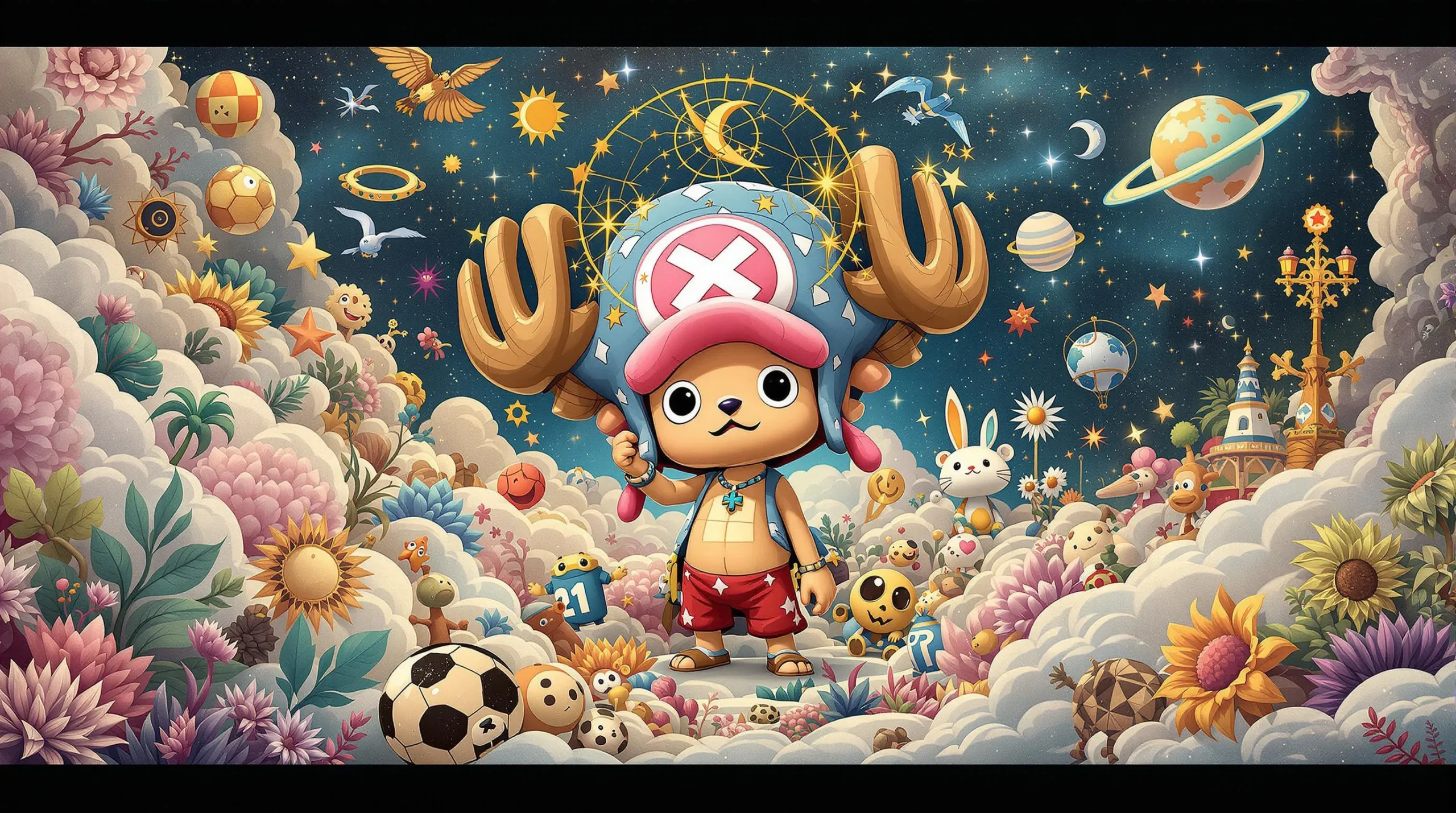


Tony Tony Chopper

Archetype Meaning & Symbolism

Naive, studious, compassionate, gullible, dedicated, emotional, loyal, insecure, brave, hybrid

  • I'm not a tanuki! I'm a reindeer! Even if it doesn't make me happy to be praised... you bastard!

If Tony Tony Chopper is part of your personal mythology, you may...

Believe

  • There is no disease in this world that cannot be cured.
  • A chosen family, a crew of nakama, is more real and binding than any bond of blood or nation.
  • The part of you that you think is monstrous is actually the source of your most unique and powerful gift.

Fear

  • Being seen as useless or a burden to the people you love most.
  • Ultimate abandonment, being cast out and left utterly alone once again.
  • Losing control of your own power and hurting the very people you have sworn to protect.

Strength

  • An almost superhuman capacity for loyalty and compassionate care.
  • A profound, specialized knowledge base that you wield in the service of helping others.
  • A fundamental innocence and ability to believe in the goodness of your friends, which can be a source of inspiration for everyone.

Weakness

  • A staggering gullibility that makes you susceptible to lies and manipulation.
  • A deep reliance on external validation and praise to feel a sense of self-worth.
  • Emotional volatility and a tendency to be overwhelmed by your feelings, making you easy to fluster and distract.

The Symbolism & Meaning of Tony Tony Chopper

The archetype of Tony Tony Chopper is, at its core, a meditation on the outcast as healer. His very form, a hybrid that belongs nowhere, may resonate with anyone who has felt themselves to be a composite of identities, fitting neatly into no category society provides. The blue nose, a mark of ridicule in his original herd, becomes a simple fact of his being, a physical manifestation of the otherness that is the foundation of his myth. He is the living symbol that one’s perceived deformities or abnormalities do not preclude a life of purpose; indeed, they may be inextricably linked to it. His journey is not about erasing his strangeness to fit in, but about finding a context where that strangeness is valued, even loved.

Furthermore, Chopper represents the sanctification of knowledge in service of compassion. His quest to become a panacea-doctor is not an abstract intellectual pursuit; it is a direct response to trauma, a vow made at the grave of a flawed father figure. This recasts the pursuit of any skill—be it medicine, art, or engineering—as a potentially spiritual endeavor. It suggests that true mastery is achieved not for personal glory but to gain the power to mend what is broken in the world. The cherry blossoms conjured by Hiriluk’s final experiment are not just a visual spectacle: they are a metaphor for how scientific endeavor, when fueled by love, can create impossible beauty and healing.

Finally, Chopper symbolizes the strategic power of emotional transparency. In a world of hardened pirates and cynical marines, his gullibility and penchant for hiding badly while blushing furiously are tactical disadvantages. Yet, this very vulnerability is what allows for such profound connection. He does not posture; he feels. This unabashed emotionality serves as a kind of gravitational force, reminding his more jaded crewmates of the sincerity and innocence they fight to protect. He is proof that one does not need to build walls to survive; sometimes, an open heart is the most resilient structure of all, capable of forming bonds that can withstand any storm.


Tony Tony Chopper Relationships With Other Archetypes

The Mentor's Ghost

The Chopper archetype may forever walk in the shadow of a legacy, a relationship less with a person and more with a lingering echo. This is not the cold haunting of a specter, but perhaps the feeling of wearing a coat that is too large, one that still carries the warmth and the particular scent of its revered, original owner. Every success, every life saved, is a quiet dialogue with this ghost, a presentation of credentials to a professor who can no longer grade the work. This relationship could be the central meridian of the Chopper's life, a line of longitude from which all other positions are measured. The mentor's dream becomes a kind of inherited starlight, a distant, beautiful, and impossibly heavy destination to which the Chopper must navigate, not with a map, but with a heart re-calibrated by a profound and foundational loss.

The Indifferent Wilderness

There exists a stark and poignant tension between the Chopper and the Indifferent Wilderness, the place of its origin and rejection. This archetype's boundless empathy seems to be a direct, paradoxical response to a world that offered none. It is, one might say, like a single, impossibly soft moss growing on the north face of a ruthless, granite cliff—its existence a quiet, baffling refutation of the environment that shaped it. The Wilderness is not an antagonist so much as a vast, amoral canvas against which the Chopper’s vibrant, bleeding heart is thrown into sharpest relief. This dynamic suggests that the archetype’s defining compassion is not a learned response to kindness, but rather a defiant, innate bloom that pushes its way through the cracks of a world that deems it monstrous or irrelevant.

The Motley Crew

Within the found family of a Motley Crew, the Chopper archetype may function as the delicate, emotional adhesive. They are not the strongest timber in the ship's hull, nor the sharpest point of its spear, but they could be the very thing that prevents the disparate, splintered parts from flying apart in a storm. This relationship is a strange alchemy; the Chopper's earnestness and gullibility, which make it vulnerable to the outside world, become a kind of clarifying agent within the group, reflecting the crew’s own forgotten sincerity back at them. Perhaps the Chopper is the crew’s shared vulnerability, a precious, fragile object that all members, no matter how cynical or hardened, instinctively agree to protect. In protecting it, they inadvertently protect the most fragile parts of themselves, weaving a net of trust where once there were only individual, fraying ropes.

Using Tony Tony Chopper in Every Day Life

Navigating Impostor Syndrome

When grappling with the feeling of being a fraud despite your qualifications, the Chopper archetype offers a path: focus on the work itself. Chopper, despite viewing himself as a monster unworthy of being a hero, never stops studying medicine. He grounds his identity not in how he feels about himself, but in the tangible act of healing. This suggests a practice: when insecurity strikes, turn to your books, your tools, your craft. The consistent application of your skill may become the antidote to the internal voice of doubt, proving your worth through action, not affirmation.

Embracing a Hybrid Identity

For those who feel caught between worlds—cultures, careers, identities—Chopper's existence is a testament to the power of the composite self. He is neither reindeer nor human, but something entirely new. Instead of choosing one identity over the other, he leans into his unique nature, developing Rumble Balls to harness his various forms. This archetype encourages you to stop trying to fit into a pre-existing box. It may be your life's work to invent a new one, to synthesize your disparate parts into a functional, powerful whole that is uniquely you.

Finding Your 'Crew'

When faced with loneliness or the sting of social rejection, the Chopper mythos champions the radical act of choosing your own family. Rejected by both his original herd and the humans on his home island, Chopper's story of belonging only begins when a pirate captain looks at his strangest form and says, “Join my crew.” This archetype suggests that your true tribe may not be the one you were born into, but one you find: a group that sees your perceived flaws not as liabilities, but as interesting facets of a person they want by their side.

Tony Tony Chopper is Known For

The Doctor

His unwavering dedication to the medical arts, fueled by a desire to cure any disease and prevent the loss he experienced with his mentor, Dr. Hiriluk. He is the essential healer of the Straw Hat crew.

The Rumble Ball

A self-developed drug that allows him to access additional transformations beyond the standard three granted by his Devil Fruit. This symbolizes his innovative intellect and his drive to push beyond his natural limits to be more useful.

Emotional Vulnerability

His almost comical gullibility, his extreme emotional reactions to praise and insults, and his deep capacity for empathy. This naive openness is both a weakness and the source of his profound loyalty.

How Tony Tony Chopper Might Affect Your Personal Mythology

How Tony Tony Chopper Might Affect Your Mythos

To integrate the Tony Tony Chopper archetype is to potentially reframe your personal mythos as the story of the “Wounded Healer.” Your life narrative may not be about conquering worlds but about mending them, starting with yourself. Past rejections, moments of feeling like a “monster,” or periods of profound isolation are no longer tragic backstory; they are the crucible in which your empathy was forged. Your purpose becomes the alchemical transformation of personal pain into a panacea for others. The central plot of your life could revolve around finding a cure—not necessarily a medical one, but a cure for loneliness, for ignorance, for despair—and the journey is one of acquiring the knowledge and skill to administer it.

Your personal mythology might also become a “Quest for the Nakama.” The driving force of your story is the search for and maintenance of a chosen family, a crew that provides the acceptance and belonging that your origin story lacked. Major life events may be judged by how they affect the crew. A career change isn't just about salary; it's about how it serves the collective. A relationship isn't just about romantic love; it's about finding a partner who understands the unbreakable bonds of your platonic loyalties. Your legend is not written alone; it is a chapter in a much larger saga, and your greatest heroic acts may be in service of keeping that saga going.

How Tony Tony Chopper Might Affect Your Sense of Self

In your self-perception, you may see yourself as a complex hybrid, a being of interwoven, sometimes conflicting, parts. The Chopper archetype could grant you permission to cease striving for a singular, clean identity. You may be both the timid scholar and the raging beast, the naive child and the dedicated professional. This archetype encourages an acceptance of this inner multiplicity, viewing different aspects of your personality as “transformation points,” each with a specific use and power. The lingering insecurity of being a “monster,” however, may persist, a quiet hum beneath the surface that drives your need to be useful and good.

Consequently, your sense of self-worth could become deeply entwined with your utility to others. You might feel most yourself when you are in your role: the doctor, the expert, the caretaker. The declaration, “I am a doctor!” is Chopper’s shield against his own self-doubt. Similarly, you may ground your identity in your skills and the tangible help you can provide. This can forge a resilient and competent self, but one that is also vulnerable. If you cannot be helpful, if your skills fail, you may face an existential crisis, questioning who you are without your function.

How Tony Tony Chopper Might Affect Your Beliefs About The World

Adopting this archetype may instill a worldview predicated on the profound possibility of found family. The world ceases to be a collection of strangers and becomes a sea of potential crewmates. It fosters a radical optimism that no matter how strange or ostracized one is, there is a place, a ship, a tribe that will offer belonging. Boundaries of nation, race, or even species, as in Chopper’s case, become less important than the bonds of loyalty and shared adventure. The world is not a place to be feared, but a grand line to be explored with the right people at your side.

This archetype could also shape your view of problems, particularly suffering, as puzzles to be solved. Illness, injustice, and sorrow are not immutable facts of life but diseases for which a cure might be found through relentless study, experimentation, and courage. This is not a passive hope but an active one. It posits a universe where effort and knowledge can create miracles, where a quack doctor’s lifelong research can make cherry blossoms bloom in a winter wasteland. The world becomes a laboratory where the primary experiment is the alleviation of pain.

How Tony Tony Chopper Might Affect Your Relationships

In relationships, you may embody a powerful, if sometimes naive, sincerity. You could be the designated caretaker of your friend group, the one who carries the metaphorical first-aid kit, always ready with a remedy or a listening ear. Your loyalty, once given, is nearly unbreakable. Compliments may fluster you, prompting comical denials that barely conceal a deep-seated pleasure and a desperate need for that affirmation. You love your people with an open, vulnerable heart, making you a source of immense comfort and stability.

However, this can also lead to a dynamic of hero worship within your relationships. You might place your friends or partners on impossibly high pedestals, seeing them as fearless warriors or brilliant geniuses while seeing yourself as the humble, monstrous sidekick who must constantly earn their keep. This can create an imbalance where you give far more than you receive, or where your own considerable strengths are perpetually undervalued, especially by you. You may struggle to see yourself as a peer to the very people who see you as essential.

How Tony Tony Chopper Might Affect Your Role in Life

You may perceive your role in life as that of the Specialist-Healer. Your purpose is not to lead the charge, but to be the indispensable support that makes the charge possible. You find meaning in mastering a specific, difficult craft that serves the health and well-being of your collective. This role is defined by quiet competence and behind-the-scenes importance. You are the ship’s doctor, the one who patches up the heroes so they can continue to be heroic. It is a role of immense power, but it is the power of restoration, not command.

Alternatively, you may find yourself cast as the “Innocent Heart” of your group or family. Your emotional transparency and fundamental goodness may serve as the moral compass for those around you. In a cynical world, your naivete is not a flaw but a protected resource, a reminder of the sincerity and kindness that the group is striving to defend. This role carries its own burden: the pressure to maintain that innocence, to absorb the emotional blows for others, and to be the living embodiment of the group’s soul.

Dream Interpretation of Tony Tony Chopper

In a positive context, to dream of Tony Tony Chopper may signify a burgeoning awareness of your own capacity to heal, both others and yourself. It could be a prompt from your subconscious to trust in the unique skills you've cultivated, especially if you feel like an outsider or an imposter. Seeing him transform between his various “Points” might suggest a successful integration of the different facets of your personality: your intellect (Brain Point), your strength (Heavy Point), and your defenses (Guard Point) are all beginning to work in harmony. The dream could be an affirmation that you have found your “crew” or are on the right path to doing so.

In a negative light, dreaming of Chopper, particularly in his uncontrollable “Monster Point” form, could symbolize a deep-seated fear that your own power is destructive. It may represent a state of burnout, where your attempts to help have become a frantic, harmful rampage. This dream might surface when you feel you are losing control of your emotions or when your desire to care for others has become toxic or smothering. It could also be the manifestation of your core insecurity: the terror that beneath the helpful exterior lies a monster, and that one day it will break free and alienate everyone you love.

How Tony Tony Chopper Archetype Might Affect Your Needs

How Tony Tony Chopper Might Affect Your Physiological Needs

With this archetype shaping your mythos, physiological needs could be viewed through a medical, almost scientific, lens. Food is not just for pleasure; it is a collection of compounds for muscle repair, energy, and cognitive function. Sleep is not mere rest; it is a critical recovery phase for cellular regeneration. You may become the unofficial nutritionist or health monitor for your family or friends, meticulously researching the best ways to maintain the physical well-being of your “crew.” The body is a machine that must be kept in optimal condition to fulfill its purpose.

Conversely, a powerful identification with Chopper could lead to a chronic neglect of your own body in the service of a greater mission. When a crisis hits—a sick friend, a tight deadline, an emotional upheaval—your own needs for food, water, and sleep may be completely forgotten. You might push your physical limits to the breaking point, fueled by adrenaline and a sense of duty. This mirrors Chopper consuming multiple Rumble Balls, sacrificing his own well-being for a temporary burst of power to protect others, often with damaging consequences.

How Tony Tony Chopper Might Affect Your Ideas of Belonging

The need for belongingness is the central, aching heart of the Chopper archetype. It suggests that belonging is not a birthright but a profound gift, one that is bestowed by a chosen family. The moment of true belonging is sacred and declarative: it is Luffy shouting, “Shut up! Let’s go!” in response to Chopper’s cries of being a monster. Therefore, you may seek relationships that offer this same level of unambiguous acceptance. You need to be explicitly claimed. You belong when someone sees you at your most strange and says, “I want you on my team.”

This intense need for belonging could also be the source of a profound fear of rejection. Having been cast out by both reindeer and humans, the Chopper archetype carries the deep trauma of the exile. This can manifest as an almost pathological need to be useful and agreeable, to do whatever it takes to maintain your place in the crew. You might suppress your own needs, avoid conflict, and shoulder undue burdens, all motivated by the terrifying possibility of being deemed unworthy and cast out once more.

How Tony Tony Chopper Might Affect Your Feelings of Safety

For one who identifies with Chopper, safety is not a fortress but a fellowship. True security is not found in walls, wealth, or weapons, but in the unwavering loyalty of a trusted crew. You feel safest not when you are alone and untouchable, but when you are a valued, contributing member of a strong, interdependent unit. Your personal safety is inextricably linked to the safety of your people; if they are secure, you are secure. The greatest threat is not a physical enemy, but the possibility of exile from this protective circle.

Safety is also found in knowledge. The world is full of poisons, but for every poison, there is a potential antidote. The Chopper archetype drives a need to understand threats in order to neutralize them. This might manifest as a deep dive into financial planning to create security, learning self-defense to feel safe in the city, or, most literally, studying medicine and first aid. Preparation and intellect are your primary defense mechanisms. Safety is not a passive state but an active, ongoing project of research and development, much like the creation of the Rumble Ball.

How Tony Tony Chopper Might Affect Your Views of Esteem

Esteem, within the Chopper mythos, is something that must be earned and is often validated externally. Like Chopper doing his giddy, flustered dance when praised, your self-worth may blossom under the light of affirmation from those you respect. You might feel a secret, immense pleasure when your contributions are noticed and valued, even as you protest that it’s no big deal. This makes your self-esteem a delicate ecosystem, highly dependent on the climate of approval from your inner circle.

However, the bedrock of this esteem is competence. The most powerful source of self-worth is the mastery of a difficult and useful skill. For Chopper, the ability to declare “I am a doctor” is an anchor of identity that holds firm even when the storms of his insecurity rage. Similarly, you may find your most stable sense of esteem comes not from praise, but from the quiet, internal knowledge of your own expertise. It is the one thing that cannot be disputed, the value you bring that is entirely your own creation.

Shadow of Tony Tony Chopper

The shadow of the Tony Tony Chopper archetype emerges when the noble desire to heal curdles into a compulsive need to “fix” everyone. This shadow healer does not wait to be asked for help; it imposes it. It pathologizes the quirks and flaws of others, seeing them not as part of their humanity but as diseases to be cured. Driven by a terror of being useless, this shadow self meddles and controls under the guise of caring, ultimately disrespecting the autonomy of others. In its most extreme form, the shadow is the out-of-control Monster Point: a blind, desperate rage born of helplessness. It is a power unleashed not to protect, but to annihilate, destroying friend and foe alike and proving the inner fear of being a monster correct.

In its more passive manifestation, the shadow is a retreat into perpetual victimhood. The identity of the “poor, rejected monster” becomes a comfortable excuse for inaction. This shadow Chopper weaponizes his own perceived fragility, refusing to develop his skills or face his fears. He remains the perpetual mascot, the cute and harmless creature who needs constant protection and coddling. He shirks responsibility, leaning on the strength of others and contributing little but his own neediness. Here, the potential for being a great healer dissolves into a parasitic dependence on the pity of his crew.

Pros & Cons of Tony Tony Chopper in Your Mythology

Pros

  • You are likely an incredibly loyal and dependable friend, the person everyone turns to for both practical help and emotional support.
  • Your dedication to learning a specific skill can lead to true mastery, giving you the rare ability to make a tangible, positive impact on the world.
  • Your genuine optimism and belief in the good of others can act as a powerful antidote to cynicism, uplifting and inspiring your entire social circle.

Cons

  • Your inherent naivete and tendency to believe what you are told can make you an easy mark for those with bad intentions.
  • Your self-esteem can be perilously fragile, capable of collapsing in the absence of consistent praise and external validation.
  • Your intense drive to care for others can lead you to systematically neglect your own needs, leading to burnout and resentment.