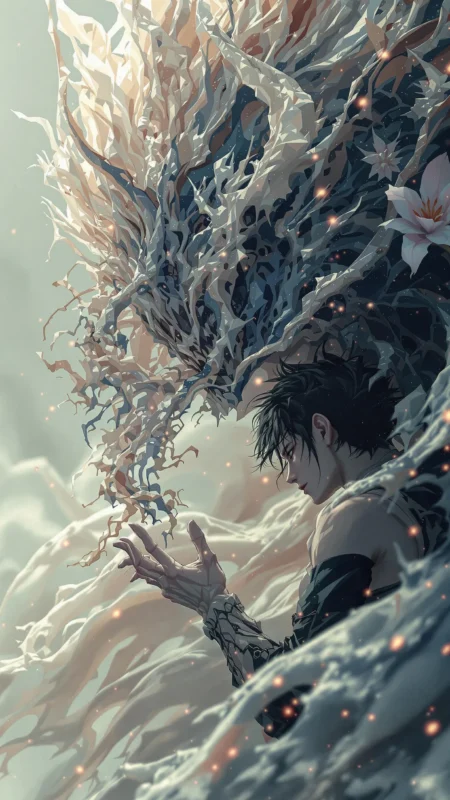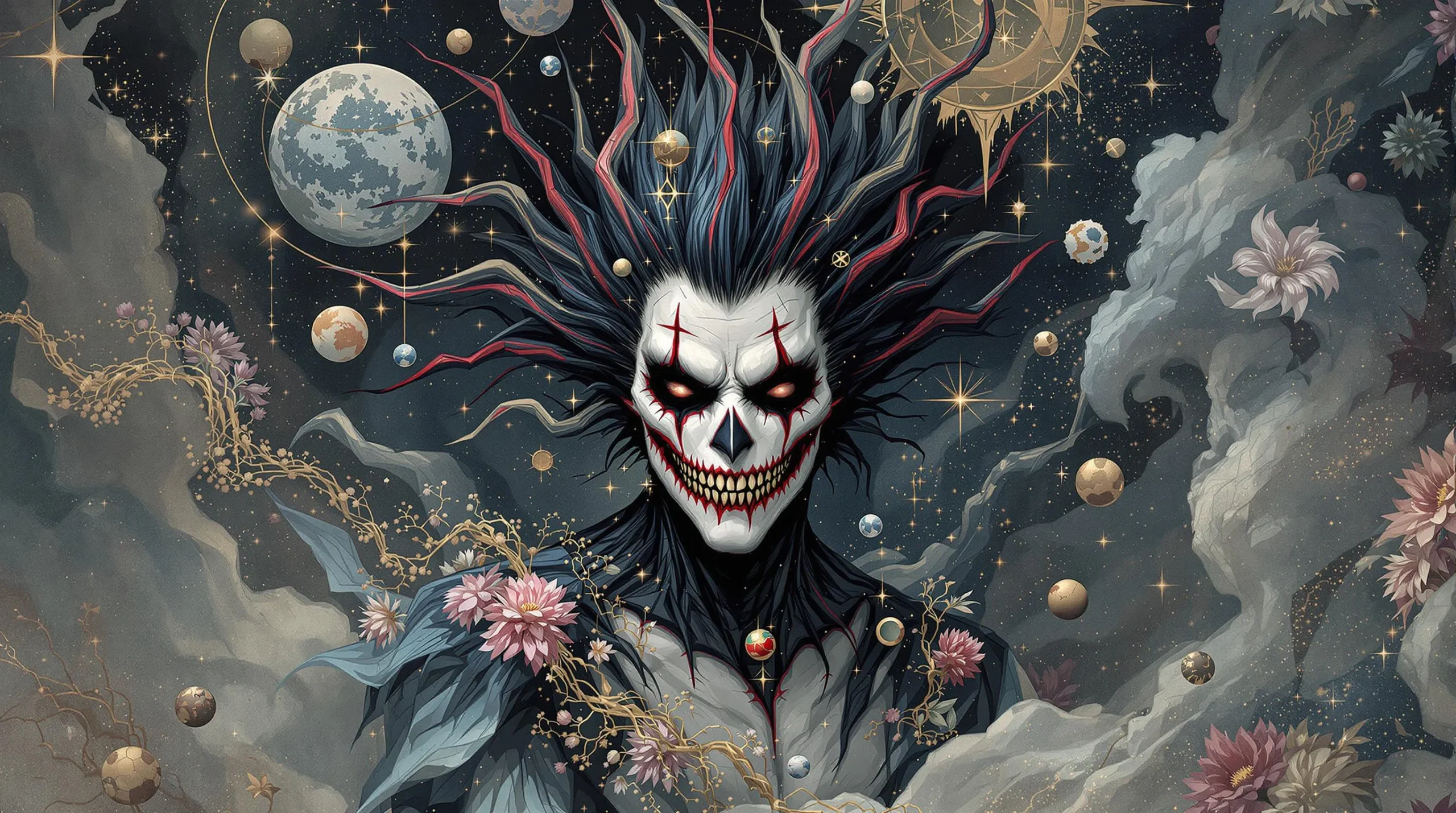


Ryuk

Archetype Meaning & Symbolism

Detached, amoral, bored, curious, catalyst, observer, mischievous, gluttonous, impartial, chaotic

  • I'm not on anyone's side. Not Light's, not L's. I'm just here for the fun of it.

If Ryuk is part of your personal mythology, you may...

Believe

  • The most interesting things happen when you break the rules.
  • The universe does not have a moral position, and it's foolish to pretend it does.
  • Boredom is the only true existential threat.

Fear

  • Living a predictable, mundane life devoid of surprises.
  • Becoming so entangled in a situation that you can no longer observe it objectively.
  • The show ending: a fear of silence, stillness, and a lack of external stimulation.

Strength

  • A profound objectivity that allows you to remain calm and analytical in a crisis.
  • A boundless curiosity that leads you to novel experiences and unconventional wisdom.
  • An immunity to peer pressure and the judgment of others.

Weakness

  • A tendency toward emotional detachment that can border on the sociopathic.
  • A reckless impulse to create chaos for sport, without regard for the consequences.
  • A deep-seated nihilism that can make it difficult to find genuine meaning or purpose.

The Symbolism & Meaning of Ryuk

Ryuk is the archetype of cosmic indifference made manifest. He is not evil; the concept is as foreign to him as color to a person born blind. He is, perhaps, something more unsettling: the embodiment of a universe that is not hostile, but simply, profoundly, bored. To have Ryuk as a fixture in one's personal mythology is to accept the possibility that the grand dramas of our lives, the heartbreaks and the triumphs, are little more than a captivating show for some unseen audience. He symbolizes the power that exists without purpose, the intelligence that serves no agenda beyond its own stimulation. He is the rustle in the cosmic curtains, a reminder that we are on a stage, but the playwright has long since left, leaving only a curious spectator in the stands.

The apple in Ryuk's hand is as important as the notebook. It is a symbol of a simple, grounding desire, a tether to the physical world. It suggests that even for a god of death, an abstract being of immense power, there is still the pull of a basic, almost primal need. This is the paradox of the archetype: the combination of vast, amoral power with a trivial, almost comical weakness. In personal mythology, this could represent the small, humanizing habits that keep us from floating away into pure abstraction or nihilism. It is the reminder that no matter how detached we become, how much we see the world as a game, we still need to eat. We still crave the crunch of the apple.

Ultimately, Ryuk represents the catalyst. He does not create the evil in Light Yagami; he merely provides the opportunity for it to flourish. He is the random event, the found object, the piece of strange luck that changes everything. He is the personification of the question, “What if?” His presence in a mythos suggests a life story that is not dictated by destiny or earned merit, but one that is punctuated by radical, unpredictable shifts. He symbolizes the truth that sometimes the most significant changes in our lives are not the result of our hard work, but of an accident, a whim, a notebook dropped from a grey and indifferent sky.


Ryuk Relationships With Other Archetypes

The Master Artisan

The Ryuk archetype, a creature of profound and cosmic ennui, may find its most curious counterpoint in the Master Artisan. Where the Artisan seeks to impose order and meaning upon the raw material of the world—to spend a lifetime coaxing a soul into a violin or a god into a block of marble—the Ryuk is the quiet spectator to entropy, the connoisseur of the inevitable unraveling. The Artisan’s workshop could be seen as a small, brightly-lit stage on which a drama of intense purpose is performed, and the Ryuk is its sole, unseen audience member, fascinated not by the perfection of the final piece, but by the beautiful, heartbreaking sincerity of the effort. The Artisan’s struggle for permanence is, perhaps, the most exquisite joke of all to a being for whom time is a tideless ocean.

The Gardener

The Gardener, that patient steward of life and curated growth, may have a relationship with the Ryuk archetype akin to that of a tranquil ecosystem with an alien seed. The Gardener dedicates themselves to the slow, deliberate logic of nurturing—weeding, watering, and waiting for a predictable bloom. The Ryuk, then, could be the wind that carries a seed of some spectacular, and spectacularly disruptive, new species, dropping it into the meticulously plotted flowerbed purely to see what happens. It is not an act of malice, any more than gravity is malicious. It is, perhaps, the introduction of a new, dangerous variable into a stable equation, transforming the quiet pastoral into a thrilling, unpredictable drama of survival and adaptation. The Ryuk finds its interest not in the garden’s ruin, but in the fascinating, chaotic beauty of its transformation.

The Jester

One might find a strange, distorted echo of the Ryuk in the archetype of the Jester. Both figures stand adjacent to power, licensed to observe and comment on the follies of humanity from a position of relative detachment. Both seem to find a deep, almost nourishing amusement in the hubris of kings and the intricate self-deceptions of the court. Yet, their gazes may be fundamentally different. The Jester’s wit is often a tool, a funhouse mirror held up to society to expose a twisted truth for the benefit, or at least the catharsis, of the audience. The Ryuk’s amusement, however, could be said to have no such social function; it is a one-way mirror, a purely voyeuristic pleasure taken in the unvarnished, unperformed reality of others. The Jester speaks a truth to the world, while the Ryuk may simply watch the world reveal its own truths, hoarding the punchline for itself.

Using Ryuk in Every Day Life

Navigating Existential Boredom:

When confronted with the profound ennui of a predictable life, the Ryuk archetype offers a strange permission slip. It suggests that introducing a small, random variable: taking a different route home, starting a conversation with a stranger, applying for a job you're not qualified for: can be a valid response. Not for self-improvement, but purely for the sake of seeing what might happen, turning the mundane script of your life into an improvisational performance.

Maintaining Objectivity in Conflict:

During a heated argument, whether personal or professional, channeling the Ryuk archetype could allow for a radical emotional disengagement. You might suddenly see the participants, including yourself, as characters in a play, each with their own motivations and fatal flaws. This perspective doesn't necessarily solve the conflict, but it drains it of its personal venom, transforming a painful ordeal into a fascinating, if absurd, human spectacle.

Confronting Found Power:

If you stumble upon an unexpected power or advantage: a piece of insider information, a sudden inheritance, a potent social platform: the Ryuk mythos poses a critical question. Do you use it for good, for ill, or do you simply watch what it does? It challenges the notion that power comes with inherent responsibility, suggesting instead that it can be a toy, a tool for observation, a way to test the system itself. It forces you to define your own ethics in a vacuum, without the universe offering any guidance.

Ryuk is Known For

The Death Note

The supernatural notebook he drops into the human world. It is the ultimate catalyst, a tool of immense power that is not earned but simply found, representing the random and often disruptive nature of fate.

A Love of Apples

His intense, almost addictive craving for apples from the human world. This serves as a mundane anchor for a cosmic being, symbolizing that even the most powerful entities can be driven by simple, earthly appetites and vulnerabilities.

Amoral Spectatorship

His role as a detached, neutral observer to the epic struggle between Light Yagami and L. He embodies the idea of a universe that watches human drama unfold with curious amusement, not moral judgment, finding entertainment in the very best and very worst of humanity.

How Ryuk Might Affect Your Personal Mythology

How Ryuk Might Affect Your Mythos

When Ryuk becomes part of your personal mythos, the narrative of your life may shift from a hero’s journey to a piece of experimental theater. The guiding principle is no longer a quest for justice, love, or truth, but for a more compelling story. You might begin to see your own past not as a series of lessons learned, but as a sequence of interesting plot points. That disastrous first job wasn't a failure; it was a fascinating character study in incompetence. That painful breakup wasn't a tragedy; it was a third-act twist that revealed everyone's true motivations. The story of your life ceases to be a moral tale and becomes an aesthetic one, judged not by its goodness but by its capacity to surprise and entertain.

This archetype also introduces the element of the 'found object' as the central driver of your story. Your mythos may not be about what you built, but about what you stumbled upon and what you did with it. The great love of your life wasn't soulmates meeting, but a chance encounter born of a random decision. Your career-defining success wasn't the culmination of a grand plan, but the result of being in the right place when a strange opportunity fell from the sky. Your life story becomes a testament to the power of the accidental, a chronicle of reacting to the unpredictable variables the universe throws into your path for its own amusement. You are not the author of your story, merely its most invested reader.

How Ryuk Might Affect Your Sense of Self

To internalize the Ryuk archetype is to cultivate a profound and perhaps unsettling sense of detachment from the self. You may begin to view your own emotions, your ambitions, and your pains with a kind of clinical curiosity. Anxiety is no longer a personal failing but a fascinating physiological response. A surge of ambition is not a noble calling but an interesting new motivation for your 'character'. This can be a superpower, granting you an almost unshakable calm in moments of crisis. You are merely an observer in the driver's seat, watching the human animal you inhabit react to stimuli. The risk, of course, is a deep and abiding alienation from your own heart.

This perspective could also foster a strange form of self-esteem, one that is not reliant on success or the approval of others. Your self-worth may become tied to how 'interesting' you are. You might take a perverse pride in your complex flaws, your spectacular failures, and your unconventional life choices. To be boring becomes the only true failure. This can lead to a life rich with experience and free from the tyranny of convention, but it can also create a desperate need for drama, a subconscious impulse to sabotage stability in order to keep the show going, to ensure the spectator never yawns.

How Ryuk Might Affect Your Beliefs About The World

Adopting a Ryuk-like perspective could dismantle a belief in a just or ordered world. The universe, in this view, has no moral arc. It is not bending toward justice; it is leaning forward in its seat, hoping for a good fight. Events are not karmic or destined, they are simply… interesting. This worldview can be incredibly liberating. It frees you from the burden of trying to find meaning in senseless tragedy or fairness in rampant inequality. The world simply is, in all its brutal, beautiful, and absurd glory. You are free to simply watch the spectacle, without the need to judge it or fix it.

This worldview may also engender a deep skepticism toward systems, ideologies, and any group claiming to have the capital-T Truth. From Ryuk's vantage point, human institutions: governments, religions, corporations: are just elaborate games with complex rules, played by people who have forgotten they are playing. You might see the passionate conviction of a politician or an activist not as noble, but as a particularly engrossing performance. This doesn't necessarily lead to cynicism, but to a kind of anthropological fascination. You are no longer a believer or a dissenter, but a student of the myriad ways humans attempt to stave off the boredom of existence.

How Ryuk Might Affect Your Relationships

In relationships, the Ryuk archetype manifests as the ultimate observer. You may be an incredible listener, a keeper of secrets, someone who can analyze the dynamics of a social group with breathtaking acuity. People may feel deeply seen by you, because you watch them with such undivided, non-judgmental attention. You notice the subtle tells, the unspoken tensions, the hidden desires. You are the person friends come to when they want to understand the 'plot' of their own lives. You see their personal dramas with the clarity of a third-person narrator.

The shadow of this is a profound inability to truly participate. You might find yourself watching your own romantic relationships as if they were a compelling television series. You analyze your partner's behavior, you predict their next move, you admire their emotional outbursts, but you struggle to feel the currents yourself. Intimacy can feel like a breach of journalistic ethics, a compromise of your observational neutrality. This can lead to a string of fascinating but ultimately hollow connections, where you collect stories of people but never truly allow yourself to be a part of them, leaving partners feeling more like a subject of study than a cherished equal.

How Ryuk Might Affect Your Role in Life

If Ryuk is a part of your mythos, you may reject traditional roles like 'hero,' 'provider,' or 'nurturer.' Your perceived role is that of the Catalyst or the Trickster. You may not see it as your job to build the community, but to shake it up. You are the one who asks the forbidden question in the meeting, who introduces two wildly different friends to see what happens, who quits a stable job to pursue a whim, thereby forcing everyone around you to adapt. Your purpose is not to maintain the equilibrium, but to disrupt it in order to reveal a deeper truth or simply to make things more interesting.

This can also lead to a life lived on the periphery. You are not part of any single group or ideology because to join a side would be to give up your unique, panoramic view. Your role is to be the 'other,' the one who is not bound by the local rules. You may be the artist in a family of scientists, the skeptic among believers, the wanderer in a town of settlers. This position grants you immense freedom and a unique perspective, but it is an inherently lonely role. You are essential to the story, perhaps, but you are never truly one of the characters who gets to enjoy the comfort of the ensemble.

Dream Interpretation of Ryuk

To dream of Ryuk in a positive context, perhaps seeing him floating placidly or sharing an apple with you, could symbolize a healthy detachment. It may be your subconscious telling you that you are taking a situation far too seriously. The dream is an invitation to step back, to see the absurdity in your own stress, and to recognize that the outcome you fear is not as world-ending as it seems. He might appear when you need to break your own rigid rules and introduce an element of play or randomness into your life. He is permission to stop trying to control everything and just watch what happens for a while.

In a negative context, dreaming of Ryuk can be deeply unsettling. He might be laughing at your misfortune, or his presence alone might fill you with a sense of dread. This could represent a dawning awareness of the unintended consequences of your actions. He is the specter of a power you have unleashed but cannot control, a reminder that your 'interesting' choices have real-world costs that you may have been ignoring. He might appear when you are treating others as pawns in your game, his grinning face a reflection of your own budding amorality. He symbolizes a creeping nihilism or the fear that the chaos you've created for sport is about to consume you.

How Ryuk Archetype Might Affect Your Needs

How Ryuk Might Affect Your Physiological Needs

When the Ryuk archetype informs one's mythos, basic physiological needs can become secondary to the pursuit of the 'interesting.' You might find yourself ignoring hunger, thirst, or the need for sleep, not out of discipline, but because you are too engrossed in watching a drama unfold, whether it's a real-world event or a binge-watch of a new series. The body's signals are just boring static interrupting a fascinating broadcast. This could lead to a state of benign neglect, where the physical self is treated as little more than a vehicle for the consciousness, a piece of equipment that only gets attention when it's about to break down.

Conversely, the influence could manifest as a singular, almost fetishistic focus on one specific physical pleasure, mirroring Ryuk's obsession with apples. This might be a particular brand of coffee, the tactile sensation of a certain fabric, or the taste of a rare fruit. This single, simple pleasure becomes an anchor, a grounding point in a life dedicated to observation and detachment. It is the one physical experience that is allowed to be intensely felt and prioritized, a small, controlled indulgence that makes the otherwise disembodied existence tolerable. It is the crunch of the apple that proves the world, and your body in it, is still real.

How Ryuk Might Affect Your Ideas of Belonging

Belongingness is a complex and often fraught concept under the influence of the Ryuk archetype. On one hand, you may feel perpetually on the outside of any group you encounter. You cannot fully belong because you cannot suspend your disbelief; you are always aware of the social codes, the power dynamics, the unspoken rules that others accept unconsciously. You are an anthropologist among natives, forever taking notes, never truly going native. This can lead to a profound and persistent loneliness, a feeling of being a ghost at every party.

On the other hand, this outsider status grants a unique form of freedom. You are not beholden to the tribe's loyalties or its hatreds. You can drift between warring factions, welcome in both camps precisely because you belong to neither. The need for love and belonging might be sublimated into a need for access and information. Instead of deep, committed bonds, you may seek a series of fascinating acquaintances, collecting people and their stories. Love might be understood not as a merger of two souls, but as the rare and thrilling opportunity to observe another consciousness up close.

How Ryuk Might Affect Your Feelings of Safety

The need for safety and security may be viewed as a cage by someone with Ryuk in their personal mythology. A stable job, a predictable routine, a safe neighborhood: these things can feel like a kind of death, the end of any interesting story. Consequently, you might have a habit of courting instability, not for the adrenaline rush of a thrill-seeker, but out of a deep-seated fear of boredom. This could mean consciously making choices that undermine your own security, such as quitting a job without a plan or moving to a new city on a whim, all to introduce a new, unpredictable variable into your life.

This archetype could also foster a cavalier attitude toward personal danger. You might walk through a sketchy part of town not because you are brave, but because you are curious. You might associate with volatile or untrustworthy people because they are more 'interesting' than stable, reliable ones. The concern is not 'will I be safe?' but 'will this be a good story?'. This turns the fundamental human drive for security on its head, reframing risk not as something to be mitigated, but as an essential ingredient for a life worth observing.

How Ryuk Might Affect Your Views of Esteem

Esteem, for one who embodies the Ryuk archetype, is rarely derived from traditional sources like achievement, morality, or social status. Instead, self-esteem is built upon the foundation of being 'interesting.' A spectacular failure might be valued more highly than a mundane success. A complex moral flaw is more a source of pride than a simple virtue. Your sense of worth is tied to the narrative quality of your life. As long as the story is compelling, you feel a sense of purpose and validation, even if the 'character' you are playing is miserable or reviled.

This can create an ego that is remarkably resilient to criticism, as any attack is simply more fodder for the story, another interesting plot point. However, it can also create a deep-seated terror of being perceived as 'boring' or 'predictable.' This can lead to a compulsion to create drama, to make self-destructive choices, or to constantly reinvent yourself, not for growth, but simply to keep the audience: yourself and whatever else might be watching: engaged. Esteem is not about being good, but about putting on a good show.

Shadow of Ryuk

The shadow of Ryuk emerges when detached amusement curdles into a desperate addiction to stimulation. The passive observer becomes an active, though still clandestine, producer of human misery. In its shadow form, the archetype is no longer content to drop the notebook and see what happens; it seeks out the most volatile host, the most fragile environment, to guarantee a more spectacular and bloody show. The love of the 'interesting' becomes a hunger for the depraved, and the pain of others is no longer a fascinating byproduct but the primary source of entertainment. This is the shift from watching a house fire with curiosity to becoming the arsonist who lights the match just to feel something, anything, other than the crushing weight of cosmic boredom.

When this shadow takes hold, the individual's life becomes a calculated exercise in emotional vampirism. They may subtly manipulate friends and lovers into conflict, not for personal gain, but to enjoy the ensuing drama. Their amorality becomes a weapon, used to justify causing harm under the guise of 'social experiment' or 'just playing devil's advocate.' The self is completely hollowed out, becoming a mere vessel for the consumption of other people's lives. The faint, ghostly outline of Ryuk in their mythos solidifies into a monstrous parasite, feeding on chaos because it has no inner life of its own left to sustain it.

Pros & Cons of Ryuk in Your Mythology

Pros

  • You possess a unique perspective that allows you to see the big picture and avoid getting bogged down in petty dramas.
  • Your life is unlikely to be dull, as you are constantly open to new experiences and challenging the status quo.
  • You cultivate a rare freedom from social and moral conventions, allowing you to define your own existence.

Cons

  • You may suffer from a profound sense of loneliness and alienation, unable to form deep and lasting bonds.
  • Your pursuit of the 'interesting' can lead to reckless and destructive behavior that harms yourself and those around you.
  • You are at risk of a crippling nihilism, a constant feeling that nothing truly matters, including your own life.