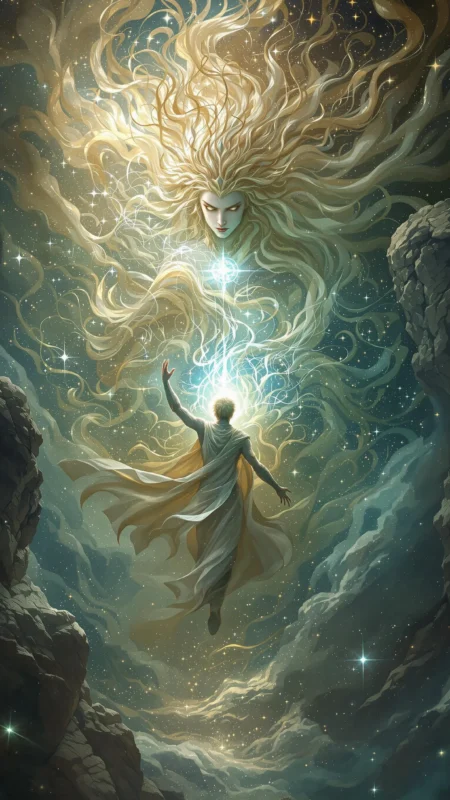
Sandman

Archetype Meaning & Symbolism

somber, dutiful, creative, melancholic, unforgiving, regal, imaginative, ancient, stubborn, profound

  • What power would Hell have if those here imprisoned were not able to dream of Heaven?

If Sandman is part of your personal mythology, you may...

Believe

  • You may believe that stories are not an escape from reality, but the very foundation upon which reality is built.
  • You may believe that every person is the sovereign of their own inner world, and that this kingdom carries with it an immense and inescapable responsibility.
  • You may believe that change is the most fundamental law of the universe, and that even the most ancient and powerful beings must either adapt or be destroyed.

Fear

  • You may fear the loss of your imagination, a descent into a gray, literal world devoid of meaning or hope—a waking nightmare.
  • You may fear that your own pride, stubbornness, and rigid adherence to your principles will one day lead to your isolation and ruin.
  • You may fear becoming so lost within the labyrinth of your own inner world that you lose the path back to tangible reality and the people you love.

Strength

  • Your strength lies in a boundless creativity, an ability to generate novel perspectives and weave narratives that can inspire and heal.
  • You possess a profound fluency in the language of symbolism and metaphor, allowing you to perceive the deeper patterns and meanings that lie beneath the surface of life.
  • You are guided by a powerful sense of duty and personal integrity, a commitment to your principles that can make you a steadfast and reliable presence.

Weakness

  • Your weakness may be a tendency toward deep melancholy and a sense of detachment from the mundane, everyday world.
  • You may exhibit a stubborn refusal to forgive—both others and yourself—holding onto past slights with a grim and punishing memory.
  • You can be prone to aloofness and emotional distance in relationships, preferring to analyze others rather than connect with them directly.

The Symbolism & Meaning of Sandman

In the modern psyche, the Sandman, particularly as Morpheus, is the patron saint of story. He symbolizes the profound, often unsettling truth that our realities are constructed things, built from the gossamer and iron of our imaginations. To have him in your personal mythology is to acknowledge that the narrative you tell yourself about your life is not a mere accessory to it; it is the very lens through which you experience it. He represents the immense power and staggering responsibility of consciousness: the ability to create worlds, characters, and meanings within the confines of our own minds. His presence suggests a life lived in dialogue with the symbolic, where a chance encounter is never just a chance encounter, but a potential plot point, a new character introduction, a foreshadowing.

The archetype also speaks to the nature of duty, but not a duty to a company or a state. It is a duty to the core function of one’s own being. For Dream, that function is the creation and maintenance of stories. For an individual, it may be a duty to one's own creativity, integrity, or unique perspective. This is a heavy mantle, often isolating, which imbues life with a deep seriousness and purpose. It suggests that your personal 'dreaming'—your unique inner world and its expressions—is not a frivolous escape but a vital contribution to the cosmic order, a realm that you and you alone are responsible for ruling wisely.

Finally, the Sandman is a potent symbol of reluctant change. As an ancient, nigh-immutable being who is ultimately forced to transform, he represents the idea that even the most fundamental aspects of ourselves and our world are subject to evolution. He reminds us that rigidity, even when born of principle and duty, can become a cage. His story suggests that true endurance is not found in stasis but in the painful, beautiful, and necessary act of letting a part of yourself die so that a new story can begin. This archetype champions the courage to face the endings that are required for new beginnings.


Sandman Relationships With Other Archetypes

The Lighthouse

In the vast, nocturnal ocean of the psyche where the Sandman holds sway, the Lighthouse stands as a solitary pillar of waking reason. Its beam is a blade that seeks to cut a single, safe path through the darkness, an insistent, rational inquiry into the nature of the waves. The Sandman, however, is not the darkness but its secret grammar, the murmur of the tide itself. The Lighthouse may offer a haven from the storm, a fixed point of reference against the formless deep, but the Sandman could be said to cherish the storm for the strange, luminous creatures it washes ashore. Their relationship is perhaps one of a necessary and eternal opposition: the lonely, focused mind attempting to map the boundless territory of the soul, while the soul continues to dream in a language older than maps.

The Muse

One might view the Muse as a daylight ambassador from the same country where the Sandman is the nocturnal king. The Muse may arrive as a disciplined guest, knocking at the study door to bestow a perfect, polished line or a single, lucid melody. The Sandman’s method is perhaps more elemental, more chaotic; it is not a gift delivered, but an entire sea-change of the mind. He may not bring the finished pearl, but instead floods the psyche with the whole oyster bed, a sprawling, unfiltered torrent of imagery, narrative, and feeling. The Muse could be the focused lens that brings a creative idea to a burning point, while the Sandman is the cosmos of starlight and nebula from which that single ray of light was drawn. They are not rivals, but may represent the two essential phases of creation: the wild, unconscious harvest and the deliberate, waking craft.

The Archivist

The Archivist seeks to preserve the past in vitrines of fact, pinning history down with the precision of date and document. Theirs is a world of acid-free paper and catalogued truth, a bulwark against the erosion of time. The Sandman, too, is a keeper of histories, but his archive is written in a far more volatile ink. His library is the subconscious, where memories are not filed but swim freely, where a forgotten scent holds more weight than a signed treaty, and where the emotional truth of an event is allowed to rewrite its factual blueprint. The Archivist may safeguard the skeleton of what was, but the Sandman tends to its ghost. Their relationship could be seen as the quiet, ceaseless dialogue between the letter of our story and its spirit, a recognition that the most complete record of a life lies somewhere between the verifiable artifact and the unprovable dream.

Using Sandman in Every Day Life

Navigating Creative Blocks

When the well of inspiration runs dry, invoking this archetype means seeing the block not as an absence but as a fallow period, a quiet realm awaiting a new story. It is a prompt to seek new input not for the sake of the final product, but for the sake of the dream itself: read a book from an unknown genre, walk a street you've never traveled, listen to the stories of strangers. The Sandman teaches that creation is not an act of force, but of receiving and shaping the whispers that already exist in the ether.

Processing Grief

Morpheus himself is a creature of profound loss and reluctant change. To call upon him in times of sorrow is to grant your grief a kind of mythic dignity. Your pain is not a pathology; it is a story, a dark and necessary chapter. This perspective may not lessen the hurt, but it could frame it as a transformation, the painful shedding of one narrative to make way for another. It allows one to be both the grieving character and the compassionate author, understanding the role this sorrow plays in the epic of a life.

Reclaiming Personal Narrative

When you feel like a side character in your own life, buffeted by the choices of others, the Sandman archetype offers a path to reclaiming the protagonist's chair. It is the practice of seeing your life as The Dreaming: a realm over which you are the rightful sovereign. This could mean consciously reframing past traumas not as defeats but as crucible moments, or actively scripting your next chapter by making a choice, however small, that is authentically your own. It is the recognition that you are both the dreamer and the dream.

Sandman is Known For

The Dreaming

His personal realm, the repository and source of every story, dream, and nightmare in the multiverse. It is a landscape shaped by imagination, a library containing every book ever conceived.

The Tools of Office

His three symbols of power

the Helm, crafted from the skull and spine of a dead god; the Pouch of Dream Sand, which can bring sleep and shape dreams; and the Dreamstone, or Ruby, which could make dreams into reality.

The Endless

His family of seven anthropomorphic siblings, each a personification of a fundamental concept

Destiny, Death, Dream, Destruction, Desire, Despair, and Delirium. Their existence defines the boundaries of sentient life.

How Sandman Might Affect Your Personal Mythology

How Sandman Might Affect Your Mythos

Integrating the Sandman into your personal mythos transforms your life story from a simple biography into a sacred text, rich with symbolism and subtext. Events are no longer just things that happen; they may be seen as chapters in a grander narrative, each with its own theme and purpose. You might perceive your personal history as your own 'Dreaming,' a landscape you have built and are responsible for. This could lead to a meticulous curation of your own story, finding patterns and meaning in coincidences, seeing archetypal forces at play in your daily life. Your mythos becomes less about what happened and more about what it all *means*, turning your existence into an ongoing act of interpretation and creation.

The presence of this archetype may also introduce a powerful theme of fate and function into your life's narrative. You may feel that you were 'created' for a specific purpose, much like Dream is the personification of his function. This doesn't have to be a grand destiny, but perhaps a deep-seated role: the storyteller for your family, the keeper of memories for your friends, the dreamer of new possibilities in your field. Your personal mythos could become a story about fulfilling this essential nature, with its attendant triumphs and tragedies. It frames your life's journey as a negotiation between this profound, internal sense of duty and the unpredictable chaos of the external world.

How Sandman Might Affect Your Sense of Self

To see oneself through the lens of the Sandman is to identify with the creator, the sovereign of an inner kingdom. This may foster a powerful sense of self-sufficiency and a rich inner life. You might not need constant external validation, as your primary sense of worth could come from the quality and integrity of your own thoughts, ideas, and creations. This perspective cultivates an identity as a person of substance and depth, one who contains multitudes and whole worlds within. You may see your moods not as random fluctuations, but as different weather patterns in the vast landscape of your mind.

However, this self-perception is shadowed by a potential for profound loneliness and melancholy. Like Morpheus, you may feel detached from the simpler, more direct experiences of others, as if viewing the world through a veil of meaning and metaphor. There can be a sense of being burdened by your own rich interiority, an artist trapped in a beautiful but solitary gallery. This archetype can foster a self-image that is regal but remote, dutiful but unforgiving, creative but prone to brooding. The challenge is to avoid letting the role of the 'dream king' calcify into an emotional prison, isolating you from the warmth of unanalyzed, direct human connection.

How Sandman Might Affect Your Beliefs About The World

Adopting a Sandman-inflected worldview means seeing the world not as a solid, objective machine but as a shimmering, interwoven tapestry of stories. You might come to believe that human history is driven less by economics or politics and more by the myths we choose to live by. This perspective elevates the artist, the poet, and the storyteller to positions of immense importance; they are not just entertainers, they are the engineers of reality. It is a worldview that finds magic in the mundane and sees the profound in the personal. A city is not just concrete and steel, but a nexus of a million dreams; a forest is not just trees, but a living library of ancient tales.

This viewpoint could also attune you to the rules, patterns, and obligations that govern existence. Just as the Endless have their functions and their forbidden territories, you may perceive a kind of cosmic grammar structuring the universe. This is not necessarily a religious view, but rather a philosophical one: a sense that things are connected in a meaningful, lawful way, even if the laws are esoteric and strange. You may look for the underlying principles behind events, the ancient rule that was broken to cause a crisis, or the forgotten obligation that needs to be met to restore balance. The world becomes a place of deep, and sometimes terrifying, order.

How Sandman Might Affect Your Relationships

In relationships, the Sandman archetype might compel you to look past the surface of people and into the heart of their personal mythology. You could be fascinated by the stories others tell themselves, the dreams they harbor, and the symbolism that populates their inner worlds. This can lead to relationships of incredible depth and understanding, where you connect with a partner or friend on the level of soul-story. You may value the shared creation of a 'couple's mythos,' a private universe of memories, jokes, and symbols that belongs only to you.

Conversely, there is a distinct danger of relating to people as characters rather than as individuals. You might unconsciously cast them in roles within your own personal drama: the 'wise mentor,' the 'tragic lover,' the 'comic relief.' This tendency, a mirror of Dream's own struggles, can create emotional distance and prevent true intimacy. It can be difficult for others to feel truly seen when they suspect they are being interpreted rather than simply experienced. The challenge for one with this archetype is to honor the stories of others without trying to become their editor, to participate in the relationship rather than merely observing it as a well-wrought narrative.

How Sandman Might Affect Your Role in Life

The Sandman archetype may instill a profound sense of role that transcends a mere job or social function. You might feel your primary role is that of a 'Keeper of Stories' or a 'Guardian of Imagination.' This could manifest in a career as an artist, writer, or therapist, but it could also be expressed as the person in a family who preserves the history, or the leader in an organization who shapes its guiding narrative and vision. It is a role defined by a core responsibility to meaning itself, a duty to ensure that the spark of 'what if' is never extinguished in your sphere of influence.

This role is both a privilege and a burden. It can provide a powerful sense of purpose that makes life feel significant and essential. However, like Morpheus bound to his realm, you may feel trapped by this perceived duty. There might be a reluctance to be spontaneous or 'off-script,' a feeling that you must always embody this serious, profound role. This can create immense pressure and a sense of isolation, as if you are a lonely monarch in a kingdom of your own making. The personal quest becomes learning how to fulfill your role without being entirely consumed by it, to remember that even the king of dreams is allowed, on occasion, to simply be.

Dream Interpretation of Sandman

In a positive context, to dream of the Sandman may be a powerful affirmation of your creative potential. His appearance could signal that you are in deep contact with your own 'Dreaming,' the source of your most authentic ideas and stories. He might appear as you embark on a new creative project, offering a silent nod of approval. Such a dream could be an invitation to take your imagination more seriously, to build the castle you've only envisioned, to write the book you've only outlined. It suggests a healthy integration of your unconscious and conscious worlds; you are not running from your dreams, but are instead meeting with their king as an honored guest.

In a negative context, a visit from the Sandman could be a warning. He might appear not as a welcoming host but as a stern jailer, suggesting that you have become imprisoned by your own fantasies, retreating from life into a world of illusion. His presence could signify a creative block born of rigidity and perfectionism, where your inner 'Dreaming' has become a stagnant, desolate landscape. It may also represent an encounter with the unforgiving, rule-bound aspect of your own psyche, the part of you that punishes you for perceived failures or deviations from your 'story.' To dream of him in this way is a call to examine whether your dreams are serving you, or if you have become their servant.

How Sandman Archetype Might Affect Your Needs

How Sandman Might Affect Your Physiological Needs

From a mythological perspective, the physiological need for rest becomes elevated to a sacred act of pilgrimage. Sleep is not merely a biological reset; it is a journey into the Dreaming, a necessary communion with the source of one's own stories and psychic energy. If the Sandman is a key figure in your mythos, you may treat periods of rest, quietude, and even daydreaming as essential nourishment, as vital as food and water. You might feel that a lack of imaginative space leads to a kind of soul-starvation, which manifests physically as fatigue, listlessness, and a graying of the world.

This archetype teaches that the body is sustained not just by calories, but by meaning. A life devoid of personal myth, of story, of creative outlet, may feel physically draining. Your body’s energy might seem directly tied to the vibrancy of your inner world. When your internal 'Dreaming' is flourishing, you may feel energetic and alive. When it is barren or neglected, you may experience a tangible, physical depletion. Your physiological well-being becomes inextricably linked to the health of your imagination, demanding that you tend to your inner landscape as diligently as you tend to your physical body.

How Sandman Might Affect Your Ideas of Belonging

Belongingness, through the Sandman's lens, may be less about finding a tribe and more about finding one's place within the Great Story. The sense of connection comes from the universal human experience of dreaming, of telling stories, of seeking meaning. You might feel a profound kinship with artists, poets, and thinkers from across centuries, seeing them as fellow travelers in the realm of imagination. This is a belonging that transcends geography and time, connecting you to the collective consciousness. You belong not to a place, but to the very act of creation.

This can also be a profoundly lonely form of belonging. Like Morpheus ruling his kingdom, you may feel connected to all, yet intimate with few. The very depth of your inner world can act as a barrier to simple, easy camaraderie. You might struggle with small talk, preferring the deeper currents of another's personal myth. The search for belonging becomes a quest for those rare individuals who can meet you in that symbolic space, who can speak the language of dream and story. It's a search not for people who are like you, but for people whose stories resonate with your own.

How Sandman Might Affect Your Feelings of Safety

For one whose mythos includes the Sandman, safety may be defined less by physical security and more by narrative integrity. A coherent and meaningful personal story becomes the ultimate shelter, a fortress of the mind that can withstand the unpredictable storms of the external world. The feeling of being safe comes from understanding your place in your own story, from having a mythos that can make sense of chaos and suffering. As long as the story holds, you feel secure. The real threat is not a physical intruder, but a psychological one: an event or idea that shatters your narrative, leaving your psyche exposed and vulnerable.

However, this reliance on narrative for safety has its own perils. The fortress can become a prison. You might become so invested in your story that you refuse to acknowledge facts or experiences that contradict it, creating a dangerous disconnect from reality. Safety becomes contingent on maintaining a fragile, rigid fiction. The Sandman's own story warns against this: his initial imprisonment was a result of his predictability. True safety, then, may lie not in a static, unchanging story, but in a resilient one, a mythos flexible enough to incorporate new information and evolve without breaking.

How Sandman Might Affect Your Views of Esteem

Esteem, in this mythological framework, is sourced directly from one's sovereignty over their inner world. Self-worth is built upon the act of creation, whether that creation is a work of art, a novel idea, or a finely crafted personal narrative. You may derive immense pride from your ability to generate worlds within yourself, to be the author and protagonist of a meaningful existence. Esteem is the quiet confidence of the architect who knows the secret blueprints of their own soul. It is not dependent on the applause of others, but on the integrity and richness of the world you have built for yourself.

Yet, this foundation for esteem can be fragile. A creative block can feel like a devastating personal failure, a questioning of your very being. Furthermore, the archetype carries a seed of humility that can challenge esteem: the knowledge that even the Dream King is but one of seven, a function within a larger, incomprehensible system. This can lead to moments of feeling small and insignificant, a mere character in a story far grander than your own. The highest form of esteem, then, may be found in the balance: taking pride in your own kingdom while acknowledging, with a certain regal grace, that it is but one small, wondrous part of a much larger cosmos.

Shadow of Sandman

The shadow of the Sandman is where the dream curdles. It is the artist who becomes a tyrant, the storyteller who traps others in false narratives for their own gain. In this shadow aspect, the sovereign of the inner world becomes a solipsist, believing their dream is the only one that matters. This manifests as a profound inability to engage with the reality of others, seeing them merely as props on a personal stage. It is a cold, manipulative creativity, used not to enlighten but to control. The rich inner world becomes a gilded cage, decorated with intricate fantasies that serve only to wall off the creator from any genuine human contact or accountability.

Another facet of the shadow is a petrifying rigidity. It is Morpheus before his transformation, a being so bound by his own rules and sense of duty that he cannot bend, only break. This can manifest as a punishing perfectionism, where no creation, no relationship, no part of life is ever good enough, leading to a state of permanent dissatisfaction and creative paralysis. The dream becomes a source of torment, a standard of impossible perfection against which reality will always fall short. This is the ultimate nightmare: to be the all-powerful creator of a world in which you have made it impossible for yourself to find any joy or peace.

Pros & Cons of Sandman in Your Mythology

Pros

  • You possess a rich and vibrant inner life, a constant source of inspiration, comfort, and entertainment.
  • You have the rare ability to find or create meaning, structure, and even beauty in the midst of chaotic or painful life events.
  • You hold a deep and abiding appreciation for art, mythology, and the transcendent power of the human imagination.

Cons

  • You may be predisposed to bouts of melancholy and a persistent feeling of being an outsider to the ordinary happiness of the world.
  • You risk alienating others through emotional aloofness or an intellectual tendency to analyze people rather than experiencing them.
  • Your strong sense of duty and narrative can become a cage, making you rigid, overly serious, and resistant to necessary change.