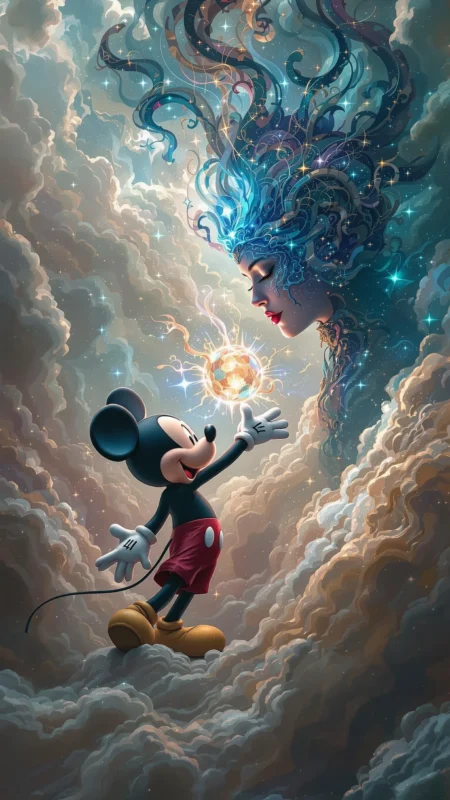
Mickey Mouse

Archetype Meaning & Symbolism

Optimistic, plucky, wholesome, resourceful, earnest, cheerful, naive, persistent, iconic, sanitized

  • To laugh at yourself is to love yourself.

If Mickey Mouse is part of your personal mythology, you may...

Believe

  • You may believe that optimism is not a feeling but a discipline, a practical tool that can actively shape a better reality.
  • You may believe that true wealth is measured in the loyalty and laughter of a small circle of friends.
  • You may believe that there are very few problems in the world that cannot be solved with a little bit of pluck, a good attitude, and a helping hand.

Fear

  • You may fear deep, intractable conflict, avoiding messy emotional truths in favor of a fragile, superficial peace.
  • You may fear being perceived as irrelevant or childish in a world that often prizes cynicism and irony over earnestness.
  • You may fear that your own optimism is a mask, and that beneath it lies a bitterness or despair that could one day consume you.

Strength

  • Your resilience is extraordinary; you bounce back from failure and disappointment with your core optimism intact, ready for the next adventure.
  • You are a natural community builder, possessing an innate talent for making others feel welcome, valued, and part of a team.
  • Your unwavering good nature is a form of charisma, capable of disarming cynics, de-escalating tension, and inspiring cooperation.

Weakness

  • Your conflict avoidance can become a critical flaw, leading you to ignore or enable problematic behavior in others simply to maintain harmony.
  • Your determinedly positive outlook can sometimes curdle into naivete, leaving you vulnerable to being exploited by those with less noble intentions.
  • You may struggle with moral complexity, preferring a black-and-white world of good guys and bad guys, which can lead to simplistic judgments.

The Symbolism & Meaning of Mickey Mouse

To have Mickey Mouse in your personal mythology is to carry a talisman of enduring optimism. He is the quiet assertion that goodness is not a weakness but a kind of low-key superpower. In the grand, often grim narrative of the world, he represents the subplot of simple decency. He is the small, circular form against the sharp, jagged edges of cynicism: a belief that most problems, no matter how daunting, can be unraveled with a bit of gumption, the help of a loyal friend, and a well-timed, 'Oh, boy!'. He may symbolize the brand as being, a logo that has transcended its corporate origins to become a secular icon of cheerfulness, a glyph for a certain kind of uncomplicated happiness that is both sought after and suspect.

He could also represent the preservation of innocence, not as a state of ignorance, but as a disciplined choice. In a personal mythos, Mickey is the core self that resists the tarnish of worldly experience. He is the part of you that still finds genuine delight in a sunset, a catchy tune, or a kind word. This isn't naivete; it's a curated worldview, a conscious decision to focus on the light, to believe in the possibility of a happy ending, and to find strength in a certain kind of simplicity. He is the proof that one can see the world's darkness and still choose to whistle a cheerful tune in defiance.

The archetype’s very design—all soft circles, non-threatening curves—may be a symbol for psychological safety and approachability. In your own story, this could translate to the power of a consistent, friendly persona. Mickey is never threatening; he is eternally welcoming. To embody this is to understand that radical approachability can be a form of strength, disarming potential aggressors and building bridges with an almost effortless grace. The mouse in your mythos might be the understanding that you don't need to be the biggest or the loudest to have a profound impact; sometimes, you just need to be the kindest.


Mickey Mouse Relationships With Other Archetypes

The Donald Duck

If the Mickey Mouse is the smooth, unyielding shoreline of our better intentions, the Donald Duck may be the sputtering, white-capped wave of daily frustration that breaks against it, again and again, to no effect. This is not a relationship of equals, but of poles; the steady, magnetic north of optimism and the quivering, agitated needle of a compass spun by indignity. One, perhaps, cannot be truly understood without the other. The mouse’s unflappable calm is given its heroic texture only by the squawking, deeply relatable chaos of the duck. It is the quiet hum of the universe set against the frantic static of a poorly tuned radio, a symbiosis where the silence is made more profound by the noise it effortlessly absorbs.

The Shadow

As an archetype of relentless sunniness, the Mickey Mouse could be seen as a figure so brilliantly and frontally lit that he must, by the laws of both physics and psyche, cast a stark and well-defined shadow. This is not the sprawling, amorphous gloom of existential dread, but something more akin to the crisp, cutout silhouette of a villain in a magic lantern show. It is the necessary antagonist, the simple, dark shape that gives the hero’s bright form its very definition. The Shadow, in this context, may serve less as a glimpse into a hidden, tormented interior and more as the simple, black velvet against which the diamond of innocence is meant to be displayed, its darkness existing only to prove the light’s purity.

The Blank Slate

The character of the Mickey Mouse may be so elemental, so stripped of troubling ambiguity, that he functions less as a personality and more as a pristine surface. He could be a perfectly still pool of ink in a calligrapher’s stone, waiting to be drawn into whatever simple, happy shape the moment requires. Or perhaps he is a mirror, polished to such a high sheen that he reflects not his own inner world—if such a thing could even be plumbed—but the aspirations of the one looking at him. In this relationship, we do not seek to understand the archetype; we seek to see a simpler, better version of ourselves echoed back, his uncomplicated smile a quiet affirmation that such untroubled goodness is, in fact, possible.

Using Mickey Mouse in Every Day Life

Navigating a Mundane Crisis:

When faced with a bureaucratic maze or a soul-crushing corporate task, you might channel the Mickey Mouse archetype. It isn't about grand rebellion, but about plucky persistence. You adopt a 'gosh, well, let's see here' attitude, finding small, clever workarounds, making allies with a simple dose of friendliness, and maintaining your spirit not by fighting the machine, but by cheerfully refusing to let it grind you down. You whistle while you work, even if the work is filling out forms in triplicate.

Responding to Personal Failure:

After a significant setback, perhaps a failed project or a personal mistake, the archetype offers a path away from shame. Think of the Sorcerer's Apprentice: a moment of ambitious overreach leading to utter chaos. The lesson isn't to never be ambitious again. Instead, it's to look at the flood of enchanted brooms with a wide-eyed 'Oh, boy!' and get to work cleaning up the mess, having learned something profound about your own limits and capabilities. The failure becomes not an indictment of your character, but a comical, instructive chapter in your story.

Cultivating Creative Joy:

When a creative spark feels lost, embodying Mickey might mean returning to fundamentals. It is a focus on simple, primary colors of emotion: pure joy, straightforward fun, uncomplicated affection. Instead of striving for a complex, ironic masterpiece, you might try to create something that simply makes you and others feel good. It’s about rediscovering the magic in a simple melody, a basic sketch, a story with a happy ending, reaffirming that art doesn't always have to be a dark struggle; it can be a sunny afternoon.

Mickey Mouse is Known For

Steamboat Willie

The 1928 short film that launched him into stardom and is celebrated for its synchronized sound, marking a pivotal moment in animation history. It established his persona as a cheerful, mischievous everyman.

The Sorcerer's Apprentice

A segment from the 1940 film *Fantasia* where Mickey, as the apprentice, overreaches his magical abilities. It is a powerful allegory for ambition, unintended consequences, and the humility of learning.

Global Icon and Corporate Mascot

He is perhaps most known as the face of The Walt Disney Company, a symbol of family entertainment, American culture, and the very concept of a global brand so recognizable it functions as a visual language.

How Mickey Mouse Might Affect Your Personal Mythology

How Mickey Mouse Might Affect Your Mythos

When Mickey is a central figure in your personal mythos, your life story may be structured less as an epic tragedy or a heroic quest, and more as a series of well-intentioned adventures. You may perceive your challenges not as soul-crushing trials, but as temporary predicaments to be solved with pluck and ingenuity. The narrative is not about a gritty, transformative struggle, but about the steadfast reaffirmation of a core, unwavering goodness. Antagonists in your story might appear less like forces of existential evil and more like a Pete: a surly, predictable obstacle that can be outsmarted or, perhaps, even redeemed by a simple act of kindness. Your mythos is one of endurance through buoyancy.

Your personal history might be organized into distinct episodes, each with a clear beginning, a comical muddle in the middle, and a satisfyingly neat resolution. This framework provides a deep sense of stability; it’s a belief that no matter how chaotic the current situation, the metaphorical credits will eventually roll, and a new, bright day will begin. The grand arc of your life isn't about becoming someone new, but about consistently and reliably being yourself. Your legend is not written in fire and blood, but in the indelible ink of a cheerful, resilient, and fundamentally decent character who always finds a way to win the day, often with a laugh and the help of his friends.

How Mickey Mouse Might Affect Your Sense of Self

Your self-concept, if informed by this archetype, may be anchored in a sense of fundamental goodness. You might see yourself as an incorruptible spirit of cheer, someone whose core identity is built on simple, powerful virtues: kindness, loyalty, optimism, and a surprising, humble competence. This is not about ego or moral superiority, but about a quiet confidence in your own character. You are the 'nice one,' the 'reliable one,' and this is a source of profound strength and stability in how you view yourself. Your worth isn't tied to being the best, but to being good.

This archetype could also foster a deep-seated humility. Mickey is almost never the strongest, wealthiest, or most powerful person in the room; his heroism lies in his everyman (or everymouse) relatability and his indomitable spirit. You may, therefore, derive self-worth not from grand achievements or external validation, but from the way you navigate the world. Your value is in your character, your ability to face trouble with a shrug and a smile, and to turn potential disasters into amusing anecdotes. You see yourself not as a hero, but as a friend, and in that, you find more than enough reason for self-love.

How Mickey Mouse Might Affect Your Beliefs About The World

Through a Mickey Mouse lens, the world may appear as a fundamentally manageable and ultimately benevolent place. Problems are seen as temporary puzzles or misunderstandings rather than as evidence of a deeply flawed, chaotic universe. Conflict is not an existential clash of irreconcilable forces, but a series of schemes concocted by cartoonishly grumpy antagonists who can be foiled with good humor and cleverness. There is an underlying faith that, in the long run, decency and good sense will prevail. The world is not a battlefield, but a slightly rickety, endlessly fascinating amusement park ride.

This perspective could also shape your view of society's larger structures. As the face of a vast and successful corporation, Mickey can symbolize a faith in institutions. You may be inclined to see systems, governments, and corporations not as inherently oppressive, but as potential sources of order, wonder, and security, provided one plays by the rules. The world is a place with clear paths and friendly guides. This worldview doesn't ignore that there are 'bad guys,' but it maintains a core belief that the system itself is designed for the good guys to win.

How Mickey Mouse Might Affect Your Relationships

In the realm of relationships, this archetype places a supreme value on the tight-knit circle of friends. Your chosen family, your 'Mickey Mouse Club,' may be the central pillar of your existence. Like his bond with Donald and Goofy, your connections are likely characterized by unwavering loyalty, mutual support through comical mishaps, and a deep, unspoken affection. Love is expressed through shared experience and steadfast presence. You seek partners and friends who share this vision of camaraderie, building a world together based on trust and shared laughter.

This outlook, however, may also idealize connection, shying away from its deeper, messier complexities. The Mickey archetype might foster a desire for relationships where problems are resolved quickly and neatly, like a 22-minute cartoon. You might become uncomfortable with lingering conflict, chronic resentments, or the kind of profound emotional friction that has no easy answer. Romance, in particular, may be viewed through the lens of Mickey and Minnie's eternal courtship: a sweet, chaste, and uncomplicated companionship, free from the turbulent passions and painful vulnerabilities that define many real-world partnerships.

How Mickey Mouse Might Affect Your Role in Life

You may perceive your role in life as that of a stabilizing force, a beacon of optimism for your family, workplace, and community. Your purpose isn't to be a revolutionary who tears down old structures, but to be the cheerful conductor who makes the current orchestra play in harmony. You are the one who remembers birthdays, organizes the social gathering, and offers a kind word when spirits are low. Your role is to make your small corner of the world a little brighter, a little kinder, and a little more fun.

This archetype could also cast you in the role of a steward or a keeper of the flame. Just as Mickey carries the legacy of the Disney brand, you might feel a profound responsibility to uphold a set of values, a family tradition, or a company culture. Your role is one of preservation and positive representation. You are the reliable ambassador of a particular brand of goodness, tasked with keeping the magic alive and ensuring that the story continues to be told in its pure, intended form. You are not the author of the story, perhaps, but its most important and dedicated performer.

Dream Interpretation of Mickey Mouse

In a positive context, Mickey Mouse appearing in a dream may symbolize a reconnection with your own core of innocence, joy, and simple optimism. His appearance could be a message from your subconscious to let go of cynicism and anxiety, and to approach a current problem with a lighter heart and a more creative, playful spirit. He might represent a surprisingly simple, wholesome solution to a complex issue, or an invitation to simply laugh at your own predicaments and start anew. Dreaming of Mickey could be a call to remember the magic in the mundane.

In a negative context, a distorted, menacing, or unsettling Mickey in a dream can be a powerful symbol of the archetype's shadow. It might represent a toxic positivity, a sense that you or someone around you is enforcing a cheerful facade to mask deep unhappiness, anger, or fear. This nightmarish Mickey could also symbolize a feeling of being a corporate tool, of having sold your authentic self for a polished, marketable persona. It could point to a deep-seated fear that your innocence is actually dangerous naivete, leaving you vulnerable and defenseless in a world that is not as friendly as you pretend it is.

How Mickey Mouse Archetype Might Affect Your Needs

How Mickey Mouse Might Affect Your Physiological Needs

The Mickey archetype in your personal mythos may guide your physiological needs toward rhythm, comfort, and play. There could be a deep-seated belief that the body is a friendly companion, not a project to be optimized. This might translate into a preference for gentle, consistent routines: regular mealtimes, a solid eight hours of sleep, and joyful movement like dancing or walking rather than grueling workouts. Physical well-being is achieved through cheerful maintenance and the avoidance of stressful extremes, keeping the body in a state of simple, happy equilibrium.

This connection may also manifest as a deep craving for sensory comfort and familiarity. Your physiological contentment could be profoundly tied to the environment you inhabit. You might favor soft textures, bright primary colors, and spaces that are clean, orderly, and free of threatening ambiguity. The food you eat may also reflect this, with a preference for nostalgic, uncomplicated 'comfort foods' that reinforce a feeling of safety and well-being. Your body's needs are met when your external world physically reflects the clean, friendly, and reliable world of the archetype.

How Mickey Mouse Might Affect Your Ideas of Belonging

For one with Mickey in their mythos, the need for belongingness is not just a desire; it is the central organizing principle of life. Love and intimacy are found within a tight-knit, fiercely loyal group of friends who function as a chosen family. These are the people you go on adventures with, the ones who help you out of comical scrapes, and with whom you share an uncomplicated, deep affection. Belonging is about having your 'Goofy' and your 'Donald,' a reliable cast of characters who make your story complete.

This drive for connection can also extend to larger entities. You may find a profound sense of belonging as part of a company, a social club, or even a brand fandom that espouses values of fun, family, and optimism. Love is about shared identity and participation in a collective ritual of cheer. Romantic love, like that of Mickey and Minnie, is often idealized as a steady, eternal companionship—a partnership built on shared values, mutual respect, and sweet, wholesome gestures rather than turbulent passion. You belong when you have a place where you can be your cheerful, best self.

How Mickey Mouse Might Affect Your Feelings of Safety

Safety needs, under the influence of the Mickey mythos, are often met through the meticulous construction of a predictable and friendly world. You may prioritize financial security not for opulence, but for the quiet stability it affords. Your home becomes a fortress of cheer, a 'Toon Town' sanctuary designed to buffer you from the harsh realities and unpredictable chaos of the outside world. Safety is found in reliable routines, in strong community ties, and in the underlying belief that as long as you maintain a good heart and a friendly demeanor, no true, lasting harm can befall you.

Furthermore, psychological safety may be paramount. Your sense of security could be deeply intertwined with being liked, accepted, and seen as non-threatening. The greatest danger is not physical harm, but social ostracization or disapproval from your chosen community. To this end, you might meticulously manage your persona, avoiding confrontation and displaying an agreeable nature to ensure you are never cast out from the protective circle of the group. Safety lies in belonging, in being a welcome and uncontroversial member of the club.

How Mickey Mouse Might Affect Your Views of Esteem

Esteem, in the Mickey Mouse framework, is primarily derived from character rather than conquest. Your self-worth is built on your reputation as a good, reliable, and kind person. You gain respect and admiration not by being the most powerful or successful, but by being the moral compass, the one who consistently does the right thing with a cheerful heart. The applause you seek is for your unwavering decency and your ability to bring light into the lives of others. Your esteem is built on the quiet, solid foundation of being a good friend.

Recognition and validation from your community are also crucial for your sense of esteem. It's less about standing out from the crowd and more about being seen as an indispensable part of it. Your self-worth is bolstered when you are acknowledged as the dependable, optimistic heart of your family, friend group, or workplace. Esteem comes from the feeling of fitting in perfectly, of playing your part in the collective harmony so well that the whole group is made better by your presence. It's the satisfaction of being valued for your steady, positive contribution.

Shadow of Mickey Mouse

The shadow of the Mickey Mouse archetype is a suffocating, compulsory cheerfulness. It is the tyranny of the 'have a nice day,' the insistent demand for a positive outlook that denies the validity of authentic pain, anger, or grief. In this shadow form, the archetype becomes a tool of emotional repression, plastering a bright, corporate-approved smile over any crack in the facade. This leads to a profound internal dishonesty and an inability to engage with the messy, complex, and often negative realities of life. The person embodying this shadow becomes a hollow vessel, a walking logo for a happiness they no longer genuinely feel, alienating others with their relentless and inhuman lack of nuance.

Another dark aspect is the quiet enforcement of conformity, the dark side of 'family-friendly.' The wholesome nature of Mickey, when twisted into a rigid ideology, becomes a means of social control. It creates an in-group of 'nice,' acceptable people and subtly excludes or judges anyone deemed too different, too critical, too loud, or too complex. This shadow does not announce its bigotry; it smothers dissent with a disarming smile and the gentle, unyielding pressure to get with the program. It creates sterile environments where true diversity and authentic expression cannot survive, all in the name of maintaining a clean, pleasant, and deeply policed harmony.

Pros & Cons of Mickey Mouse in Your Mythology

Pros

  • You are a genuine source of optimism and light, possessing the rare ability to lift the spirits of those around you and foster hope in difficult times.
  • You build and maintain strong, loyal friendships, creating a powerful sense of community and belonging that serves as your greatest strength.
  • Your inherent resilience, rooted in a belief in goodness and happy endings, allows you to navigate life's challenges with grace and without bitterness.

Cons

  • You might be perceived as naive or simplistic, causing others to dismiss your opinions or take advantage of your good nature.
  • Your deep-seated aversion to conflict may cause you to avoid necessary confrontations, allowing problems to fester and relationships to become strained by unspoken truths.
  • There is a significant risk of emotional burnout or inauthenticity from the pressure to constantly maintain a cheerful, optimistic persona, even when you don't feel it.