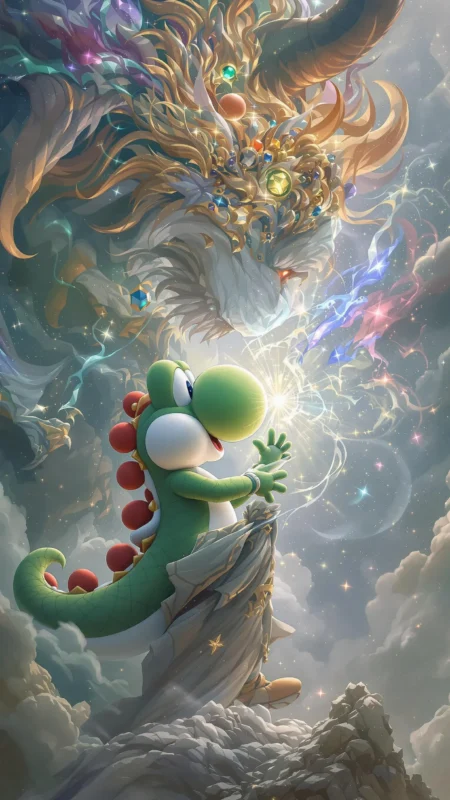
Yoshi

Archetype Meaning & Symbolism

Supportive, loyal, sacrificial, resourceful, voracious, resilient, cheerful, communal, patient, unexpectedly powerful

  • Yoshi!

If Yoshi is part of your personal mythology, you may...

Believe

  • You may believe that joy is not a luxury but a fundamental survival strategy.

  • You may believe that the most profound power lies not in being the hero, but in being the one who carries the hero.

  • You may believe that every problem, no matter how menacing, contains the seed of its own solution.

Fear

  • You may fear that you are only valued for your utility, and will be discarded once you are no longer needed.

  • You may fear that in your focus on supporting others, your own journey will be forever deferred.

  • You may fear a deep, insatiable hunger within you, a worry that you might one day consume something precious by mistake.

Strength

  • An almost boundless capacity for loyalty and supportive partnership, making you the most trusted of allies.

  • A natural alchemy for problem-solving, able to transform negative situations into useful outcomes.

  • A surprising reserve of resilience, an ability to find an extra lift just when you think you are falling.

Weakness

  • A tendency towards self-sacrifice that can lead to the neglect of your own needs and goals.

  • A potential for codependency, feeling aimless or incomplete without someone else to support.

  • An inherent optimism that can sometimes border on naivete, making you vulnerable to exploitation.

The Symbolism & Meaning of Yoshi

Within a personal mythos, Yoshi could represent the profound power of the support role. This archetype challenges the narrative that the protagonist must always be the one in front. The Yoshi mythos suggests that the one who carries the hero, who provides the platform for the leap, possesses a unique and essential form of strength. This is the power of the foundation, the quiet collaborator whose contribution makes the entire quest possible. To have Yoshi in your heart is to understand that enabling greatness in another does not diminish your own: it defines it. It is a quiet rebellion against the clamor for the spotlight, finding purpose in the steady act of lifting others up.

Yoshi may also symbolize a form of gentle alchemy. In a world that teaches us to fight or flee, Yoshi teaches a third way: to consume. This is not an act of aggression but of transformation. Obstacles, enemies, and fears are not simply defeated; they are taken in, processed, and turned into something useful, a tool for progress. This archetype could speak to a belief that the universe is not just a field of threats, but a larder of potential resources. Every problem, when met with this voracious optimism, could become the very egg that clears the path ahead.

Finally, the Yoshi archetype is a creature of deep, abiding cheerfulness, a symbol of resilience through joy. Despite the dangers of its world, Yoshi's essential nature is one of happy, trilling sounds and a bouncy, determined gait. This suggests that optimism is not a denial of reality but a strategy for navigating it. Joy becomes a kind of fuel, a flutter jump for the soul that provides that extra lift over pits of despair. The presence of Yoshi in one's personal mythology might be a reminder that a light heart can be the most serious and powerful weapon of all.


Yoshi Relationships With Other Archetypes

The Questing Knight

The relationship between the Yoshi and the Questing Knight is perhaps one of unequal symbiosis, a planetary system where one body is caught in the inexorable gravity of the other. The Knight is the narrative’s arrow, the singular point of focus, while the Yoshi may be the bowstring that gives it flight. This is not a partnership of equals, but a fusion of purpose and utility. The Yoshi could be seen as a living engine, a second heart beating for another’s quest, lending its own vitality to a journey it did not choose. It is the borrowed set of wings, the selfless vessel that carries the hero’s will across hostile lands, its own destination subsumed by the primary mission. In this dynamic, the Yoshi’s loyalty may be a form of profound, almost cellular generosity, asking for little more than to be a part of the motion, even if it is not the author of it.

The Chasm

The Chasm may be the truest, most terrifying reflection of the Yoshi’s ultimate purpose. It is the void that demands a sacrifice, the uncrossable gap in the hero’s path that can only be overcome by an act of radical trust and, often, abandonment. For the Yoshi, the relationship with the Chasm is not one of opposition, but of destiny. It is the moment where the companion becomes a bridge, its very form a temporary solution to an impossible problem. This act could be the archetype’s quiet apotheosis—a transformation from creature to concept, from friend to function. The leap across the void, powered by the Yoshi, is perhaps a metaphor for all the support structures we stand upon and then leave behind, the silent, personal costs that pave the way for every great advance.

The Unsung Ballad

With the Unsung Ballad, the Yoshi finds its most poignant counterpart. If the hero’s journey is the epic poem, recited in halls and recorded in history, the Yoshi’s contribution is the quiet, unrecorded melody that harmonized with it—essential, beautiful, but ultimately lost to the fanfare. This ballad is the ghost of its deeds, the tale of the second jump, the swallowed enemy, the cushioned fall. It may represent the countless enabling acts that exist in the penumbra of celebrated achievement. The relationship is one of quiet resonance; the Yoshi does not seek to be the song itself, but perhaps finds a humble nobility in being a single, perfect note within it, a note that, if absent, would leave the hero’s triumphant score feeling strangely, inexplicably hollow.

Using Yoshi in Every Day Life

Navigating Overwhelm

When a project or life situation feels like a hailstorm of insurmountable tasks, the Yoshi archetype offers a strategy not of evasion, but of consumption. It invites you to take one problem, one Koopa Shell of an issue, into your being. You don't just solve it: you metabolize it, turning its threatening energy into a throwable egg, a tool you can use to clear the next obstacle. It is a methodical, one-at-a-time alchemy.

Supporting a Loved One

To have the Yoshi in your mythos is to know how to truly carry someone. When a friend is faltering, you may not have the answers, but you can offer your back. You can become the steady platform from which they can take their own leap of faith. This isn't about solving their problems for them, but providing the unwavering, non-judgmental support that allows them to face their own challenges with greater height and resolve.

Finding Hidden Resilience

In moments of freefall, when you have leapt and come up short, the Yoshi archetype offers the flutter jump. This is that second kick, that hidden reserve of strength you didn't know you had. It's the moment you defy gravity, just for a second longer, long enough to reach the ledge. It is a mythic reminder that the end of your initial effort is not the end of your capability.

Yoshi is Known For

Flutter Jump

A signature, mid-air leg kick that defies gravity for a moment, granting extra distance and a brief stay against falling. It represents a surprising, last-minute reserve of resilience.

Egg Transformation

The ability to swallow enemies or objects and encase them in a spotted egg. This act symbolizes a profound resourcefulness

the transmutation of a threat into a projectile, a tool, or even a new life.

Carrying a Partner

The iconic act of allowing another hero, typically Mario, to ride upon its back. This is known as the ultimate gesture of loyal partnership and symbiotic strength, where one being provides mobility and support to another.

How Yoshi Might Affect Your Personal Mythology

How Yoshi Might Affect Your Mythos

When Yoshi stomps into your personal mythos, the entire narrative structure of your life may shift. The story is no longer necessarily about a lone hero on a singular quest for glory. Instead, your life story might reframe itself as a chronicle of powerful partnerships. You may find your greatest chapters are written not when you are the sole protagonist, but when you are part of a symbiotic dyad, achieving things together that would be impossible alone. The climax of your story might not be you on a throne, but you and a partner reaching the goal, your contribution having been the steady, reliable vehicle for that shared victory.

Furthermore, the mythos could become one of cyclical transformation rather than linear conquest. Your life may not be seen as a series of battles won and lost, but as a continuous process of encountering challenges, absorbing their lessons, and repurposing that energy for the next stage of the journey. The central conflict of your mythos is not good versus evil, but stasis versus utility. The greatest sin is letting a resource, even one that began as a threat, go to waste. Your legend becomes one of supreme, creative resourcefulness.

How Yoshi Might Affect Your Sense of Self

To see yourself through the lens of the Yoshi archetype is perhaps to accept a self-concept rooted in steadfast utility. Your self-worth may not be tied to applause or individual accolades but to a deep, internal knowledge of your own indispensability. You are the one they call when the chasm is too wide. You are the safe harbor. This view could cultivate a profound sense of quiet confidence and patience. You know your own strength, and it doesn't require announcement. It is a self built on the principle of the keystone: not the most ornate stone, but the one that holds the entire arch together.

This archetype could also foster a view of the self as surprisingly resilient and adaptable. You may see your own capacity to handle crisis not as a struggle to be endured, but as an appetite to be sated. There could be a part of you that, in a strange way, welcomes difficulty as a chance to metabolize something new, to create a new egg, a new solution. This perspective may grant you a buoyant spirit, a belief in your own ability to take a hit, even to be momentarily panicked into running, but to always, eventually, return to the path with a determined, cheerful resolve.

How Yoshi Might Affect Your Beliefs About The World

A world-view informed by the Yoshi archetype may be one where interdependence is the fundamental law of the universe. Individualism could seem like a strange, inefficient fiction. Instead, you might see the world as a vast, interconnected ecosystem of potential partnerships. Success and survival are products of collaboration. This perspective doesn't necessarily make the world safer—there are still pitfalls and enemies—but it makes it less lonely. Every other being is not a competitor, but a potential rider or a potential steed, a partner in the grand, complicated platformer of existence.

This lens could also transform your perception of problems. An obstacle is not a terminus. A monster is not just a monster. Instead, the world is a place of endless raw material. A difficult boss at work, a frustrating setback, a personal fear: these are not just things to be vanquished. They are things to be swallowed, understood, and potentially transformed into a tool. The world becomes a puzzle box of possibilities, where the most threatening elements might just be the missing pieces to a future solution, if only you have the courage and the constitution to ingest them.

How Yoshi Might Affect Your Relationships

In relationships, the Yoshi archetype could manifest as a profound commitment to the principle of the platform. You may find yourself drawn to people who need a lift, not out of a savior complex, but out of a genuine belief that your purpose is to provide that steady ground. Your expression of love might be less about words and more about action: being there, carrying the load, offering your back without complaint. You might define a successful relationship as one where your partner is able to achieve their goals because of the support you provide, finding your joy in their flight.

This archetype may also mean that you view relationships as a form of sustenance. You don't just give support; you receive purpose and direction from the act of partnership. Without a Mario to carry, a Yoshi might wander aimlessly. Therefore, you may seek relationships that have a clear, shared goal. The bond is forged in the journey itself, in the mutual navigation of obstacles. Intimacy is found in the unspoken trust required to leap over a chasm together, a perfect synchronization of your flutter jump and their directional guidance.

How Yoshi Might Affect Your Role in Life

Your perceived role in life, through the Yoshi lens, might be that of the Essential Facilitator. You are not the king, but the kingmaker. You are not the inventor, but the workshop in which the invention is built. This is not a secondary role; it is a foundational one. You may feel your purpose is to create the conditions for success, to be the stable element in a chaotic equation, the one who clears the path so that the designated hero can make the final charge. You might find your calling in professions like teaching, coaching, nursing, or project management: roles that are explicitly about empowering others.

This could also mean you see your role as the Alchemist of the Mundane. You are the one who takes the leftover scraps of a project, the rejected ideas, the difficult personalities, and finds a use for them. You are the recycler of the group, the one who sees potential where others see trash. Your contribution is not in the grand gesture but in the subtle, constant act of transformation, turning the group's liabilities into assets, ensuring that nothing and no one is wasted. Your place is one of quiet, indispensable utility.

Dream Interpretation of Yoshi

In a positive dream context, encountering a Yoshi may symbolize the arrival of unexpected and joyful support. To be riding a Yoshi in a dream could suggest you are being carried through a difficult period by forces you may not fully control but can trust implicitly. It can be a sign from your subconscious that you don't have to do it all alone. A dream where you swallow an enemy and produce an egg might represent a breakthrough moment of inspiration, where you have successfully transformed a problem into a creative solution. The flutter jump in a dream is a powerful symbol of your own hidden resilience, assuring you that you have an extra reserve of strength to get you through an impending fall.

Conversely, a dream featuring the Yoshi archetype in a negative light could signal fears of codependency or exploitation. Dreaming of your Yoshi running away in a panic could reflect a deep-seated fear of your support systems failing you when you need them most. To dream of being swallowed by a Yoshi might indicate a feeling of being consumed by your obligations to others, losing your own identity in your role as a supporter. A dream of an endless supply of enemies you cannot swallow could symbolize a state of overwhelm, where your usual methods of coping are failing and you feel powerless.

How Yoshi Archetype Might Affect Your Needs

How Yoshi Might Affect Your Physiological Needs

On a base, physiological level, the Yoshi mythos might instill a deep connection between consumption and vitality. Food is not just sustenance; it is a source of power and possibility. You may believe that what you take into your body—be it food, information, or experience—literally becomes your arsenal for dealing with the world. This can lead to a mindful approach to nourishment, seeing every meal as an opportunity to build resources. There could also be a heightened somatic awareness, a sense of your body as a vehicle, requiring sturdy legs and a strong core to carry the weight of your life's journey.

This archetype could also manifest as a physical need for grounding. The feeling of Yoshi's boots firmly on the ground translates to a psychological need for a stable base. You might feel physically unsettled or anxious without a clear sense of your footing, both literally and metaphorically. This can translate to prioritizing a stable home, a secure job, or simply the ritual of feeling the earth beneath your feet. Your body’s sense of well-being may be directly tied to its sense of stability and readiness to either stand firm or leap forward.

How Yoshi Might Affect Your Ideas of Belonging

Belonging, for one with a Yoshi mythos, is found in the herd. The image of Yoshis of many colors living together suggests a deep-seated need for community and a sense of being part of a species. You may find your tribe not through shared ideology but through shared being, a simple, cheerful acceptance of one another. Belonging is being one of many, comfortable in your role within the collective, whether you are green, red, or blue. It's a sense of family built on mutual, instinctual recognition.

Love and intimacy are expressed through acts of service and utility. To love someone is to be willing to carry them. It is to offer your tongue to pull them back from a ledge or to clear a path for them with a well-aimed egg. Words of affection may feel less significant than tangible demonstrations of support. You feel loved when someone trusts you enough to ride on your back, and you show love by being the most reliable mount imaginable. It is a practical, powerful, and deeply loyal form of connection.

How Yoshi Might Affect Your Feelings of Safety

When the Yoshi archetype informs your sense of safety, security is not a fortress; it is a function. Safety is achieved not by building walls, but by developing the capability to neutralize threats through transformation. You may feel most secure when you are most resourceful, confident in your ability to take any hostile element from the environment and render it harmless or even useful. Your safe space is not a location, but an internal state of readiness and creative problem-solving. It is the belief that you can digest danger.

Safety is also deeply intertwined with partnership. You may feel inherently unsafe when you are isolated. The presence of a trusted partner, someone to guide you while you provide the mobility, creates a profound sense of security. This codifies safety as a mutual, dynamic state. It is not something you have, but something you create together. The greatest defense against the world’s dangers is a loyal ally and an unspoken understanding of how to move in concert.

How Yoshi Might Affect Your Views of Esteem

Esteem, in the world of Yoshi, is derived from reliability. Your self-worth is not built on being the flashiest or the most powerful in a conventional sense, but on being the most dependable. You feel a surge of pride when you execute a perfect flutter jump to save a partner from a fall, or when you successfully turn a dangerous foe into a helpful tool. Esteem is the quiet hum of being essential. It is the confidence that comes from knowing your unique, perhaps strange, abilities are vital to the mission's success.

Respect from others is earned not through dominance but through steadfastness. You may not seek to be the leader, but you will command respect as the unshakable bedrock of the group. Your esteem is tied to the success of the collective you support. When your partner lands the final blow on the boss, a victory made possible by your support, you feel the triumph as your own. It is a shared esteem, a sense that your value is reflected in the achievements of those you choose to carry.

Shadow of Yoshi

The shadow of the Yoshi archetype emerges when the supportive role curdles into complete self-abnegation. This is the Yoshi who has no identity outside of its rider. It waits, placid and empty, until a Mario comes along to give it purpose. It runs from the slightest hint of trouble on its own, utterly dependent on a partner for direction and courage. Here, the cheerful willingness to help becomes a hollow shell, a being who has sacrificed its own quest so completely that it no longer knows how to walk its own path. Its loyalty becomes a chain, binding it to another's destiny at the complete expense of its own.

The other side of the shadow is voracious, indiscriminate consumption. The helpful appetite becomes a gaping maw of need. This shadow Yoshi swallows everything: friend and foe, opportunity and obstacle, all without purpose or transformation. It is driven by a hollow hunger that is never sated. The eggs it produces are duds, useless and heavy. This represents the supporter who drains the energy of those they claim to help, their 'service' becoming a form of consumption, their presence a weight rather than a lift. The helpful tongue becomes a grasping, selfish tool, pulling everything into itself out of a desperate, terrifying emptiness.

Pros & Cons of Yoshi in Your Mythology

Pros

  • You are a cornerstone of your community, known for your unshakable loyalty and reliability.

  • You possess a creative and optimistic approach to challenges, often finding solutions others have overlooked.

  • You cultivate deep, meaningful relationships built on mutual trust and tangible support.

Cons

  • You are at risk of burnout and may neglect your personal well-being by constantly prioritizing others.

  • Your identity can become enmeshed with those you support, leading to a crisis of purpose when you are alone.

  • Your selflessness can be mistaken for passivity, causing others to overlook your own ambitions and needs.