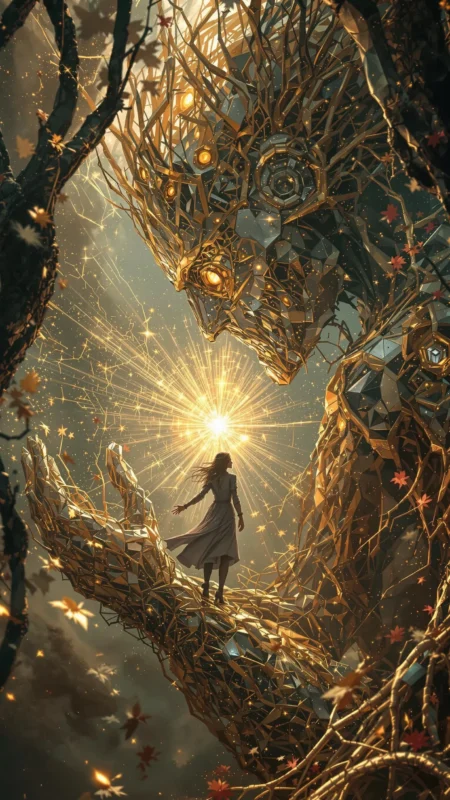
Tin Woodman

Archetype Meaning & Symbolism

yearning, sentimental, rigid, loyal, mechanical, compassionate, hollow, searching, naive, gentle

  • I shall take the heart. For brains do not make one happy, and happiness is the best thing in the world.

If Tin Woodman is part of your personal mythology, you may...

Believe

  • That your capacity to feel was destroyed or removed by a specific event or period in your past.
  • That happiness is the ultimate goal of life, and it is accessible only through the acquisition of a heart, or true emotional capacity.
  • That your primary value to others lies in your usefulness and unwavering loyalty, not in your intrinsic self.

Fear

  • Rust: the idea that your own emotions, particularly sadness or grief, will render you paralyzed and helpless.
  • The discovery that you are truly hollow, that there is nothing inside the shell to be saved or discovered.
  • That the Wizard is a fraud, and that there is no external cure or solution for your perceived lack of feeling.

Strength

  • A profound and unshakable loyalty to the companions who join you on your life's journey.
  • A persistent hope and a relentless drive toward self-betterment and emotional wholeness.
  • An unexpected capacity for deep compassion, often expressed through acts of service rather than words.

Weakness

  • A naive faith in singular, magical solutions for complex, internal problems.
  • An emotional dependency on others to validate your feelings or to help you out of states of emotional paralysis.
  • A fundamental inability to recognize the good qualities, like compassion and kindness, that you already possess.

The Symbolism & Meaning of Tin Woodman

To find the Tin Woodman in your personal mythology is to grapple with the ghost in the machine, to feel the ache of a heart you believe you do not possess. He is the patron saint of those who have been alienated from their own emotions by trauma, by labor, by the relentless mechanization of modern life. He is the man who was systematically replaced, piece by piece, until nothing original, nothing flesh, was left. His quest is a pilgrimage born of this perceived lack, a belief that wholeness is a thing to be acquired, a transplant from a benevolent wizard. His symbolism speaks to a profound dissociation, the sense of watching oneself perform the acts of life and work from a distant, metallic shell.

His central paradox, of course, is that his every action is motivated by the very feeling he seeks. His journey is fueled by a deep well of compassion for his friends and a poignant yearning for connection. He is the most tenderhearted of the companions, yet he cannot grant himself credit for it. The Tin Woodman mythos, then, becomes a meditation on this blindness. It suggests that we may already possess the qualities we so desperately seek externally. His journey is not toward acquisition, but toward recognition. The heart is not in a velvet cushion in the Emerald City; it is in the tears that rust his joints and the loyalty that keeps him on the path.

In a contemporary sense, he is the archetype of the person who fears their own softness. His armor is both a prison and a form of protection. His greatest fear is rusting, a paralysis brought on by his own sorrow. This speaks to a culture that often encourages us to suppress grief, to “keep a stiff upper lip,” lest our feelings render us non-functional. The Tin Woodman’s story suggests this is an impossible bargain. The feeling will emerge, and its emergence may be painful and immobilizing, but it is also the only true sign of life, the only proof that the man inside the tin has not, in fact, disappeared.


Tin Woodman Relationships With Other Archetypes

The Axe

The Axe may represent a past self, a ghost of purpose that now lies dormant. It is, perhaps, the sharp-edged memory of a life lived with unthinking completeness, before the body was traded for a shell. For the Tin Woodman, the Axe is not merely a tool but the very instrument of his unmaking, and to hold it again is to commune with a trauma he has yet to integrate. It could be that his inability to wield it without consequence is a metaphor for the artist who has come to fear his medium, or the lover who can no longer touch without remembering the pain of a previous wound. The Axe waits, a silent testament to a capacity for action—and for severing—that is now the source of his greatest fragility.

The Rain

Where for many, rain is a form of release, a baptismal washing-away of sorrow, for the Tin Woodman it is a profound threat. It is the world’s sentiment made manifest, a torrent of feeling that promises not cleansing but paralysis. Each drop could be a tear he cannot allow himself to shed, for the price of such catharsis is rust—a slow, creeping seizure that would lock his joints and silence his quest. He may therefore seek shelter not from the water itself, but from the overwhelming emotional weather it represents. His gleaming, impervious surface is perhaps a necessary fortress against the very empathy that might otherwise prove he has a heart, forcing him to observe the world's downpours from a place of careful, polished distance.

The Scarecrow

In the Scarecrow, the Tin Woodman finds his perfect counterpoint, a fellow traveler on the road of perceived inadequacy. Their bond might be seen as a walking dialogue between reason and sentiment, a companionship born from the classic schism of the head and the heart. The Scarecrow’s yearning for a brain could be a flight from the untidy chaos of emotion, just as the Tin Woodman’s quest suggests a desperate escape from the cold, hollow logic of his metallic form. They are, perhaps, mirrors for one another, each reflecting a deficiency the other believes they embody. Yet, in their mutual loyalty and shared purpose, they unknowingly perform the very functions of the organs they seek, suggesting that wholeness is not a thing to be found at a journey’s end, but something forged in the space between two incomplete souls.

Using Tin Woodman in Every Day Life

Navigating Emotional Numbness

When life delivers a blow that seems to sever the connection to feeling, the Tin Woodman mythos offers a map. It suggests this state of mechanical existence is not a final destination, but a chapter in a quest. One might consciously embrace the archetype's journey, acknowledging the hollowness not as a failure, but as the necessary starting point for a pilgrimage back to the self. It reframes numbness as a kind of armor forged in a specific trauma, an armor that can, with the right companions and a clear path, eventually be set aside.

Redefining Strength

The archetype challenges conventional notions of strength as stoicism. The Tin Woodman’s greatest vulnerability: his tendency to rust when he weeps: is also the first sign of his humanity returning. To use this in life is to see moments of emotional “paralysis” not as weakness, but as evidence of a heart reawakening. It allows one to ask for help, for the metaphorical oil can, not as a sign of defeat but as a courageous act of acknowledging one’s own tender, emerging feelings.

The Purpose of Companionship

This mythos provides a powerful lens for understanding camaraderie. If you feel you are on a singular quest for a missing part of yourself, the Tin Woodman reminds you that the journey is impossible alone. It sanctifies the roles of friends and partners, seeing them not as bystanders but as essential fellow travelers, each with their own lack, who make the road bearable and the goal attainable. One might learn to choose companions based not on superficial compatibility, but on a shared willingness to walk a difficult path together.

Tin Woodman is Known For

Quest for a Heart

His singular, all-consuming mission to acquire a heart from the Wizard of Oz, believing it will grant him the ability to love and feel emotion.

The Axe

The tool that symbolizes his past as a human woodsman and the tragic curse that led to his dismemberment and reconstruction as a tin figure. It represents his capacity for both utility and, in his past, unintentional self-harm.

Rusting from Tears

The physical paradox where his emerging emotions, specifically his sorrow, cause his mechanical joints to rust and seize up, rendering him immobile. This makes his very feelings a tangible vulnerability.

How Tin Woodman Might Affect Your Personal Mythology

How Tin Woodman Might Affect Your Mythos

When the Tin Woodman anchors one's personal mythos, life ceases to be a series of random events and becomes, instead, a singular, noble quest. The narrative of your life may be organized around a central perceived lack, a “heart” that was lost or taken. Past traumas are not just painful memories; they are the specific moments the axe fell, the events that replaced flesh with metal, feeling with function. Your personal history might be edited to fit this story of systematic dehumanization, whether through a demanding job, a wounding relationship, or a period of profound depression. The central plot of your mythos is this: the journey to the Emerald City, the search for a cure, a person, or an experience that will restore this essential, missing part.

This narrative structure provides a powerful sense of purpose and direction. Every friendship, every challenge, every mile on the yellow brick road of your career or personal development is imbued with meaning. People are not just people; they are fellow travelers, wizards, or witches. The world is a map leading to your own restoration. The ultimate goal of your personal myth is not just happiness, but wholeness. It is a story of profound hope, a belief in magical solutions and the possibility of becoming fully human again, even after you have come to believe you are merely a well-oiled machine.

How Tin Woodman Might Affect Your Sense of Self

One's self-concept may be built upon a foundation of perceived deficiency. To see the Tin Woodman in the mirror is to believe, on some fundamental level, that you are hollow. You might observe yourself performing acts of kindness, loyalty, and compassion, yet discount them as mere programming, a logical pantomime of feeling rather than the genuine article. There can be a persistent internal disconnect, a sense that the person the world sees, the dependable and gentle friend, is a carefully constructed facade over an empty interior. This can create a strange humility, a constant sense of not being quite good enough, not quite whole.

This view of self is also one of potential. The emptiness is not a void, but a vessel waiting to be filled. This may foster a deep commitment to self-improvement, therapy, spiritual seeking, or any path that promises to deliver the missing heart. You may see yourself as a project under construction, and your primary responsibility is to find the right tools and craftspeople to complete the work. The self is not something to be accepted, but something to be fixed. This generates a powerful engine for change, though it risks a chronic dissatisfaction with the self as it currently exists, always seeing the gleam of the metal and forgetting the warmth it already contains.

How Tin Woodman Might Affect Your Beliefs About The World

The world, seen through the Tin Woodman’s eyes, may appear deceptively simple, organized along a single, luminous path. It is a place where problems have solutions, where deficits can be filled, and where powerful figures hold the keys to one's completion. This worldview is characterized by a kind of hopeful linearity: if you just follow the road, you will eventually meet the wizard. There is a faith in experts, in systems, in the promise that an external authority can bestow what is internally lacking. This can foster a powerful optimism and a resilience in the face of obstacles, as each one is merely a delay on an otherwise guaranteed journey.

However, this perspective also contains a seed of profound disappointment. The world is rarely so linear, and wizards are often just men behind curtains. When this reality intrudes, the entire worldview can shatter. The mythos may struggle to accommodate complexity, ambiguity, or the idea that wholeness is not a destination but a process of integration. The world is not a fairy tale with a clear moral, but a tangled forest. The danger for one with this worldview is a profound disillusionment when the yellow brick road turns out to be just one of many paths, none of which offer a guaranteed solution.

How Tin Woodman Might Affect Your Relationships

In relationships, the Tin Woodman archetype fosters a profound, almost sacred sense of loyalty. Companions are not incidental; they are essential. You may gravitate toward a small, tightly-knit group of fellow travelers, each on their own quest for a brain, for courage, or for a way home. Within this fellowship, you may assume the role of the steadfast protector, the one who clears the path and stands ready with an axe. Love and friendship are demonstrated through acts of service, a tireless devotion to the well-being of the group. The bond is forged in the shared journey, the mutual need.

Yet, this can also create a dynamic of emotional dependency. You may need others to validate your nascent feelings, to provide the “oil” when you are immobilized by sadness. There might be a subconscious belief that you are only lovable as long as you are useful, that your place in the group is contingent on your function. This can lead to a fear of expressing your own needs, lest they become a burden. The relationships, while deep, might be tinged with the anxiety of the hollow man, who loves his friends dearly but fears he lacks the very organ required to do so properly.

How Tin Woodman Might Affect Your Role in Life

Your perceived role in life might be that of the functional heart. You may find yourself in professions or family roles that require immense compassion and caretaking: a nurse, a social worker, a devoted parent. Yet, you may feel you are performing these duties by rote, following a script of kindness without access to the inner emotional wellspring that seems to fuel others. You are the dependable one, the strong shoulder, the tireless worker, but you may feel like a fraud, a machine built to dispense care. Your purpose is defined by your utility to others on their own journeys.

This creates a life of service, but one colored by a private sorrow. The role is a search for vicarious feeling. Perhaps by being close to those with hearts, by serving them, some of their warmth will transfer. The life mission becomes an attempt to feel through doing, to generate an inner spark by endlessly turning an external crank. You might see your role not as a leader or a visionary, but as the humble, essential follower, the one whose contribution is quiet, steady, and selfless, motivated by a desire to earn the love you feel incapable of generating on your own.

Dream Interpretation of Tin Woodman

To dream of the Tin Woodman in a positive light is to encounter a symbol of dawning self-awareness. He may appear polished and mobile, striding purposefully down a sunlit path, perhaps even with a faint red glow in his chest. This dream could signify the beginning of a conscious journey toward emotional integration. Seeing him help others or express a gentle sentiment might be your subconscious mind’s way of showing you the compassion you already possess but do not yet recognize. An oil can appearing in the dream is a powerful symbol of grace, suggesting that help is available for emotional stuckness and that movement is possible again.

A negative encounter with the Tin Woodman in a dream speaks to a state of profound emotional paralysis. He might be found rusted solid in a dark wood, weeping tears of rust, unable to move or speak. His axe could be embedded in a tree or even in his own foot, a symbol of how one’s past work or trauma has become a source of incapacitation. This dream may reflect a deep-seated fear of grief, a belief that to start crying is to risk seizing up completely. It is a nightmare of hollowness and helplessness, a vision of the self as a discarded object, abandoned on the path and unable to continue the journey.

How Tin Woodman Archetype Might Affect Your Needs

How Tin Woodman Might Affect Your Physiological Needs

The Tin Woodman mythos can foster a profound disconnect from the body's own signals. Physiological needs: hunger, thirst, rest: may be viewed as mere maintenance requirements for a machine. One might eat for fuel, not for pleasure; sleep for efficiency, not for restoration. The body is an external object, a suit of metal that requires upkeep. This can lead to a state of being chronically out of touch with physical sensations, ignoring the subtle language of fatigue or stress until the system breaks down, much like a neglected engine seizing.

This estrangement is not necessarily neglectful in a chaotic way; it can be hyper-controlled. The body may be subjected to rigid diets and exercise regimens, all in the service of optimizing the machine's performance. There is no joy in it, only function. The core issue is the absence of felt experience. It is the difference between inhabiting a body and operating one. The individual may live almost entirely in their head, piloting a physical form from a remote control room, feeling strangely surprised by its aches, its aging, and its ultimate fragility.

How Tin Woodman Might Affect Your Ideas of Belonging

Belonging, in this personal mythology, is something that must be earned through tireless utility. Love is not a given; it is the wage paid for service. The individual might believe that their place in any group, family, or relationship is contingent upon their usefulness. “I belong because I can clear the path, because I can protect the weaker members of the party, because my axe is strong.” This fosters a powerful work ethic within relationships and an intense loyalty to the chosen few who make up one’s fellowship.

This conditional belonging, however, is a source of constant, low-grade anxiety. There may be a persistent fear that if the utility ceases, love and acceptance will be withdrawn. What happens when the axe grows dull, or when there is no more wood to chop? The person may feel they have to constantly perform acts of service to justify their existence, unable to simply be. Love and belonging are not a state of rest, but a perpetual task, an endless audition for a heart you believe you must borrow from others.

How Tin Woodman Might Affect Your Feelings of Safety

For one with the Tin Woodman as a guide, safety is equated with rigidity. The metallic shell is the ultimate symbol of security: an impenetrable barrier against the messy, unpredictable world of feeling. Safety needs are met by building inflexible routines, constructing emotional walls, and curating a life that minimizes the risk of emotional storms. The greatest danger is not a physical threat, but an emotional one. Vulnerability is the enemy; tears are the acid that will cause the entire structure to rust and fail.

This pursuit of safety can lead to a life lived in a fortress of one's own making. Relationships may be kept at a distance, careers chosen for their predictability, and passions avoided for their potential to overwhelm. The oil can, in this context, represents a threat: it is the thing that makes movement and feeling possible, and therefore makes one susceptible to pain. To feel safe is to feel nothing, to remain a gleaming, still, and untouchable statue, protected from the world by a self-imposed, hollow armor.

How Tin Woodman Might Affect Your Views of Esteem

Self-esteem within the Tin Woodman framework is perpetually deferred. It is not based on current character or past actions, but on the future acquisition of the missing piece. Worth is a destination, not a present reality. The individual may receive praise for their kindness, gentleness, or loyalty, but internally dismiss it, thinking, “They don’t understand. I’m only acting. If I had a real heart, then I would be worthy of this praise.” Esteem is an item on a shopping list, right after “heart.”

This creates a profound and painful gap between one's outward contributions and inward self-appraisal. The Tin Woodman weeps for others' misfortunes and demonstrates immense compassion long before he meets the Wizard, yet he cannot see these actions as proof of the very thing he seeks. For the individual, this means they may be constitutionally incapable of internalizing their own goodness. Their self-respect is held hostage by a singular goal, and until that goal is met, they may feel like a polished, but ultimately empty, shell.

Shadow of Tin Woodman

The shadow of the Tin Woodman emerges in two devastating forms. The first is the tyranny of sentimentality. When the quest for a heart becomes an obsession with the performance of feeling, the individual becomes maudlin, a parody of emotion. Every minor slight warrants a flood of tears, not of genuine release, but of self-pity. They rust constantly and intentionally, knowing that their paralysis commands the attention and service of others. The oil can becomes a tool of control. The axe, once a symbol of helpfulness, now lies permanently by their side, a monument to their glorious helplessness. They are no longer seeking a heart; they are weaponizing the lack of one, creating a world where everyone must cater to their delicate, yet demanding, sorrow.

The second, more chilling shadow, is the embrace of the machine. If the quest is deemed hopeless, the individual may reject the heart entirely, choosing instead the cold, efficient comfort of the metal. They become a true automaton. The gentleness hardens into indifference, the loyalty into cold calculation. The axe is no longer for clearing paths but for cutting ties, for removing obstacles with no thought to the pain caused. This is the Tin Woodman who feels nothing and is proud of it, seeing emotion as a flaw, a weakness he has successfully purged. He is brutally functional, dangerously logical, and utterly disconnected from the human consequences of his actions. In this shadow, the hollow man becomes a menace, his emptiness not a source of yearning, but of peril.

Pros & Cons of Tin Woodman in Your Mythology

Pros

  • It fosters a life dedicated to a noble quest for self-improvement and emotional depth.
  • It cultivates an intense loyalty and devotion to friends and loved ones, seeing them as essential companions.
  • It can lead to a profound appreciation for empathy and compassion once they are finally recognized within oneself.

Cons

  • It promotes a chronic feeling of being broken, incomplete, or fundamentally deficient.
  • It can create a dependency on external sources for validation and solutions to internal states.
  • It risks a state of emotional paralysis, where the fear of feeling becomes more debilitating than the feeling itself.