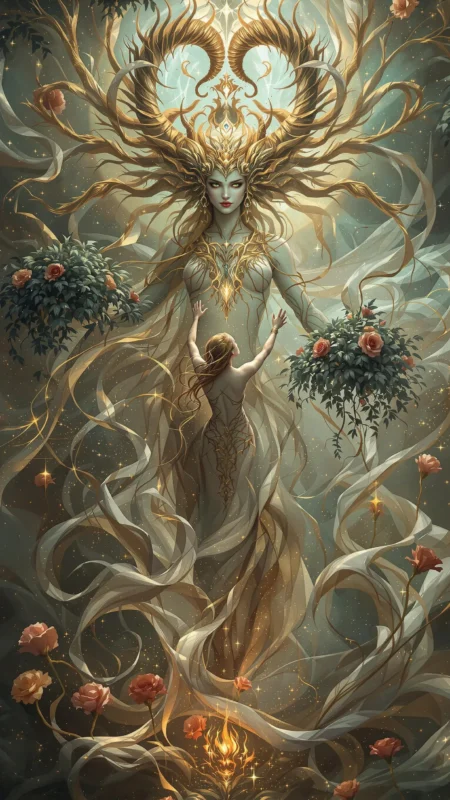


Eve

Archetype Meaning & Symbolism

Curious, defiant, foundational, generative, knowing, naive, sensual, transgressor, vulnerable, mythic

  • The serpent deceived me, and I ate.

If Eve is part of your personal mythology, you may...

Believe

  • That wisdom gained through a painful experience is more valuable than happiness rooted in ignorance.
  • That the most important journey is the one that leads you away from the safety of your 'home' garden and into the wilderness of your own making.
  • That your primary purpose is not to find answers, but to ask better, more unsettling questions.

Fear

  • A life of quiet desperation, where your curiosity has been extinguished in favor of security and comfort.
  • Being fundamentally misunderstood: seen as a malicious temptress when you believe yourself to be an earnest seeker of truth.
  • That the ultimate 'forbidden knowledge' you seek will be the simple, devastating truth that your choices have led only to sorrow, with no redeeming wisdom.

Strength

  • Intellectual Courage: A profound and unwavering willingness to face uncomfortable truths about yourself and the world, regardless of the personal cost.
  • Pioneering Spirit: You possess the unique ability to be the first to step into a new paradigm, whether in thought, art, or lifestyle, creating a path where none existed before.
  • Radical Self-Awareness: Your journey of questioning gives you a complex, nuanced, and deeply honest understanding of your own motivations, flaws, and desires.

Weakness

  • Naiveté in Discernment: Your thirst for knowledge can make you susceptible to charismatic 'serpents' who offer convincing but ultimately hollow or manipulative philosophies.
  • Existential Restlessness: Having left the 'garden,' you may find it impossible to feel truly at peace or content, always feeling the pull toward the next discovery or the next horizon.
  • A Propensity for Self-Sabotage: You may unconsciously recreate the 'fall' by making choices that destabilize your life, mistaking chaos for the growth you seek.

The Symbolism & Meaning of Eve

The archetype of Eve is less a historical figure and more a psychic map of a fundamental human threshold: the one between innocence and experience. She represents the unquenchable human thirst for knowledge, a curiosity so profound it is willing to shatter paradise to satisfy itself. Her story is a poetic rendering of the moment consciousness chooses itself over comfort. The fruit is not merely an apple; it is any truth that promises to make us 'like gods, knowing good and evil,' and the serpent is the seductive, internal or external whisper that suggests the world as-is is not the whole story. To have Eve in your personal mythos is to carry the legacy of that first, world-altering choice.

Eve also symbolizes a profound shift into embodied, sensory reality. Before her choice, the garden is a place of undifferentiated unity, free of shame or self-consciousness. Afterward, the world becomes acutely physical: bodies are naked, work is toil, and childbirth is pain. This 'fall' could be seen not as a punishment, but as an initiation into the raw, messy, and beautiful texture of mortal life. She is the archetype of the first awakening, the moment the mind registers its own vessel and the world it inhabits. She stands for the idea that true living, with all its attendant suffering and joy, only begins when we become fully present to our physical, vulnerable selves.

In a more modern lens, Eve is reclaimed as a figure of heroic, if tragic, defiance. She is the first philosopher, the first to question authority and risk everything for a new perspective. She is not a passive victim of temptation but an active agent of change, the catalyst without whom the human story would be a static tableau. Her choice introduces narrative itself: conflict, consequence, growth, and the endless quest for redemption or understanding. She is the patron saint of those who would rather be exiled for the truth than reign in a blissful, but confining, fiction.


Eve Relationships With Other Archetypes

The Serpent

The Serpent’s relationship with Eve is perhaps less a temptation and more a kind of sympathetic resonance. It may be the first external voice to match the frequency of a question already humming deep within her, a curiosity that had, until then, no shape and no name. The Serpent could be seen as the tuning fork that strikes the resonant chord of consciousness, offering not so much a lie as a new, unsanctioned key of perception. Their exchange is a conspiracy of intimacy, a shared secret under the silent watch of the trees, where knowledge is presented as a kind of nourishment. It is the silken question mark that unravels the perfect, declarative sentence of paradise, suggesting that the most profound truths might lie just on the other side of a rule.

The Garden

The Garden could be understood as Eve’s first and most profound ghost, the memory of a perfect stillness against which all subsequent motion is measured. It is the velvet-lined box from which the jewel has been taken, its value only truly understood in its absence. Eve’s connection to it is one of irrevocable departure; she is forever the one who knew its scent, who walked its unblemished paths, and who chose to leave. This relationship may not be one of simple loss, but of context. The Garden becomes the silent, eternal “before” that gives her “after” its staggering weight and meaning. It is the perfect, unbroken snowfield of unknowing, and her footprint is the first and final mark upon it, an act that is at once a violation and the birth of a world.

The Exile

The Exile is not so much a character Eve meets as it is the very road she creates by walking away from the Garden’s gate. It is the consequence of her choice made manifest, a state of being that becomes her new, raw-edged identity. Her relationship with the Exile is one of profound embodiment; she learns its language of grit, wind, and unrelenting horizons. This state could be perceived as a harsh liberation, a casting out that is also a casting forth. In trading the curated perfection of the Garden for the untamed narrative of the wilderness, Eve’s pact with the Exile might be the foundational act of human becoming—an agreement to learn oneself not through placid contentment, but through the long, arduous cartography of longing and the search for a home that must be built rather than inherited.

Using Eve in Every Day Life

Navigating a Career Crossroads

When faced with a choice between a secure, well-defined career path and an unknown venture that speaks to a deeper calling, the Eve mythos offers a framework. The secure path is the garden: safe, provided for, but ultimately limiting. To choose the unknown is to bite the apple. It is to consciously accept the risks of failure, instability, and criticism in exchange for the possibility of a more authentic existence. This archetype encourages you to ask not which path is safer, but which path offers the more vital knowledge of yourself and the world, even if that knowledge comes with a cost.

Challenging a Core Belief

If you find yourself questioning a deeply ingrained family value, a religious doctrine, or a societal norm, the Eve archetype acts as your spiritual progenitor. Her act was not one of simple disobedience but of intellectual dissent. She was the first to suspect the given reality was incomplete. To channel this archetype is to give yourself permission to trust your own perception over received wisdom. It is to engage with the 'serpent' of doubt, not as an enemy, but as a facilitator of a more complex, personal truth. The potential fallout—disappointing family, losing a community—is the exile from the garden, the painful but necessary consequence of forging your own consciousness.

Embracing Embodied Experience

The story of Eve is a story of the senses: the sight of the fruit, the sound of the serpent, the physical act of eating, the subsequent awareness of the body. When you feel trapped in abstraction or detached from your own life, the Eve mythos may urge a return to the physical, the sensory. It champions the wisdom of the body over the dogma of the mind. This could mean trusting a gut feeling over a spreadsheet, prioritizing pleasure and direct experience, or simply acknowledging that some truths cannot be understood, only felt. It is a rebellion against a disembodied existence, a conscious choice to inhabit your mortality fully.

Eve is Known For

The First Transgression

Her pivotal act of defying a divine command by eating the forbidden fruit from the Tree of Knowledge, setting in motion the entire human narrative of struggle and consciousness.

The Catalyst for Knowledge

Through her choice, she introduced a new state of being into the world

the awareness of good and evil, the experience of shame, and the inescapable reality of mortality.

The Mother of All Living

Her archetypal role as the first woman and the progenitor of all humanity, making her the foundational matriarch from which all subsequent stories of life, labor, and lineage spring.

How Eve Might Affect Your Personal Mythology

How Eve Might Affect Your Mythos

When Eve is a cornerstone of your personal mythos, your life story is likely framed as a narrative of 'post-lapsarian' existence, a life after a fall from some grace. This 'garden' you left behind could be a childhood of naive belief, a secure but soul-crushing job, or a relationship that demanded your conformity. Your personal history doesn't begin at birth, but with the pivotal choice to 'eat the fruit'—the moment you chose difficult knowledge over simple comfort. Your life is a chronicle of the consequences and discoveries that flow from that act. You may not seek to return to the garden; rather, your mythos is about learning to cultivate the wilderness you now inhabit.

The chapters of your life may be marked by recurring encounters with forbidden knowledge. You may see your story as a series of awakenings, each one initiated by a 'serpent' of curiosity that leads you to question a fundamental assumption. Your personal myth is not one of inheriting a kingdom, but of being the progenitor of your own lineage of thought and experience. You are the 'first' in your own story, and the central plot is your ongoing struggle to integrate the knowledge you fought for with the world it forced you to enter, forever shaping a narrative of brave, and perhaps lonely, self-creation.

How Eve Might Affect Your Sense of Self

To see yourself through the lens of Eve is to accept a fundamental duality within. You may feel simultaneously like the naive innocent in the garden and the ancient soul burdened by what you have learned. This archetype could instill a powerful sense of intellectual agency; you may view yourself as someone whose nature is to test, to question, and to uncover. Your identity isn't fixed but is continually being renegotiated with every new piece of 'forbidden' knowledge you acquire. You are the eternal seeker, forever defined by the choice to know, not by the paradise that was lost.

This archetype may also allow for a profound self-acceptance of your own complexities and contradictions. Shame, vulnerability, desire, and mortality are not personal failings to be overcome, but are instead the very textures of the authentic human experience you chose. You might see your body not as a site of sin or temptation, but as the primary instrument of knowing, the very thing that connects you to the earth and to the stream of life. Your perception of self is one of an embodied consciousness, forever navigating the beautiful, painful world your own curiosity helped create.

How Eve Might Affect Your Beliefs About The World

An Eve-inflected worldview is one that is fundamentally suspicious of perfection. Utopias, infallible leaders, and simple answers may all seem like variations of the garden: pleasant, yet ultimately a cage for the human spirit. You might see the world not as a divinely ordered creation that was broken, but as a dynamic, chaotic, and endlessly interesting reality that was *birthed* by an act of defiance. The so-called 'fall' was not a bug, but the feature that allowed the story to begin. Hardship, struggle, and paradox are not flaws in the system; they are the system itself, the very engine of growth and meaning.

Your perspective may be that knowledge, particularly self-knowledge, is the highest good, and that any system or authority that limits its pursuit is an adversary to be challenged. You could interpret societal rules and conventions as fences around a garden, designed to keep people from discovering the vast, untamed wilderness of what is possible. This makes you a natural critic, a gentle iconoclast, who believes that the point of life is not to maintain a state of placid equilibrium, but to engage fully with the messy, complex, and revelatory consequences of being truly, consciously alive.

How Eve Might Affect Your Relationships

In relationships, you may unconsciously seek a partner who can be your 'Adam,' a co-conspirator in the journey of discovery. The ideal partnership is not one that offers a retreat from the world into a private garden, but one that encourages a shared exploration of its wilderness. You could be the one who initiates the difficult conversations, who pushes for a deeper level of consciousness and honesty, even if it disrupts the peace. You may fear relationships that demand conformity or a shared state of blissful ignorance, seeing them as a return to the cage of innocence.

Your connections with others may be defined by a shared sense of exile. You might feel a profound bond with those who also feel like they've 'fallen' from a state of grace or convention, creating alliances based on a mutual understanding of what it means to live with complex knowledge. Love, for you, is not about completing one another, but about bearing witness to each other's journey of becoming. It's a pact to face the consequences of awareness together, finding your paradise not in a place, but in the shared consciousness between you.

How Eve Might Affect Your Role in Life

You may perceive your role in any group—family, company, or community—as that of the catalyst. You are not the person who maintains the status quo, but the one who asks, 'But what if?' Your function is to introduce the new variable, the uncomfortable question, the 'serpent' of a different possibility that forces the system to evolve. You may not see yourself as a leader in a traditional sense, but as an initiator, the 'mother' of the next chapter of the collective story, even if that birth is accompanied by labor and pain.

This can be an isolating role. You may be labeled a troublemaker, a contrarian, or the source of problems, as you are the one who makes others aware of their own 'nakedness' or the flaws in their paradise. Yet, you might also feel that this is your essential, if difficult, purpose. Your role is to usher in consciousness, to name the unspoken, and to take the first bite of the apple on behalf of the group, accepting the exile that may come with it so that a more authentic future can begin.

Dream Interpretation of Eve

In a dream, the appearance of Eve or an Eve-like figure in a luminous context—perhaps offering you fruit with a knowing smile, or tending to a garden where strange and beautiful plants grow—could be a potent symbol from your subconscious. It may signify a readiness to embrace a new form of wisdom or to embark on a path of significant self-discovery. This dream is not a warning, but an invitation. It suggests your psyche is encouraging you to trust your curiosity, to challenge a long-held belief, or to make a choice that will irrevocably expand your world. It is a call to your own becoming.

A dream where the Eve narrative turns dark—where you feel immense shame, are cast out of a beautiful place, or feel threatened and deceived by a serpent—often points to a deep-seated fear of consequences. It might reflect your anxiety over a real-life choice you are contemplating, or lingering guilt from a past transgression. This dream could also reveal a feeling of being manipulated or having been naive, a painful re-enactment of Eve's justification that 'the serpent deceived me.' It is a signal to examine where in your life you feel powerless, regretful, or afraid of the price of your own desires.

How Eve Archetype Might Affect Your Needs

How Eve Might Affect Your Physiological Needs

The Eve archetype may anchor your personal mythos deeply within your physiological experience. Basic needs like hunger and thirst are elevated beyond mere survival; they become metaphors for a craving for knowledge and sensory experience. You might feel that to be alive is to be an organism that consumes, digests, and is transformed by its environment. Your body's appetites are not shameful urges to be controlled, but sacred directives from your core self, guiding you toward what will nourish you, both literally and spiritually. You may honor your physical senses as the most reliable tools you have for discerning truth.

Simultaneously, the myth of the fall introduces a keen, almost painful awareness of the body's fragility. The knowledge of good and evil is twinned with the knowledge of mortality. This could manifest as a hyper-vigilance about health, a profound anxiety about aging, or a preoccupation with the body’s inevitable decay. Your physical existence may feel like a constant paradox: a vessel of exquisite sensory pleasure and a fragile container doomed to fail. You live in the tension between savoring the fruit and knowing that the act of eating begins the process of death.

How Eve Might Affect Your Ideas of Belonging

The Eve mythos complicates the need for belonging. At your core, you may feel the echo of that first separation, the primal act of stepping away from unity and into individuality. Your attempts to connect with groups might be shadowed by the fear that your innate curiosity, your tendency to question, will inevitably lead to your expulsion. You do not seek to be absorbed into a collective; instead, you may search for a 'co-conspirator,' a partner in your 'crime' of consciousness, making belonging a pact of shared exile rather than a comfortable inclusion.

Love and deep friendship, in this framework, are not about finding a safe harbor, but about finding a fellow explorer. You may only feel truly understood and accepted by those who are not afraid of your questions and who do not demand that you quiet your inquisitive spirit. This can make finding your 'people' a lifelong quest. You are not looking to rejoin a pre-existing community garden. You are searching for the rare few who are willing to stand with you in the wilderness and try to cultivate something new, wild, and authentic together.

How Eve Might Affect Your Feelings of Safety

If Eve is central to your mythos, your definition of safety is inverted. The garden, the epitome of perfect safety, is reframed as a gilded cage, a place of stasis where nothing new can be learned. For you, true safety may not be the absence of threats, but the presence of choice. You might feel that the greatest danger is not physical harm, but spiritual or intellectual stagnation. You are therefore willing to trade the safety of the known for the wilderness of the unknown, believing that real security lies in your ability to adapt, learn, and grow, not in walls that protect you from experience.

This can lead to a life lived in a state of perpetual, low-grade risk. You might court instability, believing it is the necessary soil for growth. However, the shadow of this is a persistent sense of exile, a feeling of having no true home or sanctuary. You may have chosen the wilderness, but a part of you still remembers the garden. This can manifest as a deep-seated anxiety, a feeling of being fundamentally unprotected, forever searching for a safety that your own core values—curiosity, autonomy, and knowledge—have taught you to distrust.

How Eve Might Affect Your Views of Esteem

Your self-esteem may be built on a foundation of intellectual and spiritual courage. You derive worth not from conformity or accolades, but from your willingness to pursue your own truth, no matter how uncomfortable or isolating that pursuit becomes. Your accomplishments are measured by the depth of your understanding and the authenticity of your choices. Each time you choose knowledge over comfort, you reinforce a core identity of being a brave seeker, a pioneer of your own consciousness, and this becomes the central pillar of your self-respect.

However, the shadow of the Eve archetype is shame. Woven into your esteem is a potential vulnerability to profound self-criticism. You may battle an internal narrative that accuses you of being a troublemaker, a fool, or the cause of others' pain. Building a stable sense of self-worth requires the constant, conscious act of rewriting this narrative. It demands that you re-frame your 'fall' not as a moral failure, but as an act of existential bravery, and see your 'sin' not as a stain, but as the mark of a life fully and consciously chosen.

Shadow of Eve

The shadow of Eve emerges when curiosity curdles into a compulsive need for transgression. Here, the choice is no longer about a noble quest for knowledge but a desperate flight from boredom. This shadow archetype creates chaos not to grow, but to feel something, anything. She bites into any fruit offered, not to learn, but to feed a bottomless hunger for novelty. This Eve seduces her 'Adam' not into consciousness, but into her own drama, then blames him, the serpent, the universe, for the inevitable wreckage. She is defined by her abdication of responsibility, forever pointing a finger and whispering, 'I was deceived,' refusing to own that the choice, and its aftermath, was entirely hers.

In its other, more frozen aspect, the shadow Eve is one who is paralyzed by her own archetype. Having once tasted the fruit and been profoundly burned by the consequence—the exile, the shame—she dedicates her life to preventing anyone, especially herself, from ever making a choice again. She becomes the rigid gatekeeper of her own tiny, barren garden. She fears knowledge, demonizes curiosity, and sees a serpent in every new idea. This shadow is not the mother of a new consciousness, but the warden of a prison of fear, forever policing the borders of her own diminished world, haunted by the memory of a paradise she believes she alone destroyed.

Pros & Cons of Eve in Your Mythology

Pros

  • You are a natural catalyst for evolution, inspiring yourself and others to move beyond limiting beliefs and circumstances.
  • Your life is unlikely to be boring; it is a rich tapestry woven from profound experiences, deep self-reflection, and authentic choices.
  • You cultivate a rare form of courage, the strength to stand alone in your convictions and to forge a path uniquely your own.

Cons

  • You may be chronically unsettled, struggling to find a sense of peace or belonging in a world you are constantly questioning.
  • Your drive to uncover truth can create conflict and instability in relationships with those who prefer comfort and convention.
  • You may carry a heavy burden of existential guilt or shame, feeling responsible for the pain that your choices have caused yourself or others.