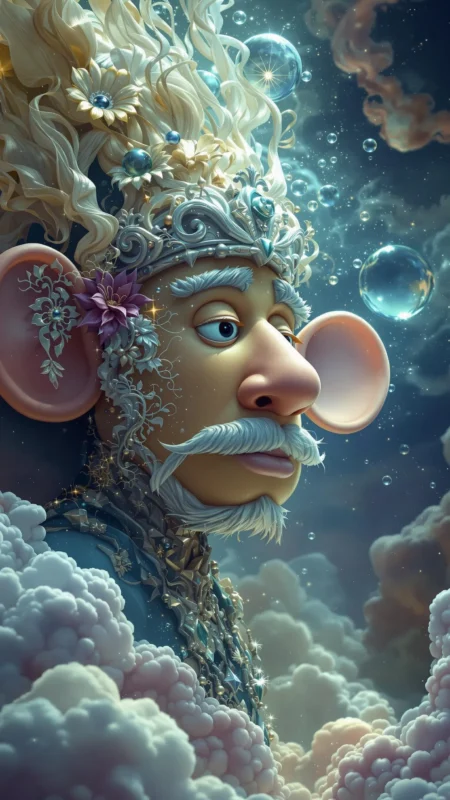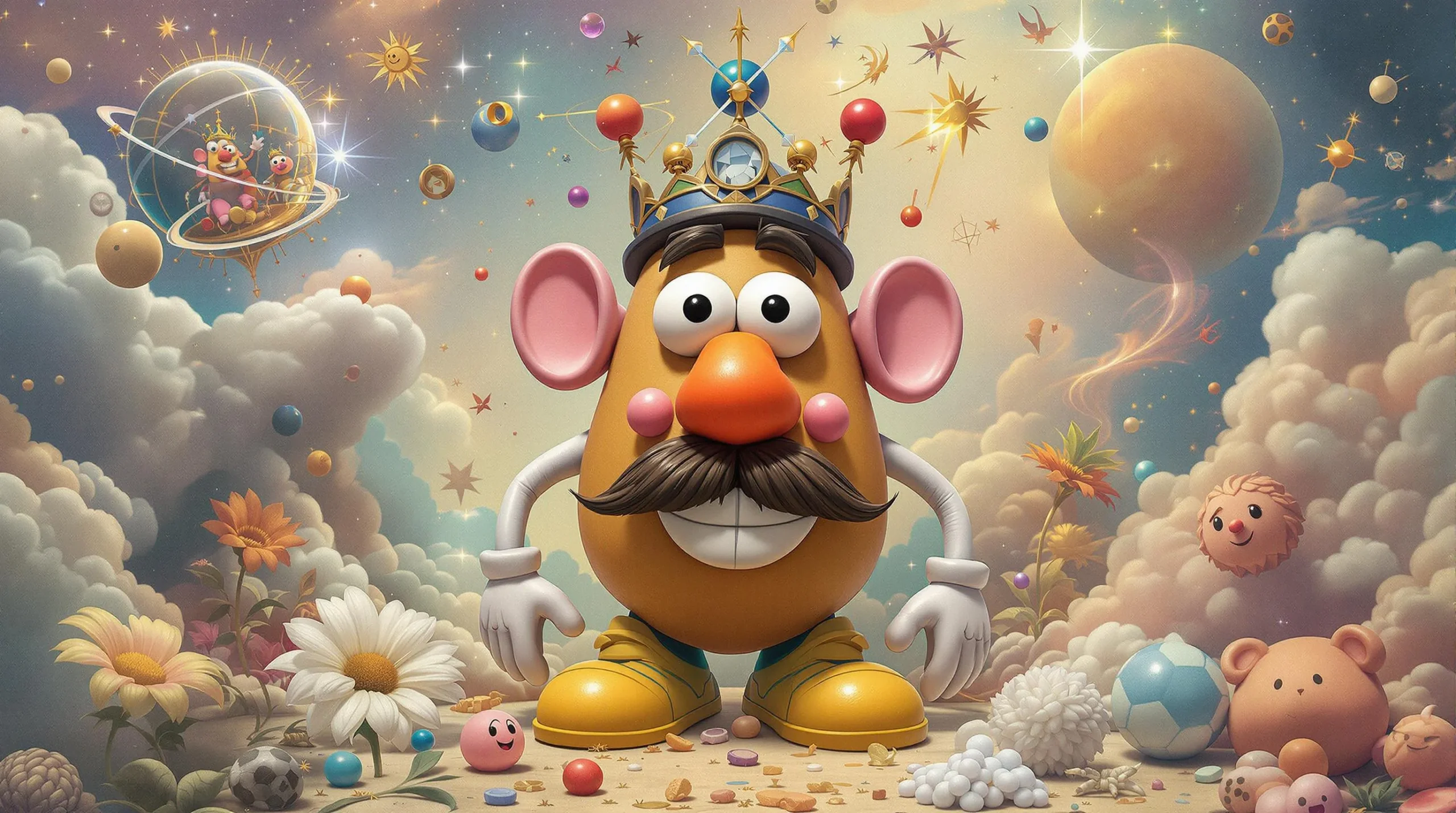


Mr. Potato Head

Archetype Meaning & Symbolism

modular, adaptable, reconfigurable, cynical, loyal, piecemeal, composite, constructed, mutable, grumpy

  • What are you lookin' at, ya hockey puck?

If Mr. Potato Head is part of your personal mythology, you may...

Believe

  • Identity is not something you find; it's something you build, piece by piece.
  • Resilience is the art of putting yourself back together differently after you've been pulled apart.
  • The self is a performance, and wisdom lies in choosing your roles consciously.

Fear

  • That if all your constructed parts were taken away, there would be nothing left underneath.
  • Losing a crucial piece of yourself—a relationship, a skill, a memory—and being unable to function without it.
  • Being seen as a fraud, inauthentic, or a collection of disconnected personas.

Strength

  • An almost supernatural ability to adapt to new environments, roles, and life changes.
  • A profound resilience that allows you to reframe failure and trauma as opportunities for reconstruction.
  • A playful, creative, and experimental approach to your own personal growth and identity.

Weakness

  • A tendency towards emotional detachment or a utilitarian view of relationships.
  • A persistent struggle with feelings of inauthenticity or a fragmented sense of self.
  • A cynical worldview that can act as armor but also prevents deep connection and vulnerability.

The Symbolism & Meaning of Mr. Potato Head

The Mr. Potato Head archetype is a potent symbol for the constructed self. In a world that often pushes a narrative of discovering a single, true identity, this figure offers a radical alternative: the self is not found, but built. We are, perhaps, a collection of parts—experiences, relationships, roles, beliefs—that we consciously or unconsciously assemble into the persona we present to the world. Your identity may not be a marble statue, fixed and singular, but a modular creation, a potato to which you are constantly adding a new set of eyes to see through, a new mouth to speak with. This perspective turns personal development from a solemn excavation into a playful act of creation.

This archetype also speaks directly to the experience of fragmentation and resilience. Life, inevitably, pulls us apart. Trauma, failure, and heartbreak can feel like a violent disassembly, leaving our pieces scattered. The Potato Head mythos suggests that this is not the end of the story. There is a profound power in the ability to gather one’s own scattered parts and put them back together. The reassembled self may not look like the old one—the parts may be in a different order, some may be missing, new ones may be added—but it is whole nonetheless. This is the art of resilient self-creation, where the scars of disassembly become interesting new features in a continually evolving masterpiece.

Finally, Mr. Potato Head embodies the tension between authenticity and performance. His parts are plastic, manufactured, not of the potato itself. This may point to a truth about our social roles: they are often artificial constructs we adopt to navigate the world. The 'work face,' the 'family face,' the 'public face'—are these genuine expressions of self, or are they convenient, plastic attachments? The archetype doesn't necessarily judge this but invites the question. It suggests that navigating life may require a wardrobe of faces, and wisdom lies in knowing which to wear, when, and never forgetting the solid, unassuming potato that lies beneath the chosen facade.


Mr. Potato Head Relationships With Other Archetypes

The Child's Hand

The relationship with The Child's Hand is perhaps the most primal, a conversation between clay and potter, if the potter were governed by pure, unadulterated whim. The Hand may grant a jaunty mustache for a moment of comedy, then pluck out the eyes for the sheer, unexplored terror of it. For Mr. Potato Head, The Hand could be seen as the force of pure contingency—the random assignments of fate, the sudden bestowal of a role, and its equally sudden retraction. It is a state of perpetual surrender, an existence that finds its meaning not in a stable core, but in a radical availability to being constantly, and sometimes nonsensically, remade by a power it cannot possibly comprehend.

The Hall of Mirrors

In The Hall of Mirrors, the Mr. Potato Head archetype may find not a simple reflection, but a dizzying parliament of selves. Each distorted panel offers a new configuration, a caricature of a caricature, refracting its assembled identity into a thousand possible lives. This encounter could be a moment of profound existential horror—the realization that without a fixed center, there is nothing to truly reflect, only an endless echo of borrowed parts. Or, perhaps, it is a kind of liberation. In the funhouse of perception, where every angle offers a new truth, the Mr. Potato Head is uniquely at home, a creature of surfaces finding its tribe among the shimmering, unreliable narratives of the glass.

The Blank Canvas

With The Blank Canvas, there exists a kind of respectful, almost philosophical, opposition. The Canvas awaits a singular, definitive stroke; it is a space consecrated for a permanent vision, a final word. The Mr. Potato Head, by its very nature, could be seen as a gentle mockery of such finality. It is a stage for endless dress rehearsals, a body that believes identity is not a masterpiece to be completed, but a game to be played. The Canvas may view the Potato Head's mutable features as a form of frivolousness, a refusal to commit to a single truth. In turn, the Potato Head might perceive the Canvas's pristine emptiness not as potential, but as a kind of paralysis, a fear of the glorious, messy, and contradictory act of simply trying on a face for a day.

Using Mr. Potato Head in Every Day Life

Navigating a Career Change

When shifting professional identities, the Mr. Potato Head archetype offers a map. Instead of a crisis, the change becomes a simple reconfiguration. You are not losing a part of yourself; you are consciously swapping the 'accountant eyes' for the 'graphic designer mustache.' It permits a playful, low-stakes approach to a high-stakes transition, acknowledging that your core self—the potato—remains intact, merely sporting a new set of professional accoutrements.

Healing from Emotional Fragmentation

After a significant loss or trauma, one can feel broken, shattered into pieces. This archetype reframes that shattering. You have not been destroyed; you have been disassembled. The task, then, is not a desperate attempt to glue the old self back together, but a creative opportunity to reassemble the parts in a new way. Perhaps the sad eyes now go where the smiling mouth once was. This new configuration is not 'wrong,' it is a testament to your history and your resilient capacity to build a new wholeness from the fragments.

Fostering Creative Problem-Solving

When faced with an intractable problem, the Potato Head mythos encourages you to pull it apart. Treat the components of the issue—the people, the resources, the constraints—as detachable features. What happens if you put the 'budget' where the 'timeline' is? What if you swap the 'angry eyes' of a stakeholder for 'curious ears'? This method of deconstruction and playful reassembly can break cognitive fixedness and reveal solutions that were hidden in the original, rigid configuration of the problem.

Mr. Potato Head is Known For

Interchangeable Parts

The fundamental quality of being a toy whose features can be removed and reconfigured at will, symbolizing endless possibilities of identity.

Cynical but Loyal Personality

As portrayed in the 'Toy Story' films, he is a curmudgeon with a buried heart of gold, a protector who presents a gruff exterior to the world.

A Perfect Match

His relationship with Mrs. Potato Head serves as a powerful symbol that even a composite, reconfigurable being can find a soulmate who loves them in every configuration.

How Mr. Potato Head Might Affect Your Personal Mythology

How Mr. Potato Head Might Affect Your Mythos

To integrate the Mr. Potato Head into your personal mythos is to rewrite your life's central theme from one of destiny to one of design. Your story is no longer a linear path toward a pre-ordained self, but a sprawling, creative workshop. The protagonist of your narrative is a fluid being, a master of reinvention. Each chapter of your life—a new job, a new city, a new relationship—is not just a plot point but an occasion to visit the parts box and reconfigure your hero. The story becomes less about 'who am I?' and more about 'who will I choose to be today?' Your mythos is a testament to the infinite ways a single being can be assembled.

This archetype profoundly reframes the role of conflict and failure in your life story. Setbacks are not tragic flaws or defeats; they are moments of creative disassembly. The moment your carefully constructed world falls apart is not the climax of a tragedy but the inciting incident for a story of reconstruction. The narrative energy shifts from mourning what was lost to marveling at what will be built in its place. Your personal myth is a chronicle of your many configurations, each one a response to the world, each one a victory of imagination over circumstance. You become the hero who can be endlessly broken and yet can never be truly destroyed, only remade.

How Mr. Potato Head Might Affect Your Sense of Self

Your relationship with yourself may become profoundly more fluid and forgiving. When you view your personality and identity as a collection of modular parts, a perceived flaw ceases to be an indictment of your entire being. A bout of anger is not 'who you are,' but merely the 'angry eyes' part, which can be observed, understood, and perhaps swapped for another piece. This can foster a spirit of gentle experimentation with your own identity. You might 'try on' a new hobby or a different way of speaking not as a permanent change, but as a temporary accessory, lowering the stakes of personal growth and making it a more playful, less judgmental process.

Conversely, this view of self might cultivate a quiet, persistent anxiety about authenticity. If all your expressive features are detachable, what is the 'real' you? Is there anything left when the mustache, the shoes, and the hat are put back in the box? You might grapple with a feeling of being a composite entity, a curated collection of personas with a hollow core. This could lead to a deep spiritual or philosophical quest to understand the nature of the 'potato' itself: the core consciousness that exists beneath all the assembled parts. The self becomes a fascinating, if sometimes unsettling, puzzle.

How Mr. Potato Head Might Affect Your Beliefs About The World

Your view of the world may be that of a grand, cosmic toy box. Social structures, political ideologies, cultural norms—none of them are seen as monolithic, immutable truths. Instead, they are constructions, vast Potato Head projects assembled by societies. This perspective allows for a critical distance and a creative engagement with the world. You might see the possibility for change everywhere, believing that any system can be improved if we are simply willing to pull off the ill-fitting parts and try a new configuration. The world is not a fixed reality to be endured, but a modular reality to be tinkered with.

This perspective, however, could be tinged with the archetype's signature cynicism. While the world is a box of parts, you may see them as cheap, mass-produced, and often absurd. You might develop a sharp, satirical eye for the ways in which society tries to force pre-packaged identities upon people. This can lead to a worldview that is witty and insightful but also potentially isolating. It is a perspective that sees the strings, the plastic, the manufactured nature of it all, which can make it difficult to fully, unreservedly believe in anything.

How Mr. Potato Head Might Affect Your Relationships

In relationships, you may seek a 'compatible configuration.' The ideal partner is not a missing piece that completes you, but another whole, self-assembled individual whose collection of parts harmonizes with your own. The search for love becomes the search for Mrs. Potato Head: someone who appreciates your current assembly, intuits the parts you keep in the box, and has a fascinating collection of their own. Relationships are a dynamic where two unique constructs learn to stand side-by-side, occasionally borrowing each other's hats, but never losing their own fundamental form.

There is a potential shadow here: the risk of viewing people as instrumental. If life is a project of self-assembly, others can become mere accessories to your own identity. A friendship might be cultivated to add the 'intellectual part' to your life, or a romantic partner chosen because they provide the 'stability part.' This utilitarian view can prevent true intimacy, which requires seeing the other person not as a component to be used, but as a whole, mysterious, and inviolable being in their own right. A conscious effort is needed to ensure that you are relating to the entirety of another's 'potato,' not just the useful parts they have on display.

How Mr. Potato Head Might Affect Your Role in Life

Your role in your community or family may be that of the ultimate adapter. You might not see yourself as having a single, fixed purpose, but rather a toolbox of roles that can be deployed as needed. You are the one who can put on the 'organizer hat' for the family reunion, then swap it for the 'listening ears' for a friend in crisis, and later don the 'stern eyebrows' to negotiate a contract. Your strength lies in your versatility, your ability to become what the situation demands. Your role is not a noun but a verb: to configure and re-configure in service of the moment.

This can, however, lead to a crisis of purpose. If your role is constantly changing, what is your true contribution? You may feel like a jack-of-all-trades and master of none, a collection of useful functions without a central calling. There may be a deep longing for a role that is not made of plastic, a purpose that feels grown from the core of you rather than attached to the surface. The constant costume changes may eventually leave you exhausted, yearning to put all the parts away and simply be the potato, undefined and at rest.

Dream Interpretation of Mr. Potato Head

To dream of Mr. Potato Head in a positive context, such as skillfully assembling him or finding a rare, perfect part, may symbolize a period of successful self-integration. Your subconscious could be signaling that you are artfully combining different aspects of your life—your career, your creativity, your relationships—into a coherent and pleasing whole. It may suggest a newfound comfort with your own complexity and a readiness to present a new, more authentic version of yourself to the world. The dream is an endorsement of your ongoing project of self-creation.

In a negative context, a dream of Mr. Potato Head can be unsettling. Dreaming that his parts are lost, scattered, broken, or refuse to fit into their holes could reflect a profound identity crisis. You may feel that you are falling apart, that the roles you play are no longer coherent, or that you have lost a crucial piece of who you are. A dream where his face is assembled into a grotesque or horrifying visage might be a warning that the persona you are presenting to the world is becoming a mask that suffocates your true self. It is a call to examine the pieces you are using and question the integrity of your current construction.

How Mr. Potato Head Archetype Might Affect Your Needs

How Mr. Potato Head Might Affect Your Physiological Needs

Your approach to your body's physiological needs may be one of pragmatic functionalism. The body is the potato: the essential, biological foundation upon which the identity is built. Food is fuel, sleep is a recharge cycle, and exercise is system maintenance. There can be a certain detachment in this, a view of the body as a machine whose inputs must be managed for optimal performance of the 'self' that is attached to it. The focus is less on the sensual pleasure of embodiment and more on the efficient operation of the vessel.

Alternatively, this archetype could inspire a deeply experimental and modular approach to physical well-being. If the self is configurable, why not the body? You might be drawn to bio-hacking, experimenting with different diets, exercise regimes, and supplements as if you were trying out new parts. The goal is to find the optimal physical configuration for your mental and emotional goals. This turns health and fitness from a chore into a creative project: the ongoing assembly of your best possible physical self.

How Mr. Potato Head Might Affect Your Ideas of Belonging

The need for belonging and love might be approached as a problem of configuration. To fit in with a desired group, you may believe you need to present the right set of parts. You might adopt the slang, the hobbies, or the opinions of the group, consciously curating a persona that will grant you entry. Love, too, might be seen as finding someone who is attracted to your specific arrangement of features. Belonging becomes a skillful performance, an act of assembling a socially acceptable self.

This strategy can lead to a profound and secret loneliness. If you are loved and accepted for the parts you are displaying, you may constantly fear that they will not love the 'real' you, the unadorned potato, or the other parts you keep hidden in the box. True intimacy may feel impossible, as it would require revealing the seams and the plastic artificiality of your constructed self. The deepest desire may be to find a place or a person where you can just be the potato, with all your parts scattered on the floor, and still be considered whole.

How Mr. Potato Head Might Affect Your Feelings of Safety

A sense of safety may be constructed, not inherited. It is not an ambient feeling but a deliberate assembly of protective measures. Financial safety is the 'savings account' part you attach. Physical safety is the 'alarm system' part. Emotional safety is the 'cynical smirk' part that keeps others at a distance. You may feel most secure when you believe you have the right components in place to handle any contingency. Safety is a fortress you build, piece by piece, to protect the vulnerable, core self from the unpredictable nature of the world.

This construction, however, can breed a pervasive sense of fragility. Because your safety is dependent on this assembly of external and internal parts, the loss of any single one can feel catastrophic. Losing a job is not just a financial setback; it is pulling a critical piece from your armor. A betrayal is not just a hurt; it is the forcible removal of your 'trusting eyes.' This can lead to a state of hyper-vigilance, a constant fear of being disassembled by forces beyond your control, leaving your soft potato-core exposed.

How Mr. Potato Head Might Affect Your Views of Esteem

Your self-esteem may be deeply tied to your powers of adaptation and reinvention. You derive a sense of worth not from a static quality, but from your dynamic ability to overcome, rebuild, and reconfigure. Pride comes from looking back at past selves and seeing a lineage of creative survival. Your esteem is rooted in the process, not the outcome. You are the artist of your own identity, and your confidence comes from your trust in your own artistic resilience, your ability to make something new and wonderful from any set of circumstances.

On the other hand, your esteem can become dangerously dependent on the external reception of your latest configuration. If you assemble a new persona and it is met with criticism or indifference, it can feel like a devastating rejection of your entire being. This can trigger a frantic cycle of reconfiguration, constantly changing your parts to chase approval. Your self-worth becomes a moving target, and you may lose touch with your own internal compass, building a self designed for applause rather than one that feels true.

Shadow of Mr. Potato Head

The shadow of the Mr. Potato Head archetype manifests as the hollow man, the ultimate chameleon whose adaptability has consumed any sense of a core self. This is not a masterful adaptation but a complete disintegration into context. He is a different person with his family, his friends, his colleagues, not by choice, but because no central self exists to unify these personas. There is no potato, only a shifting collection of plastic parts. This leads to a life of profound emptiness and transactional relationships. People are not beings to be related to, but accessories to be worn and discarded. It is a state of perpetual performance with no actor behind the mask, a horrifying freedom that is also a prison of meaninglessness.

A second, more rigid shadow appears in the one who clings desperately to a single, 'perfect' configuration. Terrified of being disassembled, this person resists all change, all feedback, all growth. Their identity becomes a brittle, plastic facade. The playfulness of the archetype curdles into a fearful perfectionism. Any challenge to their constructed self is met with rage or collapse because they have forgotten that their true nature is the resilient potato underneath, not the fragile arrangement on the surface. They have imprisoned themselves in their own creation, valuing the unchanging mask over the dynamic, living self it was meant to express.

Pros & Cons of Mr. Potato Head in Your Mythology

Pros

  • You possess an extraordinary capacity for resilience, able to reframe even devastating setbacks as a chance to rebuild.
  • You can navigate profound life transitions with a sense of playfulness and creativity, reducing the anxiety of change.
  • Your skepticism of surfaces gives you a sharp, insightful critique of social pressures and the freedom to define yourself on your own terms.

Cons

  • You may suffer from a persistent sense of inauthenticity, fearing that your 'self' is just a collection of curated roles.
  • You risk keeping others at a distance with a cynical exterior or by treating them as components in your own life project.
  • Without a stable core identity, you might feel adrift, lacking a deep sense of purpose or a role that feels truly your own.