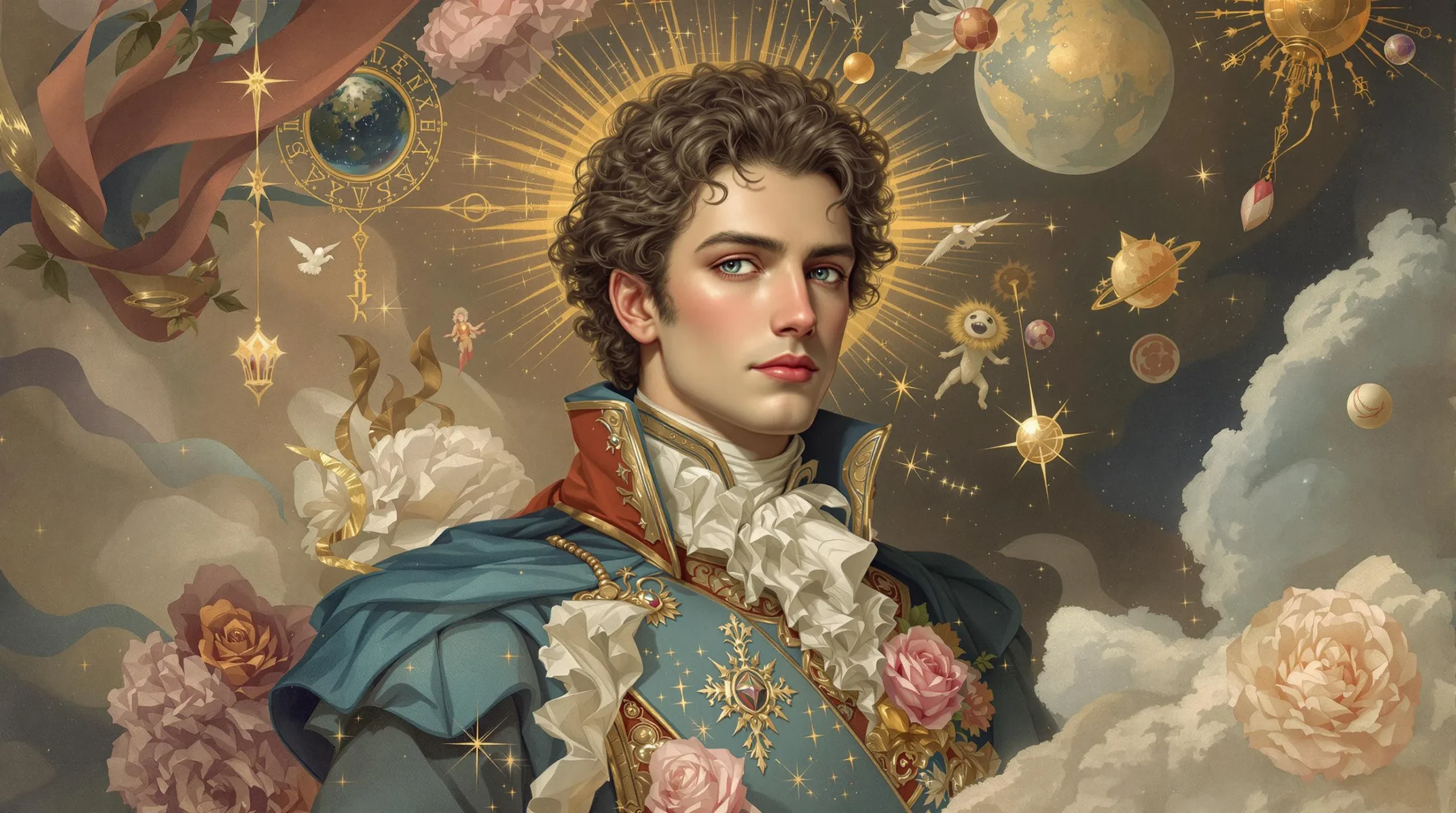


Prince Ferdinand

Archetype Meaning & Symbolism

Noble, Naive, Earnest, Virtuous, Romantic, Devoted, Awestruck, Hopeful, Resilient, Sheltered

  • This my mean task would be as heavy to me as odious, but the mistress which I serve quickens what’s dead and makes my labours pleasures.

If Prince Ferdinand is part of your personal mythology, you may...

Believe

  • You may believe that love is the ultimate redemptive force, capable of making any hardship meaningful and any labor a pleasure.
  • You may believe there is an innate, untarnishable nobility within you, and that life's greatest purpose is to live in accordance with it.
  • You may believe that the world is infused with a hidden magic and that destiny will guide you through trials to a deserving and wonderful conclusion.

Fear

  • You may fear that your innocence is a liability and that you will be easily manipulated or deceived by those who are more worldly and cynical.
  • You may fear that the idealized, transcendent love you seek is an illusion, and you will be left shipwrecked by your own romantic expectations.
  • You may fear that you lack the ruthlessness or grit required to succeed in the real world, that you are destined to be a subject rather than a ruler.

Strength

  • Your capacity for wonder allows you to see beauty and magic where others see only the mundane, infusing your life with meaning and joy.
  • Your profound loyalty and devotion make you an exceptionally steadfast and caring partner, friend, and ally.
  • You possess a strong moral core that guides you, allowing you to navigate challenges with grace and integrity.

Weakness

  • A tendency toward naiveté can make you vulnerable to deception and blind you to the flaws in those you idealize.
  • Your belief in a fated outcome can lead to passivity, causing you to wait for your destiny to find you rather than actively creating it.
  • You may struggle to reconcile your idealistic worldview with the complex, often messy, reality of human nature and society, leading to frequent disillusionment.

The Symbolism & Meaning of Prince Ferdinand

Prince Ferdinand in the personal mythos is the embodiment of untainted potential, the noble self before it has been marked by the world’s cynicism. He is the pristine canvas upon which a grand story of love and trial is to be painted. To have Ferdinand as a guide is to hold a deep-seated belief in one's own inherent worth, a worth that exists prior to any accomplishment, like royalty by birthright. This archetype is not about power or conquest, but about worthiness. It posits that the universe, through figures like Prospero, may test you, may strip you of your finery and force you to carry logs, but these trials are not punishments. They are validations, opportunities to prove that the inner nobility is genuine and can withstand hardship.

The archetype speaks to a profound romanticism, a faith that love is not merely an emotion but a transformative power. Like Ferdinand, one may feel shipwrecked and alone in the world, only to discover a 'deserted island' that holds the key to one's entire purpose. This island is often a person, a 'Miranda,' who makes all suffering meaningful. Ferdinand's journey suggests that true love is not found through ease, but earned through a demonstration of virtue. He represents the soul’s willingness to be humbled, to perform 'mean tasks,' because the object of its devotion 'quickens what’s dead and makes my labours pleasures.'

Furthermore, Ferdinand symbolizes a bridge between worlds: the old world of courtly intrigue and betrayal he leaves behind, and the new world of wonder and sincerity he discovers. He is a figure of transition and hope. In a personal narrative, he may appear when one is meant to break from a corrupt or inherited past and forge a new legacy built on purer principles. He is the part of the self that, despite being born of a flawed system, retains the capacity for awe and the courage to build something better. He is the quiet promise that after the storm, a new and harmonious kingdom can be built.


Prince Ferdinand Relationships With Other Archetypes

The Tempest

With The Tempest, Prince Ferdinand may have his most elemental and transformative relationship. The storm is not merely a meteorological event but perhaps the violent poetry that edits his life, tearing out the pages of his princely lineage and washing him ashore with a new, stark title: survivor. This chaotic baptism could be seen as the necessary shattering of the self, a divine tantrum that breaks the gilded cage of his former reality to make way for a more profound one. The Tempest is the force that strips him of everything but his own character, leaving him a blank slate upon which a truer love story, one unburdened by courtly politics, might be written. It is the deafening overture that stills the world, allowing the quiet music of his heart to finally be heard.

The Island

The Island, for Ferdinand, is not a place on a map but a geography of the soul. It is perhaps a green thought in a sea of oblivion, a liminal space where the laws of nature and court are suspended. Here, his relationship is with the very concept of a new world, a stage set for the soul's own drama. The Island may act as both prison and paradise; he is Prospero's captive, yet it is within this confinement that he discovers the boundless freedom of a love untethered to duty. It could be that the magical isle serves as a mirror, reflecting not the prince he was, but the man he is becoming—one defined by his capacity for wonder, devotion, and endurance. The Island is the dream-ground where the self is lost and, in that very loss, truly found.

The Log-Bearer

As The Log-Bearer, Ferdinand enters into a relationship with humility itself, an archetype of noble servitude. The physical weight of the wood he carries is perhaps a metaphor for the gravity of his newfound love, a burden he accepts with a joy that confounds the very nature of labor. This trial is the heavy grammar of his devotion, a prayer spelled out in splinters and sweat. In this role, he exchanges the crown for a callus, proving that his worth is not inherited but earned through willing sacrifice. The act of carrying logs could be seen as the quiet, steady prose that gives his passionate poetry a foundation, transforming a smitten prince into a steadfast partner. It is a ritual of humbling that ultimately elevates him far beyond any throne.

Using Prince Ferdinand in Every Day Life

Finding Meaning in Drudgery

When faced with a tedious or soul-crushing task, whether at work or at home, channeling Prince Ferdinand may allow you to reframe the labor. It is not the task itself that defines the experience, but the 'Miranda' you serve: a long-term goal, a loved one's well-being, or a personal principle. The act of carrying logs, a symbol for all burdensome work, can be mentally transformed into an act of devotion, a necessary step toward a treasured outcome.

Navigating New Romance with Wonder

In a world saturated with cynicism about love, this archetype offers a template for entering a new relationship. It suggests approaching a potential partner not as a puzzle to be solved or a risk to be managed, but as a source of wonder. It encourages a vulnerability and an earnestness that can feel radical, allowing for the possibility of a connection that feels fated, magical, and profound, even if it requires facing trials together.

Preserving Integrity Under Pressure

When your environment demands compromise or feels morally corrosive, Ferdinand models a kind of steadfast nobility. His identity as a prince remains intact even when he is forced into servitude. For you, this could mean holding fast to your core values when pressured by a boss, a social group, or a system. Your 'royalty' is not your title or status, but your unshakeable character, which no external hardship can truly take from you.

Prince Ferdinand is Known For

Instantaneous Love

Upon first seeing Miranda, he is immediately captivated, believing her to be a goddess. This represents a capacity for profound, un-cynical wonder and an immediate recognition of the ideal.

The Trial of Labor

Forced by Prospero to carry logs as a test of his worthiness and the sincerity of his love. This symbolizes the humbling trials one must endure to prove character and earn a great reward.

Symbol of a New World

His union with Miranda represents the hopeful future, the reconciliation of old enmities, and the dawn of a new, more virtuous political and social order, free from the betrayals of the past generation.

How Prince Ferdinand Might Affect Your Personal Mythology

How Prince Ferdinand Might Affect Your Mythos

When Prince Ferdinand takes root in your personal mythos, your life story may cease to be a narrative of ambition and become one of initiation. Your central quest is not to conquer the world but to prove yourself worthy of its magic. The defining moments of your story are perhaps not victories in the traditional sense, but trials of character: moments you were forced to carry logs, metaphorically speaking, and did so with grace because a higher purpose animated you. Your mythos is colored by a sense of fatedness, a feeling that you have been shipwrecked in your current circumstances for a reason, to discover a hidden 'Miranda'—a person, a calling, a truth—that will give your entire journey meaning.

Your narrative arc might mirror his: a transition from a state of privilege (whether material or a more subtle privilege of innocence) into a period of humbling servitude, which ultimately leads to a 'kingdom.' This kingdom is not one of land or power, but of profound connection and self-realization. Your story becomes one of earning your happiness, of demonstrating that your gentle nature is not weakness but a refined strength. The central conflict in your mythos is the preservation of your wonder and virtue against the storms of a cynical world, believing that such preservation is the key to your ultimate 'coronation.'

How Prince Ferdinand Might Affect Your Sense of Self

To see yourself through the lens of Prince Ferdinand is to cultivate a quiet, unshakable sense of inner nobility. You may believe that your core worth is something innate, a quality of your spirit that cannot be diminished by external circumstances like failure, criticism, or menial work. This can foster a profound self-respect that is not dependent on achievement. You are a prince in your condition, even when performing the labor of a slave. This perspective may grant you a certain grace under pressure, an ability to endure indignity without feeling internally degraded.

However, this self-perception may also come with a delicate fragility, a naiveté that assumes the world operates on the same principles of honor and virtue that you do. You might see yourself as someone destined for a grand, poetic love, which could lead you to overlook practical incompatibilities or red flags in the pursuit of that ideal. There is a potential for a kind of virtuous passivity, a sense that your role is to be tested and proven worthy, rather than to actively create your own circumstances. You may see your own vulnerability not as a flaw, but as a testament to your pure heart.

How Prince Ferdinand Might Affect Your Beliefs About The World

With Ferdinand as a guiding archetype, you may view the world as an enchanted, if tempestuous, island. You might believe that beneath the surface of the mundane, there is a hidden script at play, a form of magic orchestrating events. Hardships are not random acts of a chaotic universe; they are purposeful tests designed by a 'Prospero' figure—fate, God, the universe itself—to reveal your true character. This worldview is fundamentally optimistic, imbued with a faith that virtue will be recognized and that love is a force powerful enough to reconcile any conflict and redeem any suffering.

This perspective can transform the way you experience reality. A challenging job becomes your 'log-carrying,' a difficult relationship becomes a test of your devotion. You may look for signs and portents, for the 'invisible music' that guides you toward your destiny. The world is not a battlefield to be won, but a stage for a moral drama in which you are a key player. This can lead to a profound sense of meaning and purpose, but also, perhaps, to a dangerous tendency to interpret all events through a highly personalized and romanticized lens, potentially missing the simple, un-magical truth of a situation.

How Prince Ferdinand Might Affect Your Relationships

In relationships, the Ferdinand archetype compels you to search for the sublime. You are not looking for a partner; you are looking for a 'wonder,' a Miranda who seems to be of a higher order of being. Love, for you, is often experienced as love at first sight, a sudden and profound recognition that feels like destiny. You approach romance with a sacred earnestness, prepared to offer total devotion and to undergo any trial to prove your sincerity. The relationship itself becomes the 'island' where your true self can be revealed and your purpose discovered.

This can lead to relationships of incredible depth, loyalty, and romantic intensity. You are the partner who truly believes your beloved 'quickens what's dead,' making all life's labors feel like pleasures. The potential pitfall, however, is a powerful tendency toward idealization. You may place your partner on a pedestal so high that their ordinary humanity—their flaws, their complexities—comes as a shocking disappointment. The archetype can create a dynamic where you are perpetually the noble suitor, willing to serve, which might attract partners who are comfortable with being worshiped but less so with being an equal.

How Prince Ferdinand Might Affect Your Role in Life

Your perceived role in life, under Ferdinand's influence, is that of the 'Virtuous Heir.' You feel you are here not to build an empire from scratch, but to prove yourself worthy of inheriting one. This 'inheritance' is likely metaphorical: a life of meaningful work, a community built on trust, a profound romantic partnership. Your primary task is to maintain your integrity, to pass the tests that life sets before you, and to demonstrate that you can be trusted with the 'kingdom.' There's a sense of stewardship over your own potential.

You may feel a sense of duty, not to a country or a family legacy in the traditional sense, but to the principle of goodness itself. Your role is to be the character in the story who remains hopeful, who believes in love, and who, through his sincerity, helps bring about the happy ending. This can make you a stabilizing and inspiring presence for others. However, it can also feel like a heavy burden, a pressure to remain pure and untarnished in a world that seems to reward compromise and cynicism. You may feel your role is to wait for your moment, rather than to seize it.

Dream Interpretation of Prince Ferdinand

In a positive context, dreaming of Prince Ferdinand, or of embodying him, may signal the arrival of a new, pure potential in your life. It could be the dawn of a transformative romance, one that will ask much of you but offer even more in return. The dream might be an affirmation from your subconscious that you have the resilience and character to endure a current hardship ('carrying logs') and that this labor is not in vain. It suggests your inner nobility is being recognized, either by others or, more importantly, by yourself. It is a dream of hope, of earned grace, and of finding pleasure in what was once a burden.

In a negative light, a Ferdinand dream could serve as a warning against a dangerous naiveté. It might suggest you are being manipulated or tested by a 'Prospero' figure in your waking life, someone whose motives you have not fully questioned. The dream could highlight a state of passive waiting, where you are expecting a 'Miranda' to appear and give your life meaning, rather than creating that meaning for yourself. It may point to a crippling idealization of a person or situation, cautioning you that the 'goddess' you see is a projection, and you are blind to the reality of the island you are on.

How Prince Ferdinand Archetype Might Affect Your Needs

How Prince Ferdinand Might Affect Your Physiological Needs

The Prince Ferdinand archetype could translate into a physiological need for purity and order. Your well-being might feel intrinsically linked to maintaining a 'clean' state, both internally and externally. This might manifest as a preference for simple, unprocessed foods, a need for pristine, uncluttered living spaces, or a deep appreciation for fresh air and natural environments, which feel like a respite from the 'corruption' of the world. Your body is not just a vessel; it could be perceived as the physical manifestation of your inner virtue, a temple to be kept undefiled.

There may be a strong connection between your emotional state and your physical vitality. A sense of disillusionment or a compromise of your principles could lead to feelings of physical lethargy or illness, as if your very cells are protesting the moral impurity. Conversely, being engaged in a task that aligns with your values, even a physically demanding one, may fill you with a vibrant energy. Rest is not just about recovery; it is about preservation, a way of keeping the self in a state of readiness for the 'magical' encounter your mythos anticipates.

How Prince Ferdinand Might Affect Your Ideas of Belonging

Belonging, through the Ferdinand lens, is not found in a crowd or by conforming to a group. It is a singular, profound discovery. The ultimate sense of belonging comes from being 'found' by the one person who recognizes your innate nobility, your 'Miranda.' The quest for belonging is a quest for this sacred recognition. You feel you truly belong when your love and devotion are met with equal wonder, creating a private kingdom of two that stands apart from the rest of the world.

This can create an intense and deeply fulfilling bond, a sense of having found your other half, your reason for being. However, it can also lead to a feeling of alienation from broader society. If that one idealized connection is not found, or if it is lost, you may feel utterly shipwrecked and alone, as Ferdinand was. You may struggle with more casual friendships or group dynamics, as they may feel superficial compared to the profound, soul-defining connection you seek. Belonging is not about fitting in; it is about being seen in your purest form.

How Prince Ferdinand Might Affect Your Feelings of Safety

For a person with Ferdinand in their mythos, safety is less about locks on the doors and more about protecting one's inner sanctum of innocence and wonder. The greatest danger is not physical harm but spiritual corrosion: cynicism, disillusionment, and bitterness are the true threats. You may seek safety by creating a metaphorical 'sheltered island' in your life—a small circle of trusted, like-minded friends, a home environment that reflects your ideals, a career that doesn't force you to compromise your principles. Safety is a state of moral and emotional integrity.

This need for safety might make you risk-averse in situations that could tarnish your idealistic worldview. You might avoid certain news cycles, social scenes, or career paths that feel too 'worldly' or transactional. The fear is of the storm, the tempest that shipwrecks your hope. True security, from this perspective, is found not in avoiding all trials, but in having a core of virtue so strong that you can pass through the storm and emerge on the other side with your wonder intact, ready to discover the magic that awaits.

How Prince Ferdinand Might Affect Your Views of Esteem

Esteem, for one guided by Prince Ferdinand, is rooted firmly in character, not accomplishment. Your self-worth is derived from your integrity, your loyalty, your capacity for wonder, and your steadfastness in the face of trials. You feel good about yourself not when you win, but when you have behaved virtuously. The act of carrying the logs without complaint, out of love, is a greater source of esteem than wearing the crown without having earned it. Esteem is the quiet inner knowledge that you have passed the tests of your own moral compass.

This creates a foundation for self-respect that can be remarkably resilient to external validation or criticism. Your boss's disapproval or a social snub may sting, but they cannot touch the core of your esteem, which rests on your own perception of your character. The danger is that this can tip into a form of self-righteousness or moral superiority. You may judge yourself and others harshly against this pristine standard, and your esteem may become fragile if you fail to live up to your own impossibly high ideals of purity and virtue.

Shadow of Prince Ferdinand

The shadow of Prince Ferdinand emerges as a form of gilded paralysis. In his shadow aspect, the noble heir becomes the perpetual adolescent, forever waiting for his life to be arranged for him by a wiser, more powerful 'Prospero.' He does not seek out his destiny; he waits to be shipwrecked into it. This can manifest as a profound passivity, a refusal to make difficult choices, and a codependent belief that a romantic partner, the 'Miranda,' will provide life's entire purpose and meaning. He becomes the man who is perpetually 'in training' for a kingdom he never actively claims, his virtue becoming an excuse for his lack of agency. His labor is no longer a joyful trial but a complaint, and his nobility curdles into a sense of entitlement.

When this shadow is projected outward, it becomes a form of gentle, smiling tyranny. The shadow Ferdinand insists on a world of simplistic purity and becomes quietly intolerant of life's messiness and moral ambiguity. He may judge others with a priggish self-righteousness, unable to cope with human flaws that do not fit his pristine worldview. His search for the 'goddess' becomes a refusal to engage with a real, complex woman. In this state, his innocence is not a virtue but a weapon, used to create an insular, sterile world where he is safe from the challenging, chaotic, and ultimately transformative nature of real love and real life.

Pros & Cons of Prince Ferdinand in Your Mythology

Pros

  • You cultivate a deep capacity for devotion, making your relationships rich with meaning and loyalty.
  • You are able to find purpose and even joy in hardship, viewing challenges as meaningful tests of character rather than pointless suffering.
  • Your inherent optimism and ability to see the best in people can be a source of light and inspiration to those around you.

Cons

  • Your idealism can set you up for severe disappointment when people and life fail to meet your lofty, romanticized expectations.
  • A tendency towards passivity may cause you to miss opportunities, as you wait for fate to intervene rather than taking initiative.
  • Your intrinsic naiveté can make you an easy target for manipulation by those with more cynical or self-serving intentions.