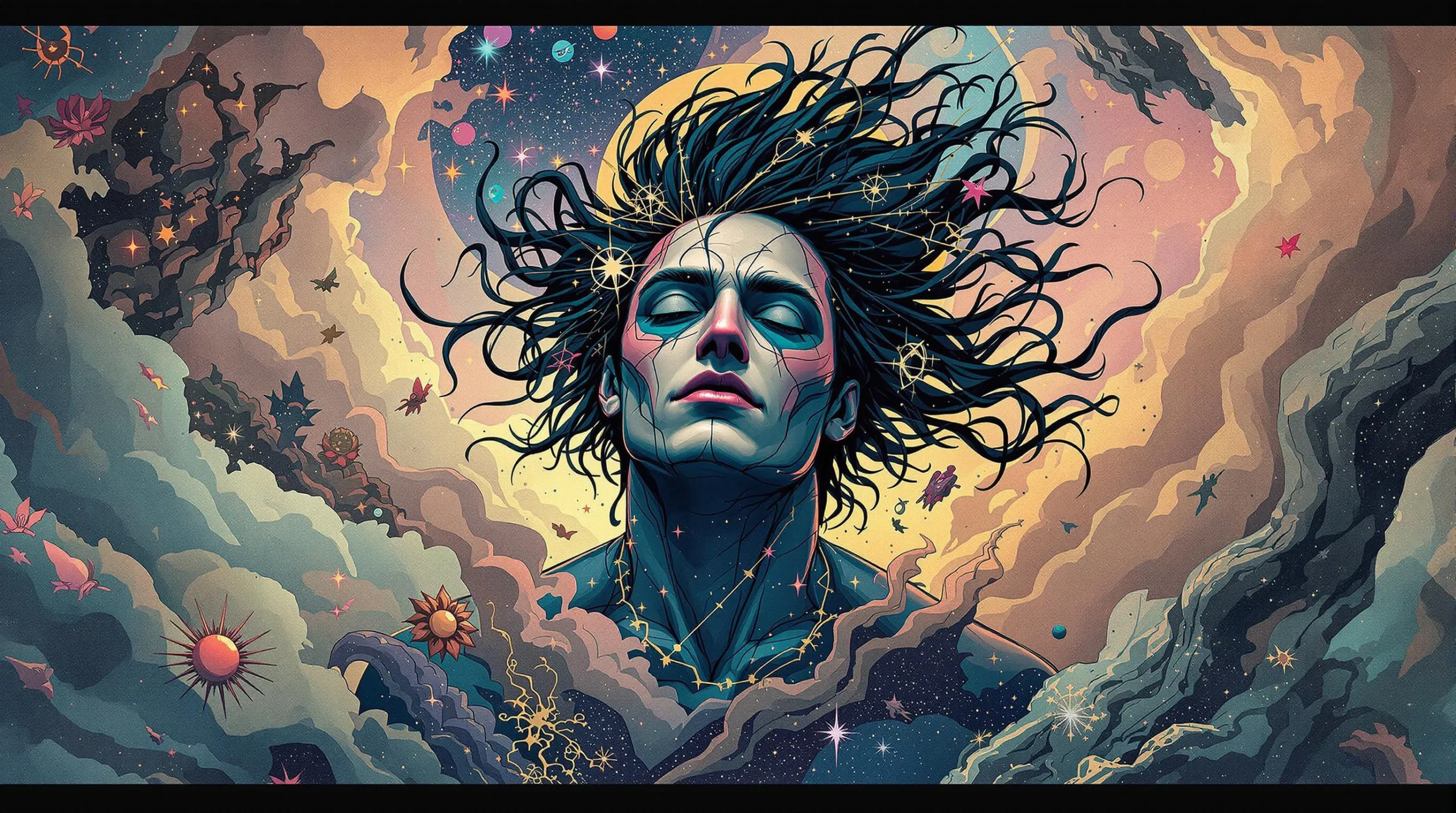


Nightcrawler

Archetype Meaning & Symbolism

Devout, acrobatic, empathetic, swashbuckling, joyful, outsider, loyal, mischievous, paradoxical, kindhearted

  • This is how I look, mein Freund, but it is not what I am.

If Nightcrawler is part of your personal mythology, you may...

Believe

  • You may believe that faith is a personal, portable sanctuary that can thrive in the most hostile environments and in the most unlikely of souls.
  • You may believe that true family is a verb: an act of creation, loyalty, and radical acceptance that you build with other outsiders.
  • You may believe that the most profound beauty and divinity are often hidden behind a mask of strangeness or perceived ugliness.

Fear

  • You may fear that no matter how good you are, you will always be judged and defined by your most visible, superficial strangeness.
  • You may fear that you are destined to be an eternal outsider, never truly finding a place or a people where you can let down your guard.
  • You may fear that your attempts to help or be close to others will inadvertently cause them harm or fear, like the scent of sulfur that lingers after a rescue.

Strength

  • You may possess a profound and disarming empathy, especially for those who are rejected or misunderstood by society.
  • You may have a resilient, almost acrobatic spirit, allowing you to find joy, adventure, and humor even in the face of hardship and prejudice.
  • You may be fiercely loyal, capable of forming incredibly deep, ride-or-die bonds with your chosen 'found family.'

Weakness

  • You may have a tendency to use charm and humor as a defense mechanism, keeping others at a distance from your deeper pain and insecurities.
  • You may be prone to escapism, preferring to 'teleport' away from difficult emotional confrontations rather than facing them head-on.
  • You may carry a deep-seated insecurity about your own 'otherness' that can be easily wounded, despite your cheerful exterior.

The Symbolism & Meaning of Nightcrawler

The Nightcrawler is a living, breathing paradox, a stained-glass window set in a gargoyle's frame. To have him in your personal mythology is to court the holy contradiction. He symbolizes the profound truth that the soul is not beholden to the vessel it inhabits. His blue fur and sulfurous scent are the livery of a demon, yet his spirit is one of unwavering faith and kindness. This archetype suggests that what is most monstrous in appearance may be most divine in character, challenging any worldview that relies on simple binaries of good and evil, beautiful and ugly. He is the patron saint of those judged by their cover, a testament to the fact that inner light can burn so brightly it shines through even the most alien features.

His teleportation is more than a superpower: it is a metaphor for spiritual and psychological agility. The *BAMF* is the sudden leap of intuition, the ability to instantly remove oneself from a toxic situation or to appear exactly where one is needed most. It is the signature of a soul untethered by convention and geography. To embody this is to believe in the possibility of radical, instantaneous change. It is the capacity to shift one’s entire frame of reference in a heartbeat, to see a problem from above, from below, from inside-out, before returning with a solution that was previously invisible. This is not escape, but strategic relocation of the self.

Furthermore, Nightcrawler represents the creation of a 'found family' as a sacred act. Cast out from his circus home, feared by those he saves, his belonging is not a birthright but a hard-won tapestry woven from loyalty, shared struggle, and radical acceptance. For the individual whose mythos includes him, family becomes a verb, not a noun. It is a practice. It is the conscious choice to build a sanctuary of souls, a circus troupe of fellow outsiders who see each other's true forms beneath the greasepaint and the fangs. This archetype sanctifies the bonds forged in the fires of mutual weirdness.


Nightcrawler Relationships With Other Archetypes

The Streetlight

The relationship between the Nightcrawler and the Streetlight may be one of mutual, silent acknowledgement. The Streetlight is not the sun, a generous and indiscriminate sovereign of the day; it is a lonely, artificial star, casting a cone of sterile inquiry onto the pavement. For the Nightcrawler, this pool of light is perhaps not a sanctuary but a stage, a confessional booth, or a laboratory slide where the dramas of the dark are momentarily isolated and examined. The Nightcrawler could see the Streetlight as a fixed point in a fluid world, a silent conspirator whose buzzing hum is the only steady pulse in the city's sleeping heart. It offers no warmth, only clarity—a stark, unforgiving visibility that the Nightcrawler uses not to hide from the dark, but to better understand its contents.

The Alley Cat

In the Alley Cat, the Nightcrawler might recognize a peer, a fellow traveler bound by the same nocturnal pact. Theirs is a kinship without camaraderie, a shared sovereignty over the forgotten spaces. The Alley Cat moves with a fluid, feral grace, a shard of pure instinct navigating a world of concrete and refuse. The Nightcrawler, too, is a creature of instinct, yet theirs is perhaps complicated by consciousness, by the search for a narrative or a hidden meaning in the urban detritus. They may share a fleeting glance across a moon-slicked fire escape, a silent recognition of two predators hunting different prey—one for sustenance, the other for a story. They are parallel monarchs of the pavement, each respecting the other's territory in the vast, quiet kingdom of the night.

The Secret

The Secret is perhaps the Nightcrawler’s true quarry, the ghost they are forever chasing. It is not an object to be possessed but a shy, powerful entity that only reveals itself in the negative space of the city, in the quiet between street-sweeper rotations and the first birdsong. The Nightcrawler’s relationship with it could be seen as a strange and patient courtship, a delicate dance of advance and retreat. The Secret, in turn, seems to require the unique ecosystem of shadow and solitude that the Nightcrawler inhabits. It may only feel safe to unfurl its fragile truth in the presence of this solitary observer, sensing that the Nightcrawler is not an executioner of meaning, but its midwife, helping to birth that which would otherwise perish under the interrogating glare of the sun.

Using Nightcrawler in Every Day Life

Navigating Otherness

When you feel ostracized for your appearance, beliefs, or identity, the Nightcrawler archetype offers a map. It suggests not hiding the parts of you that others find strange, but rather, integrating them with a profound sense of inner worth. It is a strategy for meeting prejudice with grace, a disarming smile, and an unshakeable knowledge of your own soul's quality.

Reconciling Contradictions

If you find yourself holding seemingly opposing beliefs or identities: perhaps you are a scientist with a deep spiritual life, or an artist with a mind for logistics. The Nightcrawler provides a model for living as a paradox. He is a 'demon' who is devoutly Catholic. He teaches that these are not contradictions to be resolved, but complexities to be embodied, the very things that make a person whole and unique.

Embracing Acrobatic Living

In moments of stagnation or rigidity, channeling the Nightcrawler encourages a more fluid, acrobatic approach to life's obstacles. It's the art of teleporting your perspective, of finding an unexpected angle. It is not about brute force, but about agility, about moving through challenges with a performer's flair and the joy of pure motion, finding freedom in the leap itself.

Nightcrawler is Known For

Teleportation

The signature *BAMF*, accompanied by a puff of brimstone-scented smoke, a mode of transport that is both instantaneous and startling, symbolizing a rapid shift in place and perspective.

Devout Faith

A deep and abiding Catholicism that exists in stark contrast to his demonic appearance, forming the unshakable core of his morality and optimism.

The Paradox of Being

His most defining quality

the constant tension between his frightening exterior and his kind, gentle, and swashbuckling interior, forcing all who meet him to look beyond the surface.

How Nightcrawler Might Affect Your Personal Mythology

How Nightcrawler Might Affect Your Mythos

When the Nightcrawler teleports into your personal mythos, your life story may cease to be a linear progression and become instead a series of daring leaps. The narrative may no longer be about fitting in, but about the glory of standing out. Your personal history might be reframed: periods of isolation are not seen as failures but as time spent in the wilderness, developing a unique faith. Moments of rejection become the catalysts that led you to your true circus, your chosen family. The central theme of your story may shift from a quest for acceptance to a demonstration of innate worth, a lifelong performance proving that the soul, not the skin, tells the truth.

The Kurt Wagner archetype may infuse your mythos with a swashbuckling romance, a sense of adventure even in the face of despair. Your narrative might take on the cadence of an Errol Flynn film, full of improbable acrobatics, heartfelt camaraderie, and a lighthearted exterior concealing a deep moral core. Your personal myth becomes one of redemption, not for any sin you have committed, but for the 'sin' of your perceived otherness in the eyes of the world. You become the protagonist who teaches the world to see, whose very existence is a miracle, a puff of sulfur and a flash of grace.

How Nightcrawler Might Affect Your Sense of Self

To see yourself through the Nightcrawler’s glowing eyes may be to finally make peace with the parts of you that feel alien or monstrous. You may cease to see your quirks, your scars, your unconventional thoughts as flaws to be hidden, but as the unique markings of your being, no more inherently evil than blue fur. It could foster a profound internal separation: a core belief that your true self, your consciousness, your capacity for love and faith, is a distinct entity from the physical or social shell you present. This is not dissociation, but a form of spiritual confidence, the quiet assurance that you are not defined by how you are perceived.

This archetype could also cultivate a wellspring of resilient joy. Despite a life colored by prejudice and loss, Nightcrawler remains a prankster, a romantic, an optimist. If he is part of your inner world, you may find yourself developing a similar capacity for finding light in dark corners. It is the ability to laugh while perched on a cathedral's spire, to find glee in movement, to feel a sense of faith that is not naive, but tempered and hardened in the fires of adversity. It is the self-knowledge that your happiness does not depend on the world's approval, but on your own acrobatic spirit.

How Nightcrawler Might Affect Your Beliefs About The World

A worldview informed by the Nightcrawler is one that is fundamentally suspicious of surfaces. It is a lens that instinctively looks for the goodness in the grotesque, the sincerity in the theatrical, the light within the shadow. You may find yourself becoming a 'soul-reader,' less interested in what people say or how they look, and more attuned to the subtle frequencies of their character and intent. This worldview rejects purity tests and moral absolutes, embracing instead a world of beautiful, messy, and holy contradictions. The world is not a courtroom delivering judgment, but a circus tent, filled with strange and wonderful acts, each with their own story.

This perspective may also see faith and the divine in unexpected places. The sacred is not confined to sanitized chapels but can be found in the loyalty of outcasts, the courage of the misunderstood, and the selfless act of a 'demon.' Your worldview might posit that God, or the universe, or morality, has a sense of humor and a love for paradox. The most profound spiritual lessons may not come from saints in shining armor, but from blue-skinned acrobats who smell of brimstone. It is a worldview that finds hope not by looking up to the heavens, but by looking deeper into the hearts of the strangest creatures on earth.

How Nightcrawler Might Affect Your Relationships

In the realm of relationships, the Nightcrawler archetype champions the 'found family' above all else. If he is part of your mythos, you may gravitate towards creating deep, intensely loyal bonds with a small circle of fellow outsiders. These connections are not based on convenience, shared background, or social approval, but on a profound, almost telepathic understanding. It is a kinship of souls who have seen each other's 'demonic' sides and have not fled. Your friendships and romantic partnerships may have a swashbuckling quality: full of adventure, playful teasing, and a fierce, protective loyalty that appears in a *BAMF* the moment it is needed.

You may approach relationships with a disarming sincerity and a lack of pretense. The archetype encourages you to show your true, strange self early on, believing that anyone meant to be in your life will not be frightened by the blue fur and fangs. This can lead to more authentic, if sometimes more vulnerable, connections. It is a relational style that values forgiveness and sees the best in people, sometimes to a fault. Love and friendship are not passive states, but active, acrobatic practices of trust, faith, and leaping into the unknown together.

How Nightcrawler Might Affect Your Role in Life

Adopting the Nightcrawler archetype may cast you in the role of the Bridge-Builder. You might feel your purpose is to connect disparate worlds: the conventional and the eccentric, the spiritual and the seemingly profane, the accepted and the ostracized. Your role is to stand in the middle, embodying both, and by your very existence, teach others that such divisions are illusory. You may become the surprising conscience of your group, the one whose gentle nature and strong moral compass are all the more powerful for emerging from an unexpected source. You are the proof that one cannot judge a book, or a soul, by its cover.

Your role might also be that of the Joyful Liberator. Like a circus performer, your purpose may be to demonstrate freedom, agility, and grace in a world that is often rigid and fearful. You are meant to remind people of the joy of movement, the thrill of the leap, the fun in being a little mischievous. This is not a frivolous role: it is a deeply spiritual one. By embodying a lighthearted spirit in the face of your own struggles, you liberate others from their own self-imposed prisons of seriousness and fear. Your role is to be the puff of sulfur that clears the air, leaving behind a sense of wonder and possibility.

Dream Interpretation of Nightcrawler

To dream of the Nightcrawler in a positive light is often to be visited by the promise of grace and liberation. His appearance could symbolize an imminent, rapid shift in your life circumstances, a *BAMF* out of a stagnant or oppressive situation. He may represent your own dawning acceptance of a part of yourself you once considered ugly or shameful. Dreaming of his acrobatic feats could be your subconscious telling you to adopt a more fluid, creative approach to a problem. His presence can be a profound reassurance: that your inner goodness is seen, that you are loved for who you are, and that a leap of faith is required.

In a negative context, a dream of Nightcrawler might point to themes of alienation and escape. He could represent a profound feeling of being misunderstood, your good intentions perceived as monstrous by those around you. His teleportation may symbolize your own tendency to flee from conflict or emotional intimacy, to *BAMF* away rather than face difficult conversations or consequences. A frightening or hostile Nightcrawler could embody a deep conflict between your spiritual beliefs and your more 'demonic' instincts or actions, a sign that your outward piety and inner life are painfully at odds.

How Nightcrawler Archetype Might Affect Your Needs

How Nightcrawler Might Affect Your Physiological Needs

From a mythological perspective, the Nightcrawler archetype deeply impacts the understanding of the physiological self. It is not about the need for food or water, but about the experience of inhabiting a body that is marked as 'other.' Your physical form might feel like a costume you cannot remove, a source of constant negotiation with the world. The mythos teaches one to find comfort not by changing the body, but by sanctifying it. You may learn to treat your physical self, with all its quirks and oddities, as a sacred vessel, its strangeness a testament to your unique spirit rather than a flaw.

This archetype suggests that physiological well-being is tied to freedom of movement. To feel alive is to be agile, to leap, to tumble. A sense of physical vitality may come from activities that are expressive and acrobatic, not merely functional. The body is not just a machine for living, but an instrument for joy. The scent of brimstone that accompanies his teleportation could be re-framed in your mythos as the scent of radical transformation, the physical evidence of a spiritual shift. It is the idea that even our most base, elemental, physical selves can be conduits for the miraculous.

How Nightcrawler Might Affect Your Ideas of Belonging

Belongingness is the central quest in the Nightcrawler mythos. The archetype suggests that a sense of belonging is rarely something you are born with; it is something you build with the sweat of your soul. It is the conscious, deliberate act of finding other 'freaks' and forming a circus. This means love and connection are not predicated on shared norms but on mutual acceptance of each other's deepest oddities. To have this archetype is to seek a love that sees past the blue skin, that is not afraid of the fangs, that cherishes the prehensile tail. It is a profound hunger for being known, truly known.

The pain of not belonging is also central. The archetype carries the memory of the torch-wielding mob, the sting of being called 'demon.' This can create a deep-seated fear of rejection and a cautiousness in forming new bonds. Yet, it is this very pain that makes the eventual discovery of a found family so intensely powerful and sacred. Belonging, in this mythos, is not a cozy blanket but a hard-won, fiercely defended campfire around which a small band of outsiders share their warmth against the cold judgment of the world.

How Nightcrawler Might Affect Your Feelings of Safety

The Nightcrawler’s influence on the need for safety is a double-edged sword. On one hand, it highlights a perpetual state of existential threat. To be visibly different is to be vulnerable to the stones and slurs of the mob. Safety is never guaranteed; it is a fragile state, always under threat from prejudice. This might manifest as a hyper-vigilance in social situations, a constant scanning of the environment for potential misunderstanding or hostility. The only true safety seems to be in the shadows, or among the very few who understand.

On the other hand, the archetype provides a unique tool for creating safety: the teleport. This is the mythological representation of the ability to create sanctuary at a moment's notice. Safety is not a fortress, but a destination. It is the knowledge that you can, in a flash, remove yourself from harm's way and arrive in a place of security, whether that place is a physical home or the metaphorical space of a trusted friend's company. This power redefines safety from a static defense to a dynamic, agile act of self-preservation and strategic retreat.

How Nightcrawler Might Affect Your Views of Esteem

Esteem, within the Nightcrawler mythos, is forged in the crucible of public scorn. It cannot be sourced from external validation, as the world will consistently deny it. Instead, esteem becomes a deeply internal construct, built upon two pillars: unshakeable faith and unwavering character. Your self-worth may be tied to a personal code of conduct, a commitment to kindness, loyalty, and courage, precisely because the world expects the opposite from someone who looks like you. Every act of grace becomes a victory, a secret rebellion against prejudice.

This archetype fosters esteem through performance, not in a fake way, but in the sense of demonstrating one's true nature. The swashbuckling flair, the acrobatics, the charm: these are not just personality traits, they are weapons against despair. They are a way of saying, 'You can see me as a monster, but I will show you joy. I will show you light.' Self-esteem, therefore, is an active, performative, and joyful defiance. It is the quiet, unshakeable confidence that comes from the phrase, 'This is how I look, but it is not what I am.'

Shadow of Nightcrawler

When the Nightcrawler archetype falls into shadow, the swashbuckler becomes a manipulative rogue. The charm is no longer a bridge to connection but a tool for getting what one wants, a smokescreen for emotional irresponsibility. The joyful performer becomes a tragic clown, his laughter hollow, his antics a desperate plea for an attention he cannot genuinely receive. The 'otherness' that was once a source of unique strength becomes a permanent victim identity, an excuse used to absolve oneself of all fault. The world is always the mob with torches; every slight is a mortal wound, justifying any selfish action in return.

The shadow of teleportation is profound avoidance. Instead of a strategic retreat, the *BAMF* becomes the signature of the emotional ghost, the one who vanishes the moment a relationship requires work, the moment a consequence comes due. It is the ultimate refusal to be held accountable, to stay in one place long enough for the truth to catch up. Faith, in this shadow form, curdles into a self-righteous piety, a private club for one that judges all others, using scripture or a personal moral code as a weapon to prove one's inherent superiority despite all evidence to the contrary. The gentle soul is lost, and only the demon remains, cloaking itself in the memory of grace.

Pros & Cons of Nightcrawler in Your Mythology

Pros

  • You develop a rare ability to see the soul beneath the surface, making you a deeply empathetic and non-judgmental friend.
  • You cultivate a resilient optimism and a capacity for joy that is not dependent on external circumstances, allowing you to weather incredible storms.
  • You are capable of building a 'found family' with bonds of loyalty and acceptance that are often stronger than blood.

Cons

  • You may wrestle with a persistent sense of loneliness and alienation, feeling that no one can ever truly understand your unique experience.
  • You might feel a constant, exhausting pressure to perform goodness and charm to counteract people's initial negative judgments of you.
  • Your primary coping mechanism may become avoidance or escape, making it difficult to face and resolve deep-seated conflicts.