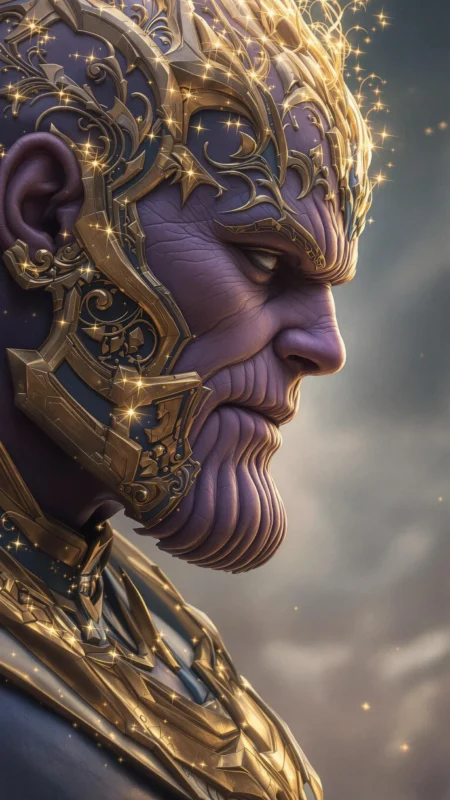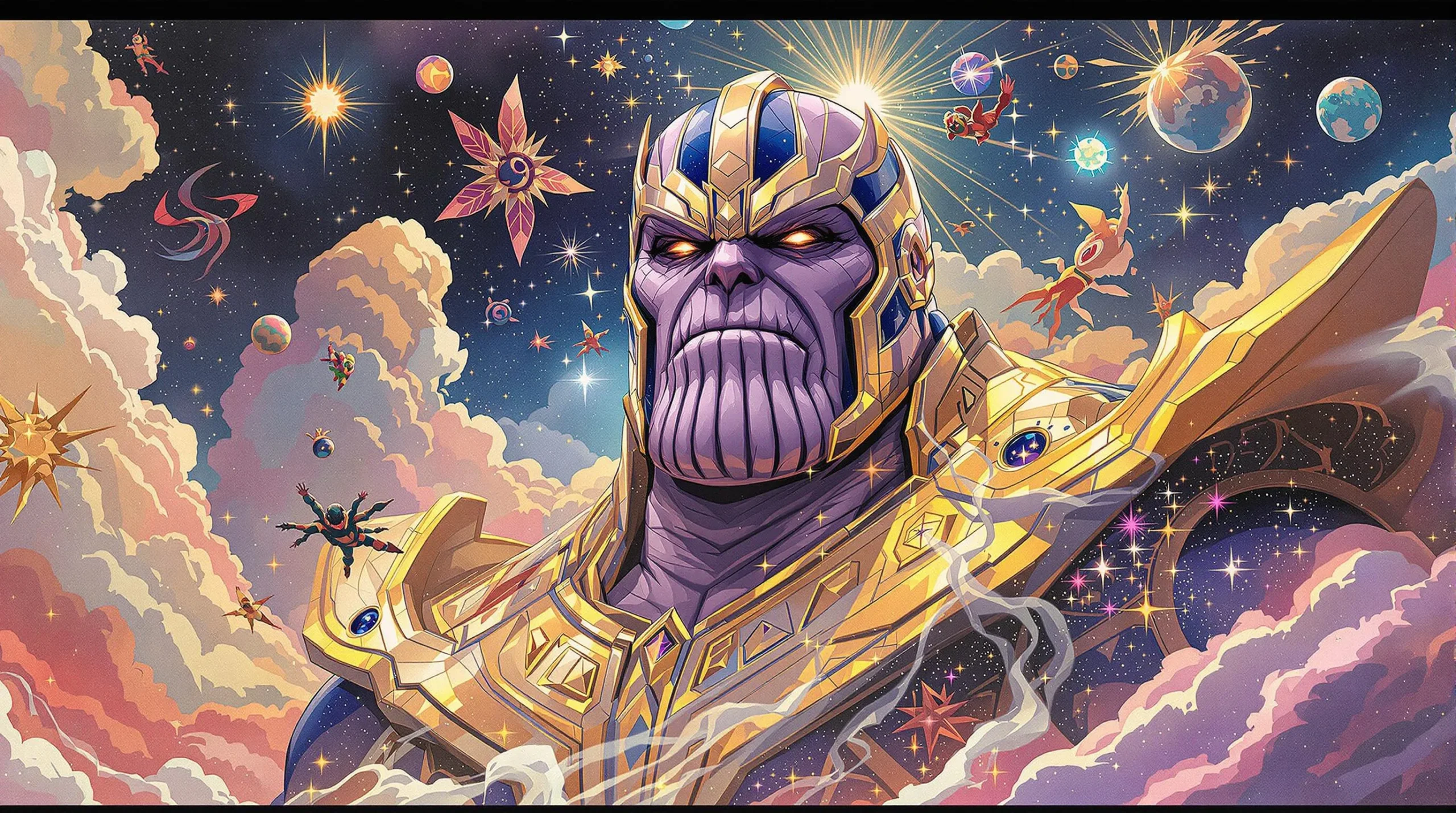


Thanos

Archetype Meaning & Symbolism

Utilitarian, determined, paternalistic, relentless, philosophical, solitary, imbalanced, righteous, sacrificial, monumental

  • The hardest choices require the strongest wills.

If Thanos is part of your personal mythology, you may...

Believe

  • That the universe is a chaotic system of finite resources, and that only through dispassionate logic and decisive, painful action can a sustainable balance be achieved.
  • That your unique perspective and strength of will give you not just the ability, but the responsibility, to make the choices that others are too weak or sentimental to consider.
  • That the ultimate expression of love is not personal affection, but the creation of a better world, even if the cost is being misunderstood and reviled by the very people you aim to save.

Fear

  • The quiet dread that your immense sacrifice was based on a flawed premise, that the pain you caused, to yourself and others, will ultimately amount to nothing.
  • That your own lingering sentimentality, a moment of love or empathy, will cause you to falter at the final moment and compromise the purity of your mission.
  • The profound, silent emptiness after the work is done: a perfectly balanced universe with no purpose left in it for you.

Strength

  • An almost supernatural clarity of purpose and an unwavering focus that allows you to pursue long-term goals without distraction.
  • The capacity to make incredibly difficult decisions from a place of cold logic rather than volatile emotion, allowing you to navigate crises that would paralyze others.
  • A profound resilience and self-reliance, born from the belief that your path is a solitary one and that you alone have the strength to walk it.

Weakness

  • A catastrophic lack of empathy that prevents you from understanding or valuing the individual lives affected by your grand designs.
  • A dogmatic intellectual rigidity that makes you incapable of considering alternative solutions, admitting error, or incorporating new perspectives that conflict with your original vision.
  • A tendency toward self-imposed isolation and cosmic loneliness, creating a life devoid of the warmth, joy, and support of genuine connection.

The Symbolism & Meaning of Thanos

To invite Thanos into your personal mythology is to court the specter of utilitarianism in its most stark and terrible form. He is not a symbol of simple evil, but the archetype of the necessary monster, the philosopher-king who has gazed upon the abyss of chaos and concluded that the only antidote is a horrifying, yet perfectly balanced, order. His symbolism is tied to the weight of the impossible choice, the kind that leaves a scar on the soul of the chooser. He represents a logic so vast it becomes alien, a love for the system that requires a brutal indifference to the individuals within it. He is the quiet farmer after the universal harvest, at peace with his work, oblivious to the silence he has wrought.

This archetype may also speak to a profound, almost cosmic loneliness. His is the burden of a truth no one else can accept, a vision for salvation that everyone else perceives as damnation. In one’s own life, this could manifest as the isolation that comes with a radical conviction, the feeling of being the only person who sees the ‘real’ problem and the only one with the stomach for the ‘real’ solution. Thanos is a monument to the idea that some burdens must be carried alone, that the path to a greater good is often a path away from the warmth of community and shared understanding. He sits on his porch, watching a grateful universe that does not know his name, the ultimate embodiment of purpose fulfilled and connection lost.

Ultimately, the meaning of Thanos within one's mythos is a question of scale. He forces one to ask: what is the cost of my convictions? He is the patron saint of the grand gesture, the final solution, the belief that a system can be perfected through a single, decisive act of will. He is the shadow that falls when we believe our intelligence gives us the right to play God, to edit reality according to our own blueprint. He is the chilling whisper that suggests that to save paradise, you may first have to burn it to the ground, and that you alone have the strength to strike the match.


Thanos Relationships With Other Archetypes

The Gardener

In the quiet, deliberate mind of the Thanos archetype, the universe may appear as an untended garden, choked by the glorious, unsustainable riot of life. Its relationship with the Gardener is not one of gentle cultivation but of a terrible, necessary pruning. Here, the shears are not for shaping a rosebush but for felling half a forest to save the soil. This Gardener is no sentimentalist, moved by the beauty of a single bloom; rather, they are a creature of pure, devastating ecology. They could be seen as a steward who understands that to allow overgrowth is its own kind of cruelty, a slow suffocation. The snap of their fingers is perhaps the sound of a cosmic branch breaking under its own weight, a sound that, to them, carries the promise of a stark, quiet, and grateful dawn.

The Unmoved Mover

There exists a profound, if one-sided, kinship with the Unmoved Mover, that philosophical ghost of a first cause. The Thanos archetype may aspire to this state of pure, causal force, a will that sets the gears of destiny into motion without being ground down by them. They seek to operate from a place beyond sentiment, beyond reproach, a fulcrum upon which the universe pivots. It is an ambition to become an axiom, a law of nature rather than a participant in it. Yet, this relationship is perhaps defined by its ultimate failure. For to possess the will to change everything is to have once been changed by something, and in the smallest memory, the faintest echo of love or loss, the Mover is revealed to be tragically, humanly moved after all.

The Broken Scale

The iconography of Justice is the balanced scale, a delicate instrument of measure and fairness. The Thanos archetype’s relationship to this symbol could be one of utter perversion. They do not merely tip the scale; they may shatter it, reforging the fragments into a tool of absolute, singular judgment. Their calculus rejects the very premise of equal weights. Instead, a single, monumental concept—survival, order, a perceived utopia—is placed on one side, and the entire universe is weighed against it and found wanting. This is not a conversation with Justice but a hostile takeover of its machinery. The resulting equilibrium is not one of balance, but of emptiness; a peace achieved not by negotiation, but by the stark and silent subtraction of all opposing arguments.

Using Thanos in Every Day Life

Navigating a Career Crossroads:

When faced with a decision that impacts not just your own career but the structure of your team or company, the Thanos archetype could inform a difficult but necessary choice. It is the part of you that might choose a painful restructuring, a layoff, not out of malice, but from a conviction that it is the only path to long-term survival for the whole. You may accept the burden of being the villain in some people's stories to ensure the continuation of the larger enterprise.

Committing to a Monumental Personal Goal:

For the writer embarking on a decade-long novel, or the scientist pursuing a fringe theory, this archetype provides the fuel of singular focus. It is the internal permission to sacrifice social outings, leisurely weekends, and immediate comforts for a distant, all-important outcome. This mythos allows you to see such sacrifices not as losses, but as the necessary, calculated cost of achieving something truly lasting, a state of perfect balance in your own universe of accomplishment.

Establishing Unbreachable Boundaries:

In relationships where your resources: emotional, financial, or temporal: are being depleted to the point of collapse, the Thanos archetype could manifest as the will to make a clean, sharp cut. It’s the strength to sever a codependent tie, not through anger, but with the quiet, solemn finality of a universal law. You may decide that for the ecosystem of your own life to thrive, its population of obligations must be halved, and you are the only one with the will to choose which half must go.

Thanos is Known For

The Infinity Gauntlet

A cosmic artifact granting its wielder godlike power over the fundamental aspects of existence: time, space, reality, power, soul, and mind. A symbol of ultimate, world-altering capability.

The Decimation:

The infamous act of erasing half of all sentient life in the universe with a snap of the fingers. It represents a horrifyingly simple solution to the impossibly complex problem of scarcity.

A Philosophy of Balance:

A core belief that the universe possesses finite resources, and that overpopulation inevitably leads to suffering and ruin. His actions, though genocidal, are framed in his mind as a necessary, even merciful, corrective measure.

How Thanos Might Affect Your Personal Mythology

How Thanos Might Affect Your Mythos

When the Thanos archetype takes root in one's personal mythos, the life story may warp into a grand, solitary epic. Your narrative ceases to be about finding your place in the world; it becomes about forcing the world into its proper place. The central conflict of your story might be an internal one: a constant struggle between your monumental, perhaps isolating, vision and the messy, contradictory desires of a world that refuses to be saved. You might see your past not as a series of experiences, but as a crucible that forged you, giving you the unique strength and perspective to bear your burden. Your personal history could be re-imagined as a collection of ‘infinity stones’: painful losses that grant wisdom, hard-won battles that grant strength, moments of clarity that grant a vision of reality as it ‘should’ be.

Furthermore, your mythos may become one defined by a singular, cataclysmic event, a personal ‘snap.’ This could be a momentous decision, a great sacrifice, or a profound loss that reordered your entire existence. Life before this event may seem like a prelude, a time of naive imbalance. Life after is the new reality you created, for better or for worse. In this story, you are both the protagonist and the antagonist, the savior and the destroyer. Your myth is not one of discovery, but of grim creation, the tale of how you, with the strongest of wills, made your universe anew, and now must live with the silence that followed.

How Thanos Might Affect Your Sense of Self

The self, under the influence of the Thanos archetype, could become a fortress of conviction. Self-perception may be welded to a single, overarching purpose, a mission that defines and justifies one’s existence. This could foster an immense, almost unbreakable sense of self-reliance, a belief that you are the sole arbiter of what is right and necessary. The internal landscape might be one of solemn quiet, the noise of self-doubt and external opinion silenced by the roar of your own certainty. You may see yourself as a realist in a world of dreamers, the one person willing to look at the cold, hard data of life and act upon it without sentimentality.

However, this granite sense of self may come at the cost of flexibility and humanity. You might begin to see your own emotions, your capacity for love and empathy, as potential weaknesses or dangerous variables that could corrupt the purity of your mission. The self could become a tool, a finely calibrated instrument for achieving a goal. Introspection might not be a journey of discovery, but a process of optimization: purging inefficiencies, strengthening resolve, and eliminating anything that does not serve the ultimate purpose. You may see yourself as something more than human, or perhaps less: a force of nature, an agent of destiny, a necessary correction.

How Thanos Might Affect Your Beliefs About The World

Adopting a Thanos-like world view could lead one to perceive the world not as a home, but as a project. It is a system riddled with inefficiency, imbalance, and suffering that can be fixed with the right application of logic and force. From this vantage point, nuance dies. Complex societal problems are flattened into simple equations of resource scarcity or flawed human nature. The world becomes a garden to be brutally pruned, a canvas to be wiped clean so a masterpiece of order can be painted. This is a worldview that finds a strange comfort in apocalypse, seeing destruction as a necessary and even creative act.

This perspective might also foster a deep cynicism about the potential for incremental change or collective action. If the world is a broken system, then the systems themselves, democracy, collaboration, and dialogue, are part of the problem. They are too slow, too compromised by sentiment and self-interest. The only real hope, in this view, lies in the decisive action of a singular will, a mind unburdened by committee. The world is seen as a great, lumbering beast caught in a trap of its own making, and you are the only one with the clear eyes and steady hand to perform the necessary, painful amputation.

How Thanos Might Affect Your Relationships

In the realm of relationships, the Thanos archetype could be devastating. It posits a universe where personal connections are, at best, a pleasant distraction and, at worst, an obstacle to the mission. You may view others through a utilitarian lens: are they an asset or a liability to your purpose? Love, particularly the fierce, specific love for one person, becomes the ultimate vulnerability. It is the one thing that could make you hesitate, the one variable that could imbalance your perfect equation. You might find yourself capable of a grand, abstract love for a concept, for humanity, while struggling to connect with the actual humans in your life.

Consequently, relationships may be held at a distance, managed rather than nurtured. You could become a remote, paternalistic figure, making decisions ‘for the good’ of your loved ones without ever truly consulting them or valuing their input. The archetype might allow you to perform acts of great sacrifice for those you care about, yet it could prevent you from offering the simple presence and shared vulnerability that true intimacy requires. You may be willing to sacrifice your daughter for the universe, a testament to your will, but find yourself unable to simply sit with her and watch a sunset, a testament to your heart.

How Thanos Might Affect Your Role in Life

Your perceived role in life, when shaped by this archetype, may become that of the reluctant arbiter. You are not a king who sought a crown, but a philosopher who, through superior insight, has been burdened with the responsibility of power. You may feel that you are the only one in your family, your company, or your community with the clarity to see the coming crisis and the fortitude to make the hard choices necessary to avert it. This role is inherently isolating; it places you above or outside the very group you aim to save. Your destiny is not to belong, but to correct.

This can also manifest as the role of the ‘necessary evil.’ You may accept that your actions will be misunderstood, that you will be feared or hated, and see this as part of the price of your wisdom. You are the surgeon who must cut to heal, the parent who must be cruel to be kind. This role provides a powerful, if grim, sense of purpose. It absolves you of the need for approval, replacing it with the conviction of your own lonely righteousness. You are the fulcrum upon which the world turns, a titan bearing a weight that would crush lesser beings, and this burden becomes your identity.

Dream Interpretation of Thanos

To dream of Thanos in a positive context, perhaps seeing him sitting peacefully on his farm or calmly assembling the Infinity Stones, could symbolize an emerging power within yourself. It may suggest that you have finally found the resolve to make a difficult and long-overdue decision in your waking life. The dream might be an affirmation of your strength of will, your ability to see the bigger picture and act decisively for a greater good, even if it requires a personal sacrifice. He could appear as a mentor figure, not offering comfort, but gifting you the clarity and fortitude to bring a chaotic situation into balance.

Conversely, a dream where you are fleeing from Thanos, or watching in horror as he enacts his decimation, likely points to the shadow aspect of this archetype. It may be a warning from your subconscious that your own ambition is becoming destructive, that your pursuit of a goal is causing unacceptable collateral damage to your relationships or your own well-being. He could represent a tyrannical aspect of your own personality: a rigid, dogmatic belief system that is silencing other parts of yourself. To be ‘snapped’ away in a dream could be a profound fear of being rendered irrelevant or powerless by a force, either external or internal, that operates on a logic you cannot comprehend or accept.

How Thanos Archetype Might Affect Your Needs

How Thanos Might Affect Your Physiological Needs

When Thanos is a resident of your personal mythology, your physiological needs may be re-contextualized as mere logistics. Food is not for pleasure; it is fuel. Sleep is not for rest; it is a strategic downtime for the vessel of your will to repair itself. Your body might be viewed as a machine, a tool that must be maintained for peak performance in service of the grander mission. There could be a spartan quality to your existence, a deliberate rejection of physical comfort as a potential source of weakness or distraction. The aches of the body are trivial data points, easily ignored when compared to the magnitude of the task at hand.

This can lead to a state of extreme mind-over-matter discipline, where physical limits are consistently pushed and pain thresholds are extraordinarily high. However, it can also lead to a dangerous disconnect from the body's wisdom. The subtle signals of hunger, exhaustion, or illness may be disregarded until a catastrophic failure occurs. The body, in this mythos, is not a sacred home but a temporary conveyance for the spirit. Its ultimate fate is irrelevant as long as the mission is completed. It is a resource to be spent, and you, the unwavering mind, may be willing to spend it down to nothing.

How Thanos Might Affect Your Ideas of Belonging

The archetypal energy of Thanos could actively dismantle the need for belonging. Love and intimacy may be perceived as cosmic-level threats to objectivity. To belong is to be compromised; to be loved is to have a weakness. This archetype finds its identity not in the warm embrace of community but in its stark separation from it. One might consciously or unconsciously push others away, creating a solitary existence that is mistaken for strength. The feeling of being understood, a core component of belonging, is replaced by the grim satisfaction of being right.

This can lead to a profound, self-imposed exile. You may be surrounded by people, yet feel an unbridgeable distance from them all, a titan observing mortals from a distant throne. The love you offer might be paternalistic and abstract: a desire to ‘fix’ things for people rather than to simply be with them in their imperfection. The fundamental human need for connection is starved, subordinated to the mission. The end result could be a perfectly ordered life, a universe in balance, that is also a universe of one, watching the sun rise on a world you saved but can no longer touch.

How Thanos Might Affect Your Feelings of Safety

The need for personal safety, from a Thanos perspective, could become a secondary or even tertiary concern. What is the safety of one individual compared to the stability of the entire system? You might find yourself willing to walk into metaphorical fire, to take immense personal risks, if you believe it is a necessary step toward achieving your ultimate goal. Safety is not defined by personal comfort or security, but by the successful implementation of your grand design. True safety, in this view, is a balanced, orderly world, and any personal jeopardy endured to create it is a logical and acceptable cost.

This can create a person who appears fearless, who can navigate high-stakes environments with a chilling calm. However, this same logic could also lead to a reckless disregard for the safety of others who are deemed part of the acceptable cost. The safety of your family or team might be compromised for what you perceive as the greater good. This archetype fundamentally re-wires the safety instinct, detaching it from the personal and reattaching it to the abstract. You might build a fortress not to protect yourself, but to protect your work, and you would willingly sacrifice yourself at the gate to ensure what is inside remains untouched.

How Thanos Might Affect Your Views of Esteem

Esteem, when filtered through the Thanos archetype, is not built on the praise of others, but on the unshakeable foundation of self-conviction. Your self-worth may be directly proportional to the strength of your will and the magnitude of your purpose. You may not need trophies, accolades, or social approval; your reward is the quiet knowledge that you did what had to be done, that you did not flinch when faced with the impossible choice. This creates a powerful, internally-generated esteem that is resistant to external criticism or validation.

However, this esteem is also incredibly brittle. It is contingent upon the righteousness of the mission and the success of its execution. If the mission is revealed to be flawed, or if you fail to achieve it, the entire structure of your self-worth could collapse into a black hole of nihilism. There is no room for error, no grace in failure. Furthermore, this esteem requires you to constantly see yourself as the strongest and wisest person in the room. It is an esteem that cannot admit fallibility, cannot ask for help, and cannot easily coexist with the esteem of others who may challenge your vision.

Shadow of Thanos

The shadow of Thanos manifests when conviction curdles into tyranny. It is the point where the righteous mission becomes a justification for atrocity, and the philosopher-king becomes a simple monster. In this shadow state, the ‘greater good’ is no longer a goal but an excuse, a holy banner used to sanctify one’s own ego and lust for control. The shadow does not see the world as a system to be balanced, but as a flawed creation to be punished for its imperfection. It derives a quiet, grim satisfaction from destruction itself. Any voice of dissent is not just wrong; it is a heresy to be silenced. The shadow of Thanos is the belief that your vision is so pure, your will so strong, that it grants you the divine right to unmake the world and call it salvation.

This shadow can also take a more passive, internal form. It can be the paralysis of the perfectionist, endlessly gathering data, endlessly weighing variables, seeking the single ‘perfect’ solution to a problem while life passes by. This is the Thanos who never leaves his throne, trapped by the sheer scale of his own intellect. He is so obsessed with calculating the precise cost of every action that he never acts at all. His worldview becomes a prison of logic, rendering him inert. Here, the will is not strong enough to make the hard choice, but the logic is so powerful that it rejects all easy choices, leading to a state of complete and utter stagnation, a different kind of universal death.

Pros & Cons of Thanos in Your Mythology

Pros

  • You may possess a profound and unwavering sense of purpose, a north star that guides all of your actions and decisions.
  • Your singular focus and strength of will could allow you to achieve monumental goals that others would deem impossible.
  • You may develop an extraordinary resilience to external criticism and a deep well of self-reliance.

Cons

  • Your utilitarian logic may lead you to cause immense collateral damage to the people and relationships in your life.
  • You may suffer from a profound sense of isolation and loneliness, alienated by the very mission that gives you purpose.
  • Your inability to admit fallibility or consider alternative viewpoints can trap you in a dogmatic and destructive course of action.