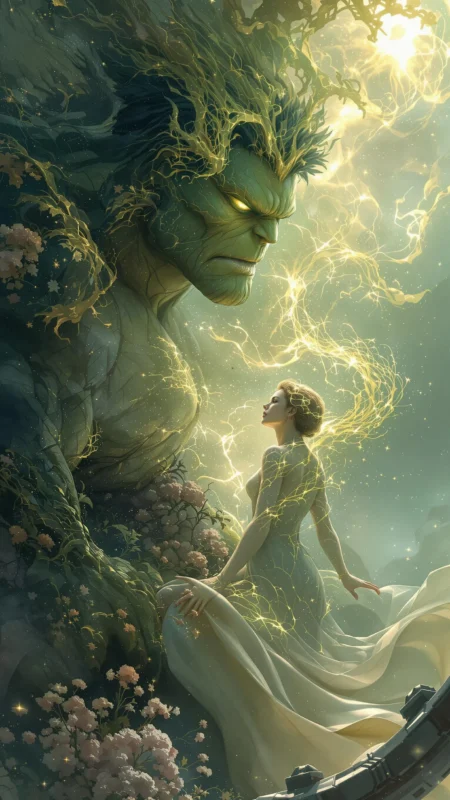
Hulk

Archetype Meaning & Symbolism

Rage, strength, transformation, duality, misunderstood, protective, primal, volatile, resilient, isolated

  • That's my secret, Captain: I'm always angry.

If Hulk is part of your personal mythology, you may...

Believe

  • You may believe that your anger is not just an emotion but a source of vital information, a compass pointing directly to what is unjust, untrue, or unbearable in your world.
  • You may believe that true strength is not the ability to win every fight, but the ability to protect the vulnerable from a world that would crush them.
  • You may believe that being 'left alone' is not an act of antisocial behavior, but a necessary, sacred ritual for maintaining inner peace and protecting others from the fallout of your internal battles.

Fear

  • You may fear that one day you will lose control completely, and the force within you will not just damage, but permanently erase, every good thing you have ever built.
  • You may fear that you are, at your core, a monster. That the civilized, gentle person you present to the world is a mask, and your true face is one of mindless rage.
  • You may fear being hunted or contained, of being misunderstood by a world that wants to 'cure' or eliminate the most powerful part of you instead of understanding it.

Strength

  • You may possess a near-superhuman resilience, an ability to endure emotional or physical punishment that would utterly break most people.
  • You may have an unparalleled capacity to be a protector, a living shield for those who cannot defend themselves.
  • You may find that your rage, when channeled, can become a crucible for profound change, burning away old structures and allowing for new growth in its wake.

Weakness

  • You may have a tendency toward all-or-nothing solutions, seeing problems only in terms of what needs to be smashed or what must be endured, with little room for nuance.
  • You may chronically isolate yourself, pushing away potential love and support out of a misplaced, protective instinct.
  • You may live in a state of constant, low-grade exhaustion from the sheer effort of policing your own emotional landscape.

The Symbolism & Meaning of Hulk

The Hulk is our modern Grendel, our Hyde, born not of ancient malice or chemical hubris, but of the radioactive anxieties of the atomic age. He symbolizes the terrifying power coiled within the mildest of us, the id given form and continent-shifting muscle. In a personal mythology, he is the keeper of the rage we are told to swallow, the force we medicate, the primal scream we muffle in a pillow. He represents not evil, but an untamed, natural energy that society has no place for. To have the Hulk in your mythos is to acknowledge a deep, internal schism: a quiet, thoughtful self forever tethered to a being of pure, destructive instinct. He is the catastrophic consequence of the unexpressed self, a walking, smashing metaphor for what happens when our deepest truths are relentlessly suppressed.

His green skin is the color of poison, of envy, but also of vibrant, untamed nature. The Hulk is a force of nature personified, as mindless and powerful as a hurricane or an earthquake. He doesn't reason, he acts. He doesn't negotiate, he overcomes. This symbolism could point to a part of the self that operates on a more fundamental, almost geological timescale. While the conscious mind worries about bills and social graces, this inner Hulk is concerned only with core threats and survival. He is the body's wisdom made manifest, the physiological response to a threat given a name and a narrative. He reminds us that for all our civilization, we are still animals, containing a power that defies our own control.

Perhaps most profoundly, the Hulk is a symbol of tragic solitude. His catchphrase is not a battle cry, but a plea: 'Hulk just wants to be left alone.' He is the ultimate paradox of power: strong enough to shatter worlds, yet unable to build a life. He represents the isolating nature of our own immense, unmanageable parts. The parts of us that are 'too much' for others, our overwhelming grief, our volcanic anger, our boundless needs. The Hulk is the story of the wound that makes us powerful, and the power that keeps us wounded. Integrating him into a personal myth means wrestling with this paradox, searching for a way to let the giant exist without letting him destroy the village.


Hulk Relationships With Other Archetypes

The Cage

The Cage may be the most intimate partner to this kind of rage, less an adversary and more a dance partner in a violent tango. It is not merely a prison of iron bars but the entire architecture of civility—the strained stitching of a dress shirt, the grid of a city map, the polite syntax of a sentence that refuses to scream. The Hulk’s relationship with The Cage is a constant, percussive testing of limits, a dialogue where the only grammar is the bending of steel and the shattering of concrete. The Cage, in turn, could be seen as the very thing that gives the monster its form; without the illusion of containment to defy, the rage might simply be a shapeless, atmospheric pressure. Every reinforced wall, every tightened chain, is perhaps an unwitting provocation, a dare that forces the beast to discover a new, more terrifying scale of its own power, proving that the true nature of the untamable is to render every boundary a starting line.

The Lullaby

In the face of geological force, The Lullaby is a strange and profound counter-agent. It is not a weapon but a whisper, not a chain but a thread of memory pulled taut. Its relationship with The Hulk is almost alchemical, suggesting that the monster is not a fortress to be sieged but a frequency to be recalibrated. Where armies and armaments fail, a familiar voice or a gentle hand may find a foothold in the roaring emptiness, proposing that the creature is not made of pure rage, but of a core of pain wrapped in its furious energy. The Lullaby, then, could be the acoustic key that resonates with this original wound, the one sound that can pass through the storm to the quiet eye within. It offers a disquieting truth: that the most titanic power might have for its greatest vulnerability the smallest, most specific tenderness.

The Desert

The Desert is the beast’s quiet cathedral, a vast tabernacle of sand and sky that can absorb a howl without an echo. For The Hulk, it may represent the only available peace—not the peace of serenity, but the peace of consequence-free existence. Here, in the indifferent expanse, the monster ceases to be a monster; it is simply another natural force, as elemental as a sandstorm or a flash flood, its rage finally commensurate with the landscape. This relationship, however, is one of sublime isolation. The Desert offers a kingdom but no subjects, a freedom from the fragile world of humanity that is also a permanent exile from it. It is, perhaps, a horizontal cage whose bars are the horizon itself, a place where the creature, finally unburdened, can roam forever, only to find that the self, when truly alone, becomes its own inescapable confinement.

Using Hulk in Every Day Life

Navigating Suppressed Emotion:

When anger feels like a forbidden language, the Hulk archetype offers a vocabulary. It suggests that rage is not something to be vanquished but a part of the self to be understood. One might use this figure not to excuse an outburst, but to explore its origins: to ask what small, persistent injustice, what ignored boundary, finally called the giant from his slumber. It becomes a diagnostic tool for the soul's unheard screams.

Establishing Unyielding Boundaries:

For the individual who struggles to say 'no,' whose personal space is perpetually invaded, the Hulk can be a potent internal symbol. Invoking this archetype could be a private ritual before a difficult conversation, a visualization of an immense, immovable presence. It is not about threatening violence, but about embodying an energy that communicates a boundary is not a request, but a fact of the landscape, as solid as a mountain.

Accessing Primal Strength:

In moments of profound crisis, a health diagnosis, a betrayal, a staggering loss, the civilized self may crumble. The Hulk mythos provides a script for what happens next. It suggests that beneath the shattered intellect lies a core of pure, primal survival. Channeling this archetype could mean accessing a ferocious will to live, a brute-force resilience that simply endures the unendurable, one thunderous step at a time.

Hulk is Known For

Transformation

The involuntary and often catastrophic shift from the mild-mannered scientist, Bruce Banner, into the monolithic green behemoth. This change is typically triggered by intense emotional stress, most notably rage.

Limitless Strength

The Hulk's physical power is legendary, allowing him to perform impossible feats. Crucially, his strength is not static: it increases exponentially with his level of anger, making his potential theoretically infinite.

The Misunderstood Monster

Despite often performing heroic acts, the Hulk is perpetually feared, hunted, and ostracized by the very society he sometimes protects. He is a figure of tragic paradox: a savior who looks like a destroyer.

How Hulk Might Affect Your Personal Mythology

How Hulk Might Affect Your Mythos

When the Hulk stomps into your personal mythos, your life story may cease to be a linear progression and become a seismic chart, marked by tremors and eruptions. Your narrative might be punctuated by moments of 'Hulking out': periods where a suppressed part of you bursts forth, altering the landscape of your life irrevocably. A sudden career change, the explosive end to a relationship, a confrontation you never thought you were capable of. These are not mere plot points; they are the footprints of the giant. Your mythos could be a tale of two characters: the careful, intellectual Bruce Banner, who plans and rationalizes, and the Hulk, who feels and acts with devastating authenticity. The central drama of your life story might be the ongoing, arduous quest to integrate these two, to build a bridge between the mind and the monster.

Furthermore, your personal myth may be defined by the theme of 'the aftermath.' Much of your story's focus might be on the quiet moments after the rage has subsided: sweeping up the emotional debris, mending connections, and dealing with the consequences of the Hulk's appearance. This narrative pattern could create a mythos of cyclical destruction and repair, a constant process of losing control and then painstakingly reclaiming it. You might see yourself as a living disaster zone, but also as a master of reconstruction. This creates a complex heroic arc, one not of simple victory, but of radical resilience and the lonely, often unglamorous work of taking responsibility for a power you never asked for.

How Hulk Might Affect Your Sense of Self

To see the Hulk in yourself is to live with a constant awareness of your own internal duality. You may feel as though you are two distinct beings inhabiting one body. There is the 'you' that the world sees and interacts with: thoughtful, controlled, perhaps even timid. Then there is the 'Other': a powerful, volatile force you work tirelessly to contain. This can lead to a sense of deep internal alienation, a feeling that your true self is a dangerous secret. Self-perception might become a tightrope walk, a continuous effort to maintain balance, knowing that a single misstep, a single surge of anger, could plunge you into a state you cannot control. Self-acceptance, in this context, is not a gentle unfolding but a radical, terrifying act of embracing the monster within.

This archetype can also shape your self-concept around the idea of potential versus reality. You may feel a profound frustration, knowing you possess an incredible, world-breaking strength that you dare not use. This could manifest as a feeling of being fundamentally underutilized or misunderstood. The self might be perceived as a caged titan, a brilliant mind (Banner) whose primary life's work is the containment of its own power. This can breed a unique form of melancholy: the sorrow of the giant who must make himself small to fit in a world made of glass. True self-esteem may only emerge when you begin to see the Hulk not as a curse to be managed, but as a sacred, albeit dangerous, part of your wholeness.

How Hulk Might Affect Your Beliefs About The World

With the Hulk as a lens, the world may appear as a minefield of triggers. Everyday annoyances, injustices, and frustrations are not just irritants; they are potential catalysts for transformation, sparks that could ignite a devastating inner explosion. This could foster a worldview of hyper-vigilance, a constant scanning of the environment for threats not to your physical safety, but to your emotional control. You may perceive society, with its rules, expectations, and endless provocations, as a relentless antagonist, actively trying to 'poke the beast.' Institutions, authority figures, and even social niceties might be viewed with suspicion, seen as flimsy cages designed to contain a power they fundamentally fear and misunderstand.

Conversely, this archetype could cultivate a profound sense of responsibility. If you contain a force capable of immense destruction, you might view the world with a tender, protective fragility. You see not a world of aggressors, but a world of glass, populated by people who could be shattered by a careless display of your own inner force. This can lead to a worldview steeped in a kind of sorrowful empathy. You may see the 'Hulks' in others, recognizing the pain and rage simmering beneath their surfaces. The world stops being a simple stage of good and evil and becomes a complex ecosystem of wounded, powerful beings all trying, and often failing, to keep from breaking everything around them.

How Hulk Might Affect Your Relationships

The Hulk archetype might cast a long, green shadow over your relationships. The primary dynamic could be one of fear: not fear of your partner, but fear for them. This may manifest as a pattern of pushing people away at the first sign of intimacy, a preemptive strike to protect them from the 'monster' within. You might believe that to be truly known is to be dangerous, and that solitude is the only ethical choice. Relationships could become a series of careful negotiations and containment strategies, where you are constantly monitoring your own emotional state, terrified that a moment of authentic anger will bring the whole house down. Love, in this context, might feel like handling unstable explosives: precious, powerful, and perpetually one wrong move away from detonation.

Yet, this archetype also contains the potential for a profoundly deep and trusting bond. The ultimate relationship goal may be to find the 'Betty Ross' to your 'Banner': the one person who is not afraid of the giant, who can soothe the beast, and who sees the humanity within the monster. You may yearn for a connection that is strong enough to withstand the transformation, a love that doesn't flee from your rage but meets it with understanding. This creates a relational life focused on the search for an almost mythical level of acceptance. When such a bond is formed, it is cherished with the fierce loyalty of the Hulk himself, who is, above all else, a protector of the few who dare to love him.

How Hulk Might Affect Your Role in Life

Adopting the Hulk archetype may cast you in the role of the Reluctant Weapon. You might feel that your purpose is not one you have chosen, but one that is thrust upon you in moments of crisis. In your family, workplace, or community, you may be the one who is quiet and withdrawn until a dire situation demands a level of force or confrontation that no one else can provide. You are the emergency glass to be broken. This role is deeply ambivalent: it grants you a sense of importance and power, but it also typecasts you as a tool for destruction, someone to be called upon and then, ideally, put away. You may feel valued not for your intellect or kindness, but for your capacity for righteous fury.

This can also lead to the role of the Permanent Outsider. The Hulk cannot be a part of the team; he is the team's failsafe or its greatest threat. In your own life, you may feel fundamentally separate from any group you join. You might participate, but you never truly belong, because you carry a secret that sets you apart. This can create a life lived on the periphery, observing social structures you cannot fully integrate into. Your role might be that of the lonely guardian, the one who watches over the village from the nearby mountain. You are of the world, but because of the immense power you carry, you can never be fully in it.

Dream Interpretation of Hulk

In a positive context, dreaming of the Hulk or of transforming into him may signify a powerful breakthrough in your waking life. It could represent the successful integration of your own anger and strength. The dream might not be violent; perhaps you are the Hulk, but you are in control, using your strength to clear a path, protect someone, or lift an impossible weight. This dream suggests you are no longer afraid of your own power but are learning to wield it consciously. It is a sign of empowerment, of finally accessing a deep well of resilience you may not have known you possessed. It is the psyche's way of saying: 'The strength you feared is now yours to command.'

In a negative light, a Hulk dream can be a visceral nightmare of losing control. You might be the Hulk on a rampage, destroying things and people you love, feeling powerless to stop the destruction. Or perhaps you are being chased by the Hulk, a terrifying symbol of your own disowned rage hunting you down. Such a dream could be a potent warning from your subconscious. It may indicate that you have suppressed your anger for too long, and it has become a monstrous, autonomous force within you. The dream is a cry for attention, urging you to address the source of your rage before it erupts in a destructive way in your waking life.

How Hulk Archetype Might Affect Your Needs

How Hulk Might Affect Your Physiological Needs

When the Hulk is part of your mythos, basic physiological needs may become entangled with the narrative of containment. The need for rest is not just about recharging; it's about keeping the beast dormant. Sleep might be seen as a vulnerable state where control is loosened. A balanced diet and stable blood sugar are not just health choices; they are critical strategies to manage the trigger-happy nervous system. The body itself is not a temple but a containment vessel, a nuclear reactor that must be meticulously maintained to prevent a meltdown. There could be a hyper-awareness of bodily sensations: a racing heart, a surge of adrenaline. These are not just feelings, they are precursors to transformation, the rumblings of the giant.

This can create a complex relationship with physical well-being. On one hand, you may be intensely disciplined, recognizing that a healthy body is the best cage for a powerful spirit. Exercise could become a vital outlet, a way to 'let the Hulk out' in a controlled environment. On the other hand, there might be a fatalism about the body, a sense that no matter how well you care for it, it ultimately houses a power beyond your control. This can lead to periods of neglect, a feeling of 'what's the use?' when the core problem is not physical, but existential. The body is both the source of the problem and the arena where the battle for control is waged daily.

How Hulk Might Affect Your Ideas of Belonging

The need for love and belonging may be fraught with peril for one who identifies with the Hulk. A deep-seated fear might be that your authentic self is simply too much for others to handle. You may operate from a core belief that if people saw the full force of your anger or need, they would run in terror. This can lead to a performance of smallness in relationships, a constant editing of your own feelings to make yourself more palatable, more 'lovable.' Belonging feels conditional, contingent on your ability to keep the giant chained in the basement. This can create a profound sense of loneliness, even when surrounded by people, as you feel you can never truly be seen.

Consequently, the drive for belonging becomes a quest for a very specific kind of love: a love that is fearless. You might not seek a partner who is gentle or placid, but one who is strong, someone who isn't intimidated by your power. The desire is for a witness, not a handler. You may form intense, fiercely loyal bonds with a very small number of people who have seen you at your 'worst' and have not fled. Belonging, when it is found, is not a gentle comfort but a fierce alliance, a pact between survivors. It’s the feeling of finding the one other person on the planet who knows how to calm the monster, not with chains, but with a steady hand.

How Hulk Might Affect Your Feelings of Safety

The archetype of the Hulk introduces a profound paradox to the need for safety. You may possess the physical power to fend off almost any external threat, making you feel, in one sense, incredibly safe. You are your own bodyguard. No one can push you around if the Hulk is standing behind you. This can instill a deep-seated confidence, a knowledge that when push comes to shove, you can protect yourself and your loved ones with overwhelming force. Safety, in this regard, is not the absence of danger, but the presence of overwhelming personal power.

However, this very power becomes the greatest threat to your own safety and stability. The world you must build for your 'Banner' self, a world of calm, predictability, and intellectual pursuit, is constantly at risk from the 'Hulk' self. The source of your safety is also the source of your peril. This means you may never feel truly safe. True safety might be imagined as an impossible state: a place where you are free to feel any emotion without risking a catastrophic transformation. The search for safety becomes an internal quest for integration and control, rather than an external search for a secure location. You are the locked house and the rampaging intruder, all at once.

How Hulk Might Affect Your Views of Esteem

Esteem, for someone with the Hulk in their mythos, is often a pendulum swinging between two extremes. On one side, there is the 'Banner' esteem: pride in your intellect, your gentleness, your control. This esteem is fragile, however, as it is predicated on the successful suppression of the Hulk. Every time you lose your temper, this esteem shatters. On the other side is the 'Hulk' esteem: a raw, primal confidence born of immense power and indestructibility. This, too, is unstable, as it is often accompanied by shame, guilt, and the destruction of things the 'Banner' self values. You may feel worthy only when you are brilliant and in control, or alternately, only when you are overwhelmingly powerful.

True, stable self-esteem may seem like an impossible goal, a mythical state of integration. It can only be achieved when you stop seeing Banner and the Hulk as a binary choice and begin to see them as a whole. Esteem grows not from picking a side, but from building a bridge. It is the quiet pride that comes from surviving an outburst and taking responsibility for the cleanup. It is the respect you earn from yourself by learning to set a boundary before the giant has to set it for you. It's the moment you realize the Hulk's strength and Banner's intellect are not opposing forces, but two parts of a single, complex, and ultimately worthy being.

Shadow of Hulk

The shadow of the Hulk emerges in the extremes. In one manifestation, it is the complete abandonment of Banner. This is not the purposeful rage of the protector but the mindless, nihilistic rampage of the World-Breaker. Here, the power is no longer a response to injustice; it is the source of it. The individual becomes a pure agent of chaos, lashing out not to defend, but simply to destroy. They may justify any outburst, any act of aggression, as an authentic expression of their 'inner Hulk,' refusing to take responsibility for the debris and blaming the world for 'making them angry.' This shadow turns a tragic hero into a mere bully, a force of nature into a petty tyrant, destroying relationships, careers, and their own soul for the fleeting, hollow satisfaction of the smash.

Conversely, the shadow can manifest as the total victory of Banner: a life lived in abject terror of the green giant within. This individual so fears their own capacity for rage that they amputate it entirely. They become pathologically passive, unable to set boundaries, assert needs, or stand up to injustice. They allow themselves and others to be harmed, all to avoid the risk of the transformation. Their life becomes a sterile, gray prison of their own making. This shadow is not a rampage but a slow suffocation, the death of the spirit by a thousand polite concessions. It is the tragedy of a giant choosing to live his entire life on his knees, all to avoid bumping his head on the ceiling.

Pros & Cons of Hulk in Your Mythology

Pros

  • You possess a profound, deep-seated well of power to draw upon in times of crisis, ensuring your survival and the protection of those you care for.
  • Having wrestled with the 'monster' within, you may develop a radical empathy for the outcasts, the misunderstood, and the 'too-much' people of the world.
  • Your very presence can establish powerful boundaries, often without a word, creating a zone of safety and respect around you.

Cons

  • The constant internal war between control and release can be spiritually and mentally exhausting, leaving little energy for creativity or joy.
  • Your fear of your own potential for harm can lead you to construct a life of profound isolation, starving yourself of the connection you deeply need.
  • Your responses to conflict may be disproportionate, causing collateral damage that you later regret and must work tirelessly to repair.