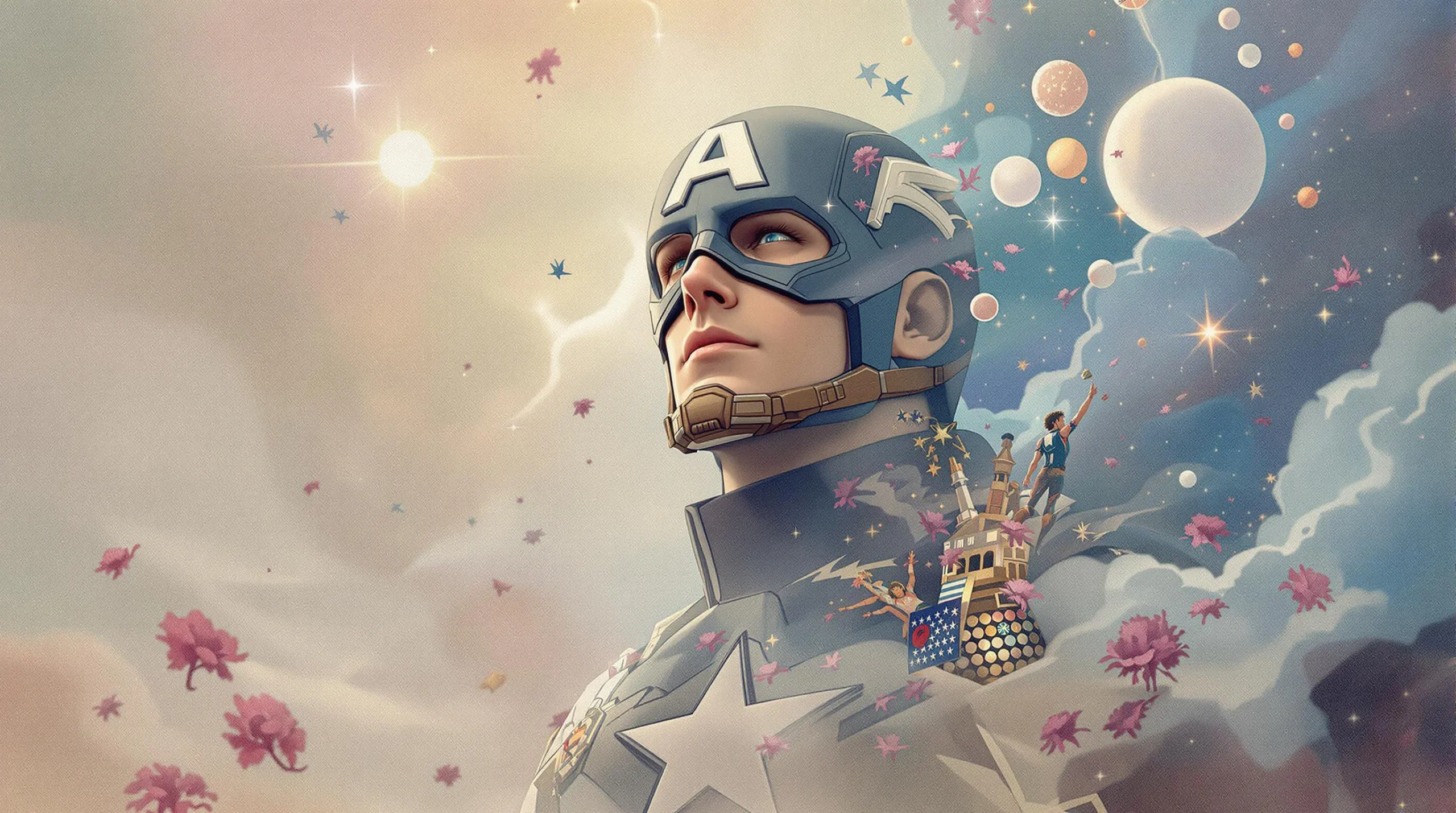


Captain America

Archetype Meaning & Symbolism

righteous, steadfast, self-sacrificing, earnest, nostalgic, resilient, defiant, incorruptible, stubborn, lonely

  • I can do this all day.

If Captain America is part of your personal mythology, you may...

Believe

  • That there is a clear, objective difference between right and wrong, and that you have a personal duty to uphold the right.
  • That a person's character is their ultimate authority, superseding any title, rank, or position of power.
  • That choosing to sacrifice for a cause or for another person is the highest expression of a meaningful life.

Fear

  • The slow, creeping erosion of your own principles through a series of small, seemingly insignificant compromises.
  • That you will one day face a moral test so great that your courage fails, proving you were never who you thought you were.
  • Ultimate disillusionment: the realization that your lifelong fight was futile and that the world is indifferent to your stand.

Strength

  • A resolute, almost unbreakable will when acting in defense of your convictions.
  • The capacity to inspire courage and profound loyalty in others simply by the example you set.
  • A clear and unwavering sense of purpose that provides direction and meaning to your actions.

Weakness

  • A tendency towards moral rigidity, making it difficult to navigate situations that require nuance, flexibility, or pragmatic compromise.
  • An inclination towards self-righteousness, and an impatience or intolerance for the perceived moral failings of others.
  • A deep, foundational loneliness that stems from being a moral outlier who is unwilling to bend to fit in.

The Symbolism & Meaning of Captain America

To invite Captain America into your personal mythology is to engage with the tension between the good man and the perfect soldier. The archetype's origin is not about gaining power, but about having one's innate character amplified. The serum, in this reading, is a metaphor for any life event that grants you influence or strength: a promotion, a platform, a newfound confidence. The core symbolic question then becomes whether that new power serves the preexisting goodness within. He could represent the belief that what you do with power is a direct reflection of who you were when you were powerless. This mythos doesn't ask you to become a super-hero: it asks you to be a good person, and then it dares you to accept the strength to act on that goodness on a larger scale.

The shield he carries is perhaps the most potent symbol. It is not a sword or a gun: its primary nature is to absorb, to deflect, to protect. In a personal myth, this could translate to a life posture of principled defense. You may see your role as shielding others from harm, absorbing cynical attacks, and standing in the way of injustice. It is a symbol of defiant endurance. Yet, the shield can be thrown, it can become a weapon. This duality suggests that a purely passive defense is insufficient. There are moments where one's principles must be projected out into the world, to disarm a threat or clear a path for progress. Your personal shield may be your intellect, your art, your voice: its meaning is found in how you use it to both protect and to act.

This archetype is also a potent symbol of righteous rebellion. Not rebellion for its own sake, but rebellion born from a commitment to a higher set of principles than those offered by a flawed authority. When Captain America stands against his own government, it is a mythological enactment of the individual conscience against the compromised system. In your own life, this could manifest as the courage to be the lone voice of dissent in a meeting, to challenge a family tradition that feels unjust, or to reject a societal norm that conflicts with your core values. He symbolizes the idea that patriotism is loyalty to a country's ideals, not its administration, and that sometimes the most profound act of loyalty is to say no.


Captain America Relationships With Other Archetypes

The Iron Man

In the grand, clattering workshop of modernity, The Iron Man archetype may stand as the polished chrome counterpoint to The Captain America's weathered hickory. Where one is a marvel of engineering, a self-made deity forging the future in a blaze of calculated risk and sardonic wit, the other is a monument, seemingly carved from a single, unyielding piece of moral bedrock. Their relationship could be less a simple rivalry and more a profound, ongoing philosophical dialogue—the cold, hard logic of the algorithm debating the stubborn, humanistic whisper of the conscience. The Captain America might be seen as the anchor that prevents the futurist's ship from drifting into the starless void of its own hubris, while The Iron Man, in turn, could represent the necessary, uncomfortable friction that forces the idealist to contend with a world that refuses to neatly conform to his pristine blueprint.

The Winter Soldier

The relationship with The Winter Soldier, or the Fallen Brother archetype, is perhaps the cracked and silvered mirror in which The Captain America must gaze upon his own capacity for failure. This figure is not an enemy but a wound, a walking ghost of shared memory and corrupted loyalty. He represents the terrifying suggestion that the brightest virtues can be twisted into the most effective weapons, that the past is a debt that can never be fully repaid. To confront this archetype is to confront the self, to wrestle with the ghost of a promise unkept. Their dynamic could be a quiet, desperate attempt to mend a broken piece of stained glass, to see if the original light of brotherhood can still shine through the leaden lines of trauma and manipulation, suggesting that redemption is not an act of victory, but an agonizing, patient act of faith.

The Citizen

With The Citizen, The Captain America may share his most sacred and paradoxical bond. He is both their protector and their creation, a living flag woven from the collective, often unspoken, aspirations of the populace. He is not their ruler but their reflection, the personification of a quiet, Main Street decency that might otherwise be drowned out by the din of power and politics. This relationship suggests a form of spiritual symbiosis: The Citizen looks to him and perhaps sees the best version of themselves, a tangible promise of their own latent courage. In turn, The Captain America might look out upon the sea of ordinary faces and find the very wellspring of his strength, the quiet affirmation that the ideal he serves is not a lonely abstraction but a living, breathing reality, however fragile.

Using Captain America in Every Day Life

Navigating Institutional Betrayal

When the systems you have placed your faith in, a company, a government, a community, reveal a deep-seated corruption, this archetype provides a script. It suggests that loyalty is not to the institution itself, but to the ideals it is supposed to represent. You may find the strength not to quietly exit, but to become a righteous dissenter, to plant yourself like a tree beside the river of truth and tell the whole world to move.

Confronting a Beloved Friend

When a person you care for deeply embarks on a path you find morally indefensible, the Captain America mythos informs a painful choice. It posits that some principles are more foundational than even the most cherished bonds. The archetype does not offer an easy way to abandon a friend, but rather a model for standing firm in your convictions, even if it means standing opposite them on a battlefield of ideals, creating a personal civil war.

Leading Without a Title

In situations where you lack formal authority but see a need for action, this archetype offers a path. It is the story of leadership born not of rank, but of character. You may find yourself stepping forward in a crisis, not because you were chosen, but because you are the one willing to do what is necessary. Your actions, your willingness to absorb the first blow or take the first step, could galvanize others to form a line behind you.

Captain America is Known For

The Super-Soldier Serum

The transformation from the physically frail but morally resolute Steve Rogers into a paragon of human potential. It symbolizes the idea that true strength is not granted, but revealed, amplifying the goodness that was already present.

The Vibranium Shield

An iconic, near-indestructible shield. It is a metaphor for principled action: a tool that is primarily defensive, used to protect others, but can be thrown as an offensive weapon, suggesting that sometimes the best defense is to proactively disable a threat.

A Man Out of Time

His story is one of profound temporal dislocation, being frozen in ice and awakening in a modern world he doesn't recognize. This makes him a symbol of nostalgia, idealism, and the struggle to apply timeless values to contemporary, cynical realities.

How Captain America Might Affect Your Personal Mythology

How Captain America Might Affect Your Mythos

When the Captain America archetype takes root in your personal mythos, your life story may cease to be a simple progression of events and could instead become a narrative of moral campaigning. Each challenge, from a workplace dilemma to a political disagreement, is framed as a battle in a larger war between right and wrong. Your personal history might be reinterpreted through this lens: moments of standing up for someone are seen as early skirmishes, moments of compromise as strategic retreats or even defeats. The narrative drive of your life becomes a quest not for happiness or success in the conventional sense, but for moral consistency and righteous impact. You may see yourself as the protagonist in a story about holding the line.

Furthermore, your mythos could become colored by the 'man out of time' theme. You may feel that your values, your sense of honor, decency, and justice, are relics from a bygone era. This can shape your life story into one of quiet alienation, a search for a world that aligns with your internal moral landscape. Your narrative might be one of trying to build a small pocket of the past in the present, surrounding yourself with people and routines that reflect these older values. Or, it could be a story of deliberate, painful adaptation, trying to translate your 'old-fashioned' principles into a language the modern, cynical world can understand, a lonely and often thankless diplomatic mission.

How Captain America Might Affect Your Sense of Self

To see yourself through the lens of this archetype could instill a profound, almost burdensome, sense of personal responsibility. The belief that you should, and could, always do the right thing may become central to your self-concept. This transforms your internal landscape into a high-stakes tribunal where your actions are constantly judged against an ideal of incorruptible goodness. Your self-worth might become deeply tethered to your moral performance. This can be a source of immense strength and clarity, a way of knowing who you are at your core. You are the one who gets back up, the one who stands for the little guy, the one who holds the line.

However, this may also create a significant internal schism. There is the idealized self, the Steve Rogers within, who is clear, decisive, and unwavering. And then there is the actual self, with its complexities, doubts, and messy compromises. This gap can be a source of perpetual dissatisfaction and harsh self-criticism. Every failure to live up to the ideal feels not just like a mistake, but like a betrayal of your own essence. You might struggle with a form of moral perfectionism, where the inability to be the 'perfect soldier' for your own cause leads to feelings of fraudulence or despair, overlooking the fact that the archetype's power comes from the good man, not the perfect one.

How Captain America Might Affect Your Beliefs About The World

Adopting this archetype could lead you to view the world as a place of stark moral contrasts. While you may acknowledge complexity, your fundamental worldview might operate on the principle that, beneath the fog of nuance and rationalization, there is a right and a wrong path. The world is not just a chaotic system; it is an arena for ideological struggle. This perspective could attune you to injustice, making you keenly aware of the abuse of power, the plight of the vulnerable, and the moments where courage is required. You might see the world as constantly testing your resolve, presenting you with opportunities to prove your convictions.

This worldview also fosters a deep-seated skepticism towards established power structures. If the individual conscience is the ultimate arbiter of right and wrong, then all institutions, governments, and leaders are fallible and subject to scrutiny. You may believe that authority is not granted by a title but must be continuously earned through moral action. This could lead to a worldview where you place your faith not in systems, but in people. The world is saved not by grand policies or powerful organizations, but by the cumulative effect of individuals choosing to do the right thing, one difficult decision at a time.

How Captain America Might Affect Your Relationships

In relationships, the Captain America archetype might compel you to seek out a fellowship, a band of 'howling commandos' bound by shared values and mutual trust. Friendship is not a matter of convenience or shared hobbies, but of deep, almost sacred, loyalty. You may assess potential partners and friends based on their character and principles above all else. The people you let into your inner circle are those you know would stand with you, back-to-back, when things get difficult. This can lead to incredibly profound, resilient, and meaningful relationships, a chosen family forged in shared purpose.

Conversely, this same principled stance can introduce significant friction and distance into relationships. Your unwillingness to bend on matters of principle can be interpreted by others as rigidity, stubbornness, or even self-righteousness. It can make it difficult to maintain relationships with those who live in shades of gray, who prioritize harmony over confrontation, or whose moral calculus is simply different from your own. The archetype's story is rife with broken friendships over matters of ideology, suggesting that you may be faced with the painful choice between your convictions and a person you love, creating a deep well of potential loneliness within you.

How Captain America Might Affect Your Role in Life

You may perceive your role in life as that of a protector. This is not necessarily a physical guardianship, but a moral or ideological one. You might feel a deep-seated calling to shield the vulnerable, to defend ideals that are under threat, and to stand as a bulwark against cynicism and corruption. Your purpose is not to lead or to conquer, but to serve and to preserve what is good. This role is often accepted rather than sought, a responsibility you feel you must shoulder because few others will. You might be the unofficial ethical compass for your family, your workplace, or your community.

This role of the moral guardian can also be deeply isolating. By positioning yourself as the defender of a principle, you may stand alone. The role requires you to be the one who says the uncomfortable truth, the one who refuses to go along with the crowd, the one who absorbs the initial shock of a confrontation. While others may eventually rally to your side, the initial act of standing is a solitary one. Your perceived role may be that of the lonely sentinel, watching over the walls while others sleep, defined as much by your steadfastness as by your separation from the very people you aim to protect.

Dream Interpretation of Captain America

In a positive context, dreaming of Captain America, or perhaps of wielding his shield yourself, could symbolize an integration of your own highest ideals. It may suggest that you have found the courage to act on your convictions and are stepping into a period of personal strength and moral clarity. The dream might be an affirmation from your subconscious that you are on the right path, encouraging you to continue fighting for what you believe in. Seeing the shield successfully deflect an attack could represent a newfound ability to protect yourself from cynicism or criticism and to remain true to your core values in the face of adversity.

In a negative context, a dream featuring this archetype can be unsettling. Dreaming of a defeated Captain America, a broken shield, or of being unable to lift it, might point to a crisis of faith in your own personal mythos. It could reflect feelings of powerlessness against what you perceive as a corrupt or unjust world. Perhaps you fear that your moral code is naive, obsolete, or simply not strong enough to handle the challenges you are facing. Such a dream could be a manifestation of deep disillusionment or a warning from your subconscious that the burden of your own ideals is becoming too heavy to carry, leading you towards burnout or cynical despair.

How Captain America Archetype Might Affect Your Needs

How Captain America Might Affect Your Physiological Needs

When this archetype shapes your personal mythology, basic physiological needs like food and rest may be reframed through a lens of mission-readiness. Eating is not just for sustenance; it is fueling the body for the challenges ahead. A healthy diet could become a tenet of your personal discipline, a way of ensuring the 'instrument' is always prepared. Rest is not idleness; it is a strategic recovery, a necessary pause to gather strength before re-engaging with the world's struggles. You might find yourself treating your body like a soldier treats their rifle: something to be maintained with care and respect, for it is the primary tool with which you enact your will.

This perspective may also influence how you experience physical exertion and pain. A grueling workout, a long and thankless task, or physical hardship could be interpreted as training. It is the crucible that forges resilience. The exhaustion you feel after a long day of fighting your particular battles might carry a sense of satisfaction, the 'good tired' that comes from having spent your energy in service of your principles. The body's limits are not just biological facts; they are frontiers to be tested, pushed against in the endless quest to become stronger for the sake of the mission.

How Captain America Might Affect Your Ideas of Belonging

For one who identifies with this archetype, the need for belongingness is channeled into a search for a true team. It's not about being liked by everyone or fitting into a broad social group; it's about finding the small, trusted unit with whom you can go 'to the end of the line.' Belonging is forged in shared struggle and unconditional loyalty. You may feel a sense of kinship with other idealists, dissenters, and protectors, regardless of their background. Love and friendship are not merely emotional comforts; they are alliances, pacts of mutual defense against a challenging world.

However, this intense need for principled fellowship can also foster a profound sense of loneliness. The standards for entry into your inner circle may be incredibly high, leaving you with few who can meet them. Furthermore, the archetype is defined by a willingness to stand alone if necessary. When your principles clash with those of your group, your mythos demands you choose the principle. This can lead to a cycle of finding and then losing your sense of belonging, making you an outsider by necessity. The love you seek is deep and true, but its rarity can make the world feel like a very solitary place.

How Captain America Might Affect Your Feelings of Safety

The need for safety, in the context of this mythos, undergoes a profound transformation. Physical and financial security may become secondary to ideological security. You might feel safest not when you are comfortable and untroubled, but when you are actively living in accordance with your principles, even if that means courting conflict or instability. The greatest danger is not bodily harm or material loss; it is the spiritual death of moral compromise. True safety is the unimpeachable knowledge that you have not betrayed your own conscience.

This creates a paradox where you may be driven to put yourself in conventionally 'unsafe' situations to achieve a deeper sense of security. You might risk your job to blow the whistle on an unethical practice, or risk social ostracism to speak out against an injustice. The feeling of being unsafe, in this framework, arises from silence and inaction. The shield is not meant to be kept in a display case; its purpose is to be placed in the path of danger. Therefore, your personal safety becomes inextricably linked to your willingness to be brave, to stand on the front lines of your own convictions.

How Captain America Might Affect Your Views of Esteem

Self-esteem, within the Captain America mythos, is almost entirely derived from internal validation. It is the quiet, bedrock certainty that comes from acting in alignment with your own strict moral code. Accolades, promotions, and public opinion may be secondary to the simple, private knowledge that you did the right thing when no one was looking, or that you refused to do the wrong thing when everyone was pressuring you. Your esteem is built not on your successes, but on your refusal to yield. It is the pride of the small kid from Brooklyn who never backed down, magnified to the scale of your own life.

This foundation for esteem, while powerful, can also be brittle. Because it is tied to moral perfectionism, a single significant compromise can feel catastrophic. A moment of weakness, a choice made from fear rather than conviction, could shatter your self-image. This can create a constant, low-level anxiety about your own moral fallibility. You may struggle to forgive yourself for past mistakes, viewing them not as learning experiences but as permanent stains on your character. The esteem is high when the line is held, but a single step over it can plunge you into a deep chasm of self-recrimination.

Shadow of Captain America

The shadow of the Captain America archetype emerges as a chilling form of self-righteousness. When this aspect is dominant, the firm moral compass becomes a weapon of judgment. The world is flattened into a simplistic binary: heroes and villains, allies and traitors. There is no room for redemption, no space for nuance, no empathy for those who fail to meet your impossibly high standards. This shadow turns principled stands into destructive crusades, sacrificing relationships, compassion, and even the greater good for the sake of being 'right.' It is the Inquisitor who believes they serve the light. The inner voice that says 'I can do this all day' is no longer about resilience, but about a stubborn refusal to ever listen, learn, or back down, even when you are demonstrably in the wrong. This is the patriot who becomes a tyrant.

The other facet of the shadow is the crushed idealist. When the weight of the archetype becomes too much, or when the world delivers a blow so cynical it shatters the shield of belief, the shadow manifests as a complete and total retreat. The righteous anger curdles into a bitter, pervasive cynicism. If you cannot be the perfect soldier, you will be no soldier at all. This leads to a withdrawal from the world's problems, a nostalgic paralysis where you lament the state of things without ever acting. You may become a ghost haunting your own life, a monument to a lost cause, judging the world from a distance but refusing to engage, convinced that any action is pointless. This is the hero who has not just been defeated, but has given up.

Pros & Cons of Captain America in Your Mythology

Pros

  • You are guided by a powerful and clear internal compass, which can cut through confusion and simplify difficult decisions.
  • You naturally become a source of strength and inspiration for others, a person people look to when they need to be reminded of what is right.
  • Your life is imbued with a profound sense of purpose and meaning that transcends a quest for personal comfort or gain.

Cons

  • You risk being seen as naive, dogmatic, or hopelessly old-fashioned in a world that often rewards flexibility and pragmatism.
  • The immense pressure of living up to your own moral expectations can be an exhausting and unforgiving burden.
  • Your principled inflexibility, while a strength, can lead to profound isolation and the painful loss of relationships with those who cannot or will not live by your code.