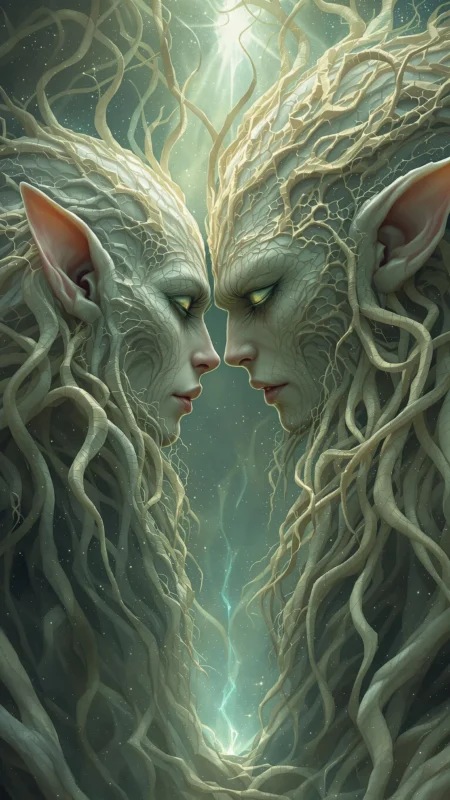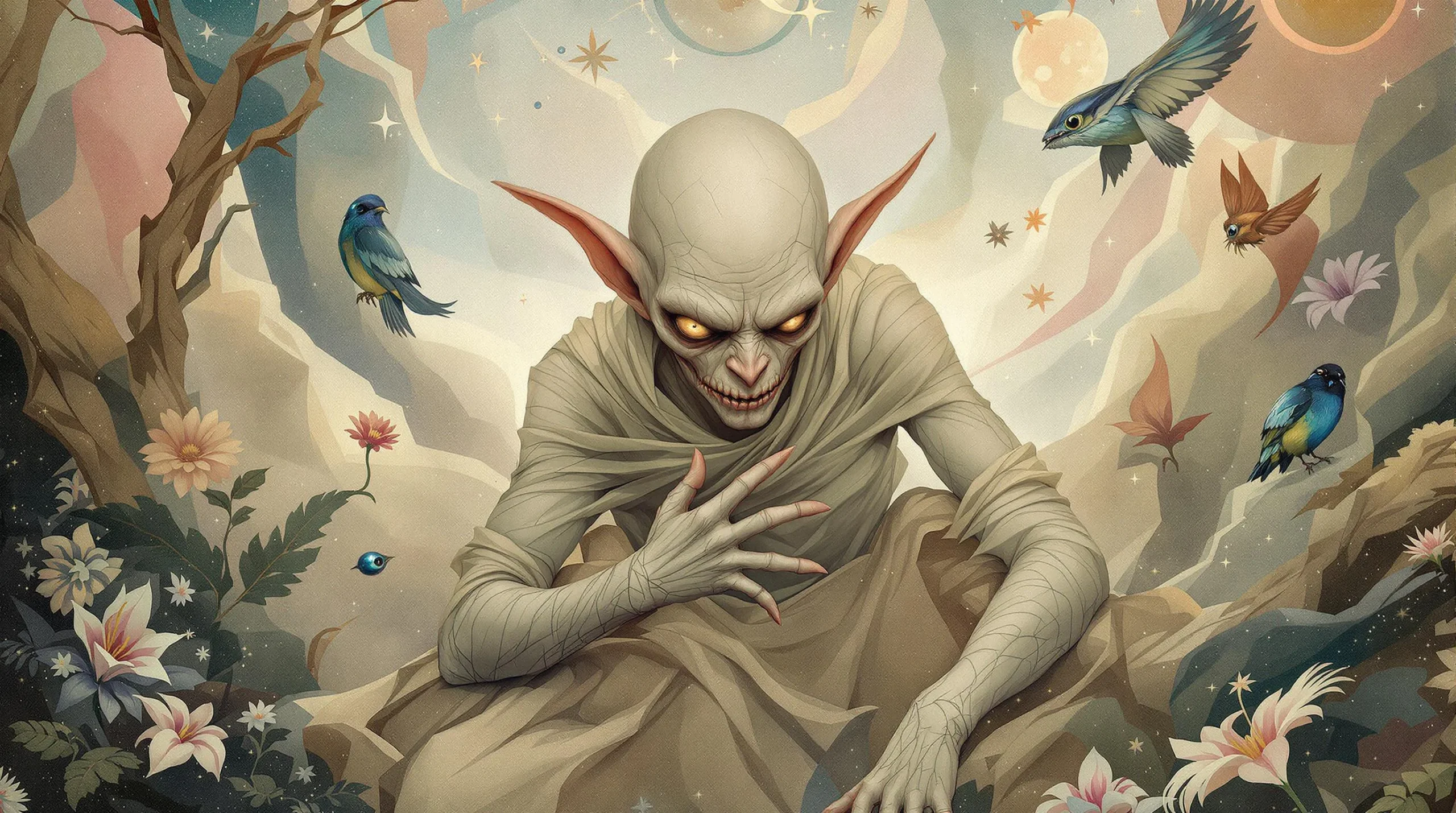


Gollum

Archetype Meaning & Symbolism

Obsessed, corrupted, isolated, cunning, wretched, pitiful, dualistic, survivor, tormented, grasping

  • We wants it, we needs it. Must have the precious.

If Gollum is part of your personal mythology, you may...

Believe

  • That one thing, a single person, object, or goal, is the source of all meaning, and life without it is worthless.
  • That you are fundamentally and irrevocably damaged, and must hide your true, wretched self from the world to survive.
  • That all relationships are a power struggle, and to trust is to give someone a weapon to use against you.

Fear

  • The loss of your 'precious,' which feels synonymous with the annihilation of your entire being.
  • That others will discover your obsession and your true, hidden nature, and will cast you out.
  • That the 'good' part of you, the memory of who you were before the obsession took hold, will be extinguished forever.

Strength

  • A powerful, tenacious will to survive that allows you to endure hardships that would crush others.
  • A profound, innate understanding of the shadow, addiction, and the dark side of desire, making you a source of uncanny wisdom for those lost in similar struggles.
  • The ability to navigate the 'underground' of society or the psyche, finding paths and resources where others see only darkness and despair.

Weakness

  • A singular, all-consuming obsession that overshadows health, relationships, and personal growth.
  • A deep-seated paranoia that isolates you from genuine connection and creates a world of perceived enemies.
  • A fractured identity, leading to constant internal conflict, indecision, and self-sabotage.

The Symbolism & Meaning of Gollum

Gollum is perhaps the modern myth for the anatomy of addiction. He is a ghost haunting the hallways of the self, a testament to how a single, glittering desire can hollow a person out until nothing remains but the shape of their wanting. He symbolizes the beautiful thing that becomes a monstrous thing, the love that sours into possession, the ambition that eats the ambitious. In a personal mythos, Gollum may represent that one vulnerability, that singular 'precious' around which the entire soul orbits, a dark sun that warms with its promise and destroys with its gravity. He is a living portrait of the bargain we may make with our own shadows: to trade the world for a single, perfect, secret thing.

The archetype could also be a profound exploration of lost innocence. The memory of Sméagol, of sun on a riverbank and simple friendship, is what makes Gollum’s fate a tragedy rather than just a horror. He is the chilling whisper that reminds us of a self we may have lost to trauma, to a poor choice, to the slow erosion of time. His existence in one’s personal narrative might serve as a constant, low hum of grief for a self that could have been. He is the embodiment of the question: can we ever truly go home again, or are we forever shaped by the darkest caves we have hidden in?

Furthermore, Gollum could represent the repellent, wretched parts of ourselves we wish to disown. He is the cringe-inducing neediness, the bitter jealousy, the sly manipulations we barely admit to in the quiet of our own minds. To have Gollum in one’s mythology is to accept the existence of this creature within, not as an enemy to be slain, but as a pitiable, wounded part of the whole. He suggests that enlightenment may not be about purification, but about integration: learning to live with the whispering, grasping creature who also, tragically, happens to be us.


Gollum Relationships With Other Archetypes

The Ring

The Ring is not so much an object as it is a relationship, a covenant with emptiness. It is, perhaps, a lover who consumes, a promise whispered in a dead language that one feels compelled to obey without understanding. For the Gollum, this artifact could be seen as a kind of anti-soul, a singularity of desire that has pulled the self inside out, leaving a mere husk orbiting its terrible light. The Ring may offer a kind of purpose, but it is the purpose of a key that fits only the lock to one's own cage, a purpose that mistakes the rhythmic clanking of a chain for the beating of a heart. It is the cold, perfect circle of obsession, offering a center to a life that has lost its own.

The Cave

The Cave is the architecture of the Gollum's soul, a geography of absolute interiority. It is perhaps less a dwelling and more an externalized skull, within which the shrunken consciousness ricochets. Here, in the dripping dark, the world is reduced to the slick feel of stone and the memory of a sun that has become mythological. The Cave could be understood as a kind of perverse sanctuary, a womb that did not birth a life but gestated a pathology. It is a cathedral built to honor a single, wretched relic, where the only hymns are the guttural whispers of a name, and the darkness is not an absence of light, but a presence in itself—a thick, silencing blanket for a self that can no longer bear the world.

The Echo

The Echo might be the truest companion to the Gollum, the ghost that lives in his throat. His speech, looping and broken, is not true communication but the sound of a thought that has been trapped for centuries, bouncing off the damp walls of his own isolation. It is as if his identity has been reduced to a single, fraying thread of sound—“precious”—a word that has long since shed its meaning to become a pure, sonic compulsion. The Echo could be the auditory signature of a hollowed-out being, a testament to a mind that no longer generates new light but can only reflect the ghost of an old fire. In this way, the Gollum's every utterance may be a kind of desperate performance, an attempt to prove he still exists by hearing the sound of his own ruin returned to him from the dark.

Using Gollum in Every Day Life

Recognizing the Corrupting Object

When a career ambition, a creative project, or even a wellness goal ceases to be a source of growth and instead becomes a private, guarded treasure, the Gollum archetype offers a map. It may help one question if the object of desire is still serving life, or if life is now serving the object. One might ask: have I retreated to a cave of my own making to polish this one, single thing?

Navigating Internal Conflict

The stark split between the whimpering, nostalgic Sméagol and the hissing, ravenous Gollum is perhaps a perfect mirror for internal moral battles. When faced with a choice that pits a nostalgic, simpler self against a more ruthless, ambitious one, invoking this archetype can clarify the stakes. It lays bare the dialogue of self-sabotage and self-preservation, showing how easily one can become a stranger to who they once were.

Understanding the Nature of Survival

The archetype may serve as a potent meditation on the costs of endurance. For anyone who has survived a profound trial, Gollum poses a chilling question: what parts of myself did I bargain away to get through? He is a monument to the idea that survival is not always a clean victory; it can be a long, slow corruption, a twisting of the self that may require a second, more difficult journey to heal.

Gollum is Known For

The One Ring

His singular, all-consuming obsession that warped his body and mind, which he lovingly and tragically referred to as his "Precious."

A Fractured Psyche

The constant, visible war within himself between two personalities: the original, gentler Hobbit-like creature named Sméagol, and the corrupted, monstrous creature he became, Gollum.

A Pivotal, Ambiguous Role

He is neither purely hero nor villain; a wretched, pitiable thing whose actions are driven by addiction, yet he is ultimately instrumental in the destruction of the Ring he so coveted.

How Gollum Might Affect Your Personal Mythology

How Gollum Might Affect Your Mythos

When Gollum slinks into the personal mythos, he drags the entire narrative into the shadows. The life story is no longer a simple hero’s journey, a linear progression toward a noble goal. Instead, it becomes a cautionary tale, a chronicle of temptation. The central plot may pivot from 'What can I achieve?' to 'What must I resist?' Every triumph might be scrutinized for its cost, every treasure assessed for its potential to become a 'precious.' The mythos may be one of constant vigilance, of managing an internal schism, where the protagonist is also their own primary antagonist. The story's climax might not be a grand battle, but a quiet, internal moment of choosing the memory of the sun over the gleam of the Ring.

The Gollum archetype may also infuse the mythos with a profound sense of tragedy and consequence. Past mistakes are not chapters to be closed; they are ghosts that live in the present, shaping every decision. The narrative might be built around a core wound, a moment of corruption from which the protagonist has never fully recovered. This creates a story not of overcoming, but of enduring with a limp. The character's purpose in their own myth could shift from finding greatness to simply finding a way to live with the damage, to prevent the monster from consuming what little is left of the person they once were.

How Gollum Might Affect Your Sense of Self

To see oneself through the Gollum lens is to perhaps accept a vision of the self as fundamentally fractured. There is no unified 'I,' but a constant, tense negotiation between the 'we': the wretched, craving Gollum and the pitiable, nostalgic Sméagol. Self-perception might be a pendulum swinging between abject self-loathing and a faint, desperate echo of former innocence. One could feel perpetually haunted by the person they used to be, a ghost of a memory that only serves to highlight their current state of perceived corruption. This internal split may make self-acceptance a near-impossible task; how can one accept a self that feels like a civil war?

This archetype could also foster a sense of being inwardly grotesque, regardless of outward appearance or accomplishment. The secret knowledge of one's own 'precious'—the obsessive thoughts, the hidden compulsions, the dark desires—may create a profound and isolating shame. The self is a thing to be hidden in a dark cave, away from the judging eyes of others who could never understand the 'tricksy' nature of one's own heart. Self-worth is not inherent; it is tethered completely to the object of desire. Without it, one feels like nothing, and with it, one is only a guardian, not a person.

How Gollum Might Affect Your Beliefs About The World

A worldview colored by the Gollum archetype may be one of pervasive suspicion and scarcity. The world is not a place of wonder and opportunity, but a dark forest full of thieves who want your 'precious.' Every beautiful object, every powerful position, may be seen as a potential snare, a Ring that promises dominion but delivers only bondage. This perspective could breed a deep cynicism about power, relationships, and even beauty itself, viewing them all as potential agents of corruption. Trust is a fool’s luxury. The world is reduced to a simple, brutal binary: that which helps you keep the 'precious,' and that which threatens it.

This view may also flatten the world into a stark, survivalist landscape. The grand tapestries of culture, society, and intellectual pursuit could seem like frivolous distractions from the only thing that truly matters: sustenance and security of the obsession. The world is not a community to participate in, but a hunting ground. Others are not peers, but rivals or obstacles. The Gollum perspective is profoundly lonely; it is the viewpoint from the bottom of a ravine, where the only thing visible is the stone walls of one's own making and the sliver of sky one can no longer reach.

How Gollum Might Affect Your Relationships

In relationships, the Gollum archetype may manifest as a corrosive possessiveness. Love and friendship are not partnerships; they are acquisitions. The other person becomes a 'precious,' an object to be guarded, hidden, and controlled, lest they be stolen away. This can lead to a smothering, jealous form of affection that is rooted in fear of loss rather than genuine care. The internal monologue might be a constant mantra of 'my own, my love, my precious,' turning the other person into a mirror for one's own needs, rather than seeing them as a separate individual with their own life.

Alternatively, the archetype could compel one to push all relationships away to protect the true 'precious,' be it a secret addiction, a career, or a hidden part of the self. Connection is a threat. Intimacy is a risk of exposure. The Gollum-aspected person might sabotage their own chances at love and belonging, retreating into a self-imposed exile where they can be alone with their obsession. The tragedy is that the Sméagol part of them may desperately crave the warmth of companionship, the memory of a shared meal, but the Gollum part cannot bear the light, convinced that it will only reveal its wretchedness and result in loss.

How Gollum Might Affect Your Role in Life

One who incorporates Gollum into their personal mythology may feel destined for the role of the outcast or the pariah. They might not see themselves as the hero, the sidekick, or even the villain, but as something else entirely: a necessary consequence, a piece of living collateral damage in someone else's grander story. Their purpose may feel defined by their wound, their role to serve as a walking, talking cautionary tale for others. This can be a profoundly isolating identity, a sense that one's place is forever on the periphery, looking in on the warmth of community from a cold, damp cave.

Conversely, the role might be interpreted as that of the unwilling guide through darkness. Having navigated the treacherous tunnels of obsession and moral decay, the individual may feel uniquely qualified to lead others through similar landscapes. They are the ferryman across the river of addiction, the one who knows the secret paths because they have crawled them on their hands and knees. This is not a heroic role born of strength, but a grim duty born of bitter experience. Their function is not to slay the dragon, but to point out precisely where it sleeps and to warn of the terrible beauty of its treasure.

Dream Interpretation of Gollum

In a dream, Gollum’s appearance in a positive context may not be a curse, but an invitation. He could emerge from the water of the subconscious holding not a Ring, but a key, a forgotten memory, or a lost part of the self. His presence might signal that it is time to confront an obsession, not to destroy it, but to understand its origins. He may be a guide, leading the dreamer back to the 'riverbank,' to the moment before the corruption, asking them to reclaim the innocent desire before it curdled into need. He could represent the wisdom that comes from surviving the depths.

In a negative context, dreaming of Gollum is a potent warning. He might be seen stealing something the dreamer holds dear, symbolizing an obsession that is robbing them of joy, relationships, or peace. A dream of physically becoming Gollum, of feeling one’s own hands become grasping claws and one’s voice a hateful hiss, could reflect a deep-seated fear of moral decay. It may suggest the dreamer feels they are losing their humanity to a singular, destructive pursuit. He is the symbol of the soul’s famine, a sign that the 'precious' is starving everything else to death.

How Gollum Archetype Might Affect Your Needs

How Gollum Might Affect Your Physiological Needs

The Gollum mythos may impress upon the body a story of pure, unadorned survival. Physiological needs are met with a grim functionality, stripped of all ritual or pleasure. Food is not cuisine; it is fuel, 'raw and wriggling.' It could translate into disordered eating habits, a cycle of desperate consumption followed by long periods of neglect, mirroring the feast-or-famine existence of the creature. The body is not a temple to be cared for but a rickety vehicle to be pushed onward, its aches and pains ignored in service of the greater, singular need.

This archetype might also manifest as a state of perpetual, wiry tension. The physical self could be coiled like a spring, subsisting on nervous energy and adrenaline. Sleep may be fitful and light, a state of semi-vigilance against potential threats. There might be a disregard for comfort, a preference for hard, cold places, an unconscious physical mirroring of the emotional austerity Gollum represents. The body becomes a landscape of its own narrative: gaunt, sinewy, and adapted for the dark.

How Gollum Might Affect Your Ideas of Belonging

The Gollum archetype may cast a long and lonely shadow over the need for belonging. Love and intimacy are seen through a lens of profound suspicion. To belong is to be vulnerable, to expose one's 'precious' to the risk of being misunderstood or stolen. This may lead to a pattern of self-imposed exile, pushing away potential friends and partners with 'tricksy' behavior or by retreating into silence. The desire for connection may be intense, a faint Sméagol-like whimper, but it is constantly overruled by Gollum’s paranoid conviction that 'they're all thieves, they're all enemies.'

Belongingness may also be poisoned by the memory of a past betrayal or loss, symbolized by how Sméagol was cast out by his own people. This core wound could create a belief that one is fundamentally unlovable or too corrupted to be part of any group. They may haunt the edges of social circles, deeply envious of the easy camaraderie of others but convinced they have no place in it. The only 'belonging' they can trust is the bond with their obsession, a closed loop of subject and object that permits no one else inside.

How Gollum Might Affect Your Feelings of Safety

For one with Gollum in their mythos, safety is not a feeling of peace but an act of possession. Security is not found in community, but in a secret, isolated place with one's 'precious.' This can manifest as a deep-seated paranoia, a constant fear that the world is conspiring to take what is yours. Safety needs might be met through hoarding, whether it be money, information, or objects, creating secret stashes that no one else knows about. The home is not a haven; it is a fortress, or more accurately, a cave, designed to repel intruders.

Furthermore, safety could be paradoxically linked to danger. The Gollum archetype may feel most secure when on the move, skulking in the shadows, and trusting no one. A stable, predictable environment might feel like a trap, making one vulnerable to attack. This person could unconsciously create chaos or instability in their own lives to maintain a sense of control, believing that if they are always navigating a treacherous landscape, no one can ambush them. Safety is the absence of trust, a state of being so isolated that no one can get close enough to hurt you or steal from you.

How Gollum Might Affect Your Views of Esteem

Esteem, within the Gollum framework, is perhaps a shattered concept. It is replaced by a vicious cycle of self-aggrandizement and self-hatred, both tethered to an external object. When the 'precious' is secure, there might be a flicker of smug, secretive pride. But this is not true self-esteem; it is the temporary satisfaction of a craving. For the most part, the inner world may be dominated by Gollum’s litany of self-loathing: 'We are wretched, we are filthy.' The self is perceived as contemptible, a thing of pity and disgust.

The archetype might completely sever the link between personal accomplishments and self-worth. Achievements in the world mean nothing if the 'precious' is threatened. The only measure of value is the possession of the singular object of desire. This creates a terrifyingly fragile sense of self. Without the Ring, Gollum is nothing, just a whimpering, lost creature. This could translate to a person whose entire identity and sense of esteem are wrapped up in one thing—a job, a relationship, a status symbol—and who would feel completely annihilated without it.

Shadow of Gollum

The shadow of the Gollum archetype emerges when the internal dialogue ceases, not because Sméagol wins, but because he is finally and utterly silenced. In its shadow form, this archetype is no longer a conflicted figure but a singular, monstrous appetite. The 'precious' is no longer just an obsession; it is the only reality. The person may become wholly consumed by their want, their moral compass shattered and discarded. They are not just hiding from the world; they may be actively hostile to it, viewing everything and everyone as a direct threat to be neutralized or destroyed. The shadow Gollum is not pitiable; it is purely predatory.

When this shadow takes hold, the person may lose all perspective, sacrificing their health, their home, their family, and their humanity on the altar of their desire. Their cunning, once a tool for survival, becomes a weapon for pure manipulation and malice. There is no more talk of 'we,' only a terrifying, singular 'I' that is synonymous with the craving itself. This is the endpoint of corruption, where the person has not just been twisted by their Ring of power, but has become it: a cold, hard, empty circle of endless, grasping need.

Pros & Cons of Gollum in Your Mythology

Pros

  • The archetype provides a powerful, universally understood metaphor for addiction and obsession, offering a framework for confronting these issues in oneself.
  • It fosters an extreme resilience and a will to live, an ability to subsist on the barest of emotional and physical resources.
  • By acknowledging the Sméagol within the Gollum, it opens a path to self-compassion, allowing one to pity and care for the most wounded and repellent parts of the self.

Cons

  • It may promote a worldview drenched in cynicism and paranoia, making genuine trust and intimacy feel impossible.
  • There is a constant danger that the internal 'Gollum' will overwhelm the 'Sméagol,' leading to self-destructive choices and moral compromises.
  • It can lead to a state of profound and agonizing isolation, a self-imposed exile from the warmth of community and belonging.