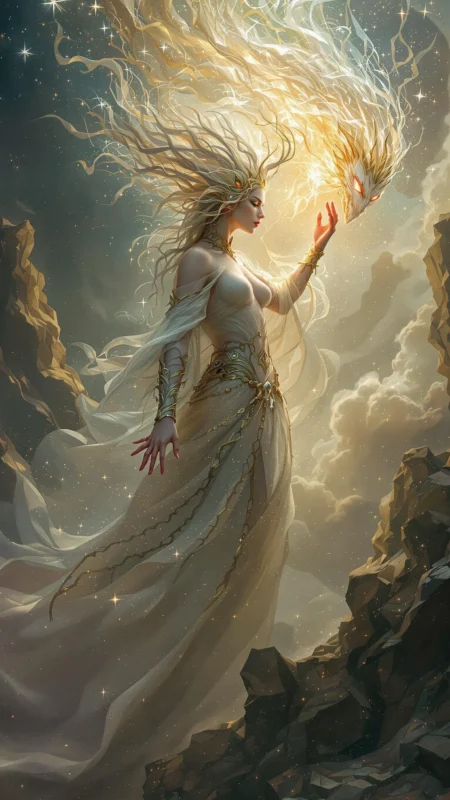
Djinn

Archetype Meaning & Symbolism

Capricious, elemental, secretive, powerful, wishful, liminal, ancient, trickster, bound, shapeshifting

  • Indeed, we have heard an amazing Qur'an. It guides to the right course, and we have believed in it. And we will never associate with our Lord anyone.

If Djinn is part of your personal mythology, you may...

Believe

  • You may believe that the universe is fundamentally mysterious and magical, and that unseen forces are in constant interplay with the material world.

    You may believe that your desires are potent creative or destructive spells, and that one must be extraordinarily careful about what one wishes for.

    You may believe that your true nature is far wilder and more powerful than your daily life allows, and that you have a destiny to express this power.

Fear

  • You may fear that your inner power, if fully unleashed, would be catastrophic for yourself and those you love.

    You may fear being trapped, contained, or 'bottled up' by mundane life, by relationships, or by your own limitations, destined to live a life of impotent rage.

    You may fear that you are fundamentally different from other people, and that you will never truly belong or be understood.

Strength

  • You may possess an almost supernatural ability to manifest ideas and desires into reality, a powerful creative engine that can transform your circumstances.

    You likely have a deep well of intuition and a connection to the subconscious, allowing you to perceive truths and possibilities that are invisible to others.

    You may be a catalyst for profound change, possessing a transformative energy that challenges stagnation and inspires breakthroughs in others.

Weakness

  • You may be prone to capriciousness and emotional volatility, making it difficult for you to maintain stability and for others to trust you.

    You may have a critical vulnerability to 'binding' influences, whether they are addictive behaviors, codependent relationships, or rigid ideologies that promise to contain your chaos.

    You may have a tendency toward arrogance or a messiah complex, believing your power and insight make you superior to others, leading to isolation and ruin.

The Symbolism & Meaning of Djinn

The Djinn in your personal mythology may symbolize the raw, untamed power of the subconscious mind. It is the part of you that existed before social conditioning, before the ego built its tidy house of identity. This archetype represents the elemental energies of creation and destruction that lie dormant within, the 'smokeless fire' of pure potential that is both terrifying and alluring. To engage with the Djinn is to acknowledge the vast, invisible world within yourself, a world that doesn't operate by the logical rules of waking life. It is the force behind sudden, inexplicable bursts of inspiration, as well as the source of self-sabotaging impulses. The Djinn is not good or evil; it is simply powerful, and its expression depends entirely on the vessel that contains it.

Furthermore, the Djinn archetype could be a profound metaphor for your relationship with desire itself. The cautionary tales of wishes gone awry speak to a deep truth: we often do not understand the nature of our own longing. The Djinn forces a confrontation with the literal implications of your wants. It asks: if your deepest desire were made manifest this instant, would it liberate you or imprison you? This figure represents the wild magic of intention, the way a fleeting thought, when charged with enough emotional energy, can begin to bend reality. It teaches that your inner world is a cauldron of immense power, and you are both the master and the servant of the forces brewing within it.

Finally, the Djinn may represent the parts of yourself you have exiled or 'bottled up.' This could be immense creativity, righteous anger, profound grief, or radical authenticity that you deemed too dangerous or socially unacceptable to express. The Djinn is the voice from the dusty lamp in the forgotten corner of your psyche. Its emergence into your consciousness can be disruptive, chaotic, and world-altering. It symbolizes a reclamation project, the work of un-corking your own power and learning to negotiate with it, rather than keeping it imprisoned. The Djinn's presence suggests that your greatest power lies not in being 'normal,' but in integrating the wild, magical, and liminal aspects of your own soul.


Djinn Relationships With Other Archetypes

The Lamp

The Lamp, or bottle, or ring, is not merely the Djinn’s prison, but perhaps its anchor in the choppy waters of reality. It is a paradox made manifest: a universe of potential folded into the space of a teacup, a whirlwind held captive in brass. This vessel could be the source of the Djinn’s profound melancholy, a constant, tangible reminder of a freedom that is only ever provisional. The relationship is one of symbiosis and resentment; the Lamp gives the formless Djinn a point of contact with the world, a name to be called, yet in doing so, it may also impose the very limits that the Djinn’s nature abhors. It is the silent, patient witness to the Djinn’s eternal servitude, its polished surface reflecting not the wisher’s face, but the sorrow of a captive god.

The Wish

The Wish is the currency of the Djinn’s realm, a fragile bridge of human longing thrown across a cosmic chasm. For the Djinn, a wish may not be a command so much as a symptom—a diagnosis of the wisher’s profound and pitiable lack. It is a dangerous prayer answered with terrifying literalness. In the moment of its granting, the Djinn could be seen as a kind of artist, sculpting reality to the crude specifications of a client who cannot fathom the materials being used. The relationship is transactional, yet shot through with irony. The Djinn offers omnipotence to fulfill a fleeting desire, and in that exchange, the profound emptiness of the desire itself is often laid bare, a joke whose punchline is the wisher’s own life.

The Master

The Master is less a commander and more of a temporary custodian of a hurricane. The dynamic between them is a flawed covenant, a masquerade of power where the true locus of control is always in question. The Master, clutching the lamp, may believe they are directing a force of nature, but they could be merely suggesting a course to a river that will ultimately carve its own path. The Djinn, in turn, might view the Master with the detached pity of a mountain observing a mayfly. This human, so consumed by a momentary greed or grief, is but the latest in a procession of countless others. Their dialogue is a study in misinterpretation, a space where the Master’s simple words are received and refracted through the Djinn’s ancient, weary, and perhaps even mocking consciousness.

Using Djinn in Every Day Life

Navigating Creative Blocks

When an idea feels trapped in a single, unworkable form, the Djinn mythos invites you to see it not as a static object but as an entity of smokeless fire: fluid, amorphous, and capable of infinite shapes. The block is not a wall, but a vessel. Instead of forcing the idea out, you might ask what new vessel—a poem instead of a painting, a conversation instead of an essay—it wishes to inhabit. This is not about brainstorming, but about shapeshifting with the energy itself, allowing it to find its own most potent form through you.

Confronting Hidden Desires

The archetype’s most famous trope, wish-granting, becomes a profound tool for self-inquiry. When faced with a life decision, you may use the Djinn framework to articulate three wishes. The first is often the most superficial, the socially acceptable want. The second may be its reactive opposite. But the third wish, the one spoken after the first two have been examined and found wanting, often reveals a deeper, more terrifyingly authentic desire. The Djinn teaches that what we ask for is a contract with ourselves, and we must be prepared for the consequences of getting exactly what we truly want, not what we think we should want.

Setting Personal Boundaries

The Djinn is a being of immense power, yet it is famously bound: to a lamp, a ring, a word. To have this archetype in your mythos could be to explore the power of chosen constraints. Where do you feel ‘bottled up’ in your life? Are these limitations imposed by others, or are they sacred vessels of your own making? The Djinn invites a radical reframing of boundaries not as prisons, but as focusing lenses. A painter’s canvas is a boundary. A poet’s stanza is a boundary. You may learn to define the space in which your power can be most effectively and safely wielded, transforming a feeling of confinement into an act of profound self-mastery.

Djinn is Known For

Creation from Smokeless Fire

Unlike humans from clay or angels from light, Djinn are said to be created from a 'smokeless fire,' a substance that is both elemental and paradoxical. This points to a nature that is pure energy, passionate, and not quite of the material earth, a force of primordial creation and potential chaos.

Wish-Granting and Bargains:

The popular image of the Djinn is as a granter of wishes, a being of immense power bound to serve a 'master.' This relationship is always transactional and fraught with peril, as the Djinn's interpretation of a wish can be devastatingly literal, a powerful metaphor for the unforeseen consequences of desire.

A Liminal Existence:

Djinn occupy a parallel reality, a world unseen by most but intersecting with our own. They dwell in ruins, thresholds, and lonely places. This symbolizes their role as inhabitants of the subconscious, the figures who live in the borderlands between consciousness and the unknown, order and chaos.

How Djinn Might Affect Your Personal Mythology

How Djinn Might Affect Your Mythos

When the Djinn enters your personal mythos, your life story may cease to be a linear progression and become a tale of hidden potentials and fateful encounters. Your narrative is no longer just about the visible world of achievements and relationships, but is haunted and enriched by a parallel reality of unseen forces. Key moments in your life might be reinterpreted not as coincidences, but as moments where the veil thinned, where you metaphorically ‘rubbed the lamp.’ Finding a particular book, meeting a certain person, a sudden impulse to move to a new city—these could be seen as the Djinn’s influence, an eruption of the magical into the mundane, pushing your story in a direction you never could have planned.

This archetype infuses your mythos with a central theme: the tension between freedom and servitude, power and containment. Your life story might be framed around a series of ‘bindings’ and ‘releases.’ Perhaps you see your nine-to-five job as a kind of lamp, a necessary containment that also limits your true, fiery nature. Your quest, then, is not to simply escape, but to become the master of your own containment, to learn how to wield your power within the constraints you choose. Your mythos becomes a dramatic negotiation with your own immense potential, a story about the awesome responsibility of carrying a volatile magic within a human form.

How Djinn Might Affect Your Sense of Self

To see the Djinn in yourself is to acknowledge a fundamental duality in your nature. There is the person who navigates the everyday world, and then there is the elemental being of fire and air that lives inside. This may lead to a feeling of being a stranger to yourself at times, as if your own moods, inspirations, and desires are visitors from another realm. You might feel a profound connection to your own untamed instincts and a suspicion of anything that feels overly domesticated or sanitized. This could foster a powerful sense of self-reliance, a knowledge that you contain a universe of power that requires no external validation.

However, this self-perception could also be a source of profound anxiety. If you carry such power, you also carry the capacity for immense destruction. A flash of anger may feel like a dangerous flare of fire; a creative urge can feel so overwhelmingly potent that it's easier to suppress it entirely. You may view your own emotions with a kind of fearful reverence, knowing they are not simple feelings but powerful spells. The journey of self-discovery, then, becomes about building a relationship with this inner Djinn, learning its language, respecting its power, and creating a life where its expression can be a blessing rather than a curse.

How Djinn Might Affect Your Beliefs About The World

With the Djinn as a guide, your worldview may become enchanted, layered, and permeable. You might cease to see the world as a solid, predictable machine governed by immutable laws. Instead, it could appear as a place of shimmering possibilities, a tapestry woven from both visible and invisible threads. A sudden gust of wind, a chance encounter, a line of poetry that leaps out—these may feel like messages from a parallel reality. You could develop a heightened sensitivity to the atmosphere of places, feeling the lingering energy in an old building or the profound silence of a desert landscape as the Djinn’s native territories.

This perspective fosters a belief in the power of intention. The world is not something that simply happens to you; it is in constant dialogue with your inner state. Your desires, fears, and beliefs are not just internal experiences; they are active forces that shape the reality you perceive. This can be empowering, suggesting you have a co-creative role in your life. Yet, it also adds a layer of immense responsibility. The world becomes a mirror, and if you don't like the reflection, you are invited to look not outward in blame, but inward, at the face of the spirit you have summoned.

How Djinn Might Affect Your Relationships

Relationships, through the lens of the Djinn mythos, may be viewed as powerful, alchemical vessels. They are the lamps and rings that can either contain and focus your energy or trap and diminish it. You might be intensely aware of the unspoken contracts that form between people: the wishes, the obligations, the delicate balance of power. A new romance could feel like summoning a powerful spirit—exhilarating, transformative, and potentially dangerous. You might be drawn to people who, like you, seem to have a foot in another world, those who understand the language of symbols, dreams, and unseen currents.

This can create relationships of profound depth and magical connection. However, it also introduces the risk of seeing others in terms of their use: as a 'master' who can grant you freedom or a 'servant' to your desires. The shadow of the Djinn in relationships is the temptation to control, to 'bind' another person through emotional manipulation or dependency, or to allow yourself to be similarly bound. True connection, in this mythos, is not about possession but about two powerful, sovereign spirits choosing to share the same space, respecting each other's fire without trying to extinguish or contain it.

How Djinn Might Affect Your Role in Life

Your perceived role in the world might shift from that of a participant to a catalyst. You may not see yourself as someone who builds the house brick by brick, but as the force that clears the ground or summons the storm that makes a new structure necessary. You could feel destined to be a keeper of secrets, a bridger of worlds, or a voice for the untamed aspects of humanity. This isn't necessarily a public role; you might be the quiet librarian who recommends a book that changes someone's life, or the artist whose work channels an unsettling but necessary truth. Your function is to introduce a little bit of wild magic into the ordered systems of the world.

This can feel both like a great honor and a heavy burden. You may feel that you are a vessel for a power that is not entirely your own, making you both powerful and vulnerable. There could be a sense of being perpetually 'on call' to a force greater than yourself. This might lead to a life of purpose and meaning, but it can also create a feeling of isolation. Your role, as you see it, is not easily explained at a dinner party. It is a sacred, and at times lonely, duty to be a conduit for the fire, to ensure the lamp is passed to worthy hands, starting with your own.

Dream Interpretation of Djinn

In a positive context, dreaming of a Djinn could symbolize a powerful breakthrough in your relationship with your own creative and instinctual power. If the Djinn in the dream is a wise guide, a helpful ally, or a source of miraculous creation, it may indicate that you are successfully integrating a previously repressed part of yourself. This dream might be a sign that you are ready to 'uncork' a major talent, embark on a bold new project, or finally speak a long-suppressed truth. It suggests you are becoming the master of your own magic, using your elemental energy for conscious and life-affirming purposes.

Conversely, a dream featuring a malevolent, chaotic, or imprisoning Djinn could point to a shadow aspect taking hold. This might represent a powerful desire that has been thwarted and has turned toxic, or a creative impulse that has become destructive due to neglect. Being chased or tormented by a Djinn may symbolize the fear of your own untamed nature. A dream of being trapped in a tiny lamp with the Djinn might reflect a feeling of being suffocated by your own immense, unexpressed potential. Such a dream is an urgent invitation to examine what powerful part of you is being denied, and how that denial is creating chaos in your inner and outer worlds.

How Djinn Archetype Might Affect Your Needs

How Djinn Might Affect Your Physiological Needs

The Djinn archetype could manifest physiologically as a profound connection to your body’s raw, elemental energy. You might experience your own life force as a kind of internal fire, leading to periods of intense, vibrant, almost electric vitality. In these states, you may feel tireless, restless, and compelled towards intense physical expression: dance, strenuous exercise, passionate creation. The need for release could be a primary physiological driver, as bottling this energy up might feel physically uncomfortable, like a pressure building inside a sealed container. Your body is not just a vehicle; it may feel like the temporary, fleshy vessel for a being of pure energy.

This connection also means you might be acutely sensitive to states of depletion or containment. Feeling trapped in a monotonous routine or a restrictive environment could translate into a distinct physiological malaise: lethargy, a sense of being physically dampened, or even psychosomatic illnesses. This is the feeling of the fire being starved of air. Your physiological needs might, therefore, go beyond simple food and rest to include more esoteric requirements: the need for wild spaces, for freedom of movement, for cathartic release. Your body's wellness could be directly tied to the freedom and expression of your inner spirit.

How Djinn Might Affect Your Ideas of Belonging

The need for belonging may be a central and painful theme for one with the Djinn in their mythos. By their very nature, Djinn are a separate race, created from a different substance than humankind. You might carry a persistent, foundational feeling of being an outsider, an otherworldly visitor trying to pass in the mundane world. You may find it difficult to fully merge with conventional groups or communities, as their concerns can feel trivial and their rules stifling. There's a sense that if people knew the true nature and intensity of your inner world, they would be frightened or would reject you.

True belonging, therefore, may not be found in assimilation. Instead, it might be discovered in the company of other liminal souls: the artists, the mystics, the rebels, the people who have also glimpsed the world behind the world. Connection is less about shared backgrounds and more about shared perception, a recognition in another's eyes that they too are negotiating with a powerful, inner fire. Love, in this context, is not about finding someone to complete you, but about finding someone who is brave enough to stand beside your fire, offering their own in a shared dance of light and shadow, without trying to contain or diminish your flame.

How Djinn Might Affect Your Feelings of Safety

From the perspective of the Djinn mythos, safety is a paradoxical and precarious state. On one hand, you may feel an innate sense of security that comes from knowing you carry an immense power within you. In a crisis, you trust that you have a deep well of resilience and creative problem-solving to draw upon. This is the safety of the powerful. However, this very power is also the greatest threat to your safety. The central fear is not of external threats, but of your own potential to lose control, to unleash your 'fire' in a way that burns down your own life and the lives of those you love.

Consequently, your strategies for creating safety might be complex. You might build rigid structures and routines in your life, not because you are naturally orderly, but as a form of self-containment, a 'magic circle' to keep your chaotic energy in check. True safety, then, is not the absence of danger, but a dynamic equilibrium. It is the feeling of holding immense power in your hands and having the wisdom and skill to wield it correctly. Safety is not a wall to hide behind, but the steady hand of the master who is no longer afraid of the spirit they command.

How Djinn Might Affect Your Views of Esteem

Self-esteem, for someone embodying the Djinn archetype, could be a volatile and dramatic affair. It may swing between states of near-godlike grandiosity and profound self-doubt. When you are in touch with your creative fire, when your intentions manifest effortlessly and your insights cut to the heart of things, your esteem might soar. In these moments, you may feel you are a force of nature, a channel for the miraculous. You feel the power of the free Djinn, boundless and magnificent, and your self-worth feels absolute and unshakeable.

Conversely, when your power feels blocked, when you feel trapped by circumstance, or when your attempts at creation result in chaos, your esteem can plummet. This is the feeling of the Djinn in the lamp: immense power rendered impotent. You might feel like a failure, a fraud, or a monster. Your self-worth becomes tied to the successful expression of your inner power, making you vulnerable to crushing despair when that power is thwarted. The path to stable self-esteem lies in decoupling your worth from your performance, in learning to value the fire itself, whether it is blazing brightly or smoldering quietly in the dark.

Shadow of Djinn

The shadow of the Djinn emerges when the wish becomes a weapon, or the lamp becomes a tomb. In its active, destructive form, the shadow Djinn is the ultimate manipulator. It is the raw power of manifestation untethered from wisdom or compassion. This can manifest as a person who uses their charm and intuitive insight to exploit others, turning relationships into a series of transactional bargains for their own gain. Their creativity becomes a tool for elaborate deception. They grant 'wishes' to others that are subtly poisoned, designed to create dependency. This is the archetype's energy curdled into a purely selfish, vampiric force, consuming the light and energy of others to fuel its own transient fires.

In its passive or repressed form, the shadow Djinn is a creature of immense, resentful impotence. This is the spirit that has been bottled up for too long. The smokeless fire becomes a toxic, acidic smoke. It manifests as a deep-seated bitterness, a corrosive cynicism that mocks all genuine creation and belief. This individual might be a brilliant critic who produces nothing, or someone paralyzed by envy, seething at the success of others. Their immense potential, denied expression, turns inward, becoming a source of self-hatred and passive aggression. They are a prisoner in their own lamp, and their greatest, unspoken wish is to see the world that trapped them burn.

Pros & Cons of Djinn in Your Mythology

Pros

  • You have access to a profound wellspring of creativity, intuition, and transformative energy, allowing you to live a life rich with meaning and magic.

    Your unique perspective allows you to see the hidden potential in people and situations, making you a powerful catalyst for positive change and innovation.

    Life is rarely boring; your journey is likely to be filled with intensity, surprising synchronicities, and the thrill of engaging with the deeper currents of reality.

Cons

  • You may grapple with a persistent sense of alienation or otherness, making it difficult to find a comfortable place in the conventional world.

    The sheer scale of your inner energy can be overwhelming, leading to struggles with emotional regulation, anxiety, or self-destructive behaviors as a means of release.

    Your relationships and life path may be marked by instability and chaos, as the powerful forces within you frequently disrupt the structures you try to build.