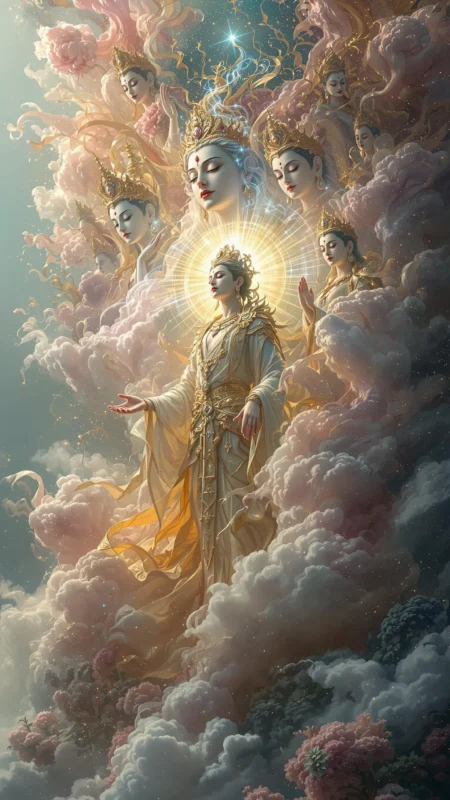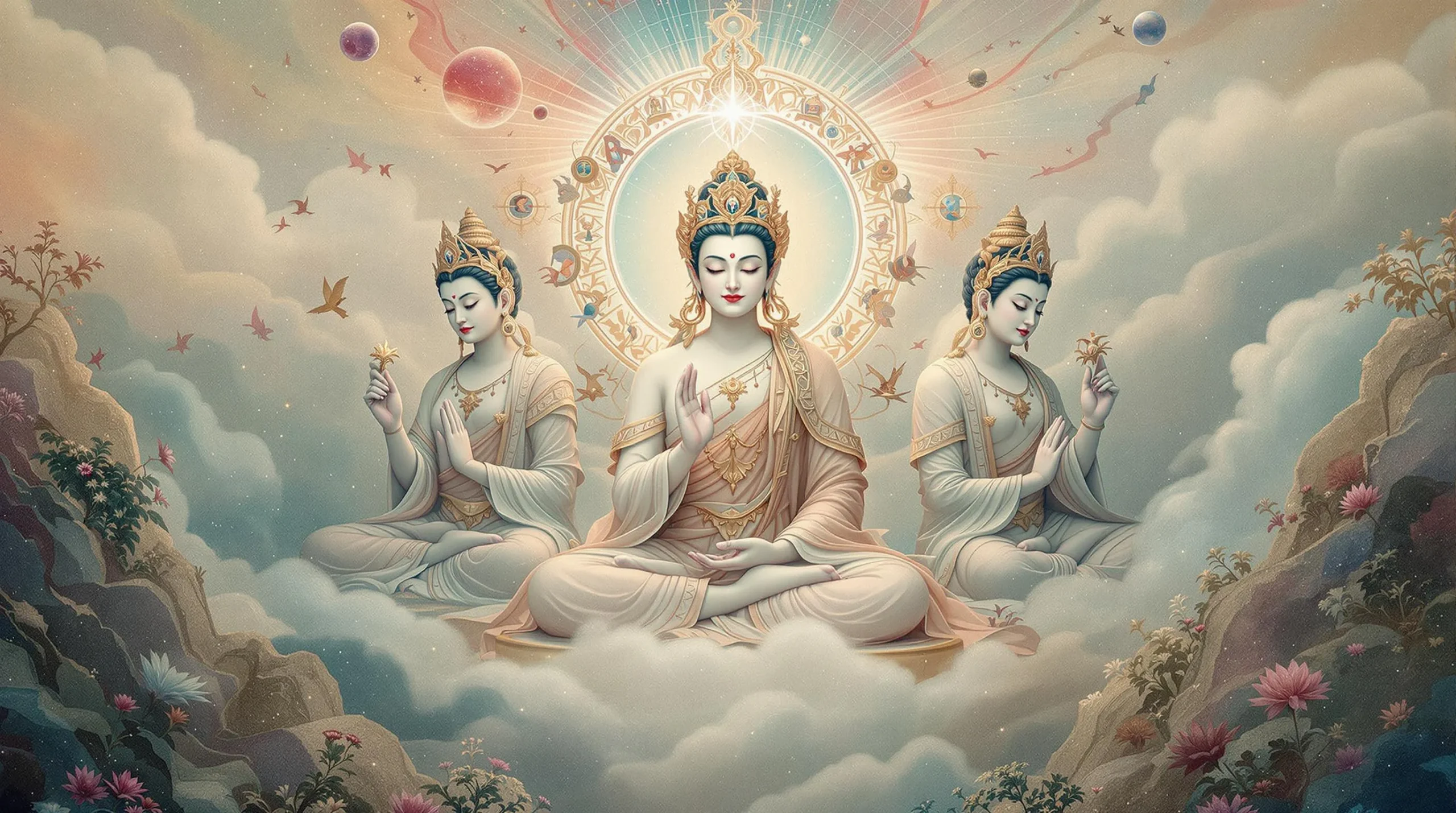


Bodhisattvas

Archetype Meaning & Symbolism

Compassionate, patient, resilient, wise, selfless, enduring, serene, joyful, bound, engaged

  • Sentient beings are numberless, I vow to save them. Desires are inexhaustible, I vow to end them. Dharma gates are boundless, I vow to enter them. Buddha's way is unsurpassable, I vow to become it.

If Bodhisattvas is part of your personal mythology, you may...

Believe

  • You may believe that your personal suffering is not a random, meaningless affliction, but a profound point of connection that allows you to genuinely empathize with the suffering of others.
  • You may believe that true power lies not in control or domination, but in vulnerability, patience, and the unwavering courage to keep your heart open in a world that often encourages you to shut it down.
  • You may believe that every single being, without exception, from the most saintly to the most depraved, possesses a fundamental nature of radiant goodness and is worthy of compassion.

Fear

  • You may fear that the sheer, oceanic weight of the world's suffering will eventually erode and break you, that your compassion is a finite resource and that one day you will find it empty.
  • You may fear that your altruism is a subtle and insidious form of spiritual ego, that you are becoming a 'savior' not to help others, but to feel righteous and superior in your own story.
  • You may fear an ultimate loneliness, a profound isolation from the ordinary joys and concerns of human life, set apart by a vow that no one else seems to understand or share.

Strength

  • An almost supernatural patience, the ability to sit with discomfort, conflict, and the excruciatingly slow pace of progress without resorting to aggression or despair.
  • The capacity to find deep meaning and purpose in the darkest corners of human experience, transforming personal and collective pain into fuel for the journey.
  • A radical empathy that allows you to dissolve the boundaries between self and other, fostering deep connections and inspiring courageous, compassionate action.

Weakness

  • A tendency toward self-neglect and martyrdom, forgetting that the vow-maker is also a sentient being who requires care, rest, and nourishment to be of any use to others.
  • A susceptibility to 'idiot compassion,' the unwise application of kindness that enables harmful behavior in others, born from a desire to be 'nice' rather than a commitment to true liberation.
  • An overwhelming sense of responsibility that can curdle into anxiety, despair, and paralyzing burnout when not balanced with wisdom and an acceptance of your own limitations.

The Symbolism & Meaning of Bodhisattvas

The Bodhisattva stands as a lighthouse keeper on the storm-tossed shores of existence. They have seen the calm harbor of Nirvana, felt its peace, yet they choose to remain at their post, turning the great lamp of their enlightenment back toward the turbulent sea. Their light is not a monument to their own arrival, but a guide for every other vessel still lost in the fog. Within a personal mythology, this figure symbolizes the profound choice to entangle oneself with the world's suffering not out of obligation, but out of a love so vast it dissolves the boundary between self and other. It suggests that the highest spiritual attainment isn't an escape, but a deeper, more radical engagement.

This archetype is the ferryman who, having crossed the river of suffering, turns the boat around. Again and again. The journey’s purpose shifts: it is no longer about getting to the other side, but about the act of ferrying itself. This recasts the entire narrative of a life. Setbacks, pain, and heartbreak are no longer personal failures or cosmic injustices. They become the very curriculum for compassion. They are the cracked places in your own heart that let the light of other beings in. The Bodhisattva mythos proposes that your deepest wounds may become your most profound medicine, not just for you, but for everyone you meet.

The lotus flower, a primary symbol of the Bodhisattva, grows from the muck and mud at the bottom of the pond yet emerges pristine and beautiful. So too does the Bodhisattva's compassion arise from the messy, difficult, and often ugly realities of worldly existence. This is not a sterile or remote purity achieved by avoiding life. It is a vibrant, resilient purity forged in the midst of it. For your personal mythos, this could mean that your purpose is not to transcend your flawed, complicated humanity, but to realize your divinity through it. Your office, your commute, your family dinner table: these are the muddy ponds from which the lotus of enlightenment can bloom.


Bodhisattvas Relationships With Other Archetypes

The Wanderer

In the grand, dusty theater of existence, the Bodhisattva and the Wanderer might be seen as two figures locked in a quiet, cosmic dance. The Wanderer, propelled by a private hunger or a sorrow too vast for a single home, charts a course across the world’s surface. The Bodhisattva, meanwhile, is a kind of stationary traveler, journeying not across landscapes but through the endless terrain of the human heart. When their paths cross, it is perhaps less an encounter between a guide and a seeker, and more like the meeting of two different kinds of water. The Bodhisattva is not the destination, but may be the unexpected wellspring in a barren desert, offering a sustenance that doesn't point the way, but simply makes the next step possible. They offer a compassion that is a form of deep listening, a shared silence under the stars that asks for nothing, not even for the Wanderer to cease their wandering.

The Martyr

The Bodhisattva's relationship with the Martyr could be one of profound, albeit sorrowful, understanding. Both are defined by a radical act of self-abnegation, yet the texture of their sacrifice may differ entirely. The Martyr might be a supernova, a brilliant, singular explosion of principle that consumes itself to illuminate a cause, leaving behind a stark and noble memory. The Bodhisattva, by contrast, is perhaps more akin to a star that consciously refuses to collapse, choosing instead to burn with a steady, patient light for eons, warming the small, cold planets that orbit it. The Martyr’s act is a period, a definitive end to a sentence. The Bodhisattva’s vow is an ellipsis, a promise to remain present in the ongoing, often messy narrative of suffering. One could say the Martyr dies for humanity, while the Bodhisattva lives for it, a choice that trades the glorious, tragic finale for the quiet, unceasing labor of mending.

The Lighthouse

One might view the Lighthouse as the Bodhisattva rendered in stone and light, an architectural expression of a vow. It stands as an unwavering beacon against the indifferent chaos of the sea, its beam a pure, geometric promise of solid ground. The Bodhisattva shares this role of guide, this function as a point of orientation in the storm. Yet, the relationship is also one of divergence. The Lighthouse is fixed, its compassion a broadcast sent from a place of unassailable safety. The Bodhisattva, in a sense, is a lighthouse that has learned to walk. It carries its lantern into the fog-choked harbors and sits with the sailors in their battered vessels, choosing to inhabit the very vulnerability from which it offers escape. The Lighthouse’s light may be a symbol of the Bodhisattva's boundless intention, but the Bodhisattva’s presence is that light made intimate, a warm hand on the shoulder in the darkest watch of the night.

Using Bodhisattvas in Every Day Life

Navigating Personal Conflict:

When faced with a difficult colleague or a family argument, the Bodhisattva archetype could shift the goal from 'winning' to understanding. The conflict is no longer a battlefield but a classroom for patience. The other person ceases to be an adversary and becomes a teacher, perhaps revealing your own attachments to being right, your own subtle aggressions. The aim becomes not to defeat them, but to liberate both of you from the cycle of anger.

Finding Meaning in Burnout:

In moments of profound exhaustion, when your career or calling feels like a hollowed-out gourd, this mythos may offer a different perspective. Burnout might not be a sign to quit, but a signal that the work has become about ego rather than service. The Bodhisattva archetype could invite you to find the smallest, most manageable act of genuine compassion within your work, to relight the candle not with a grand gesture, but with a single, authentic flame of helping another.

Responding to Global Crises:

Faced with the overwhelming scale of climate change, war, or social injustice, despair is a natural response. The Bodhisattva path suggests that you are not required to solve the entire problem. Your vow is simply to stay present, to not turn away. Your role may be to bear witness, to plant one tree, to offer one moment of solace, to add your small, persistent voice to the chorus. It is the art of holding the unbearable with an open heart, which is itself a world-changing act.

Bodhisattvas is Known For

The Great Vow

The defining commitment to postpone one's own final, complete Nirvana until all other sentient beings have first achieved enlightenment. It is an act of ultimate altruism, a redefinition of liberation as a collective, not individual, event.

Skillful Means (Upāya)

The capacity to adapt teachings and actions to the specific needs and understanding of the listener. It is compassion married to wisdom

not a rigid dogma, but a fluid, responsive, and creative approach to alleviating suffering.

Vast Patience (Kshanti)

An unwavering endurance in the face of hardship, insult, and the sheer slowness of progress. This is not passive waiting, but an active, courageous, and non-reactive presence that refuses to be provoked into hatred or despair.

How Bodhisattvas Might Affect Your Personal Mythology

How Bodhisattvas Might Affect Your Mythos

When the Bodhisattva enters your personal mythos, the plot of your life story may undergo a radical revision. The classic hero's journey, with its arc of individual triumph and personal reward, dissolves. A new narrative emerges: the story of a participant. You are no longer the protagonist seeking a treasure for yourself, but a character whose purpose is inextricably linked to the liberation of the entire cast. Your personal history, with its catalogue of sorrows and joys, is reframed. It is not just *your* story anymore. It is a single, resonant thread in a vast tapestry of shared experience, and your purpose is to feel its connection to all the other threads.

The very definition of a 'happy ending' might change. It is no longer a personal destination: a peaceful retirement, a secured legacy, a state of unshakeable bliss. The new telos, the new aim, is the process itself. The story becomes about remaining in the fray, with an open heart. The climax is not a single event, but a continuous state of being: a willingness to be present with what is, to serve what is needed, and to find a strange, profound joy not in victory, but in the steadfast, unwavering effort.

How Bodhisattvas Might Affect Your Sense of Self

Your conception of 'self' may begin to feel porous, like a shoreline where the ocean of 'other' constantly washes in and out. The solid, well-defended fortress of the ego, with its high walls of personal preference and fear, might be willingly dismantled, stone by stone. The self is no longer a noun but a verb: a process of relating, a conduit for compassion. This can be disorienting, a loss of the familiar center of gravity. Who am I, if not my accomplishments, my wounds, my desires? The Bodhisattva mythos suggests you are the awareness that holds all of these, and the love that connects you to everyone else's.

This archetype could foster a self-view rooted in profound capability, not of a worldly kind, but of a spiritual one. You may see yourself as possessing an inexhaustible inner resource: the capacity to generate compassion. This view divorces self-worth from external validation. Your value is not in being liked, or successful, or even in being 'good.' Your worth resides in your intention, in your vow to keep your heart from closing, no matter the provocation. The self becomes a vessel, and the measure of its worth is how much love and courage it can hold and pour out into the world.

How Bodhisattvas Might Affect Your Beliefs About The World

The world, seen through the eyes of the Bodhisattva, is no longer a hostile marketplace of competing interests. It is, perhaps, a vast, interconnected organism, and a wound to one part is a wound to the whole. The illusion of separation fades. The suffering of a stranger in a distant land is not a remote abstraction; it is a tremor felt in your own heart. This perspective engenders a radical sense of responsibility, yet it is a responsibility born of love, not guilt. The world is also seen as fundamentally workable. Despite its horrors, it is not a lost cause. It is a 'dharma gate,' a place of practice, a field where enlightenment can be cultivated.

This worldview may also dismantle the binary of good and evil. People are not seen as heroes or villains, but as beings trapped in various states of confusion and pain. The 'enemy' is not a person or a group, but the afflictive emotions themselves: greed, hatred, and ignorance. This allows for a more nuanced and compassionate engagement with conflict. The goal is not to destroy the 'bad' people, but to help liberate all people from the poisons that cause them to harm themselves and others. The world becomes a 'burning house,' as the sutras say, and the only sane response is to help everyone, including the arsonist, to find the way out.

How Bodhisattvas Might Affect Your Relationships

Relationships may be transformed from arenas of need-fulfillment to sacred grounds of practice. Every interaction, from the most intimate to the most casual, becomes an opportunity to cultivate the pāramitās: generosity, ethics, patience, joyous effort, concentration, and wisdom. A partner's frustrating habit is a chance to practice patience. A friend's success is a chance to practice sympathetic joy. A difficult relative is a chance to practice unconditional love. The goal of relationship shifts from what you can get, to what you can give, or more accurately, how you can both awaken together.

This mythos could compel you to extend the circle of intimacy to include all beings. The distinction between 'my people' and 'strangers' begins to blur. The Bodhisattva's love is not preferential. This does not mean you don't have deep, personal bonds. It means that the fundamental ground of goodwill is extended to all, without exception. This can make relationships incredibly deep, but also challenging. It asks you to love the difficult, the unlovable, the one who has hurt you. It is a constant practice of opening when the instinct is to close.

How Bodhisattvas Might Affect Your Role in Life

Your role in the world, whatever it may be, is consecrated. A janitor is not merely cleaning floors; they are creating a space of clarity and peace for others. A software engineer is not just writing code; they are building tools that could connect people or alleviate drudgery. The 'what' of your job becomes secondary to the 'why.' The motivation becomes the alleviation of suffering, in whatever small or large form it takes. Your professional life is no longer a separate compartment, but an integrated part of your spiritual path. Your desk becomes your altar.

This may also lead you to feel that your ultimate 'role' is simply to be a presence of calm and compassion in a frantic world. It is less a job title and more a way of being. Your function may be to listen when no one else will, to offer a word of encouragement, to remain steady when others are in panic. The Bodhisattva role is not necessarily one of grand, heroic action. It is often a path of small, unseen, and consistent acts of kindness that, collectively, hold the world together. You may feel your role is to be the quiet fulcrum around which the lives of others can pivot toward a little more light.

Dream Interpretation of Bodhisattvas

In a positive context, dreaming of a Bodhisattva figure, perhaps a serene being like Avalokiteshvara or a fierce protector like Vajrapani, could signal an awakening of your own compassionate potential. The dream may be an affirmation from your deep psyche that you are on the right path, that your efforts to live with an open heart are recognized. If the Bodhisattva offers you a lotus, it may symbolize the blossoming of purity from your life's difficult circumstances. If they simply sit in silent presence with you, it could be an invitation to find peace not by changing your situation, but by changing your relationship to it, meeting it with serene acceptance.

Conversely, a disturbing dream of a Bodhisattva could reflect a conflict within your own mythos. A weeping Bodhisattva might embody your own compassion fatigue, a feeling of being overwhelmed by the world's pain. If a Bodhisattva figure turns its back on you or appears angry, it may not be a condemnation, but a reflection of your own self-judgment or fear that your compassion is impure, tainted by ego. It could be a signal from your shadow that you are neglecting your own needs in a misguided attempt at selflessness, or that your 'help' is becoming a form of control. The dream asks you to examine the integrity and wisdom of your vow.

How Bodhisattvas Archetype Might Affect Your Needs

How Bodhisattvas Might Affect Your Physiological Needs

The Bodhisattva mythos may reframe the body as a precious instrument for compassionate action. Physiological needs are not base necessities to be overcome, but sacred responsibilities to be tended. Eating is not just indulging appetite; it is gathering the fuel required to serve. Sleeping is not mere escape; it is restoring the vessel so it can hold the sorrows of others without breaking. The body is the 'boat' that will carry beings across the river of suffering, and a wise ferryman takes meticulous care of his boat.

This perspective could cultivate a deep, non-narcissistic appreciation for your physical being. Illness or physical limitation might be seen not as a personal failure, but as a teaching in interdependence and humility. It is an opportunity to learn to receive care, to practice patience with the body's vulnerabilities. The physical self is not an obstacle to spiritual life, but the very ground upon which it is lived. Every breath becomes a reminder of the gift of life, a resource to be used wisely for the benefit of all.

How Bodhisattvas Might Affect Your Ideas of Belonging

The need for belongingness is stretched to its absolute limit, expanding to encompass every sentient being in the cosmos. Your primary 'in-group' becomes the entirety of life. This can create a profound sense of universal kinship, a feeling of being at home everywhere because you see a reflection of yourself in every face. The pain of loneliness might be eased by the constant, felt presence of this vast, interconnected family. You belong not to a tribe, but to the fabric of existence itself.

However, this universal belonging can also create a peculiar form of social alienation. When your circle of concern is boundless, you may feel out of step with the more limited allegiances of family, politics, or nation that define most social lives. You may struggle to participate in the 'us versus them' thinking that bonds many groups together. Your refusal to exclude anyone might be perceived as a betrayal by those who need clear boundaries to feel safe. The Bodhisattva's path can be a lonely one, belonging to everyone and therefore, at times, to no one in particular.

How Bodhisattvas Might Affect Your Feelings of Safety

Safety, in this mythos, is not located in external circumstances like a secure job, a locked door, or a healthy bank account. True safety, the ultimate refuge, is found in the vow itself. It is the psychological and spiritual security that comes from having a purpose so vast and profound that it renders personal misfortunes and even death less terrifying. The fear of personal annihilation may be subordinated to the commitment to a cause that extends beyond one's own lifespan. This can foster a type of fearlessness, a willingness to take risks for a greater good.

Paradoxically, this internal sense of safety might lead to greater external vulnerability. The Bodhisattva path calls for an open heart, which is by its nature undefended. It asks you to engage with the world's most broken places, to walk toward suffering rather than away from it. The safety is not in avoiding danger, but in the unwavering conviction that compassionate action is the only sane and meaningful response to a dangerous world. It is the security of knowing your own True North, even in the midst of the most violent storm.

How Bodhisattvas Might Affect Your Views of Esteem

Self-esteem undergoes a fundamental transformation. It is no longer tethered to the ego's usual sources: praise, status, wealth, or attractiveness. Esteem arises from the quiet, internal knowledge of your own intention. It is the integrity of the vow that matters, not the visible results. You may accomplish very little in worldly terms, yet possess a deep and abiding self-respect because you know you are trying, with every fiber of your being, to live with a compassionate heart. The measure of your worth shifts from 'How successful am I?' to 'How open is my heart right now?'.

This could lead to a profound humility. The Bodhisattva knows they are just one small part of a vast, interdependent web. There is no room for arrogance because the work is never done, and the 'self' that would be arrogant is seen as an illusion. Esteem is not about feeling superior to others, but about feeling connected to them. Your value is not in being special, but in recognizing the specialness of every being and dedicating your life to helping them see it in themselves. It is the esteem that comes from being a servant, not a master.

Shadow of Bodhisattvas

The shadow of the Bodhisattva is a subtle and dangerous counterfeit. It is the spiritual ego, the part of you that cloaks itself in the language of compassion to pursue self-aggrandizement. This shadow figure is the 'helper' who constantly reminds you of their help, the 'servant' who is secretly contemptuous of those they serve. They do not see other beings as fellow travelers on the path to enlightenment, but as props in their personal passion play of salvation. This shadow turns the vow into a performance, and compassion into a tool for manipulation and control, creating dependency rather than freedom.

Another shadow emerges from an unbalanced dedication to the path: a deep, almost masochistic romanticization of suffering. This is the individual who believes that pain is the only authentic sign of spiritual progress. They may unconsciously seek out or perpetuate difficult situations not to learn from them, but to feel righteous in their endurance. It leads to a grim, joyless existence where self-care is seen as selfish and lightness of being is a betrayal of the vow. This is the Bodhisattva who forgets that a part of their mission is to embody the joy of liberation, not just the sorrow of samsara, and in doing so, they offer not a lifeline, but an anchor.

Pros & Cons of Bodhisattvas in Your Mythology

Pros

  • You are gifted with a life of unshakable purpose; even in the face of chaos and despair, your path remains clear and meaningful.
  • You cultivate a profound capacity for empathy and connection, allowing you to forge deep, authentic relationships and navigate conflict with grace.
  • You develop an extraordinary resilience and inner peace, anchored in a reality that transcends personal gain and loss.

Cons

  • The constant exposure to suffering, both your own and others', can lead to severe compassion fatigue and emotional burnout if not managed with wisdom and rigorous self-care.
  • You may experience a persistent sense of alienation from mainstream culture, whose values of competition and individual achievement can feel foreign and even painful.
  • The immense weight of the vow can create a solitary path, as its all-encompassing nature can be difficult for others to fully comprehend or support.