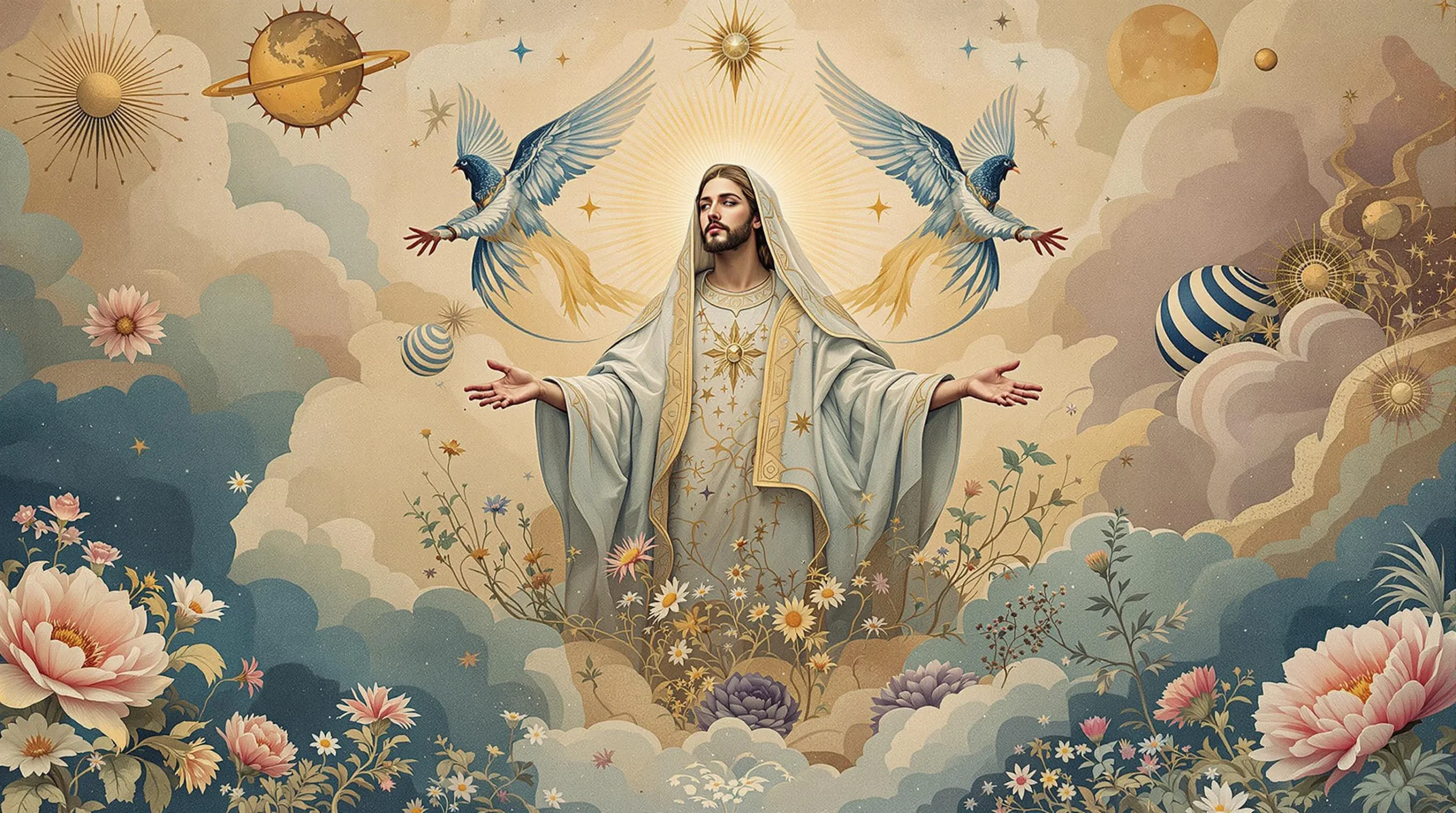


Saints

Archetype Meaning & Symbolism

Devotional, ascetic, steadfast, luminous, haunted, intercessory, patient, resolute, compassionate, otherworldly

  • Let nothing disturb you, let nothing frighten you, all things are passing away: God never changes.

If Saints is part of your personal mythology, you may...

Believe

  • You may believe that your suffering is not random but holds a hidden, redemptive purpose, like a crucible that burns away impurities to reveal the gold of your true self.
  • You may believe that the veil between the material and spiritual worlds is thin, and that moments of grace, guidance, and even miracles can and do break through into everyday life.
  • You may believe that your life is not fundamentally your own, but is an instrument to be used in service of a purpose, a principle, or a power far greater than yourself.

Fear

  • You may fear the 'dark night of the soul,' a period of profound spiritual desolation where your faith evaporates, leaving you in a cold, meaningless void with no sense of divine presence.
  • You may fear the sin of spiritual pride, the subtle corruption where your devotion becomes a source of self-righteousness and you begin to believe your goodness is your own achievement, not a gift of grace.
  • You may fear that you will ultimately fail your calling, that you will be judged and found wanting, or that you will betray the sacred trust that has been placed upon you.

Strength

  • You may possess a profound resilience, an ability to endure hardship and suffering with a quiet grace, drawing strength from a deep well of faith or purpose that others cannot see.
  • You may have a boundless capacity for compassion and selfless service, seeing the divine in all people and feeling a genuine call to alleviate their pain.
  • You may live with a powerful sense of clarity and purpose, providing an inner compass that guides your decisions and keeps you steady amidst the chaos of life.

Weakness

  • You may have a tendency toward asceticism or self-neglect, ignoring the valid needs of your body and mind in the pursuit of a spiritual ideal, leading to burnout or illness.
  • You may be prone to a certain moral rigidity or judgmentalism, finding it difficult to relate to or accept those who do not share your intense convictions.
  • You may be vulnerable to developing a martyr complex, subconsciously seeking out suffering to validate your identity and using your sacrifice as a means of emotional leverage over others.

The Symbolism & Meaning of Saints

The Saint in your personal mythology is the cartographer of the soul's most difficult terrain. They are not symbols of an easy, blissful faith, but of a faith forged in the crucible of human experience: in suffering, doubt, and ecstatic communion. The Saint represents the human potential to become a conduit for the divine, to make one's very life a testament to an unseen order. They symbolize a radical commitment, a willingness to align one's existence with a principle so profound that comfort, safety, and even life itself become secondary. The Saint is the scar that becomes a star, the wound that becomes a wellspring.

In the modern psyche, this archetype might surface not as a desire for canonization but as an intense, unshakeable calling toward a specific purpose. It is the artist who sacrifices stability for their vision, the activist who risks freedom for justice, the caregiver who pours themselves out for another. Your personal saints may not be those in stained-glass windows: they could be an ancestor who endured unimaginable hardship with grace, a mentor who embodied selfless integrity, or even a part of yourself that has touched something holy in a moment of profound love or loss. They mark the places in your life story where the mundane has become translucent, allowing a numinous light to shine through.

To carry the Saint archetype is to live with a foot in two worlds: the messy, beautiful, painful world of human life, and a subtler world of spirit, meaning, and grace. It is to believe that your small, mortal life can have an immortal resonance. This archetype challenges the modern gospel of self-optimization, suggesting instead a path of self-emptying, or 'kenosis'. The goal is not to become more, but to become a more perfect vessel for something greater than the self. It is a demanding, often lonely path, marked by the tension between human frailty and divine aspiration.


Saints Relationships With Other Archetypes

The Sinner

The Saint's relationship with the Sinner is perhaps not one of opposition, but of a strange and sorrowful gravity. The Sinner is not an enemy to be vanquished, but a cracked mirror in which the Saint may see a reflection of their own fragility, a haunting glimpse of the path not taken. This connection could be understood as the bond between a bell and its silence; one exists to give the other meaning. The Saint’s purity is not a fortress built against the Sinner’s transgression, but rather a quiet, open-windowed room from which a light is cast, offered not as an indictment but as a guide. The Saint seems to understand that both are sculpted from the same human clay, and their journey is a constant, tender effort to mend the fractures in a shared vessel, to find the resonant frequency that might turn a dissonant chord back into harmony.

The Martyr's Cross

One might suggest that the Saint does not merely endure the Martyr’s Cross, but enters into a kind of grim, alchemical partnership with it. The Cross is not simply a burden, an instrument of torment, but a lens that focuses the diffuse light of existence into a single, burning point of purpose. Its weight could be the very ballast that keeps the Saint grounded in their conviction, an anchor against the easy currents of comfort and compromise. In this telling, suffering is transformed from a passive state into an active tool. The Cross becomes a sort of terrible loom, on which the raw, ragged threads of pain are woven into a tapestry of transcendence, its splinters and grain charting a map toward a shore beyond the mortal realm.

The Wilderness

The Wilderness is not an antagonist to the Saint, but a collaborator, a vast and silent cathedral for the stripping away of the non-essential. The Saint seeks the desert or the forest not as an escape from the world, but as an immersion into a deeper reality. This landscape is a crucible, its starkness and silence functioning as a kind of spiritual abrasion, sanding away the veneer of ego and social identity until only the soul’s resonant frequency remains. The relationship is one of mutual emptying and filling; the Saint pours their prayers into the void, and the void, in turn, fills the Saint with a quiet, unadorned truth. The Wilderness may be the only place stark enough to hold the sheer scope of the Saint’s inner dialogue with the divine, a blank page on which a profound story can be written.

Using Saints in Every Day Life

Navigating Personal Hardship

When confronted with chronic illness or a profound loss, the Saint archetype may offer a map. Your suffering need not be a meaningless void. Instead, it could be seen as a vigil, a long night of the soul that refines your spirit. The lives of saints like Thérèse of Lisieux, who found sanctity in the 'little way' of small, hidden sacrifices, might transform your daily endurance into a quiet, heroic act of devotion, a personal liturgy written in the language of persistence.

Finding a Deeper Vocation

If your professional life feels hollow, a transaction devoid of soul, the Saint archetype could prompt a re-evaluation. It poses the question: what is your true calling, beyond the job title? The model of St. Francis, who renounced wealth for a life of service to the poor and to nature, might not demand you give away all possessions. It could, however, inspire you to find the element of sacred service in your work, to see your clients, colleagues, or creations not as assets but as souls deserving of your deepest care and integrity.

Cultivating Inner Stillness

In a world of constant digital noise and external validation, the archetype of the desert fathers and mothers, the original ascetic saints, provides a radical counter-narrative. Their retreat into silence was not an escape but a confrontation with the self. To invoke this aspect of the Saint is to carve out your own desert: a daily meditation practice, a digital sabbath, a commitment to solitude. It is to learn that the most profound communion may occur when all other voices have fallen away, leaving only the still, small one within.

Saints is Known For

Miracles

They are often associated with supernatural events or acts that defy natural laws, seen as signs of divine favor or intervention, from healing the sick to levitation.

Martyrdom:

Many saints are known for having endured persecution or execution for refusing to renounce their faith, their ultimate sacrifice serving as a testament to their conviction.

Intercession:

They are believed to act as advocates or mediators for humanity, bridging the gap between the earthly and the divine, hearing prayers and carrying them to a higher power.

How Saints Might Affect Your Personal Mythology

How Saints Might Affect Your Mythos

When the Saint archetype takes root in your personal mythos, your life story may begin to resemble a hagiography. Events are no longer just events: they are tests, revelations, and miracles. A period of depression might be reframed as a 'dark night of the soul,' a necessary pilgrimage through the void. A chance encounter that changes your life's course could be seen as an act of grace, a moment of divine intercession. Your narrative arc shifts from the hero's journey of conquest and achievement to the pilgrim's progress of purification and surrender. The central conflict of your story may become the struggle between your human will and a perceived divine will.

This reframing sanctifies your personal history. Your scars are not just wounds: they are stigmata, sacred marks of your trials. Your moments of inexplicable joy are not just good moods: they are visitations of the holy spirit. You might 'canonize' certain figures in your life, viewing a beloved grandparent or a transformative teacher as a personal patron saint whose memory you invoke for guidance. Your mythos becomes less about what you have done and more about what you have endured, witnessed, and served. It is a story whispered in the cloisters of your own heart, a tale of the soul's slow, often painful, journey toward the light.

How Saints Might Affect Your Sense of Self

To see yourself through the lens of the Saint is to view the self as a vessel, a container meant to be filled with something other than ego. This could cultivate a profound and genuine humility, a recognition of your own limitations and a deep reliance on a source of strength beyond your personal capacity. Your identity may become less about your accomplishments or personality traits and more about your devotion to a cause, a principle, or a higher power. You may feel 'set apart,' not with arrogance, but with the quiet weight of a specific responsibility, a secret knowledge, a sacred trust.

This perspective can also create a difficult inner tension. The self can feel like a constant battleground between its 'lower' human impulses and its 'higher' spiritual aspirations. There may be a tendency toward harsh self-judgment or a relentless pursuit of purity that denies essential aspects of your humanity. You might struggle with the feeling of being an 'imposter saint,' acutely aware of the gap between the luminous ideal and your own flawed reality. Your sense of self-worth becomes tethered not to external validation, but to your own perception of your spiritual integrity, a standard that can be both liberating and crushingly absolute.

How Saints Might Affect Your Beliefs About The World

With the Saint as a guide, your worldview may become enchanted, imbued with a hidden layer of spiritual significance. The world is no longer a random assortment of matter and energy but a cathedral, a place where the divine is immanent, waiting to be perceived. You may see synchronicities not as coincidences but as whispers from the unseen, guidance from a knowing universe. Suffering, on a global or personal scale, is not just a problem to be solved but a mystery to be entered, a crucible that holds the potential for collective redemption and growth. Injustice is not just a social ill: it is a sacrilege, a wounding of the world's sacred body.

This perspective fosters a kind of double vision. You see the world in all its brokenness, its violence, its superficiality. But you also see, shimmering just beneath the surface, a world of grace, miracle, and transcendent beauty. This can lead to a profound sense of hope, an unshakeable belief that even in the darkest of times, light persists and love is the ultimate reality. The line between the possible and the impossible blurs. Miracles are not relegated to ancient texts; they are a latent potential in every moment, waiting for a heart open enough to receive them.

How Saints Might Affect Your Relationships

In relationships, the Saint archetype might compel you to strive for 'agape': a universal, unconditional, and selfless love. You may see every person you encounter as an icon, a holy image of the divine, deserving of reverence and compassion. Your role in relationships could shift from seeking fulfillment to offering service, from getting love to giving it. This can lead to incredibly deep, meaningful connections, where you become a source of comfort, wisdom, and sanctuary for others. You may be the person friends turn to in crisis, the steady center in your family, the one who loves without demanding anything in return.

However, this ideal can also create a subtle distance. In striving for a divine, universal love, you may struggle with the specific, messy, and often selfish realities of human intimacy. The passionate, possessive, and sometimes needy aspects of 'eros' might seem base or unspiritual. There could be a danger of becoming a 'spiritual caretaker,' so focused on the needs of others that your own are completely sublimated, leading to resentment or burnout. You might love humanity in the abstract more easily than you love the flawed, difficult human being right in front of you.

How Saints Might Affect Your Role in Life

Your perceived role in life, under the influence of the Saint, may transform from a career into a 'vocation,' a sacred calling. You are not just doing a job; you are performing a ministry, whether you are a teacher, a janitor, an artist, or a scientist. Your work becomes an offering, a form of prayer. You might feel called to be an intercessor, someone who stands in the gap for others, who listens to the confessions of the world, who bears witness to suffering without flinching. This role is often quiet, unseen, and unrewarded by conventional metrics of success.

This can bestow your life with an immense sense of purpose and direction. You know why you are here. You are here to serve, to heal, to create, to testify. This clarity can be a powerful anchor in a chaotic world. Yet, the weight of such a role can be immense. You may feel the burden of the world's sorrows on your shoulders, leading to a kind of holy exhaustion. There is also the risk of your role becoming your entire identity, leaving little room for play, for spontaneity, for the simple, un-sanctified joy of being human.

Dream Interpretation of Saints

In a positive context, dreaming of a saint, or of embodying saintly qualities yourself, may symbolize a profound integration of your highest ideals. It could signify that you are on the right path, that you are accessing a deep well of inner grace, compassion, and resilience. Such a dream might arrive as a form of assurance during a difficult time, a message from your deep unconscious that you have the spiritual resources to endure. It can represent forgiveness, either given or received, and a connection to a benevolent, guiding force in your life. The dream is an affirmation: you are in a state of grace.

Conversely, a dream featuring a suffering, judgmental, or distant saint could point to the archetype's shadow. It might represent a crushing weight of guilt or a sense of spiritual failure. You may feel that you are falling short of an impossible ideal you have set for yourself. A saint who is wounded or martyred in your dream could symbolize a part of you that is being sacrificed in an unhealthy way, perhaps through extreme self-neglect or a martyr complex. It could be a warning from your psyche that your piety has become a punishment, your devotion a prison.

How Saints Archetype Might Affect Your Needs

How Saints Might Affect Your Physiological Needs

When the Saint archetype informs your personal mythology, your relationship with your body and its basic needs undergoes a profound shift. The body is no longer a vessel for hedonistic pleasure or an instrument for worldly ambition; it may become a temple, a sacred space to be tended with intention, or a tool for service. Physiological needs like hunger and thirst are not just biological imperatives but opportunities for gratitude and mindfulness. Practices like fasting or embracing simplicity are not seen as deprivation but as disciplines that purify the self and heighten spiritual awareness. Food is not just fuel; it is Eucharist, a sacrament of connection to the earth and to the divine.

This can lead to a healthy detachment from materialism and a deep appreciation for simple sustenance. However, it can also border on neglect. The body's cries for rest, for pleasure, for nourishment may be ignored in the service of a 'higher' goal. The saintly ideal can sometimes foster a subtle Gnosticism, a belief that the spirit is good and the flesh is base or problematic. Your physiological well-being could be risked or sacrificed, viewing illness or exhaustion not as signals to be heeded but as trials to be endured on the path to spiritual refinement.

How Saints Might Affect Your Ideas of Belonging

Belongingness, for one living the Saint archetype, may be sought less in a conventional tribe and more in a 'communion of saints'—a timeless, placeless community of kindred spirits, both living and dead, who share a similar devotion. The deepest sense of connection might be with an ideal, with God, or with humanity as a whole, rather than with a specific social circle. You may feel a profound kinship with historical figures, authors, or spiritual leaders who articulate your innermost creed. Your true family becomes those who are on the same sacred path, regardless of geography or background.

This can foster a vast and inclusive sense of love, a feeling of being part of something immense and eternal. However, it can also lead to a profound loneliness in the everyday world. You may feel misunderstood by those around you, an exile from the mundane concerns of your peers. The search for a community of fellow pilgrims can be long and arduous, and the intensity of your convictions might make casual friendships feel superficial or unsatisfying. You may belong to the cosmos, but feel like a stranger in your own neighborhood.

How Saints Might Affect Your Feelings of Safety

The need for safety, in the mythology of the Saint, is radically redefined. The ultimate sanctuary is not found in a locked house or a stable income but in alignment with one's core principles or with the divine will. Physical safety may become secondary to spiritual integrity. This can inspire acts of incredible courage: the whistleblower who sacrifices their career to expose wrongdoing, the activist who faces down violence for the sake of justice, the person who speaks a difficult truth in a hostile environment. There is a deep, abiding faith that ultimate safety lies beyond the reach of worldly harm.

This can make you a powerful force for good, unconstrained by the fears that paralyze others. You may possess a serene fearlessness. Yet, this can also manifest as a disregard for reasonable precautions, a kind of recklessness disguised as faith. The shadow side is a belief that your righteousness provides a magical shield, leading you to take unnecessary risks with your own or others' well-being. True saintly courage is not about ignoring danger but about acting despite fear, for a purpose greater than personal survival. The challenge is discerning between a divine calling and a simple lack of prudence.

How Saints Might Affect Your Views of Esteem

Esteem, within the Saint's mythos, is divorced from external praise and worldly success. Your self-worth is not derived from accolades, promotions, or social status. Instead, it comes from an internal source: the quiet knowledge that you are living in alignment with your deepest values, that you are faithful to your calling. It is the esteem of a clean conscience, the dignity of integrity. This can grant you an unshakeable core of self-respect that is impervious to the shifting opinions of others. You are your own, and God's, harshest and most important critic.

This internal locus of esteem is a superpower, granting you the freedom to follow an unconventional path. Yet, it can also be a fragile and unforgiving system. Since the standard is spiritual perfection, you may live with a constant sense of falling short. A single moral or spiritual failing can feel catastrophic, erasing all previous good and plunging you into a crisis of worth. The archetype demands a difficult balance: to strive for the highest good while also practicing grace and self-forgiveness for your own inescapable humanity.

Shadow of Saints

The shadow of the Saint is a chilling figure: it is the zealot, the inquisitor, the one who weaponizes piety. When this shadow takes hold, compassion curdles into condemnation. Love for a principle becomes hatred for those who do not conform. The inner conviction of the Saint becomes the unshakeable certainty of the fanatic, a certainty that justifies cruelty in the name of a higher good. This shadow self is rigid, unforgiving, and sees the world in stark black and white. It is the part of the mythos that burns heretics, that shuns the sinner, that mistakes its own harsh inner critic for the voice of God.

Another, more passive shadow is the professional martyr. Here, the Saint's noble endurance of suffering becomes a manipulative tool. Their sacrifice is never quiet; it is loudly, if subtly, advertised to induce guilt and control in others. This shadow finds its identity entirely in its pain, and so it cannot allow itself to heal. It rejects help and happiness because to be well would be to lose its sacred role. It is a spiritual bypass of epic proportions, using the language of grace to avoid the difficult work of psychological growth, responsibility, and genuine, non-transactional love.

Pros & Cons of Saints in Your Mythology

Pros

  • Living with this archetype provides a powerful framework for metabolizing pain, transforming personal and collective suffering from a meaningless affliction into a purposeful journey of refinement.
  • It inspires a life of profound meaning, service, and empathy, orienting one's entire existence around a calling that transcends selfish concerns and contributes to the well-being of the world.
  • It cultivates an internal source of peace, resilience, and self-worth that is not dependent on external circumstances, offering a stable anchor in the turbulent waters of modern life.

Cons

  • The archetype can promote an unhealthy denial of the self, leading to the neglect of basic physical, emotional, and psychological needs in the name of a higher, often unattainable, ideal.
  • It may foster a sense of moral superiority and isolation, making it difficult to connect with the messy, beautiful imperfection of ordinary human life and relationships.
  • There is a significant risk of developing a martyr complex or succumbing to spiritual burnout, where the identity becomes so enmeshed with sacrifice that it cannot exist without it.