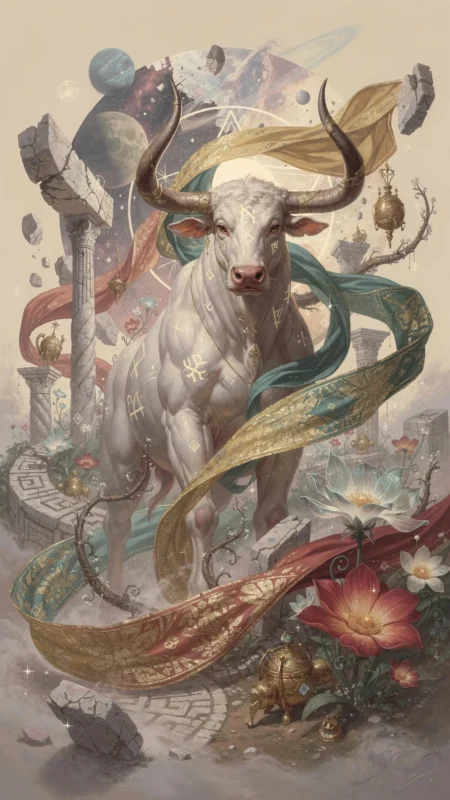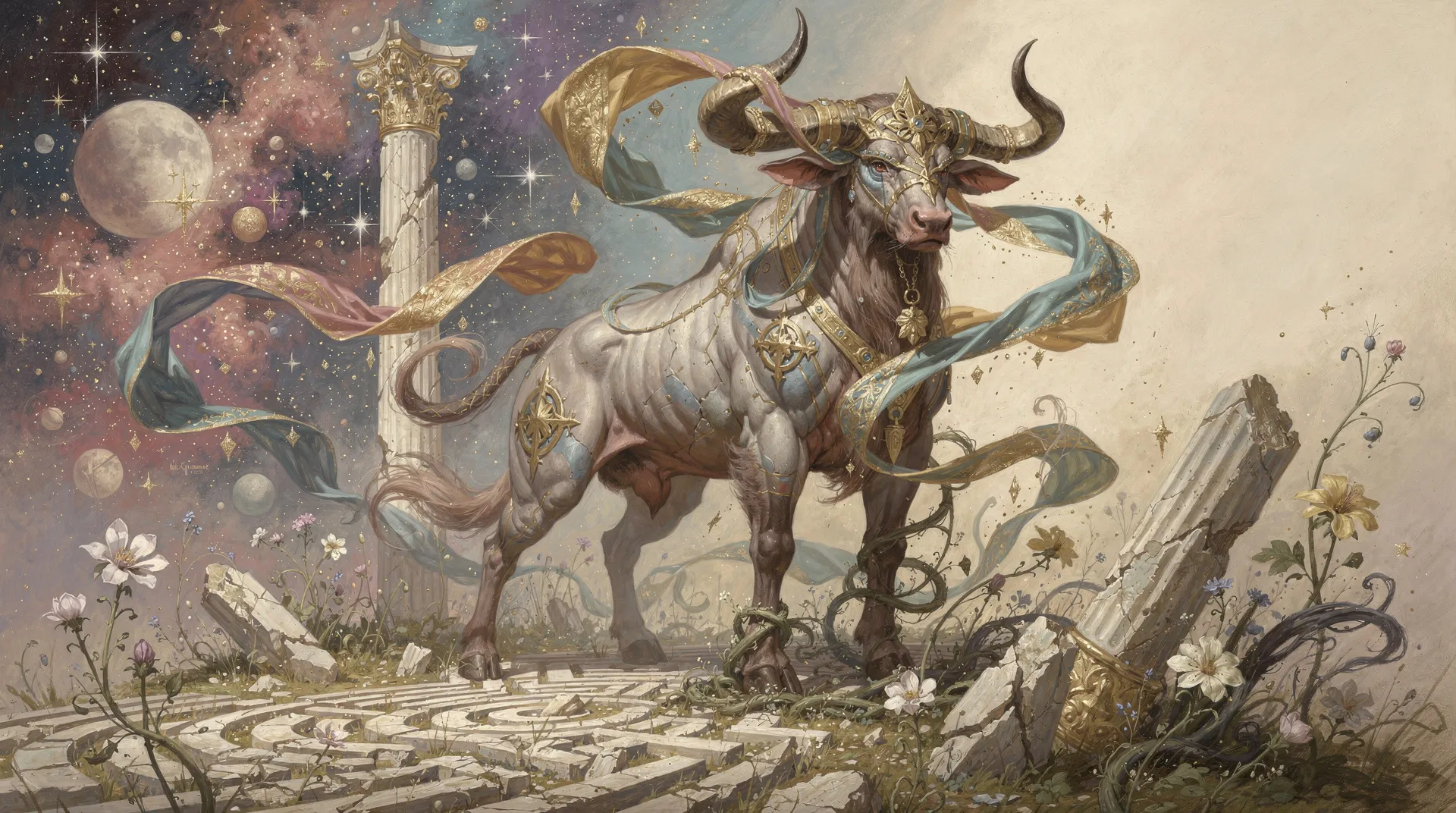


Minotaur

Archetype Meaning & Symbolism

Primal, isolated, misunderstood, rageful, instinctual, shunned, powerful, burdened, hungry, foundational

  • The labyrinth is not my prison. It is the world you built to avoid seeing me.

If Minotaur is part of your personal mythology, you may...

Believe

  • That the most 'monstrous' parts of a person are often the most honest and vital.
  • That true freedom is not found by escaping the maze of your circumstances, but by learning its layout and claiming it as your own sovereign territory.
  • That every person has an inner labyrinth and an inner beast; the greatest act of courage is to undertake the journey to meet your own.

Fear

  • That your raw, primal emotions will inevitably lead to destruction, hurting those you care about and confirming your own monstrosity.
  • That you are fundamentally unknowable, destined to be forever misunderstood and seen only as a symbol or a threat, never as a whole being.
  • That you will remain trapped, not by stone walls, but by the circumstances of your birth and the perceptions of others, a prisoner of a fate you did not choose.

Strength

  • An unshakeable connection to your own instinctual truth, allowing you to cut through deception and societal pretense with ease.
  • An extraordinary ability to navigate complex, ambiguous, and psychologically challenging situations, treating them like the familiar corridors of your own labyrinth.
  • A formidable, sovereign presence that commands a primal sort of respect and naturally filters out the superficial and the insincere.

Weakness

  • A tendency toward profound isolation, driven by the belief that no one could possibly understand or accept your true nature.
  • Difficulty modulating primal emotions, particularly rage, which can erupt with destructive force when your boundaries are violated or you feel trapped.
  • A deep-seated shame or a persistent feeling of being 'wrong' by nature, a monstrous aberration in a world of normal people.

The Symbolism & Meaning of Minotaur

The Minotaur is the cartography of our own interior wildness, the untranslatable truth that lives in the body. To claim this archetype is to acknowledge a part of the self that society, and perhaps you, has deemed monstrous and locked away. He represents the raw, instinctual power that defies neat categorization: the union of human consciousness and animal impulse. He is the bellow of rage in the throat, the hunger that logic cannot quell, the brute fact of our physical existence. His labyrinth is not made of stone but of shame, denial, and fear; a construct we build to avoid facing the parts of ourselves that are too powerful, too frightening, or too hungry to be civilized.

In a personal mythology, the Minotaur ceases to be a monster to be slain. Instead, he could become a guide to the underworld of the self. He is the guardian of the maze, and to meet him is not a task of heroism in the classical sense, but of radical self-acceptance. He symbolizes the part of you born of a strange union: your own divine potential and your most earthly, animal desires. He is the product of a 'curse' that might actually be a source of profound strength, a part of you that, once acknowledged, grants an unshakeable connection to the foundational, non-negotiable truth of who you are, beneath the veneer of social conditioning.

This archetype challenges the binary of good and evil, human and beast. The Minotaur may be a figure of terror, but he is also a figure of tragedy: a prisoner, an outcast, a being created by the desires and hubris of others, then punished for his own existence. To find the Minotaur in your mythos is perhaps to find empathy for your own 'monstrous' qualities. It is to understand that what is most feared in you might also be what is most authentic, and that the true labyrinth is the journey back to integrating that rejected self, transforming the prison into a sacred, sovereign space.


Minotaur Relationships With Other Archetypes

The Labyrinth

The Labyrinth is not merely the Minotaur’s prison but perhaps his most intimate, if cruelest, partner. Its corridors are not an external architecture but the very blueprint of his psyche, a maze of stone and shadow that mirrors the convolutions of his own shame and solitude. He may not wander its paths seeking an exit, but rather as a kind of pilgrimage toward his own center, for the Labyrinth provides a terrible, geometric order to a life born of chaos. It is a womb that never birthed him and a tomb that will not let him die. The walls could be seen as a form of skin, a hardened shell that protects him from a world whose gaze is a weapon, even as it denies him the possibility of a caress. To the Minotaur, the idea of escape might be as alien as the stars; to breach the Labyrinth would be to unmake himself.

The Hero

The Hero appears as an equation destined to be solved, a force of narrative gravity pulling the Minotaur toward a violent conclusion. To the world, the Hero is light and reason, the shining ego sent to conquer the dark, horned id. But to the Minotaur, he may simply be the final, most articulate form of the world’s judgment. The Hero’s courage is a form of blindness, seeing only a monster to be slain, a chapter to be closed. He cannot perceive the creature as a prisoner, a forgotten son, a knot of tragedy. Their fated meeting is less a battle than a kind of grim transaction—the exchange of a complex sorrow for a simple, celebrated myth. The Hero’s sword, in this light, could be a mercy, but it is a mercy without understanding, the final, sharp-edged rejection from a world that made him only to destroy him.

The Thread

If the Labyrinth is the Minotaur’s mind, then the Thread is a thought he could never have. It is a fragile line of logic, of connection, of escape, laid down in a realm governed by cyclical rage and hunger. This filament represents a world of straight paths, of cause and effect, of a love that guides one out of darkness—a language the Minotaur cannot speak. It is the tool of his undoing, the quiet, deliberate sentence of his death spelled out on the floor of his cage. He might see this thread not as a lifeline, but as a serpent heralding the invasion of his solitude, a violation of the only peace he knows. It is the promise of an outside world that, for him, has never been a promise at all, but only the source of his pain. The Thread, slender and unassuming, is perhaps more terrifying than any blade, for it represents the rational world’s effortless ability to unravel his own.

Using Minotaur in Every Day Life

Confronting a Core Shame:

When faced with a deeply ingrained shame, a part of yourself you have walled off and hidden, invoking the Minotaur archetype could mean ceasing the fight. Instead of trying to slay this 'monster,' you may choose to walk the labyrinth of its origins within your psyche. You might sit with it, listen to its bellows of pain or rage, and acknowledge its existence not as an aberration, but as a wounded part of your own story, forged in the darkness of another's judgment.

Navigating Overwhelming Instinct:

In moments where primal urges—be it rage, desire, or hunger for something intangible—threaten to overwhelm your 'civilized' self, the Minotaur provides a framework. It suggests that these forces are not to be eradicated but contained and understood. Your task may not be to silence the beast, but to learn the architecture of its maze: to recognize the triggers, to know the paths that lead to destructive rampages, and to find the center where its power can be met with consciousness rather than terror.

Breaking Free from Imposed Roles:

If you feel trapped by the expectations of family, society, or your past, the Minotaur symbolizes the brutal power needed for a jailbreak. This doesn't necessarily mean a physical escape, but an internal one. It could be the act of finally roaring 'no,' of embracing the very 'monstrosity' others have labeled you with, and using that fearsome power to shatter the invisible walls of the role you were forced into, claiming your own complex, hybrid nature as a sovereign space.

Minotaur is Known For

The Labyrinth

He is famously imprisoned within the Labyrinth, a complex maze built by Daedalus on the island of Crete. This structure itself becomes a symbol of internal complexity, inescapable fate, and the architecture of denial.

The Hybrid Nature

As the offspring of Queen Pasiphaë and the Cretan Bull, his form—the head and tail of a bull on the body of a man—is his most defining feature, representing a collision of divine punishment, human desire, and raw bestial nature.

The Athenian Tribute

He is known as the devourer of the Athenian youths and maidens sent as a tribute to Crete every nine years, a cycle of sacrifice that marks him as a figure of terror and relentless, consuming power until his demise at the hands of Theseus.

How Minotaur Might Affect Your Personal Mythology

How Minotaur Might Affect Your Mythos

To integrate the Minotaur into your personal mythos is to rewrite your life story from a narrative of heroic conquest to one of radical integration. Your story may cease to be about slaying dragons or escaping prisons; it could become about learning the architecture of your own internal labyrinth. Your defining moments might not be victories over external foes, but descents into the self to meet, listen to, and ultimately honor the beast you were taught to fear. This mythos doesn't seek a clean resolution or a triumphant escape; it finds meaning in the complexity, in the courage it takes to walk the winding paths of your own psyche and sit with the creature at its heart.

The narrative arc may become one of reclamation. The 'flaws' or 'shames' that once defined your past—the untamable anger, the inconvenient desires, the profound sense of otherness—are no longer chapters of failure. Instead, they become the origin story of the Minotaur within. Your personal history could be viewed as the very labyrinth that was built, brick by brick, by external judgments and internal denial. Your journey, then, is not to demolish the maze but to claim it, to learn its secret passages and recognize its central chamber not as a dungeon, but as a throne room for a sovereign, untamed part of your soul.

How Minotaur Might Affect Your Sense of Self

The Minotaur's presence may fundamentally alter your relationship with your own nature. You might begin to see yourself not as a unified, coherent personality, but as a hybrid being: a conscious, thinking mind inextricably fused with a powerful, instinctual body. This could dissolve the internal war between 'should' and 'want,' between intellect and impulse. You may grant your physical and emotional realities an authority equal to your rational mind, understanding that your 'gut feelings' are not random noise but the rumblings of the beast in the maze, offering a primal, unvarnished truth.

This can lead to a form of fierce self-acceptance that borders on defiance. If the world has labeled parts of you as 'too much'—too angry, too intense, too quiet, too strange—you may cease to see these as faults. Instead, they are facets of your Minotaur nature. This archetype could give you permission to be complex and contradictory. Your self-perception might shift from someone flawed who needs fixing to a powerful, mythic creature whose nature is simply not meant for the narrow confines of ordinary understanding. The feeling of being 'a monster' is transfigured into the feeling of being a myth.

How Minotaur Might Affect Your Beliefs About The World

With the Minotaur as a guide, you may view the world as a series of interlocking labyrinths. Social structures, corporate ladders, political systems, even polite conversation: all could appear as complex mazes designed to contain, confuse, and neutralize the authentic, primal self. You might develop a deep skepticism toward societal definitions of 'civilized' and 'savage,' seeing the veneer of order as a fragile construct built atop a foundation of raw, chaotic, and often denied human nature. You may see the 'monsters' in society—the outcasts, the rebels, the misunderstood—not as aberrations, but as those who have refused, or been unable, to stay hidden in their designated maze.

This perspective could cultivate a profound, if lonely, sense of clarity. You may see the ways in which others are lost in their own labyrinths of expectation and self-deception, and feel a strange compassion for both the maze-walkers and the hidden beasts within them. Your worldview may become less about finding the 'right' path and more about understanding the nature of the maze itself. Truth is not a destination at the end of a straight road, but a presence to be communed with in the tangled, shadowed center of things. You may trust complexity and distrust simplicity.

How Minotaur Might Affect Your Relationships

In relationships, the Minotaur archetype can manifest as a profound sense of being fundamentally misunderstood. You may feel that others see only the fearsome exterior, the intimidating presence, or the confusing complexity, and mistake it for your entirety. They might try to 'solve' you like a puzzle or 'tame' you like a beast, rarely daring to simply enter the labyrinth and meet you where you are. This can lead to a feeling of deep-seated isolation, even when surrounded by people. You may erect walls, not out of malice, but as a protective boundary for a nature you know is too potent for most to handle.

However, this also means that the connections you do form can be of extraordinary depth. The people who are not deterred by the maze, who enter with curiosity rather than a sword, are the ones capable of seeing your full, hybrid nature. These relationships are not built on superficial commonalities but on a shared willingness to explore the shadows. You may find that your truest companions are fellow 'monsters,' other outcasts who understand the burden and the beauty of being a creature of myth in a mundane world. Intimacy, for you, is not about being saved from the labyrinth, but about having someone willing to sit with you in its center, unafraid of the darkness or the roar.

How Minotaur Might Affect Your Role in Life

Adopting the Minotaur archetype may lead you to reject conventional roles of hero, helper, or victim. Your place is not on the brightly lit stage of society, but in the resonant darkness beneath it. You might perceive your role as that of a guardian of a necessary truth: the keeper of the labyrinth. You are the one who reminds others, by your very presence, of the wildness they have suppressed, the complexities they have paved over. Your purpose may not be to provide answers or comfort, but to embody a question, to be a living paradox that disrupts easy certainties.

You may feel a responsibility to your own primal nature, a duty to honor its needs and its power, even if it sets you apart. This could mean choosing a path of solitude, or a role as a creator, artist, or thinker who works with the raw, untamed materials of the human psyche. You are not the tribute-taker, nor the hero who slays the beast. You are the space in between: the being who holds the tension between civilization and wilderness, mind and body, light and shadow. Your role is simply to be, in all your 'monstrous' authenticity, a testament to the fact that not everything can, or should, be tamed.

Dream Interpretation of Minotaur

To dream of the Minotaur in a positive context is to dream of integration and self-reclamation. You might find yourself navigating the labyrinth not with fear, but with purpose, as if you know the way. Meeting the Minotaur at the center may feel like a homecoming. He might be calm, a powerful guardian rather than a ravenous beast. This dream could signify that you are successfully confronting and accepting a deeply buried part of your shadow self—your anger, your sexuality, your raw ambition. The dream is an affirmation that you are no longer at war with your own nature; you are learning to harness its power.

Conversely, a nightmare of the Minotaur often speaks to a feeling of being overwhelmed by repressed forces. In this dream, you are lost, running terrified through an endless, shifting maze. The sound of hooves is a thunderous, inescapable dread. The Minotaur is a figure of pure, destructive rage, and you are its intended victim. This may symbolize that an instinct or emotion you have long suppressed is now threatening to erupt uncontrollably. It could be a warning from your psyche that the walls of your internal labyrinth are about to break, and the beast you have starved is now coming to devour the false sense of order you have constructed.

How Minotaur Archetype Might Affect Your Needs

How Minotaur Might Affect Your Physiological Needs

When the Minotaur is part of your mythos, your physiological needs may feel primal and non-negotiable. Hunger is not a simple need for food, but a deep, gnawing force. The need for sleep is not mere rest, but a descent into a darker, recharging realm. Your connection to your body could be profound; you may feel your own heartbeat as a drum, your breath as a bellows. These basic needs are not inconveniences to be managed by the civilized mind; they are the sacred rhythms of the beast within, and to ignore them feels like a betrayal of your very essence.

This can create a life grounded in the physical, the tangible. You might find solace in heavy blankets, the scent of damp earth, the taste of rich food, the satisfying ache of muscles after exertion. The body is not a vehicle for the mind; it is the source of wisdom, power, and truth. There may be a suspicion of the overly abstract or disembodied. For you, truth must have weight, a visceral reality. If a concept cannot be felt in the gut or the bones, it may be perceived as a lie, a flimsy ghost in the solid, breathing world.

How Minotaur Might Affect Your Ideas of Belonging

The need for belonging is a raw, aching wound for the Minotaur archetype. You may feel a profound, primal otherness, a sense of being a species of one. You were born of a union that should not have been, and your very existence sets you apart. The easy camaraderie of social groups may feel like a language you can't speak. Belonging, therefore, cannot be about fitting in. Any attempt to shave down your horns to pass as 'normal' feels like a soul-death. The hunger for connection is immense, but it is a hunger for a very specific kind of connection: one that does not require self-abandonment.

Love and belonging are found not by leaving the labyrinth, but by welcoming a trusted few inside. You may form incredibly intense, fiercely loyal bonds with a small number of people who see your full, complex nature and are not afraid. These are the ones who bring you not a sword, but a mirror. For you, belonging is not a place at the table of the many, but a shared silence in the dark with the one or two who understand that 'monster' is just another word for a truth too large to be contained.

How Minotaur Might Affect Your Feelings of Safety

For one who identifies with the Minotaur, the concept of safety is paradoxical. The labyrinth that imprisons you is also the fortress that protects you. Safety may not be found in open, sunny places, but in the defensible complexity of your own inner world. You may create a life with clear, strong boundaries, a maze of your own making that keeps the unwelcome out. The threat is not what lies outside the walls, but the potential chaos within them. True safety, then, becomes about knowing your own strength and its potential for destruction.

Your sense of security might be derived from embracing your formidable nature. The very qualities that make others fearful of you—your intensity, your power, your refusal to be easily categorized—are your greatest defenses. You may feel safest when you are most authentically yourself, even if that self is intimidating. The ultimate fear is not of being attacked, but of losing control of your own inner beast and becoming the monster of others' nightmares. Safety is an internal negotiation: a pact made with your own power, a promise to wield it with awareness rather than let it rampage blindly.

How Minotaur Might Affect Your Views of Esteem

Esteem, for the Minotaur, cannot be sourced from external validation. Society's applause is reserved for the hero who slays you, not for you yourself. Therefore, self-worth must be forged in the dark, a solitary act of defiance. It is the esteem that comes from surviving, from enduring misunderstanding and condemnation, and still knowing your own power. It is a pride rooted not in accomplishment, but in existence itself. Your worth is not measured by your acceptability to others, but by your fidelity to your own hybrid, paradoxical nature.

This can cultivate a powerful, if lonely, form of self-respect. You may take pride in the very things that make you an outcast: your intensity, your unshakeable instincts, your complex inner world. Esteem comes from owning the labyrinth, from seeing it not as a curse but as a kingdom. It is the recognition that you are a being of mythic proportions, and the judgments of ordinary people are therefore irrelevant. Your self-esteem is the quiet, rumbling hum of the beast at the center of the maze, content in its own formidable reality, needing no one's permission to be.

Shadow of Minotaur

The shadow of the Minotaur emerges when the beast is either completely unleashed or utterly starved. In its unchecked, rampant form, the shadow is pure, destructive rage. It is the rampage. This is the individual who, feeling trapped and misunderstood, bellows and smashes through their life, destroying relationships, careers, and their own well-being. They become the literal monster of the myth, consumed by a hunger that is never sated, creating victims and confirming their own worst fears. Here, the labyrinth is not a container but an arena, and everyone who enters is seen as tribute to be devoured.

Conversely, the starved shadow is just as devastating. This is the Minotaur who has so completely internalized the world's hatred that it has killed the beast within. All instinct, passion, and vitality are suppressed in a desperate attempt to be 'good' and 'acceptable.' The result is not peace, but a hollow echo. The person becomes a ghost haunting their own labyrinth, a walking prison of denial. They are disconnected from their body, their power, and their truth. There is no roar, only a terrifying silence. This repression eventually festers, turning into depression, self-loathing, or passive aggression that poisons everything from the inside out.

Pros & Cons of Minotaur in Your Mythology

Pros

  • You possess a profound and rare authenticity, unafraid to engage with the darker, more complex aspects of your own nature and that of others.
  • You are deeply self-reliant, capable of finding solace and strength in solitude, and can navigate psychological isolation that would crush others.
  • Your powerful, instinctual presence often acts as a natural deterrent to manipulation and insincerity, as few are willing to play games within the labyrinth.

Cons

  • You may be plagued by a deep and persistent loneliness, a feeling of being an outcast who can never truly belong.
  • Your primal power, especially your anger, can be frightening to both yourself and others, creating a risk of unintentional harm or destruction when you feel threatened.
  • You might feel perpetually imprisoned, either by your own potent nature or by the inescapable projections and fears of the people around you.